
What is an Original Bill of Lading? The Bill of Lading Issuance Process
Original Bill of Lading, commonly known as an Original B/L, is the most important maritime transport document in international trade. It serves simultaneously as evidence of a contract of carriage, a receipt confirming that the carrier has received the goods, and most critically – a document of title. Whoever physically holds the original has the legal right to take delivery of the cargo at the destination port. This fundamental legal principle is what makes the Original B/L uniquely significant in the chain of international commercial transactions.
1. What Is an Original Bill of Lading (Original B/L)?
The Original Bill of Lading is also referred to as an Original B/L or OBL. It is a Bill of Lading issued by the shipping line (or its agent) in the form of a physically printed document bearing a signature and official stamp – typically in a set of three originals (3/3 originals), each carrying equal legal weight. The fundamental rule: only one of the three originals needs to be validly presented to take delivery; the remaining two automatically become void.
Unlike a Seaway Bill — which serves only as evidence of a contract of carriage and is not a document of title or a Telex Release which is the process of cancelling the legal effect of the original – the Original B/L carries the highest and most complete legal standing of all Bill of Lading handling methods. It is the irreplaceable instrument for cargo control and payment security in L/C transactions and in international trade with unfamiliar counterparts.
In Vietnamese logistics practice, the Original B/L is also referred to as a negotiable B/L or ocean bill of lading. The term “negotiable” describes the transferable nature of the Original B/L – the fundamental characteristic that distinguishes it from a Sea Waybill and other non-negotiable instruments.
The three legal functions of an Original B/L: (1) Contract of carriage – evidence of the terms agreed between the shipper and the carrier; (2) Receipt for goods – confirmation that the carrier has received the goods as described; (3) Document of Title – the party lawfully holding the original has the right to take delivery of the goods. The third function is what creates the entire special legal value of the Original B/L.
2. Types of Original Bills of Lading
Original B/Ls are not all the same. Depending on how the consignee field is completed and the degree of transferability, original B/Ls are classified into three main types, each with distinct legal characteristics and practical applications:
| TYPE OF B/L | WHAT IS WRITTEN IN THE CONSIGNEE FIELD? | TRANSFERABILITY | COMMON APPLICATIONS |
|---|---|---|---|
| Order B/L | “To Order”, “To Order of [Bank]”, or “To Order of Shipper” | Freely transferable by endorsement – the last endorsee has the right to take delivery | L/C payment – banks require an Order B/L to maintain control over the cargo |
| Straight B/L | The specific name and address of the consignee is stated directly | Non-transferable – only the named consignee on the B/L may take delivery | T/T with trusted partners, intra-group transactions; similar to a Sea Waybill but with a physical original |
| Bearer B/L | “To Bearer” – no specific consignee named | Whoever physically holds the original may take delivery – no endorsement or identity verification required | Extremely rare in practice – very high risk of fraud and cargo loss; most carriers do not accept this type |
The most common type in practice: Order B/L accounts for the vast majority of import/export transactions in Vietnam – particularly for L/C payment, where banks always require “To Order of [Name of Issuing Bank]” or “To Order of Shipper.” Straight B/L is appropriate for T/T and intra-group transactions. Bearer B/L is virtually no longer used in modern international trade due to its extremely high risk.
3. Distinguishing Between Original B/L, House B/L, and Master B/L
This is one of the most common sources of confusion in the logistics industry – particularly for those new to import/export. Original B/L, House B/L and Master B/L are all “original bills of lading” in the sense that they exist as physical printed documents, but they are issued by different parties, serve different purposes, and carry different legal standing in the logistics chain.
What Is a House B/L?
A House B/L (HBL) is a Bill of Lading issued by the freight forwarder to the shipper – that is, to the forwarder’s customer. The House B/L represents the contractual relationship between the shipper and the forwarder, recording the forwarder’s commitment to transport the goods from origin to destination. However, the forwarder does not own the vessel – they book space from the actual carrier and assume responsibility to the shipper through the House B/L.
What Is a Master B/L?
A Master B/L (MBL) is a Bill of Lading issued by the shipping line (carrier) to the forwarder – who is the carrier’s customer in this case. The Master B/L represents the contractual relationship between the forwarder and the carrier, confirming that the goods have been loaded on board the vessel. The shipper (exporter) typically does not hold the Master B/L directly – it is a document between the forwarder and the carrier.
| Criteria | Original B/L (Carrier B/L) | House B/L (HBL) | Master B/L (MBL) |
|---|---|---|---|
| Who issues it? | Shipping line (Carrier) or NVOCC | Freight forwarder | Shipping line (Carrier) |
| Issued to whom? | Shipper (exporter) | Shipper (forwarder’s customer) | Forwarder (carrier’s customer) |
| Relationship represented | Shipper ↔ Carrier | Shipper ↔ Forwarder | Forwarder ↔ Carrier |
| Who appears as shipper on the B/L? | The actual exporting company | The actual exporting company | The forwarder’s name (not the actual shipper) |
| Who appears as consignee on the B/L? | The buyer’s name or bank | The actual buyer | The forwarder’s agent at the destination port |
| Suitable for L/C payment | Yes – UCP 600 standard | Depends – the L/C must explicitly state that HBL is acceptable; not accepted by default | Not used directly for the shipper’s L/C |
| Used to collect cargo at destination | Directly at the carrier’s office | At the forwarder’s agent office at the destination port | The forwarder uses it to obtain the D/O from the carrier |
| Does the shipper see the MBL? | Yes – all MBL information will be visible | No – the shipper only holds the HBL | The shipper does not hold the MBL – the forwarder retains it |
| Common applications | FCL booked directly with the carrier; L/C; high-value cargo | LCL (groupage cargo); FCL via forwarder; protecting shipper/consignee identity | Internal between forwarder and carrier; LCL and FCL cargo via forwarder |
Key point to remember: When the shipper books directly with the carrier (direct booking), there is only one type of B/L – the Carrier B/L (commonly referred to as the Original B/L). When the shipper books through a forwarder, two parallel layers of B/Ls coexist: the HBL (issued by the forwarder to the shipper) and the MBL (issued by the carrier to the forwarder). The shipper and consignee transact via the HBL; the forwarder and carrier transact via the MBL.
4. Mandatory Information on an Original B/L
A valid Original B/L must contain all of the following information. Any missing or incorrect field can result in L/C payment rejection or delays in cargo collection:
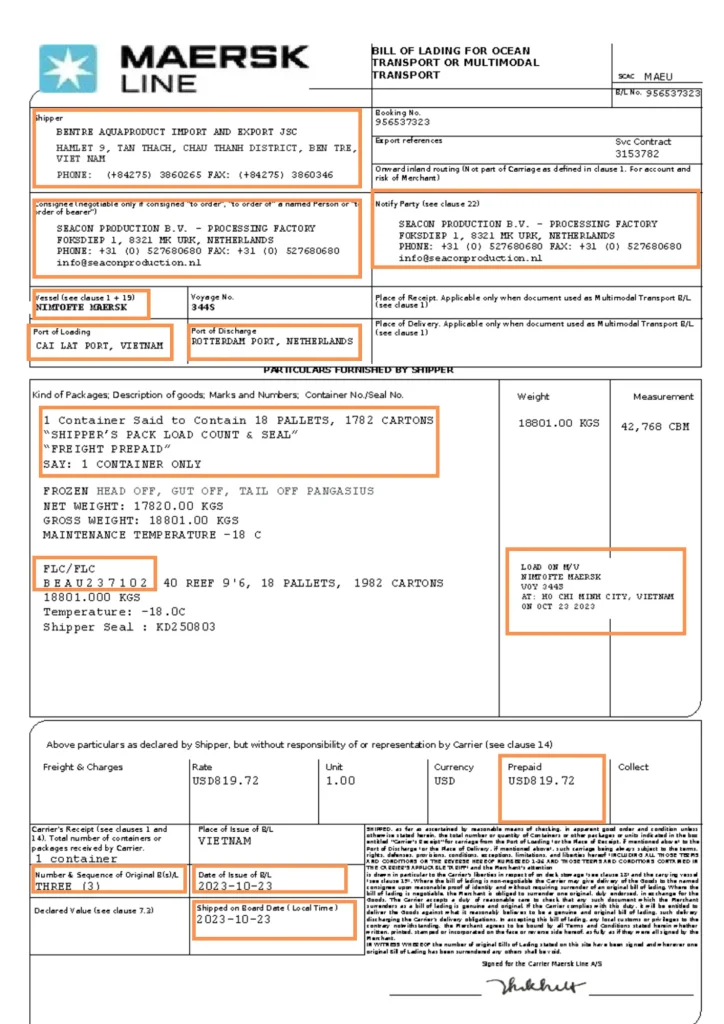
| FIELD | CONTENT REQUIRED | PRACTICAL NOTE |
|---|---|---|
| Shipper | Full name, address, and country of the party delivering the goods | Must match exactly with the Invoice and L/C (if applicable) |
| Consignee | Name of the consignee, the bank, or “To Order” | For L/C: typically “To Order of [Issuing Bank]” or “To Order of Shipper” |
| Notify Party | The party to be notified upon vessel arrival – usually the buyer or their agent | Not the party taking delivery – this party is only notified, not entitled to collect the goods |
| Vessel / Voyage | Vessel name and voyage number | Must match the L/C if the L/C specifies a particular vessel |
| Port of Loading / Discharge | Port of loading and port of discharge | Must match the L/C exactly – incorrect port name is the most common reason for discrepancy |
| Description of Goods | Description of goods, HS code (if required), quantity, weight, and volume | Need not be overly detailed, but must not contradict the Invoice; the L/C may specify the required level of detail |
| Container No. / Seal No. | Container number and seal number | Critically important – incorrect container or seal number is a serious error |
| Freight Terms | Prepaid (freight paid by shipper) or Collect (freight paid by consignee) | Must align with the Incoterms conditions in the contract and L/C |
| On Board Date | The date on which the goods were actually loaded on board the vessel (on board notation) | For L/C: the on board date must not be later than the latest shipment date specified in the L/C |
| Number of Originals | Number of original copies issued – typically “Three (3) originals” | L/C typically requires a full set (3/3) – presenting an incomplete set constitutes a discrepancy |
5. The Original B/L Issuance and Circulation Process
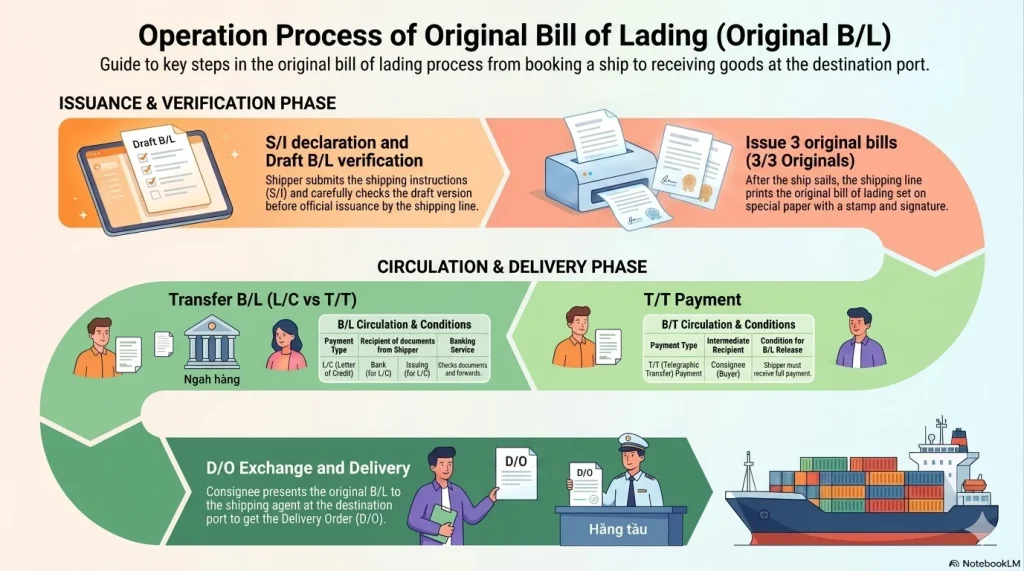
- Shipper books the vessel and submits the Shipping Instruction (S/I): The shipper (or their forwarder) books space with the carrier. Once the container has been assigned and the goods stuffed, the shipper submits a Shipping Instruction (S/I) – the instruction document for B/L issuance – to the carrier, specifying all information to be printed on the B/L. The S/I must be submitted before the SI Cut-off deadline (typically 1–2 days before the vessel’s ETD).
- Carrier prepares a Draft B/L: The carrier prepares the B/L based on the information in the S/I and sends a Draft B/L to the shipper for review. This is the most critical step – the shipper must carefully verify every detail and request any amendments before the B/L is officially issued.
- Shipper approves the Draft B/L: The shipper reviews all information on the Draft B/L – cross-referencing it in particular against the L/C (if applicable), the sales contract, and the packing list. Once confirmed error-free, the shipper sends an email confirmation reading “Draft B/L Approved” to the carrier.
- Carrier issues the Original B/L: After the vessel has departed (or once the on-board notation is confirmed), the carrier issues the originals – typically 3 original copies (3/3 originals) along with a number of non-negotiable copies. The originals are printed on special security paper bearing the carrier’s stamp and authorized signature.
- Shipper collects the Original B/L: The shipper visits the carrier’s office to collect the originals, or the carrier dispatches them by domestic courier to the shipper’s address. The shipper should verify the originals once more against the approved Draft before accepting them.
- Shipper forwards the Original B/L to the consignee or bank:
- For L/C payment: The shipper presents the full set of original B/Ls together with the complete document set to the advising/negotiating bank to obtain payment. The bank forwards the B/L to the issuing bank, which releases it to the consignee after examining the documents.
- For T/T payment: The shipper sends the full set or a portion of the originals directly to the consignee by international courier (DHL/FedEx) after confirming receipt of full payment.
- Consignee takes delivery at the destination port: The consignee presents at least one original copy at the carrier’s office at the destination port. The carrier verifies it and stamps “Original Surrendered” on the presented copy, then issues a Delivery Order (D/O) to the consignee. The consignee uses the D/O to complete customs clearance and collect the cargo.
Note on SI Cut-off and B/L Cut-off: The two most important deadlines in the process: SI Cut-off is the deadline for submitting the Shipping Instruction (typically 1–2 days before ETD); B/L Cut-off is the deadline for confirming the Draft B/L (typically the same as or one day after the SI Cut-off). Missing either of these deadlines means the B/L will be issued late, affecting the on board date – which constitutes a violation of the L/C if the latest shipment date has already passed.
6. Common Errors on Original B/Ls and How to Correct Them (Amendment)
Errors on B/Ls are one of the most common causes of discrepancies in L/C transactions and cargo delivery delays. Below are the most frequently encountered errors and how to handle them:
| COMMON ERROR | DESCRIPTION AND CONSEQUENCES | HOW TO HANDLE |
|---|---|---|
| Incorrect Shipper or Consignee name/address | The most common error – typically caused by typing mistakes or incorrect copy-paste from the S/I; results in L/C discrepancy and customs clearance delays | B/L Amendment: the shipper returns the originals to the carrier and requests re-issuance with the correct information; amendment fee: USD 30–80 |
| Incorrect on board date | An on board date later than the L/C’s latest shipment date → serious discrepancy; the bank will refuse payment | The on board date cannot be changed arbitrarily – it may only be corrected if the carrier confirms a technical error. If the goods were genuinely shipped late, a L/C amendment must be requested from the buyer |
| Incorrect goods description | Description of goods does not match the L/C or Invoice – causes discrepancy and may create customs issues | B/L Amendment; if the cargo has already arrived at the destination port, a Note of Protest or Letter of Indemnity (LOI) from the carrier may be required in certain cases |
| Incorrect container or seal number | Does not match the Equipment Interchange Receipt (EIR) and vessel manifest – creates serious customs issues | Urgent amendment before the vessel arrives at the destination port; the carrier must update the manifest – higher fee and longer processing time |
| Incorrect freight terms (Prepaid/Collect) | Prepaid stated instead of Collect or vice versa – causes disputes over freight payment responsibility and L/C discrepancy | B/L Amendment and update of freight payment records with the carrier; must be resolved before the consignee takes delivery |
| Incorrect port of loading or discharge | Does not match the L/C – the second most common reason for discrepancy after incorrect names | B/L Amendment as soon as the error is discovered; if the vessel has already arrived at the destination port, correction is far more difficult and requires extensive additional procedures |
The golden rule: Review the Draft B/L meticulously BEFORE confirming approval – cross-checking it against the L/C word by word. The cost of correcting a Draft (free of charge) is far lower than the cost of an amendment after the B/L has been issued (USD 30–80 plus lost time). Once the B/L has been issued and submitted to the bank, an amendment is nearly impossible to process before the bank has finished reviewing the document set.
7. Legal Risks When an Original B/L Is Lost and How to Handle Them
Losing an Original B/L is one of the most serious legal situations in international logistics. Because the B/L is a document of title, anyone who holds an original can potentially take delivery of the goods – making cargo loss and legal disputes a very real risk.
Common Causes of Lost Original B/Ls
- Lost in postal/courier transit: The document package is lost, misdelivered, or stolen during shipping.
- Lost internally within a company: Documents go missing during storage or when being transferred between departments.
- Lost by the bank: In L/C transactions, a bank can lose a document set during processing — rare, but it has happened.
- Document fraud: A third party deliberately misappropriates the original B/L to take unauthorized delivery of the cargo.
Procedure for Handling a Lost Original B/L
| STEP | ACTION | IMPLEMENTATION DETAILS |
|---|---|---|
| 1 | Notify the carrier immediately | Contact the carrier as soon as the loss is discovered – request that the carrier place a stop delivery alert on the shipment to prevent any party from taking delivery while the matter is being resolved |
| 2 | Notify the bank (if L/C) | Immediately inform the bank handling the L/C so they can halt the transfer of documents to the collecting party and coordinate on next steps |
| 3 | Issue a Letter of Indemnity (LOI) | The shipper and consignee sign a Letter of Indemnity (LOI) – an indemnity letter committing to compensate the carrier for any losses if the original B/L is subsequently used to take unauthorized delivery; many carriers require the LOI to be backed by a bank guarantee (bank-backed LOI) |
| 4 | Obtain a court order (if required) | In some cases, the carrier may require a court order confirming that the original B/L has been lost and authorizing delivery without it – this procedure is costly and time-consuming |
| 5 | Carrier issues a replacement B/L | After receiving a valid LOI (and/or court order), the carrier may issue a Replacement B/L or release the cargo against the LOI; the cost and timeline vary by carrier and trade lane |
Important warning: A Letter of Indemnity (LOI) is not a perfect solution – it transfers the risk from the carrier to the shipper/consignee rather than eliminating it. If the original B/L is subsequently found and the holder demands delivery (after cargo has already been released under the LOI), the carrier may be compelled to pay compensation and will then seek recovery from the shipper/consignee under the LOI. This is why an LOI is a last resort, not a preferred solution. The best way to avoid the risk of losing a B/L is to use Telex Release or a Sea Waybill from the outset, when a physical original is not required.
8. Advantages and Limitations of the Original B/L
| Advantages | Limitations |
|---|---|
| The strongest legal instrument available – the shipper retains complete control of the cargo for as long as the original B/L is in their possession | The slowest of all methods – must wait 3–7 days for the courier; on short trade lanes, cargo typically arrives before the documents, resulting in costly port storage charges |
| Mandatory for L/C transactions under UCP 600 – there is no substitute in letter of credit payment | Risk of losing the original – once a B/L original is lost, the recovery process is complex, costly, and time-consuming |
| Transferable (Order B/L) – goods in transit can be sold to a third party via endorsement | Additional costs incurred: courier fee to send the originals (USD 30–80) + fraud risk if the originals fall into the wrong hands |
| Highest legal standing in international maritime disputes – recognized by both common law and civil law courts worldwide | Complex processing — multiple steps, multiple parties involved; prone to errors and delays if not managed rigorously |
| Can be used as collateral for bank financing (pledge/hypothecation of B/L) – particularly important for businesses requiring working capital | Not suitable for short trade lanes where cargo always arrives before documents – generates unnecessary storage costs |
Frequently Asked Questions About the Original Bill of Lading
What is an Original Bill of Lading (Original B/L) and why is it important?
How does an Original B/L differ from a House B/L and a Master B/L?
How many original copies are issued, and how many are needed to collect the cargo?
What should you do if the original B/L is lost?
When should you use an Original B/L instead of a Telex Release or Sea Waybill?
How long does a B/L amendment take and what does it cost?
9. Conclusion
In summary, the Original Bill of Lading (Original B/L) is the legal foundation of international maritime trade:
- Three legal functions: contract of carriage, receipt for goods, and document of title – the third function is what creates the entire special value of the Original B/L.
- Three main types: Order B/L (most common, used for L/C), Straight B/L (named, non-transferable), Bearer B/L (unnamed, extremely rare and high-risk).
- Must be clearly distinguished from the House B/L (issued by the forwarder to the shipper) and the Master B/L (issued by the carrier to the forwarder) – when booking through a forwarder, two parallel layers of B/Ls coexist.
- Mandatory for L/C payment – cannot be replaced by a Telex Release or Sea Waybill in bank transactions.
- Losing an original B/L is a serious legal situation – handled via LOI but risk remains; prevention is better: review the Draft B/L thoroughly and use a secure courier service.
How Does 3W Logistics Support Its Clients?
Whether you are importing or exporting under L/C, T/T, or Open Account terms, handling the original B/L correctly – from reviewing the Draft B/L and selecting the right B/L type, to submitting the correct document set to the bank and managing lost B/L emergencies – are the factors that determine on-time delivery and payment security. 3W Logistics provides comprehensive support at every stage:
- Advisory on B/L type and document handling method: Based on your payment terms, trade lane, and transaction characteristics, 3W advises whether to use an Original B/L, Telex Release, or Sea Waybill – and if an Original B/L is used, whether an Order, Straight, or other type is most appropriate.
- Draft B/L review before approval: The 3W team carefully cross-checks the Draft B/L against the L/C, sales contract, and packing list – identifying potential discrepancies before the B/L is officially issued, avoiding the cost and complications of amendments later.
- Full L/C document set preparation: Preparing a complete set of original B/Ls together with all accompanying documents (Invoice, Packing List, Certificate of Origin, Insurance, etc.) in compliance with UCP 600, and reviewing everything before bank presentation to minimize discrepancies.
- Timely amendment coordination: When an error is discovered on a B/L, 3W processes the amendment with the carrier as quickly as possible to avoid affecting L/C deadlines and the consignee’s delivery schedule.
- Lost B/L emergency support: Coordinating with the carrier to place a stop delivery alert, guiding clients through the LOI process, and assisting with the issuance of replacement B/Ls in urgent situations.
- End-to-end import/export documentation management: From the S/I, Draft B/L, and Original B/L to the Certificate of Origin, electronic customs declarations, and international payment document sets – 3W handles everything from A to Z.
A note from 3W Logistics’ practical experience: The most common discrepancies we encounter in L/C document sets do not stem from major errors but from small details – a single incorrect character in a company name, an incorrect on board date, or a goods description that does not precisely match the L/C. These errors are entirely avoidable with a thorough review of the Draft B/L before approval. A single discrepancy can delay payment by 2–3 weeks and incur discrepancy fees from the bank (USD 50–100 per discrepancy). Contact 3W Logistics for professional document checking support.
Address: 34 Bach Dang Street, Tan Son Hoa Ward, Ho Chi Minh City
Hotline: +84 28 3535 0087
____________________________
3W Logistics Hanoi Branch
Address: 81A Tran Quoc Toan Street, Cua Nam Ward, Hanoi
Hotline: +84 24 3202 0482
____________________________
3W Logistics Hai Phong Branch
Address: 8A Lot 28 Le Hong Phong Street, Gia Vien Ward, Hai Phong
Hotline: +84 225 355 5939
____________________________
3W LOGISTICS CO., LTD – We here serve you there!
Email: quote@3w-logistics.com
Website: www.3w-logistics.com

Ms. Apple is the CCO (Chief Commercial Officer) at 3W Logistics, with over 10 years of experience in sales and business operations management.
At 3W Logistics, Ms. Apple is responsible for commercial strategy, corporate customer development, managing a team of more than 50 sales professionals, and improving business performance in the logistics sector.
With practical experience in sales management and market development, Ms. Apple shares professional insights on business logistics solutions, international transportation, freight forwarding, customer management, trade lane development, and growth strategies in the logistics industry.


