

What is a Bill of Lading? All types of B/L shipping documents
Bill of Lading (abbreviated: B/L or BL), known in Vietnamese as vận đơn đường biển, is the most important transport document in international sea trade, issued by the shipping line or forwarder upon receiving or loading cargo onto a vessel.
A B/L has 3 core legal functions: Contract of Carriage, Receipt of Goods, and Document of Title. There are many common types of B/L, including Straight B/L, Order B/L, Clean B/L, Claused B/L, Master B/L, House B/L, On Board B/L, and Received for Shipment B/L.
A B/L is issued by the shipping line after receiving cargo at the port of origin or after the cargo has been loaded onto the vessel. The key distinction between a B/L and a Sea Waybill is that the B/L is a Document of Title – it can transfer ownership of the cargo – whereas a Sea Waybill does not carry this function and does not require the original to be presented for cargo release.
1. What is a Bill of Lading? Definition and 3 Core Legal Functions
A Bill of Lading (B/L) is a sea transport document issued by the shipping line (carrier) or its authorized agent, confirming that cargo has been received for shipment or loaded onto a vessel. The B/L records information about the cargo, port of loading, port of discharge, shipper, consignee, and terms of carriage.
The B/L is commonly abbreviated as B/L or BL. It is issued at one of two points: (1) when the carrier receives the cargo into the warehouse or yard at the port of origin, producing a “Received for Shipment B/L”; or (2) after the cargo has physically been loaded onto the vessel, producing an “On Board B/L,” which carries higher legal standing and is preferred by banks in L/C transactions.
3 Core Legal Functions of a B/L
1. Contract of Carriage
The B/L serves as evidence of the contract of carriage between the shipper and the carrier. The reverse side of a B/L typically contains pre-printed Terms & Conditions covering the carrier’s limits of liability, claims procedures, dispute resolution, and governing law. By signing and accepting the B/L, both parties implicitly agree to these terms.
2. Receipt of Goods
The B/L confirms that the carrier has received the cargo as described in terms of quantity, weight, dimensions, and apparent external condition of the goods and packaging. If the cargo is received as described with no unusual remarks, the B/L will be a “Clean B/L.” If there are issues with the cargo condition, the carrier will add a reservation note, producing a “Claused B/L.”
3. Document of Title
This is the most important function and the key differentiator between a B/L and other transport documents such as a Sea Waybill or Air Waybill. The B/L represents ownership of the cargo. Whoever holds a valid original B/L (properly endorsed if required) has the right to claim the cargo at the destination port. This function allows the B/L to be used as a financial instrument in L/C transactions — the bank controls the cargo by controlling the B/L.
Important Note: Only the Original B/L has legal standing to claim cargo at the destination port. B/L copies (stamped “Copy” or “Non-Negotiable”) are for reference, filing, or content review only – they cannot be used to collect cargo. Shipping lines typically issue a set of 3 originals (Full Set of 3 Originals); presenting just 1 is sufficient to collect the cargo, and the remaining originals become automatically void.
2. Types of Bill of Lading – Definitions and Comparison
B/Ls are classified by several criteria: by the named consignee, by cargo condition, or by the time of issuance. Below are the 8 most common types of B/L in international trade practice:
DEFINITION AND COMPARISON TABLE OF BILL OF LADING TYPES
| B/L Type | Common Name | Key Characteristics | When to Use | Suitable Payment Method |
|---|---|---|---|---|
| Straight B/L | Non-Negotiable B/L | Names a specific consignee; cannot be transferred by endorsement; not a Document of Title in the full sense | Intra-company transfers (parent–subsidiary), gifts/non-commercial goods, fully pre-paid transactions | T/T (advance payment), non-commercial cargo |
| Order B/L | Negotiable B/L | Consignee field reads “To Order” or “To the Order of Shipper”; transferable by endorsement; full Document of Title | Standard international trade, cargo that may be sold or transferred while in transit | L/C, D/P, D/A |
| Order of Bank B/L | Bank Order B/L | Consignee field reads “To the Order of [Bank Name]”; the bank controls cargo release until the buyer makes payment | When the bank needs to hold cargo as collateral security | L/C (most common), D/P |
| Bearer B/L | Bearer B/L | No consignee named; whoever holds the original can collect the cargo; high risk if lost | Rarely used in modern practice due to high fraud risk | Not suitable for L/C |
| Clean B/L | Clean Bill of Lading | No reservation clauses regarding cargo or packaging condition; confirms cargo received as described | Mandatory requirement in L/C and D/P payment transactions | All methods; mandatory in L/C |
| Claused / Foul B/L | Dirty Bill of Lading | Contains reservation clauses, e.g. “Cartons wet,” “Packaging damaged”; carrier disclaims liability for the noted damage | Issued when cargo or packaging is damaged prior to loading | Not accepted under L/C |
| On Board B/L | Shipped on Board B/L | Confirms cargo has physically been loaded onto the vessel, with vessel name and on-board date stated; highest legal standing | Mandatory requirement under L/C per UCP 600 Article 20 | L/C (mandatory), D/P, T/T |
| Received for Shipment B/L | Pre-Shipment B/L | Confirms carrier has received the cargo but it has not yet been loaded; vessel name and on-board date not yet specified | Issued when cargo is in the port warehouse/yard but the vessel has not yet berthed | T/T; must be converted to On Board B/L for L/C |
Clean B/L vs. Claused B/L – A Simple Comparison
The difference between a Clean B/L and a Claused B/L is straightforward: a Clean B/L contains no remarks about any defective condition of the cargo or packaging, while a Claused B/L (also called a Foul B/L or Dirty B/L) carries reservation notes from the carrier, such as “5 cartons wet and torn,” “Drum leaking,” or “Packaging insufficient.”
Why Do Banks Reject Claused B/Ls in L/C Transactions?
Banks reject Claused B/Ls in L/C transactions based on UCP 600 Article 27, which states that banks will only accept a B/L bearing no clause or notation expressly declaring a defective condition of the goods or packaging. Accepting a Claused B/L would mean financing a shipment already known to have issues, significantly raising the risk of disputes and payment refusal from the buyer. Shippers and forwarders must therefore pay particular attention to packaging quality before delivering cargo to the port warehouse in order to avoid receiving a Claused B/L.
3. How to Read Each Field on a Bill of Lading
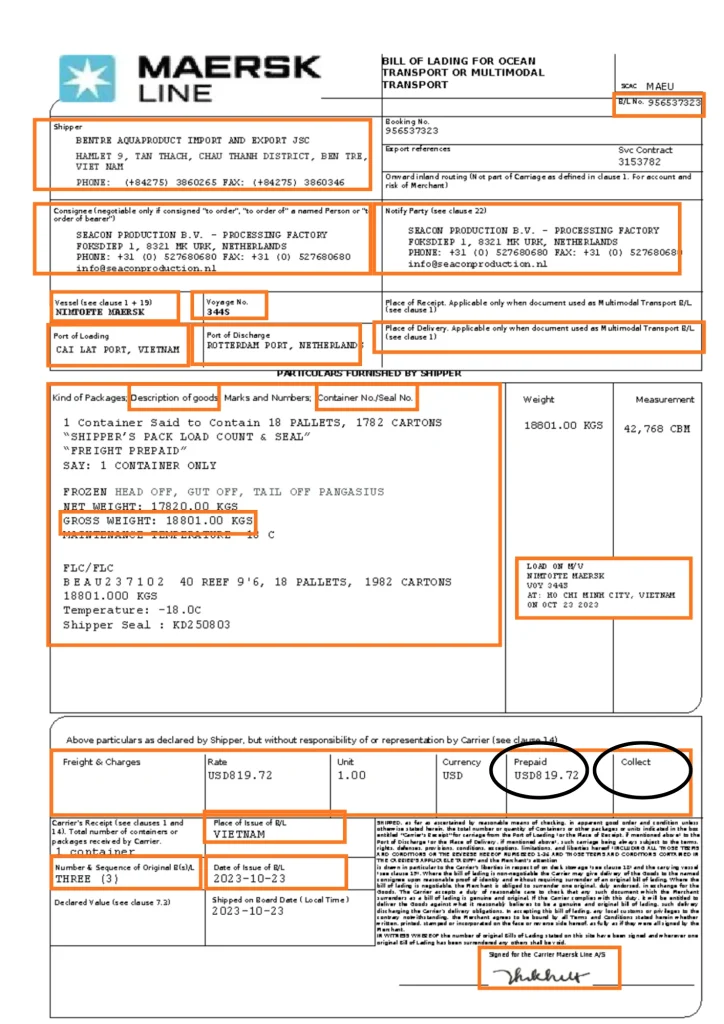
A standard B/L typically contains the following fields in the order they appear on an actual form. Understanding each field correctly helps shippers avoid errors when reviewing the Draft B/L and prevents unnecessary amendment fees.
| Field Name | Meaning and Completion Notes |
|---|---|
| Shipper | The exporter / sender of the cargo. Enter full company name, address, and phone number. Must match the Commercial Invoice and Packing List. In L/C transactions, must match the Beneficiary name on the L/C. |
| Consignee | The party entitled to receive the cargo. Can be a specific company name (Straight B/L), “To Order” (Order B/L), or “To the Order of [Bank Name].” This is the most critical field — any error here can cause the bank to reject payment. |
| Notify Party | The party to be notified when the vessel arrives at the destination port — typically the actual importer or their agent. This party does not have the right to collect cargo. In an Order of Bank B/L under L/C, the importer is often listed in the Notify Party field rather than the Consignee field. |
| Vessel & Voyage No. | Vessel name and voyage number. Example: “COSCO SHIPPING UNIVERSE V.120E.” Must match the Booking Confirmation from the shipping line. Changes when cargo involves transhipment. |
| Port of Loading (POL) | The port where cargo is loaded. Example: “Ho Chi Minh City Port, Vietnam” or “Cat Lai Port, Vietnam.” Must match the L/C requirement for the port of export. An incorrect port name is the most common L/C discrepancy. |
| Port of Discharge (POD) | The destination port where the vessel berths. Example: “Hamburg, Germany.” Note the distinction from Place of Delivery – this is only the port where the vessel docks, not necessarily the final delivery point. |
| Place of Delivery | The final delivery location – typically used in multimodal transport. Example: “Frankfurt, Germany” when the vessel berths at Hamburg but cargo is then forwarded by road to Frankfurt. |
| B/L Number | The unique identifier for the B/L. Used for shipment tracking and document matching. Example: “COSU6278943450.” Record this immediately upon receiving the Draft B/L. |
| Container No. & Seal No. | Container number and seal number. Example: “COSU7654321 / SEAL: 3456789.” Must match the Packing List and Equipment Interchange Receipt. An incorrect container number can cause complications during customs clearance at the destination port. |
| Description of Goods | Cargo description: name, quantity, and marks & numbers. Must be consistent with the Invoice, Packing List, and customs declaration. In an L/C, the description must not be more detailed than but must align with the L/C. Avoid descriptions that are overly vague or excessively technical. |
| Gross Weight & Measurement | Gross weight (kg) and cargo volume (CBM – Cubic Meters). Used to calculate ocean freight for volumetric cargo billed by M³. A significant discrepancy from actual figures may result in a weight discrepancy surcharge from the carrier. |
| Freight & Charges (Prepaid / Collect) | Freight terms: who pays and where. “Freight Prepaid” = shipper has paid at the port of origin; “Freight Collect” = consignee pays at the destination port. This field directly impacts whether the bank will accept the B/L. |
| Number of Originals | Number of original B/Ls issued. Typically “Three (3) Original Bills of Lading” – presenting 1 of the 3 is sufficient to collect cargo. In L/C transactions, banks typically require submission of the full set (all 3 originals). |
| Place & Date of Issue | Place and date the B/L was issued. Under an L/C, the B/L date must be on or before the Presentation Period deadline and the L/C expiry date. This is the second most common source of discrepancies after port errors. |
| Carrier Signature | Signature of the shipping line or its Authorized Agent. The B/L only has legal standing when this signature is present. This is the distinguishing feature between an original (bearing a real signature) and a copy (stamped “Copy”). |
4. The B/L Issuance Process – 6 Practical Steps from 3W Logistics’ Experience
Understanding the B/L issuance process helps shippers be more proactive in document preparation, avoid missing deadlines, and save on unnecessary amendment costs. Below are the 6 standard steps drawn from 3W Logistics’ hands-on experience.
Step 1: Shipper submits the Shipping Instruction (SI) to the forwarder
The Shipping Instruction is the document provided by the shipper so the forwarder can populate the B/L – including shipper information, consignee, notify party, cargo description, container numbers, freight terms, and the number of originals requested. Each shipping line has its own SI cut-off deadline, typically 1–2 days before the vessel’s ETD. Submitting the SI late means the carrier may not be able to issue the B/L in time, or the shipper will incur a late documentation fee.
Step 2: Forwarder submits the SI into the carrier’s system
After receiving the SI from the shipper, the forwarder verifies consistency of information, cross-checks against the Booking Confirmation and container/seal numbers, then submits into the carrier’s electronic platform (e.g., Maersk Connect, Hapag-Lloyd’s MyHL, COSCO’s ESS). This step requires a high level of accuracy – any errors will generate a chain of amendments later.
Step 3: Carrier issues Draft B/L and sends it to the shipper for review
After processing the SI, the carrier issues a Draft B/L – a preliminary version for the shipper to verify before finalization. Draft B/Ls are typically sent by email within 12–24 hours of SI submission. This is the only opportunity to identify and request corrections with no cost or minimal cost.
Step 4: Shipper confirms or requests amendments
The shipper must carefully review every field on the Draft B/L and cross-check against the full document set (Invoice, Packing List, Certificate of Origin) and L/C terms if applicable. If errors are found, submit amendment requests immediately and specifically (clearly stating which field needs to change, from what to what). Each amendment after the carrier has issued the official B/L can cost USD 35–60.
Step 5: Carrier issues the official B/L
After the shipper’s confirmation, the carrier issues the official B/L. There are 3 formats: (a) Original B/L – physical originals sent via courier; (b) Telex Release / Surrendered B/L – the shipper surrenders the originals at the origin port, and the carrier electronically instructs its destination agent to release cargo without requiring the originals; (c) Sea Waybill – issued as a non-negotiable document, no original presentation required.
Step 6: Shipper receives the B/L and forwards it to the consignee per the payment method
For T/T (fully paid): Telex Release or express courier of the original B/L may be used. For L/C: shipper presents the full set of original B/Ls to the bank along with the document set to claim payment. For D/P/D/A: original B/L is sent through the banking collection channel. How the B/L is sent determines the risk exposure – always follow the terms stipulated in the trade contract.
5 Common Errors Shippers Make When Reviewing the Draft B/L
From handling hundreds of shipments each year, the 3W Logistics team has compiled the 5 errors shippers most frequently overlook when reviewing the Draft B/L:
Incorrect Consignee Name or Address
This is the most serious error, especially in L/C transactions. A single wrong character, an incomplete bank name, or an incorrect address will be treated as a discrepancy by the bank. Consequences: the bank rejects the document set, payment is delayed by 5–10 days, and discrepancy fees of USD 50–150 are charged. Amendment fee to correct: USD 35–60 per occurrence, plus waiting time.
Incorrect Description of Goods
The description does not match the Invoice/Packing List, or is inconsistent with the cargo description in the L/C. For example: the L/C states “Garments” but the B/L reads “Clothing items” – even though the meanings are similar, the bank may still reject. Consequences: L/C discrepancy, payment delay.
Incorrect Container Number or Seal Number
The container number on the B/L does not match the Packing List or EIR (Equipment Interchange Receipt). This error creates difficulties for customs at the destination port and may result in the cargo being held for inspection. Amendment fee: USD 35–60.
Incorrect Port (Port of Loading or Port of Discharge)
Wrong port name, wrong country, or an intermediate port listed instead of the main port. Under an L/C, the port is typically specified, so any mismatch is an immediate discrepancy. Real example: entering “Saigon Port” instead of “Ho Chi Minh City Port” – while some banks may accept this, it is not worth the risk.
Incorrect Freight Terms
Stating “Freight Collect” when the L/C requires “Freight Prepaid,” or vice versa. The consequences are twofold: a bank discrepancy and a dispute with the consignee over who should pay the freight. Always cross-check the Freight & Charges field against the Incoterms in the trade contract.
Recommendation from 3W Logistics: “Always review the Draft B/L within 24 hours of receipt – once the cut-off deadline has passed, amendment fees are unavoidable. Each correction costs USD 35–60 and adds 1–2 days of waiting time. In practice, 80% of B/L errors can be prevented if the shipper prepares a complete SI and reviews the Draft thoroughly the first time.” – Ms. Apple, CCO, 3W Logistics
5. Comparing 4 Types of Sea Transport Documents: B/L – Sea Waybill – Telex Release – eB/L
One of the most common areas of confusion in import/export practice is failing to distinguish between these 4 types of sea transport documents: Original B/L, Sea Waybill, Telex Release, and eB/L. The comparison table below is a comprehensive reference that few in the industry compile as thoroughly.
| Criterion | B/L (Original) | Sea Waybill | Telex Release | eB/L |
|---|---|---|---|---|
| Document of Title? | Yes – represents ownership of the cargo | No – only a contract of carriage and receipt of goods | Yes (a variant of the Original B/L after surrender) | Yes – equivalent to Original B/L under DCSA/MLETR standards |
| Original required to collect cargo? | Yes – must present 1 of the 3 originals | No – consignee only needs to provide proof of identity | No – carrier received the originals at origin port; electronic release at destination | No (original is a digital file; transfer done via platform) |
| Transferable? | Yes (Order B/L) – via endorsement | No – Non-Negotiable | No (already surrendered – ownership is fixed) | Yes (Negotiable eB/L) – via digital platform |
| Processing time at destination port | Waiting for original to arrive (3–7 days by DHL) + D/O processing 1–2 days | Immediately upon vessel arrival – no document waiting required | Fast – a few hours after carrier confirms surrender | Very fast – a few hours after transfer on platform |
| Suitable payment methods | L/C, D/P, D/A, T/T (when cargo control is needed) | T/T, Open Account – established trusted relationships | T/T (fully paid) – familiar trading partners | L/C (expanding acceptance), T/T – depending on bank acceptance |
| Acceptable under L/C? | Yes – standard per UCP 600 Article 20 | Only when the L/C explicitly permits a Sea Waybill (UCP 600 Article 21) | No – not accepted under L/C | Some banks and L/Cs now accept eB/L (acceptance expanding in 2024–2026) |
| Main risks | Loss of originals during courier transit; cargo arriving before the B/L | Consignee collects cargo before shipper receives payment – risk with deferred T/T | Carrier releases to wrong party if confirmation process is not rigorous | Platform dependency; not yet legally recognized in some countries |
| Associated fees | B/L Fee USD 25–50; DHL courier USD 30–60; D/O Fee USD 25–50 | SWB fee typically comparable to B/L Fee; no courier cost | Telex Release Fee USD 50–150 depending on carrier | eB/L Fee USD 10–30 + platform fee (if applicable) |
| Usage trend in 2026 | Still the standard for L/C and bank-guaranteed transactions | Growing in intra-company and trusted partner transactions | Steadily popular, especially on intra-Asia routes | Strong growth – industry targeting 50% digital transactions by 2030 |
6. What is an eB/L (Electronic Bill of Lading)?
An eB/L (Electronic Bill of Lading) is the digitized version of the traditional paper sea transport document, issued, transferred, and processed entirely through electronic platforms. An eB/L carries the full legal functions of an Original B/L through the use of encryption and digital signature technology, while eliminating printing, courier delivery, and waiting for paper originals entirely.
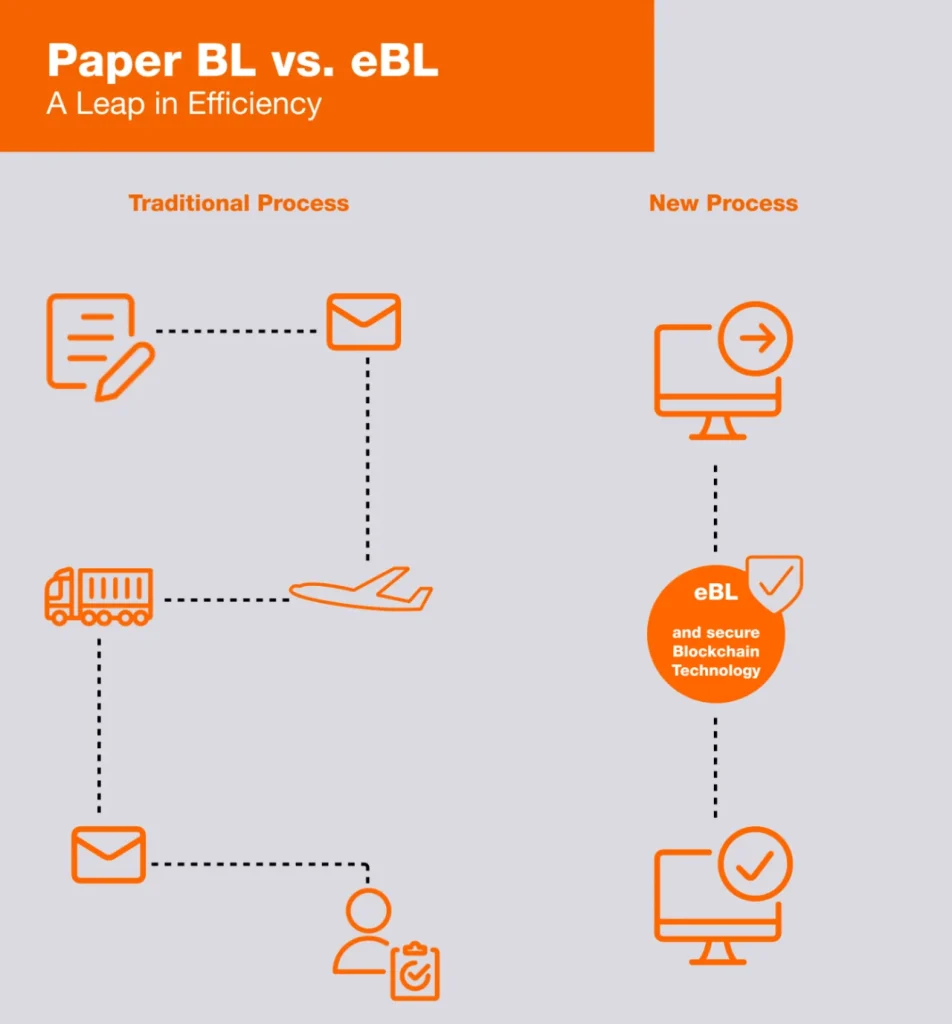
eB/L standardization is being led by the DCSA (Digital Container Shipping Association) – a consortium of the world’s largest shipping lines. DCSA published its eB/L standard in 2020 and continues to update it, aiming to ensure interoperability between different platforms. In parallel, MLETR (Model Law on Electronic Transferable Records) by UNCITRAL provides the international legal framework for eB/L.
In early 2026, major financial institutions and shipping lines (including COSCO, HSBC, and others) successfully completed cross-platform eB/L transfers without breaking the chain of title. This resolved the “isolated protocol” problem that had previously been the biggest barrier for banks when processing eB/Ls.
From May 2026, China’s amended Maritime Code officially came into force, recognizing eB/Ls as having the same legal standing as paper bills of lading – aligned with the MLETR model law. Prior to this, major trading nations including the United Kingdom, India, and the Netherlands had already finalized their own legal frameworks for eB/L.
Leading eB/L Platforms Today
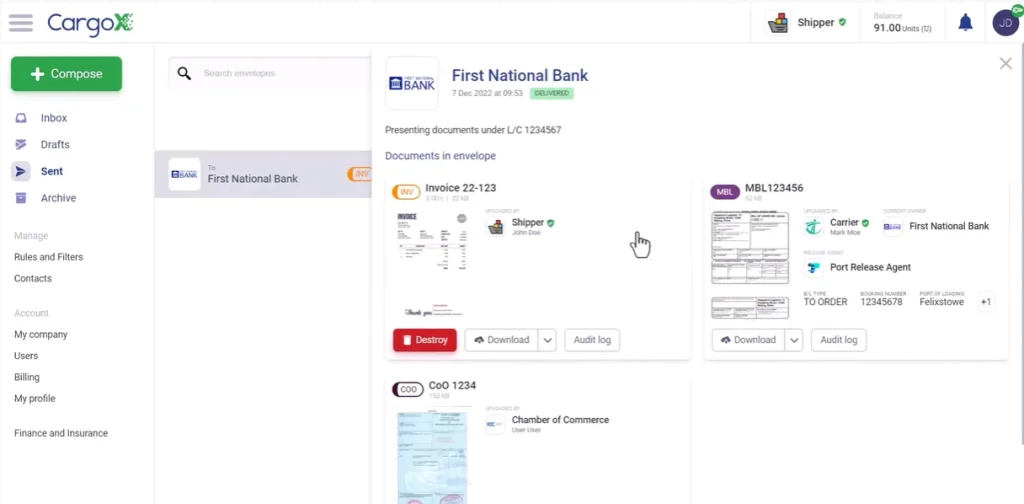
The eB/L market currently features several competing platforms, including: WAVE (blockchain-based, focused on Asia), essDOCS (one of the oldest platforms, widely used in bulk cargo), CargoX (blockchain on Ethereum, recognized by customs authorities in several countries), Bolero (linked with SWIFT, strong in L/C transactions), and TradeWindow (popular in Australia–New Zealand markets). These platforms are progressively moving toward interconnection under DCSA standards.
On the carrier side, major players that have deployed eB/L include Maersk (via TradeLens and later through CargoX/WAVE pilots), MSC, CMA CGM, Hapag-Lloyd, ONE (Ocean Network Express), and Yang Ming. As of 2026, the adoption rate of electronic bills of lading in global shipping and trade is estimated at approximately 11%–12%.
The tangible benefits of eB/L are clear: reducing turnaround time from 5–7 days (waiting for paper originals by courier) to just a few hours; significantly lowering costs for printing, courier, and document handling (estimated savings of USD 100–300 per shipment); reducing fraud risk and document loss; environmental sustainability (the global logistics industry consumes millions of sheets of paper per year for B/Ls alone); and speeding up capital circulation in the supply chain.
While the ~11% figure for 2026 may appear modest, this represents a critical momentum-building phase. The FIT Alliance and major shipping lines continue to uphold their commitment to reaching 50% by 2030 and moving toward 100% paperless within the decade.
“In 2026, we successfully piloted eB/L with 3 export partners on the HCMC–Hamburg and HCMC–Rotterdam routes using the CargoX platform in conjunction with Hapag-Lloyd. Document processing time dropped from 6 days to under 4 hours. However, Vietnamese banks have not yet accepted eB/L in L/C document sets – this remains the biggest barrier for the domestic market.” – Ms. Apple, CCO, 3W Logistics
7. B/L in L/C Transactions – UCP 600 Article 20 and Common Discrepancies
In Letter of Credit (L/C) transactions, the B/L is the most important transport document and the most frequent source of discrepancies. UCP 600 Article 20 (Uniform Customs and Practice for Documentary Credits, ICC 2007 version) specifies the detailed requirements for B/Ls presented under an L/C. Download: UCP-600-Rules-3w-logistics
Under UCP 600 Article 20, a bank will accept a B/L if it meets all of the following conditions: (1) clearly identifies the carrier/agent and bears an authenticating signature; (2) contains an “on board notation” stating the vessel name and date of loading – not merely “received for shipment”; (3) is a Clean B/L – no clauses or notations regarding defective cargo or packaging; (4) evidences port-to-port transportation as required by the L/C; (5) constitutes a Full Set of Originals – all issued originals; and (6) is dated no later than the document presentation deadline.
| Discrepancy | Specific Description | Consequences | How to Avoid |
|---|---|---|---|
| B/L date after L/C expiry | The B/L issue date (or on-board date) exceeds the Latest Shipment Date in the L/C, or the document set is submitted after the Presentation Period | Bank rejects the entire document set; a waiver must be obtained from the buyer | Book the vessel early; check the ETD before signing the trade contract; if delayed, request an L/C amendment immediately |
| Claused B/L | B/L contains reservation clauses about cargo or packaging condition: “Packaging damaged,” “Some cartons wet” | Bank rejects under UCP 600 Article 27; buyer has grounds to refuse payment | Inspect packaging thoroughly before delivering to the warehouse; replace damaged packaging; supervise the loading process |
| Incorrect Consignee | The issuing bank name or buyer name on the B/L does not match the L/C requirement – one wrong character, missing address, or missing branch name | Serious discrepancy; bank rejects; B/L amendment required at USD 35–60 | Copy and paste the exact bank/consignee name directly from the L/C into the Shipping Instruction — never type manually |
| Description of Goods mismatch | Cargo description on B/L differs from the L/C — synonyms used, extra details added not in the L/C, or description shorter than what the L/C requires | Bank rejects; amendment or waiver needed; payment delayed 3–7 days | Use the exact wording from the L/C when completing the B/L cargo description; never paraphrase |
| Missing “on board” notation | B/L is only “Received for Shipment” without confirmation that cargo was actually loaded, or the on-board stamp is missing the vessel name and date | Does not meet UCP 600 Article 20; bank rejects the entire document set | Request the carrier to issue an On Board B/L; verify that the Draft B/L contains the on-board notation before confirming |
“Each bank discrepancy costs USD 50–150 and delays payment by 3–7 business days. In our consulting experience with clients, we find that 90% of discrepancies stem from these 5 errors and 100% of them are entirely preventable with a careful document review before submission to the bank.” – Ms. Apple, CCO, 3W Logistics
8. Lost Original Bill of Lading – Handling Procedures and Letter of Indemnity
Losing an original B/L is one of the most distressing situations in import/export practice, with serious legal and financial consequences. Because the B/L is a Document of Title, whoever holds the original has the right to claim the cargo – losing the B/L can lead to disputes over cargo ownership, carrier liability if cargo is released to the wrong party, and loss of control over assets used as collateral by the shipper or bank.
The most common remedy when an original B/L is lost is a Letter of Indemnity (LOI). This is a legal document issued by a bank (or by the cargo owner if the carrier accepts it), committing to indemnify the carrier for any losses, costs, or liabilities arising if someone later presents a valid original B/L and claims entitlement to the cargo.
The LOI Process – 4 Practical Steps from 3W Logistics
Step 1: Report the loss immediately
Contact the carrier or forwarder in writing, stating the lost B/L number, the related shipment, and the circumstances of the loss. Also notify the bank if the B/L is in the process of an L/C or collection payment. Do not delay — if the cargo has already arrived and another party presents the original first, the carrier may have already released it.
Step 2: Apply for an LOI at the bank
The cargo owner goes to their bank (typically the bank currently holding the B/L or a reputable commercial bank) to request the bank to issue an LOI. The bank will require related documentation: the original document set, trade contract, Invoice — and will typically require a security deposit or collateral equivalent to the value of the shipment.
Step 3: Bank issues the LOI and sends it to the carrier
The LOI is signed by the bank, providing indemnity in the carrier’s standard format (each carrier has its own LOI template). The LOI must clearly state the B/L number, cargo description, ports, and an open-ended indemnity commitment (LOIs typically have no expiry date).
Step 4: Carrier reviews and releases the cargo
Upon receiving the LOI from a reputable bank, the carrier issues a Delivery Order (D/O) to the consignee to collect the cargo. Processing typically takes 2–5 business days. LOI processing fees: approximately USD 100–300 depending on the carrier and circumstances. Note: not all carriers accept LOIs from every bank – check acceptable banks in advance.
Important to know: Using an LOI is only a temporary solution and carries costs. Legal risk persists until the original B/L is declared void or the maritime claims limitation period expires. The best approach is to avoid losing the B/L in the first place by using trackable courier services, saving a scan of the original immediately upon receipt, and considering Telex Release or eB/L when commercial conditions allow.
9. Bill of Lading (B/L) Related Fees
When working with B/Ls, shippers and consignees need to be familiar with the fees that may arise in order to avoid surprises and accurately calculate logistics costs into their pricing. Below are the 6 most common B/L-related fees in Vietnam practice.
| Fee Type | Full Name | Typical Rate (USD) | Charged by | When It Arises |
|---|---|---|---|---|
| B/L Fee | Bill of Lading Fee / Documentation Fee | USD 25–50 / B/L | Carrier or forwarder | Charged each time a B/L is issued; applies to every shipment |
| Amendment Fee | B/L Amendment Fee / Correction Fee | USD 35–60 / amendment | Carrier | When B/L content needs to be corrected after the official B/L has been issued; avoidable by thorough Draft review |
| Telex Release Fee | Telex Release / Surrender B/L Fee | USD 50–150 / B/L | Carrier | When shipper surrenders originals and requests the carrier to electronically release cargo at the destination port without requiring the originals |
| D/O Fee | Delivery Order Fee | USD 25–50 / shipment | Carrier / carrier’s agent at destination port | Paid by consignee when exchanging the original B/L for a Delivery Order to collect the container from the port |
| Late B/L Fee | Late Documentation / Late SI Fee | Varies by carrier (USD 30–100+) | Carrier | When the shipper submits the SI after the cut-off deadline; some carriers refuse to process, others charge a late fee |
| eB/L Fee | Electronic Bill of Lading Fee | USD 10–30 / B/L | Carrier / eB/L platform | When issuing an electronic B/L instead of paper originals; lower than courier costs but includes a platform fee |
10. FAQ – Frequently Asked Questions About the Bill of Lading
1. What is a Bill of Lading in import/export?
A Bill of Lading (B/L), or sea transport document, is issued by the shipping line or forwarder after receiving cargo for shipment. The B/L simultaneously serves as a contract of carriage, a receipt of goods, and a document of title. In import/export, the B/L is the legal basis for the consignee to collect cargo at the destination port and is a mandatory document in an L/C payment document set. Without a valid original B/L, the carrier will not release the cargo to the consignee.
2. Are “B/L” and “Bill of Lading” the same thing?
Yes. B/L (abbreviation of Bill of Lading) and the full term refer to exactly the same document. B/L is the commonly used English abbreviation. It is also sometimes written as BL (without the slash). All three forms refer to the same document used in international sea transport. Do not confuse it with an Air Waybill (AWB) or a road transport document (CMR).
3. What is the difference between a Master B/L and a House B/L?
A Master B/L is issued by the shipping line to the forwarder, while a House B/L is issued by the forwarder to the actual shipper (cargo owner). Many people commonly confuse House Bill and Master Bill. In LCL (Less than Container Load) shipments, the forwarder consolidates multiple cargo owners’ shipments, receives one Master B/L from the carrier, then issues individual House B/Ls to each cargo owner. The House B/L is the document the actual shipper uses for commercial transactions and bank payments. Cargo owners generally do not need to concern themselves with the Master B/L — that is the relationship between the forwarder and the carrier.
4. How many original copies does a Bill of Lading have?
Typically, the carrier issues a Full Set of 3 Original B/Ls. The B/L will state, for example, “Three (3) Original Bills of Lading.” Presenting any 1 of the 3 originals at the destination port is sufficient to collect the cargo — the remaining originals become automatically void. However, in L/C transactions, banks typically require submission of the full set (all 3 originals) to ensure complete control over the cargo. In some special cases, 1 or 2 originals may be issued at the shipper’s request.
5. What is a Clean B/L and why is it critical in L/C transactions?
A Clean B/L is a B/L bearing no reservation clauses regarding any defective condition of the cargo or packaging when received by the carrier. It is the standard B/L type and is mandatory under L/C transactions per UCP 600 Article 27. If the carrier finds issues with the cargo or packaging and adds a notation to the B/L (creating a Claused B/L), the bank will reject the document set. Proper cargo packaging before delivering to the port is therefore a prerequisite for obtaining a Clean B/L.
6. How does a Telex Release differ from an Original B/L?
An Original B/L is a physical document; the recipient must present an original at the destination port to collect cargo — suitable when paying via L/C or D/P, where the bank controls the B/L and thus controls the cargo. A Telex Release (or Surrendered B/L) means the shipper has surrendered the originals at the origin port, and the carrier electronically instructs its destination agent to release cargo without requiring the originals — suitable when both parties have completed payment (T/T) and have a trusted relationship. Telex Release is faster and eliminates courier costs, but is not accepted under L/C.
7. What should you do if you lose the original Bill of Lading?
Act immediately: contact the carrier/forwarder and bank in writing to report the loss. The standard solution is to obtain a Letter of Indemnity (LOI) — an indemnity letter issued by the bank committing to compensate the carrier if someone later presents the original B/L. The process typically takes 2–5 days and costs USD 100–300 plus bank security deposit costs. To avoid this situation, always use tracked courier services, save a scan of the original upon receipt, and consider using Telex Release or eB/L where commercially appropriate.
8. How are Freight Prepaid and Freight Collect stated on a B/L?
On the B/L, the Freight & Charges field will clearly state the freight terms as either Freight Prepaid or Freight Collect. If the shipper has paid the freight, it reads “Freight Prepaid” (or “Freight PP”) – common with CIF, CFR, CPT terms. If the consignee will pay freight at the destination port, it reads “Freight Collect” (or “Freight CC”) – common with FOB, EXW, FCA terms. In L/C transactions, if the L/C does not permit Freight Collect, then Freight Prepaid is mandatory. In some cases, freight is split: part Prepaid (ocean freight) and part Collect (local charges at the destination port).
How Does 3W Logistics Support Bill of Lading Documentation?
3W Logistics is an OTI-NVOCC with FMC bond, capable of self-issuing HBLs and self-filing AMS/ISF (for US shipments) and E-Manifest (for Canadian shipments) using 3W’s own SCAC code. This makes the shipping process to the US and Canada significantly smoother with 3W Logistics.
With over 10 years of experience in logistics and freight forwarding, the 3W Logistics team provides comprehensive B/L documentation support for import/export businesses:
- SI and Draft B/L Review: Verifying the Shipping Instruction before submission and reviewing the Draft B/L against the commercial document set, particularly in L/C transactions, to identify errors before amendment costs arise.
- Amendment Handling: Facilitating prompt amendment requests with the carrier to minimize time and cost.
- L/C Documentation Support: Advising and preparing document sets for bank presentation in compliance with UCP 600 to reduce discrepancy rates.
- Telex Release and eB/L: Advising on the appropriate method and handling carrier procedures efficiently.
- Cargo Release Support: Processing D/Os, assisting with issues arising at destination ports, including cases involving lost B/Ls or LOI requirements.
Head Office – 3W Logistics Ho Chi Minh City Branch
Address: 34 Bach Dang Street, Tan Son Hoa Ward, Ho Chi Minh City
Hotline: +84 28 3535 0087
____________________________
3W Logistics Hanoi Branch
Address: 81A Tran Quoc Toan Street, Cua Nam Ward, Hanoi
Hotline: +84 24 3202 0482
____________________________
3W Logistics Hai Phong Branch
Address: 8A, Lot 28, Le Hong Phong Street, Gia Vien Ward, Hai Phong
Hotline: +84 225 355 5939
____________________________
3W LOGISTICS CO., LTD – We here serve you there!
Email: quote@3w-logistics.com
Website: www.3w-logistics.com

Ms. Apple is the CCO (Chief Commercial Officer) at 3W Logistics, with over 10 years of experience in sales and business operations management.
At 3W Logistics, Ms. Apple is responsible for commercial strategy, corporate customer development, managing a team of more than 50 sales professionals, and improving business performance in the logistics sector.
With practical experience in sales management and market development, Ms. Apple shares professional insights on business logistics solutions, international transportation, freight forwarding, customer management, trade lane development, and growth strategies in the logistics industry.


