

What are Freight Collect and Freight Prepaid on a bill of lading?
Freight Collect and Freight Prepaid are two freight terms that appear on the Bill of Lading and international shipping documents, defining who is responsible for paying the freight charges – the shipper or the consignee. This is one of the most critical pieces of information on a bill of lading, directly tied to the Incoterms conditions in the sales contract, the payment method, and the financial obligations of each party in international trade transactions.
1. What Are Freight Collect and Freight Prepaid?
Before distinguishing between these two concepts, it is important to understand what freight charges are. Freight charges are the total costs that a shipping line or airline charges for transporting goods from the port/airport of origin to the port/airport of destination – excluding local charges at the port of loading or port of discharge. Freight terms define which party is responsible for paying these freight charges.
What Is Freight Prepaid?
Freight Prepaid (prepaid basis) means that the shipper is responsible for paying all freight charges to the shipping line or airline at the port/airport of origin – before the cargo departs or immediately after the vessel sails. When the bill of lading states “Freight Prepaid,” the consignee at the destination does not need to pay any freight charges to the carrier.
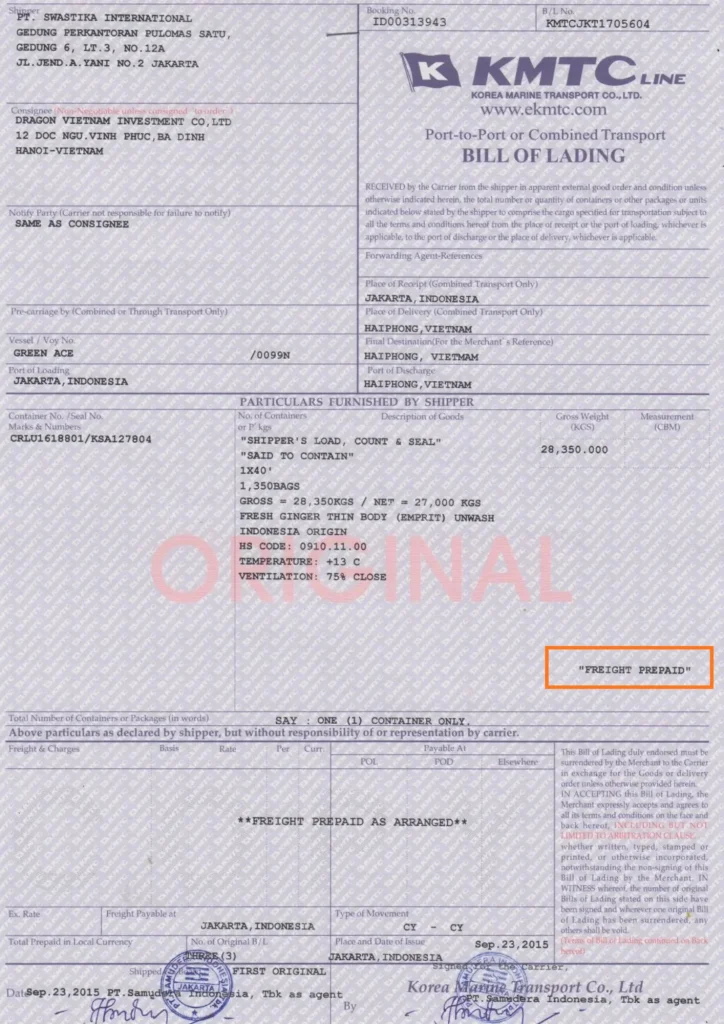
Freight Prepaid is commonly seen as: Ocean Freight Prepaid, Air Freight Prepaid.
What Is Freight Collect?
Freight Collect (collect basis) means that the consignee is responsible for paying all freight charges to the shipping line or airline at the port/airport of destination before or upon taking delivery of the goods. When the bill of lading states “Freight Collect,” the carrier will not release the cargo to the consignee until the freight has been paid in full.
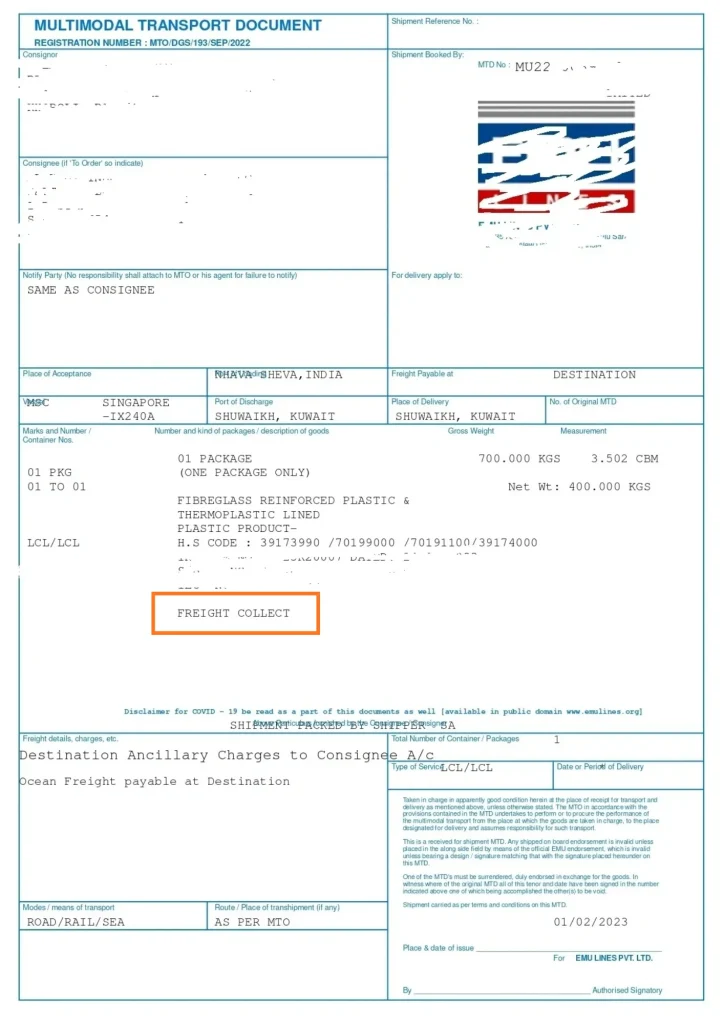
Freight Collect is commonly seen as: Ocean Freight Collect, Air Freight Collect, Collect shipment.
Important note on terminology: “Freight Collect” does not mean freight is “gathered” or “collected together” – this is a common mistranslation among beginners. “Collect” here means “to collect payment at the destination,” similar to “Collect on Delivery (COD)” in domestic delivery. “Prepaid” simply means “paid in advance” at the point of origin.
2. How to Read and Identify Freight Collect and Freight Prepaid on a Bill of Lading
On an Original Bill of Lading, House B/L or Master B/L, freight term information typically appears in one of the following locations:
| LOCATION ON B/L | FREIGHT PREPAID | FREIGHT COLLECT |
|---|---|---|
| “Freight & Charges” box | “Prepaid”, “Freight Prepaid”, “As Arranged – Prepaid” | “Collect”, “Freight Collect”, “As Arranged – Collect” |
| “Freight Payable at” box | Name of the port/city of origin (Port of Loading) | Name of the destination port/city (Port of Discharge) |
| Bottom-right corner of B/L | Stamped or printed “FREIGHT PREPAID” | Stamped or printed “FREIGHT COLLECT” |
| Freight amount field | May show the specific amount or “As Arranged” | Usually shows “As Arranged” – the exact amount is not disclosed to the consignee |
Practical note on reading a B/L: Many modern bills of lading issued by major carriers do not show the specific freight amount (they use “As Arranged” or leave it blank) regardless of whether it is Prepaid or Collect – this is standard commercial practice to keep the freight rate confidential between the shipper and the carrier. The key information to look for is the Prepaid or Collect status, not the specific amount.
3. The Relationship Between Freight Terms and Incoterms
This is a point where many people in the industry – even experienced import-export professionals – often get confused or are not entirely clear on. Freight terms on the B/L must be consistent with the Incoterms conditions in the sales contract because Incoterms define who bears the main freight cost, and the freight terms on the B/L are the reflection of that commitment in the transport document.
| INCOTERMS | WHO PAYS FREIGHT? | FREIGHT TERMS ON B/L | PRACTICAL NOTES |
|---|---|---|---|
| EXW | Buyer | Freight Collect | Buyer bears all costs from the seller’s warehouse – including ocean/air freight |
| FOB | Buyer | Freight Collect | Seller bears costs until goods pass the ship’s rail at the port of loading; buyer pays ocean freight |
| FCA | Buyer | Freight Collect | Similar to FOB but the risk transfer point is at the named place, not the port |
| CFR / CPT | Seller | Freight Prepaid | Seller pays freight to the destination port; risk transfers to buyer when goods are loaded on vessel |
| CIF / CIP | Seller | Freight Prepaid | Seller pays freight + insurance to the destination port; most common under L/C |
| DAP / DPU / DDP | Seller | Freight Prepaid | Seller bears all costs to the named destination or buyer’s premises |
Quick memory rule: Incoterms where the seller bears the main freight cost (CFR, CIF, CIP, CPT, DAP, DPU, DDP) → Freight Prepaid. Incoterms where the buyer bears the main freight cost (EXW, FCA, FOB, FAS) → Freight Collect. However, this is a general rule – in practice, the two parties may agree otherwise based on specific commercial conditions.
4. Detailed Comparison: Freight Collect vs. Freight Prepaid
| Criteria | Freight Prepaid | Freight Collect |
|---|---|---|
| Who pays freight? | Shipper (sender) | Consignee (receiver) |
| Where is freight paid? | At the port/airport of origin | At the port/airport of destination |
| When is freight paid? | Before or immediately after vessel/aircraft departure | Before or upon taking delivery at the destination port/airport |
| Common Incoterms | CIF, CFR, CIP, CPT, DAP, DPU, DDP | FOB, FCA, EXW, FAS |
| Common with L/C payment? | Yes – especially CIF/CFR L/C; banks typically require Freight Prepaid on the B/L | Less common with L/C – banks may reject a B/L showing Freight Collect if the L/C does not permit it |
| Can carrier hold cargo for non-payment? | Shipper has already paid – carrier will not hold cargo at destination due to freight | Yes – if consignee does not pay freight at the destination port, carrier will hold cargo and charge demurrage |
| Risk to Shipper | Lower – freight is paid, cargo will be delivered at destination without freight issues | If consignee refuses cargo or becomes insolvent, carrier may seek freight payment from shipper |
| Risk to Consignee | Must verify shipper has actually paid freight – especially important when using a forwarder | Must pay freight at destination port before taking delivery – requires ready available funds |
| Prevalence in Vietnam | Very common – especially for CIF exports and FOB imports | Common – especially for FOB exports and CIF imports |
5. Advantages and Limitations of Each Freight Term
| Freight Prepaid – Freight Paid in Advance | Freight Collect – Freight Paid at Destination |
|---|---|
| Consignee does not need to worry about paying freight at the destination port – cargo can be collected immediately upon receiving the D/O | Shipper does not need to advance freight payment upfront – particularly advantageous when exporting under FOB |
| Suitable for L/C payment – banks readily accept B/Ls showing Freight Prepaid | Consignee controls carrier selection and negotiates freight directly – optimizes cost from their end |
| No risk of cargo being held at destination port due to unpaid freight | Common in CIF import model – importer controls freight costs on the import side |
| Shipper must advance freight payment before receiving payment from the buyer – affects cash flow | If consignee refuses cargo or becomes unable to pay freight, the carrier may claim freight from the shipper |
| Shipper bears the risk of exchange rate and freight rate fluctuations if the CIF contract was signed at a fixed price | Not suitable for L/C payment if the L/C does not explicitly allow Freight Collect – creates discrepancy |
| Shipper depends on their ability to negotiate rates with the carrier – may not be optimal without large volumes | Consignee needs to manage freight payments at multiple destination ports – more complex financially |
6. Freight Collect and Freight Prepaid in Sea and Air Freight
Freight terms apply not only to ocean freight but are also widely used in Air Freight. However, there are some important differences to note:
| Criteria | Ocean Freight (Sea) | Air Freight |
|---|---|---|
| Transport document | Bill of Lading (B/L) | Air Waybill (AWB) |
| Is Prepaid more common? | Both are common depending on Incoterms | Air Freight Prepaid is more common – especially for express shipments and e-commerce |
| Is Air Freight Collect common? | Ocean Freight Collect – common for FOB shipments | Air Freight Collect is less common – some airlines do not accept Collect for certain cargo types |
| Dangerous goods (DG) | Either Collect or Prepaid depending on agreement | Air Freight Collect is generally not permitted for DG cargo – most airlines require Prepaid |
| High-value cargo | Both terms are applicable | Airlines may impose maximum value limits on Collect shipments |
Note on Air Freight Collect: Not all airlines accept Freight Collect on every route and for every cargo type. Before booking air freight under Collect terms, confirm with the airline or forwarder whether Collect is accepted at the destination airport – particularly for shipments to markets with specific regulations such as the US, Japan, and certain African countries.
7. When Should You Use Freight Prepaid vs. Freight Collect?
Situations Where Freight Prepaid Is Recommended
- Selling under CIF, CFR, CIP, CPT: The contract requires the seller to bear the freight – Prepaid is mandatory to be consistent with Incoterms.
- L/C payment – especially CIF L/C: A CIF L/C typically requires the B/L to state Freight Prepaid. If the B/L shows Freight Collect and the L/C does not permit it, the bank will reject payment (discrepancy).
- When you want to control freight quality and rate: Shippers with large volumes who have negotiated favorable rates with the carrier may prefer to pay freight themselves rather than leaving it to the consignee.
- Consignee in a new market unfamiliar with the process: Avoids situations where the consignee does not know they need to pay freight at the destination port, causing delays and demurrage.
- Perishable or time-sensitive cargo: Freight Prepaid ensures no waiting for consignee freight payment – cargo is released faster.
Situations Where Freight Collect Is Recommended
- Selling under FOB, FCA, EXW: The contract requires the buyer to pay the main freight – Freight Collect is the correct term per Incoterms.
- Buyer wants to control carrier selection and freight costs: The buyer has a separate freight contract with a carrier or forwarder and wants to manage import-side freight independently.
- Shipper wants to optimize cash flow: No need to advance freight payment before receiving payment from the buyer – especially important for small and medium-sized enterprises.
- Buyer is a large corporation with better freight rates: Many multinational corporations can negotiate better freight rates than smaller shippers – letting the buyer pay freight reduces overall cost.
- Intra-group transfers: In intercompany transactions, Freight Collect often simplifies internal accounting procedures.
8. Legal and Financial Risks to Consider
Risks With Freight Collect
| RISK SCENARIO | ANALYSIS AND NOTES |
|---|---|
| Consignee refuses to pay freight | When a consignee fails to pay Collect freight at the destination port, the carrier holds the cargo and charges demurrage. Importantly: many carriage contracts allow the carrier to claim Collect freight from the shipper if the consignee does not pay – even though the shipper is not the primary obligor. Shippers should carefully read the terms and conditions in the bill of lading. |
| Consignee becomes insolvent before taking delivery | Cargo is stranded at the destination port – Collect freight goes unpaid, demurrage accumulates. The shipper loses the cargo and may face demurrage charges if they attempt to recover the goods. |
| Freight Collect on B/L causes L/C discrepancy | If the L/C requires Freight Prepaid (or does not permit Collect) but the B/L shows Freight Collect, the bank will reject the entire document set. This is one of the most common and most easily avoidable discrepancies. |
| Collect freight rate rises after contract signing | If the sales contract was fixed under FOB but market freight rates surge afterward, the consignee bears a higher cost than expected – potentially causing commercial disputes if there is no price adjustment clause. |
Risks With Freight Prepaid
| RISK SCENARIO | ANALYSIS AND NOTES |
|---|---|
| Forwarder collects Prepaid freight but does not remit to the carrier | Similar to HBL risk: the shipper has paid Prepaid freight to the forwarder, but the forwarder fails to pass it on to the carrier – cargo arrives at destination and is held because freight has not been settled with the carrier. This is why you should always work with reputable forwarders and check the MBL number to verify. |
| Prepaid freight is non-refundable | In most carriage contracts, Prepaid freight is non-refundable even if the cargo is damaged, lost, or a dispute arises. Shippers must purchase cargo insurance to protect the value of the shipment. |
| Freight rate fluctuation after signing a fixed CIF contract | If the shipper sold CIF at a fixed price but market freight rates surge afterward, the shipper absorbs the difference – directly impacting shipment profitability. |
Frequently asked – Can Freight Prepaid be refunded? The answer is almost never under normal conditions. Once the cargo has been loaded and Prepaid freight has been recorded, the carrier does not refund it even if the cargo is cancelled, returned, or a dispute arises. Only in special cases – such as cancelling a booking before the vessel departs – may a partial refund be possible (minus cancellation fees), but once the vessel has sailed, Prepaid freight is a sunk cost and cannot be recovered.
Frequently Asked Questions About Freight Collect and Freight Prepaid
Is Freight Collect paid in advance or at destination?
Does FOB use Freight Collect or Freight Prepaid?
Does CIF use Freight Collect or Freight Prepaid?
What risks does Freight Collect pose to the shipper?
Can Freight Prepaid be refunded?
What is the most fundamental difference between Freight Collect and Freight Prepaid?
9. Conclusion
In summary, Freight Collect and Freight Prepaid are two fundamental yet critical freight terms in international transport documents:
- Freight Prepaid – freight paid in advance: shipper pays at origin port/airport; typically used with CIF, CFR, DAP, DDP; required for many types of L/C
- Freight Collect – freight paid at destination: consignee pays at destination port/airport; typically used with FOB, FCA, EXW; suitable when the buyer controls freight costs
- Freight terms on the B/L must be consistent with the Incoterms in the contract – any mismatch is one of the most common sources of L/C discrepancy
- Freight Prepaid is almost never refundable once the vessel has sailed – cargo insurance must be purchased to protect the shipment value
- Freight Collect carries risk for the shipper if the consignee refuses to pay freight – the carrier may seek payment from the shipper under the carriage contract
How Does 3W Logistics Support Its Clients?
3W Logistics is an OTI-NVOCC with FMC registration and bond, capable of issuing its own HBL and filing AMS/ISF (for US shipments) and E-Manifest (for Canada shipments) under 3W’s own SCAC code. This makes the process of shipping to the US and Canada through 3W Logistics significantly smoother.
Whether you are exporting under FOB, CIF, or any other Incoterms condition, correctly stating freight terms on the B/L and ensuring consistency with the L/C is critical to having your document set accepted by the bank and your cargo released on time. 3W Logistics provides comprehensive support:
- Freight terms consultation: Based on Incoterms, payment method, and shipment specifics, 3W’s team advises whether Freight Prepaid or Freight Collect is appropriate – avoiding L/C discrepancies and unnecessary financial risk.
- Draft B/L review before approval: 3W cross-checks freight terms on the Draft B/L against the L/C and sales contract conditions – identifying any inconsistencies before the B/L is officially issued.
- Freight rate negotiation with carriers and airlines: With consistent cargo volumes across multiple clients, 3W can negotiate competitive rates – helping shippers optimize costs whether they choose Prepaid or Collect.
- Full import-export documentation handling: From B/L, AWB, C/O, and electronic customs to the complete L/C document set – 3W ensures freight terms and all document information are consistent and accurate.
- Freight dispute resolution support: When cargo is held at the destination port due to a Collect freight dispute, or when there are issues with Prepaid freight paid through a forwarder, 3W’s team provides urgent support to release the cargo as quickly as possible.
A practical note from 3W Logistics: Discrepancies caused by incorrect freight terms on a B/L are among the most common errors in L/C document sets – and also among the most easily preventable. Simply reading the “Freight” clause in the L/C carefully before sending the Shipping Instruction to the carrier is sufficient to avoid this issue entirely. In practice, however, time pressure and inattention to detail are what continue to cause this error. Contact 3W Logistics for professional document review services – especially for high-value L/C shipments.
Address: 34 Bach Dang Street, Tan Son Hoa Ward, Ho Chi Minh City
Hotline: +84 28 3535 0087
____________________________
3W Logistics Hanoi Branch
Address: 81A Tran Quoc Toan Street, Cua Nam Ward, Hanoi
Hotline: +84 24 3202 0482
____________________________
3W Logistics Hai Phong Branch
Address: 8A Lot 28 Le Hong Phong Street, Gia Vien Ward, Hai Phong
Hotline: +84 225 355 5939
____________________________
3W LOGISTICS CO., LTD – We here serve you there!
Email: quote@3w-logistics.com
Website: www.3w-logistics.com

Ms. Apple is the CCO (Chief Commercial Officer) at 3W Logistics, with over 10 years of experience in sales and business operations management.
At 3W Logistics, Ms. Apple is responsible for commercial strategy, corporate customer development, managing a team of more than 50 sales professionals, and improving business performance in the logistics sector.
With practical experience in sales management and market development, Ms. Apple shares professional insights on business logistics solutions, international transportation, freight forwarding, customer management, trade lane development, and growth strategies in the logistics industry.


