

What is the difference between a House Bill and a Master Bill?
House Bill of Lading (HBL) and Master Bill of Lading (MBL) are two types of bills of lading that exist simultaneously within a single shipment when a shipper uses a freight forwarder’s services but are issued by different parties, represent two different contractual relationships, and carry different legal weight within the international shipping chain. Understanding the distinction between HBL and MBL not only helps businesses handle documentation correctly but also protects their legal rights when risks arise because this is the point from which many real disputes and financial losses in the logistics industry originate, stemming from confusion or insufficient knowledge.
1. What Are House Bill and Master Bill? Why Do Both Exist?
To understand why both HBL and MBL appear in the same shipment, it’s important to first understand the structure of the modern logistics industry. In the majority of import/export transactions, shippers do not book vessels directly with shipping lines but instead work through a freight forwarder particularly for LCL (Less than Container Load) shipments or when value-added services are needed such as cargo consolidation, information confidentiality, or complex documentation support.
It is precisely the presence of this intermediary that creates two parallel layers of contractual relationships:
| LAYER | RELATIONSHIP | DOCUMENT REPRESENTING IT | WHO HOLDS IT? |
|---|---|---|---|
| Layer 1 (upper) | Forwarder ↔ Shipping Line | Master B/L (MBL) | Forwarder holds it – shipper typically never sees it |
| Layer 2 (lower) | Shipper ↔ Forwarder | House B/L (HBL) | Shipper holds it – consignee uses it to collect cargo |
Put simply: the forwarder is the “buyer” of shipping services from the carrier and the “reseller” of those services to the shipper. The MBL represents the forwarder’s purchase transaction with the shipping line; the HBL represents the forwarder’s resale transaction to the shipper. These two layers exist in parallel and are legally independent of each other.
Freight Prepaid and Freight Collect on a House Bill of Lading (HBL) represent the payment of freight between the shipper and the forwarder, while on a Master Bill of Lading (MBL) it is between the forwarder and the shipping company.
What does this mean in practice? When cargo arrives at the destination port, the consignee uses the HBL to collect cargo from the forwarder’s local agent at the destination port. That local agent uses the MBL to obtain the Delivery Order (D/O) from the shipping line. This is the “Back-to-Back” process – two layers of document transactions linked in sequence. If there is a problem at any layer (for example, the forwarder has not paid freight charges to the shipping line), the entire chain can become blocked and cargo may be held at the port.
2. What Is a House Bill of Lading (HBL)?
A House Bill of Lading (HBL), also known as a Forwarder B/L, Secondary B/L, or Freight Forwarder B/L, is a bill of lading issued by a freight forwarder or NVOCC (Non-Vessel Operating Common Carrier) to the shipper – that is, their customer.
The HBL represents the forwarder’s commitment to the shipper: “We have received your cargo and will transport it to the destination under the terms stated on this document.” In terms of appearance, an HBL looks nearly identical to a standard bill of lading – featuring all the same fields: shipper, consignee, notify party, cargo description, port of loading, port of discharge, vessel name, and on-board date. However, the most important visual distinction lies in the header and stamp: instead of a shipping line’s logo, the HBL bears the logo and name of the freight forwarder.
Key Fields on an HBL
| FIELD | CONTENT ON HBL |
|---|---|
| Header / Logo | Logo and name of the Forwarder – not the shipping line |
| Shipper | Name of the actual exporting company (Real Shipper) – the party who physically owns the cargo |
| Consignee | Name of the actual buyer (Real Consignee) – or the issuing bank if payment is by L/C |
| HBL Number | A reference number assigned by the forwarder under their own internal system – entirely different from the MBL number issued by the shipping line |
| Signature and stamp | Signature and stamp of the Forwarder or their authorized agent – not the shipping line |
| Vessel / Voyage | Same as the MBL – accurately reflects the actual vessel and voyage number carrying the cargo |
| For Delivery Contact | Contact details of the forwarder’s local agent at the destination port – where the consignee must go to collect cargo, not the shipping line’s office |
3. What Is a Master Bill of Lading (MBL)?
A Master Bill of Lading (MBL), also known as a Carrier B/L, Ocean B/L, or Main Bill of Lading, is a bill of lading issued by the shipping line (Carrier). It is the most official transport document in the sea freight chain, carrying the highest legal authority.
When a forwarder books vessel space to transport cargo belonging to multiple shippers (particularly for LCL consolidations), the shipping line has no direct knowledge of the individual actual shippers – the shipping line only knows the forwarder as their customer. As a result, the MBL lists the forwarder as the shipper and the forwarder’s local agent at the destination port as the consignee.
Key Fields on an MBL
| FIELD | CONTENT ON MBL |
|---|---|
| Header / Logo | Logo and name of the Shipping Line (Maersk, MSC, CMA CGM, Evergreen, etc.) |
| Shipper | Name of the Forwarder at the port of export – not the actual cargo owner |
| Consignee | Name of the Forwarder’s local agent at the destination port (Forwarding Agent) – not the actual buyer |
| MBL Number | A reference number assigned by the Shipping Line under their own system – this number can be used to track the shipment directly on the shipping line’s website |
| Signature and stamp | Signature and stamp of the Shipping Line or their authorized agent – highest legal authority |
| Cargo description (LCL) | For LCL cargo: MBL typically states “Said to contain consolidated cargo as per attached manifest” – a summary description, not itemized per individual shipment |
| HBL reference | Some MBLs include the corresponding HBL number in the Marks & Numbers section; others do not – varies by shipping line and forwarder |
4. How Are House B/L and Master B/L Different?
| Criteria | House B/L (HBL) | Master B/L (MBL) |
|---|---|---|
| Who issues it? | Freight forwarder or NVOCC | Shipping line (Carrier) |
| Issued to whom? | The actual shipper (Real Shipper) | The forwarder (as the shipping line’s customer) |
| Shipper named on B/L | Name of the actual exporting company | Name of the Forwarder (not the actual shipper) |
| Consignee named on B/L | Actual buyer / Issuing bank | Forwarder’s local agent at the destination port |
| Legal standing | Binds the Forwarder to the Shipper | Binds the Shipping Line to the Forwarder – higher legal authority |
| Applicable international conventions | Not directly governed by Hague Rules / Hamburg Rules | Governed by Hague-Visby Rules, Hamburg Rules, or Rotterdam Rules depending on the trade route |
| Used to collect cargo at destination | At the forwarder’s local agent office – not the shipping line | At the shipping line’s office – forwarder uses it to obtain D/O |
| Who can shipper sue if something goes wrong? | Can only sue the Forwarder – cannot directly sue the Shipping Line | Can directly sue the Shipping Line – higher likelihood of compensation |
| Accepted for L/C payment | Possible – only if the L/C explicitly states acceptance of HBL from a named forwarder; banks default to requiring MBL | Yes – UCP 600 default standard accepts MBL issued by the shipping line |
| Ease of amendment | Easier – forwarders are more flexible with fewer procedures; lower fees | Harder – shipping lines follow strict procedures; higher fees; some amendments are not possible |
| Confidentiality of shipper/consignee | High – shipping line does not know the actual shipper/consignee; protects trade secrets | Lower – when shipper books directly, their actual identity appears in the shipping line’s system |
| Suitable for LCL cargo | Mandatory – LCL cargo always comes with an HBL because the shipping line only issues 1 MBL for the entire consolidated container | Forwarder uses the MBL to collect the container from the shipping line, then splits it into individual HBLs for each cargo owner |
5. Why Do Shippers Often Not Know the MBL Exists?
This is a point of confusion for many newcomers to import/export and even for some experienced practitioners. When a shipper works with a forwarder, they only receive the HBL and are typically completely unaware that an MBL exists. Several reasons account for this:
| REASON | EXPLANATION |
|---|---|
| Forwarder has no obligation to share the MBL | The MBL is a document between the forwarder and the shipping line – not directly related to the service contract between the forwarder and the shipper. The forwarder has no legal obligation to provide the MBL to the shipper unless this is explicitly required in the service agreement. |
| Forwarder has commercial reasons to keep it confidential | The MBL number allows the shipper to look up the shipment directly on the shipping line’s website and discover which carrier the forwarder is using and at what freight rate – commercially sensitive information the forwarder wants to protect. |
| Shippers do not proactively ask | Many Vietnamese import/export businesses – particularly SMEs – are unaware that an MBL exists or do not know that they have the right to request the MBL number for independent verification and direct shipment tracking. |
| The HBL is sufficient for normal operations | In routine import/export operations with no incidents, the HBL is sufficient for customs clearance, cargo collection, and payment – shippers have no practical need to access the MBL. |
Should You Ask Your Forwarder for the MBL Number?
The answer is: Yes – particularly in the following situations:
- High-value shipments: Knowing the MBL number allows the shipper to track the shipment directly on the shipping line’s website – without relying entirely on information provided by the forwarder.
- New forwarder with no track record: Having the MBL number helps confirm that the cargo has actually been loaded onto the vessel – guarding against situations where a dishonest forwarder issues an HBL for cargo that has not yet shipped.
- Time-critical shipments with tight deadlines: Tracking directly on the shipping line’s system is typically more accurate and updated more promptly than information relayed through a forwarder.
- When a dispute or incident arises: The MBL number is the tool that allows shippers and consignees to work directly with the shipping line when necessary.
Practical note: A reputable forwarder will readily provide the MBL number when asked for a legitimate reason. If a forwarder refuses to provide the MBL number without a valid explanation – especially when you are asking about the status of your own cargo – this is a warning sign that warrants caution.
6. How HBL and MBL Are Issued in Parallel for the Same Shipment
Below is the real-world process for an FCL shipment routed through a forwarder – illustrating how HBL and MBL are issued simultaneously in parallel:
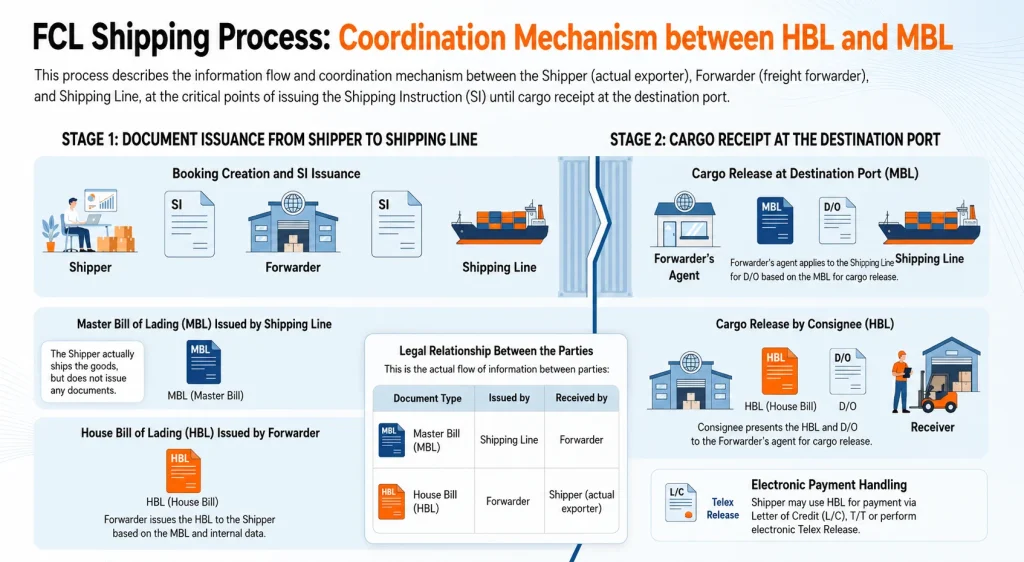
- Shipper signs a service agreement with the Forwarder: The forwarder quotes a rate and receives the booking from the shipper; the shipper agrees to use an HBL (or makes no specific request for an MBL).
- Forwarder books vessel space with the Shipping Line: The forwarder books in their own name as shipper with the shipping line; the forwarder arranges an empty container for the shipper to stuff.
- Shipper submits Shipping Instruction (SI) to the Forwarder: The shipper sends cargo details, the actual shipper name, and actual consignee information to the forwarder for preparation of the HBL. This is an internal S/I between the shipper and forwarder – separate from the S/I the forwarder sends to the shipping line.
- Forwarder submits S/I to the Shipping Line: The forwarder prepares and sends a separate S/I to the shipping line – in which the Forwarder is listed as Shipper and the Forwarding Agent at the destination port is listed as Consignee.
- Shipping Line issues Draft MBL → Forwarder reviews → Shipping Line issues Original MBL: The shipping line issues the MBL to the forwarder after the vessel departs. The forwarder retains the MBL – the shipper typically does not receive this document.
- Forwarder issues Draft HBL → Shipper reviews → Forwarder issues Original HBL: In parallel with the MBL process, the forwarder prepares and issues the HBL to the shipper – based on the information in the shipper’s S/I and the vessel/voyage details from the MBL.
- Shipper receives HBL and processes according to payment terms: Submits the HBL to the bank (L/C), couriers it to the consignee (T/T), or arranges a telex release through the forwarder.
- At the destination port – Two-layer cargo collection in parallel: The forwarder’s local agent at the destination uses the MBL to obtain a D/O from the shipping line; the actual consignee uses the HBL to obtain a D/O from the forwarder’s local agent; the consignee uses the D/O to clear customs and collect cargo.
Critical point in Step 8: If the forwarder’s local agent at the destination port has not paid freight charges to the shipping line, the shipping line will refuse to release the D/O – even if the consignee holds a valid HBL. The cargo is held at the port, and the consignee has no legal standing to sue the shipping line because the contract of carriage is between the shipping line and the forwarder, not the consignee. This is the most common “cargo hold” scenario in practice.
7. HBL in L/C Transactions: When Is It Accepted and When Is It Not?
This is the most frequently misunderstood and debated point in real-world import/export practice. The answer is not a simple “yes” or “no” – it depends entirely on the specific terms stated in the L/C.
The UCP 600 Default Standard
Under Article 20 of UCP 600, banks default to accepting bills of lading issued by a carrier, the master, or their authorized agent. An HBL issued by a forwarder does not meet this standard by default – because a forwarder is not a carrier. Download UCP 600 Rules here
| L/C Scenario | Is the HBL Accepted? |
|---|---|
| L/C makes no mention of B/L type | No – the bank applies UCP 600 defaults and requires a B/L issued by the carrier (MBL/Carrier B/L). The HBL will be rejected as a discrepancy. |
| L/C states “Forwarder B/L acceptable” or “House B/L acceptable” | Yes – the bank will accept the HBL in accordance with the explicit L/C clause. |
| L/C states “Third party B/L acceptable” | Possibly – depends on the bank’s interpretation; generally accepted but should be confirmed with the handling bank before submission. |
| L/C states “B/L issued by named carrier only” | No – requires a B/L issued by the specific named carrier. An HBL will be rejected outright. |
| HBL from an FMC-licensed NVOCC (US-bound cargo) | May be accepted – NVOCCs licensed by the US Federal Maritime Commission (FMC) can issue B/Ls with higher legal standing than standard HBLs in the US market. |
Practical recommendation: If you are exporting under an L/C and using a forwarder’s services, ask the buyer to include “Forwarder B/L acceptable” or “House B/L acceptable” as an L/C term before the L/C is opened. If the L/C is already open without this clause, an L/C amendment from the buyer will be required – adding time and cost. The simplest solution: if paying by L/C, ask your forwarder to place your name as shipper directly on the MBL issued by the shipping line – in which case you receive a Carrier B/L directly without needing an HBL.
8. Legal Risks When Using an HBL
This is an area where many Vietnamese businesses have not yet developed sufficient awareness – and have paid a heavy price as a result.
Risk 1: Forwarder Insolvency or Inability to Pay
The most common and most damaging scenario: the forwarder collects freight charges from the shipper but fails to pay the shipping line or the local agent at the destination port. When the vessel arrives, the local agent at the destination holds the cargo as leverage to recover payment from the forwarder — the consignee holds a valid HBL but cannot collect the cargo.
Consequences:
- Cargo is held at the destination port – demurrage and storage fees accumulate daily.
- The shipper/consignee has no legal standing to sue the shipping line because they have no direct contract with the shipping line (they only hold an HBL issued by the forwarder).
- The only recourse is to sue the forwarder – but if the forwarder has become insolvent, there are virtually no recoverable assets.
- Legal proceedings are time-consuming and costly, while port charges continue to accumulate.
Risk 2: Consignee Collecting Cargo with Forged Documents
One of the most high-profile legal disputes to shake Vietnam’s logistics industry in recent times – reported on 19 May 2026 — involved a rubber exporting company and a chain of eight logistics companies, forwarders, and shipping lines, with total damages exceeding VND 150 billion.
The sequence of events: the shipper exported multiple shipments to China using MBLs issued directly by the shipping line (not through a forwarder’s HBL). The full set of original bills of lading was sent by the shipper directly to the consignee in China. Upon arrival at the destination port, the consignee was alleged to have used sophisticated forged bills of lading to deceive the shipping line’s local agent at the destination, removing all cargo from the yard without paying the shipper. The shipper lost the entire cargo and filed suit against the entire logistics chain on the grounds of “joint and several liability.”
The lawsuit remains under review by the People’s Court. This case stands as the clearest possible illustration of the principle: the type of document you hold determines who you can sue and how much you can recover when things go wrong.
Risk 3: Back-Dating the HBL
A practice that is not recommended but does occur in reality: some forwarders agree to back-date the on-board date on the HBL to help the shipper meet the latest shipment date under an L/C when cargo actually shipped later than required. This constitutes document fraud and can lead to serious legal consequences – including criminal liability in some jurisdictions.
Lessons from real-world cases in Vietnam’s logistics industry: Many “cargo hold” situations follow the same pattern: a Vietnamese shipper exports through a low-cost forwarder; the local agent at the destination port (often in China or India) has not been paid; cargo is held hostage. The consignee presents the HBL at the shipping line’s office – the shipping line refuses because they have no contract with the consignee. The shipper takes the HBL to the forwarder – the forwarder has no money left or has gone silent. The total loss is not just the cargo value but also months of port storage fees, legal costs, and lost customers. To avoid this, only work with forwarders who are members of reputable international logistics associations such as FIATA, WCA, or IATA and always ask for the MBL number for independent verification.
9. When Should You Use an HBL vs. an MBL?
| Situation | Use an HBL | Request an MBL (Carrier B/L) |
|---|---|---|
| Cargo type | LCL cargo – HBL is mandatory | FCL cargo – you can request an MBL directly from the shipping line |
| Payment terms | T/T with a trusted partner; Open Account for intra-company shipments | L/C – banks default to requiring an MBL; or when the L/C does not include an HBL acceptance clause |
| Confidentiality | When the actual shipper/consignee identity needs to be concealed from other parties in the chain | When there are no confidentiality requirements and maximum legal standing is desired |
| Complex documentation | When legitimate date adjustments, multiple amendments, or bill splitting/consolidation are needed – forwarders are more flexible than shipping lines | When documentation is straightforward, minimal amendments are anticipated, and maximum legal authority is required |
| Risk level | Reputable, long-established forwarder who is a FIATA/WCA member – HBL risk is low | New forwarder, high-value cargo, or routes with a history of disputes – MBL provides greater security |
| Litigation rights | When you accept that your only recourse in the event of a loss is against the forwarder | When you want the right to sue the shipping line directly in the event of cargo damage or loss during transit |
What If There Is No MBL, or No HBL?
- No HBL (only an MBL): This occurs when the shipper books vessel space directly with the shipping line – no HBL is needed, and the MBL is the sole document used to collect cargo. The consignee goes directly to the shipping line’s office to obtain a D/O.
- No MBL (only an HBL): Technically impossible – an MBL must always exist for cargo to be transported. If the shipper “cannot see an MBL,” this does not mean the MBL does not exist – the forwarder is simply holding it. The shipper has not been provided with it, but the MBL does exist.
- Both HBL and MBL are lost: A serious situation – the Letter of Indemnity (LOI) process described in the article on Original Bill of Lading must be followed. For a lost HBL: contact the forwarder to issue a replacement. For a lost MBL: the forwarder contacts the shipping line to issue a replacement under LOI.
Frequently Asked Questions About House B/L and Master B/L
How are House B/L and Master B/L different?
Does the shipper have the right to request the MBL number?
Is an HBL accepted by banks in L/C transactions?
Cargo is being held at the destination port despite a valid HBL – what should I do?
Is an HBL mandatory for LCL cargo?
How do I choose a trustworthy forwarder when using an HBL?
10. Conclusion
In summary, a clear understanding of the difference between House B/L and Master B/L is foundational to protecting your interests in every international logistics transaction:
- HBL is issued by the Forwarder to the actual Shipper; MBL is issued by the Shipping Line to the Forwarder – two layers of documentation exist in parallel whenever a forwarder intermediary is involved
- MBL carries greater legal authority and is governed by international maritime conventions; HBL only binds the Forwarder – the Shipping Line cannot be sued directly by a party holding only an HBL
- Shippers have the right to request the MBL number for independent verification – especially important with new forwarders and high-value shipments
- HBL is not accepted under L/C transactions by default per UCP 600 – the L/C must explicitly include an HBL acceptance clause before it is opened
- The greatest risk of using an HBL is the forwarder’s failure to pay the shipping line or local agent – leading to cargo being held at the destination port; only work with FIATA/WCA-member forwarders of established reputation
- LCL cargo always comes with an HBL – this is an unavoidable reality of consolidated cargo; understanding it is essential for proper risk management
How Does 3W Logistics Support Customers?
Whether you are importing or exporting FCL or LCL cargo, using an HBL or requiring an MBL directly for an L/C, choosing the right documentation method and working with a trustworthy forwarder are the factors that determine whether cargo arrives on time and whether your rights are fully protected. 3W Logistics provides comprehensive support across every aspect of this process:
- HBL vs. MBL advisory: Based on your payment terms, cargo type (FCL/LCL), L/C requirements, and acceptable risk level, the 3W team advises on the optimal documentation method – preventing L/C discrepancies and protecting cargo control rights.
- Accurate and timely HBL issuance: 3W issues HBLs with precise information cross-checked against the L/C and sales contract, and provides the MBL reference number to customers upon request.
- Global network of trusted agents: 3W maintains a network of reliable forwarder agents at major destination ports worldwide – ensuring seamless cargo collection at the destination end with no risk of “cargo hold” situations arising from agent disputes.
- End-to-end L/C documentation support: For L/C transactions, 3W coordinates to ensure the shipper receives the exact type of B/L required by the bank – either an MBL directly from the shipping line or an HBL with clauses aligned to the L/C terms.
- Emergency incident handling: When cargo is held at a destination port or a documentation dispute arises, the 3W team acts urgently with the shipping line and local agent to minimize the time cargo remains at port and the associated costs.
- Full import/export documentation service: From HBL and Certificate of Origin to electronic customs declarations and the complete international payment document set – 3W handles everything from A to Z.
A note from 3W Logistics’ practical experience: The most costly mistake we see time and again is businesses choosing a forwarder based solely on the lowest freight quote – without checking financial stability, association membership, or the quality of their destination agent network. When a forwarder cannot pay the shipping line’s freight charges at the destination, the cost of “rescuing” the cargo is typically many times greater than the initial savings from the cheaper rate. At 3W Logistics, we are committed to full transparency in our documentation process – including providing MBL numbers to customers upon request – because we believe that trust is built on transparency. Contact 3W Logistics for advice on the most appropriate documentation method for your shipment.
Address: 34 Bach Dang Street, Tan Son Hoa Ward, Ho Chi Minh City
Hotline: +84 28 3535 0087
____________________________
3W Logistics Hanoi Branch
Address: 81A Tran Quoc Toan Street, Cua Nam Ward, Hanoi
Hotline: +84 24 3202 0482
____________________________
3W Logistics Hai Phong Branch
Address: 8A, Lot 28, Le Hong Phong Street, Gia Vien Ward, Hai Phong
Hotline: +84 225 355 5939
____________________________
3W LOGISTICS CO., LTD – We here serve you there!
Email: quote@3w-logistics.com
Website: www.3w-logistics.com

Ms. Apple is the CCO (Chief Commercial Officer) at 3W Logistics, with over 10 years of experience in sales and business operations management.
At 3W Logistics, Ms. Apple is responsible for commercial strategy, corporate customer development, managing a team of more than 50 sales professionals, and improving business performance in the logistics sector.
With practical experience in sales management and market development, Ms. Apple shares professional insights on business logistics solutions, international transportation, freight forwarding, customer management, trade lane development, and growth strategies in the logistics industry.


