What is C/O Form E? Latest Procedures in Vietnam for Export Businesses
Many businesses still have their C/O Form E rejected when importing goods from China due to incorrect declarations or using the wrong type of Form E, resulting in the loss of preferential tariff benefits and customs clearance delays.
So, what is C/O Form E? This article will help you understand the conditions for enjoying ACFTA tariff preferences, how to complete the declaration correctly, and how to distinguish different types of C/O Form E to avoid common mistakes and comply with current standards.
1. What is C/O Form E?
1.1 Definition of C/O Form E
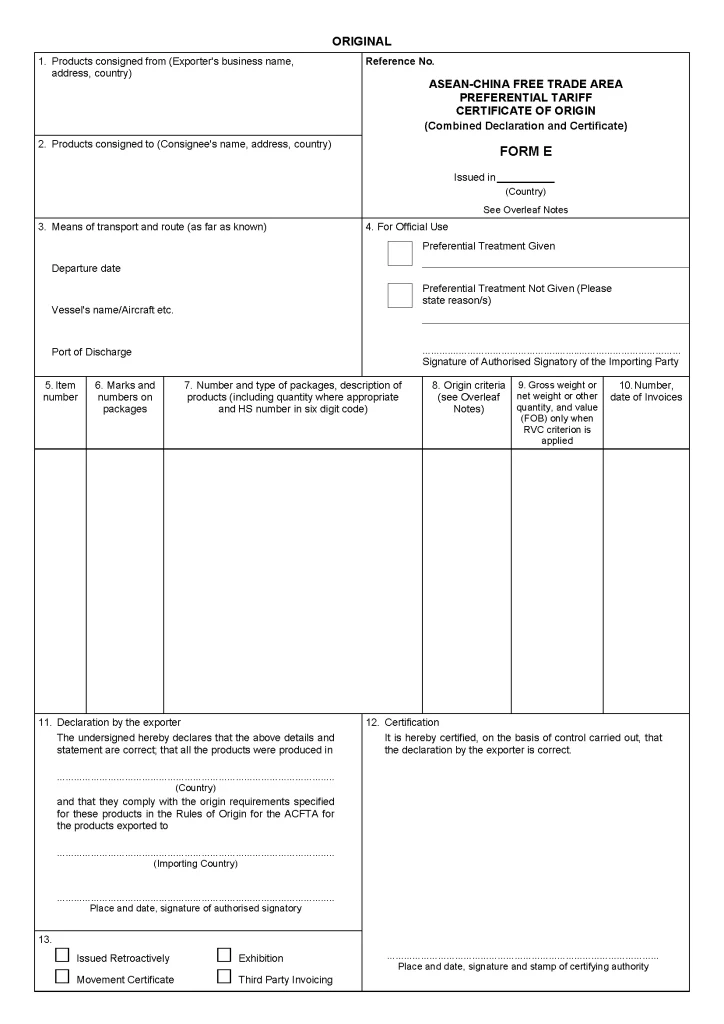
C/O Form E is the Certificate of Origin Form E issued under the ASEAN–China Free Trade Area Agreement (ACFTA), certifying that goods originate from a member country of this agreement.
Under ACFTA, goods traded between ASEAN member countries and China may enjoy special preferential import tariffs — with some products even eligible for a 0% import duty rate — provided they satisfy the applicable rules of origin.
Because of these benefits, C/O Form E is often considered a “trade passport” that helps goods move across borders faster, more cost-effectively, and more smoothly.
C/O Form E issuance fees:
- New issuance: VND 30,000/set
- Re-issuance/amendment: VND 15,000/set
According to Circular 64/2025/TT-BTC issued by the Ministry of Finance, applicable from July 1, 2025 to December 31, 2026.
Authorities authorized to issue C/O Form E:
- Regional Import-Export Management Offices under the Ministry of Industry and Trade
- Certain Export Processing Zone and Industrial Zone Management Boards authorized by the Ministry of Industry and Trade
⚠️ Note: Regulations may be updated over time. Businesses should always check the latest legal documents before carrying out procedures.
Besides C/O Form E, there are many other types of Certificates of Origin (C/O) such as C/O Form S, C/O Form AK, etc. Each form has different characteristics and applications, so businesses should understand them clearly to avoid confusion.
1.2 Legal Basis of C/O Form E
The ACFTA (ASEAN-China Free Trade Area) Agreement was signed between ASEAN member countries and China in Laos in 2004 to strengthen economic cooperation and trade relations. As an ASEAN member, Vietnam fully benefits from this agreement.
| Legal Document | Content |
|---|---|
| Circular 36/2010/TT-BCT | Original regulation on rules of origin and procedures for issuing C/O Form E under ACFTA |
| Circular 21/2014/TT-BCT | Amendments and supplements to product-specific origin rules under Circular 36 |
| Circular 12/2019/TT-BCT | Updated regulations currently governing the format and contents of C/O Form E |
| Official Dispatch 12149/BCT-XNK | Regulations on third-party invoices under ACFTA |
| Decision 4286/QĐ-TCHQ | Procedures for inspection and determination of goods origin applicable to all C/O forms |
| Decree 31/2018/NĐ-CP | General legal framework on rules of origin |
2. Rules of Origin Criteria for Issuing C/O Form E
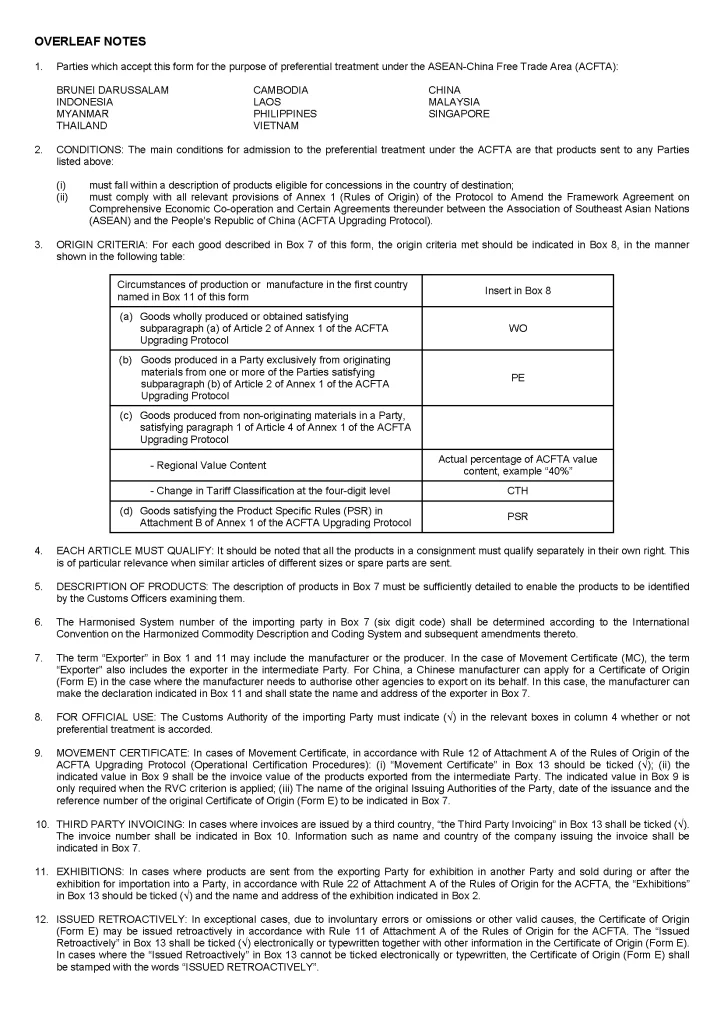
Pursuant to Section 9, Appendix III issued together with Circular 12/2019/TT-BCT, goods must satisfy one of the following origin criteria:
WO Criterion — Wholly Obtained
The product is entirely produced in China, from raw materials to the manufacturing process. This criterion generally applies to minerals, agricultural products, and naturally obtained seafood.
PE Criterion — Produced Entirely
The product may be processed in another country, but 100% of the materials used must originate from China.
RVC Criterion — Regional Value Content ≥ 40%
The regional value content (materials + processing costs in the exporting country) must account for at least 40% of the FOB value of the finished product.
RVC (%) = (FOB Value – Non-originating Material Value) / FOB Value × 100%
⚠️ Important note: If the regional value content is below 40%, the goods will not be considered originating products, and the C/O Form E may be rejected.
CTC/CTH Criterion — Change in Tariff Classification
The HS code of the finished product must change compared to the HS code of imported raw materials after processing or manufacturing.
3. Classification of C/O Form E — 3 Common Types of C/O Form E
This is the most important section — and also the leading reason why many businesses have their C/O rejected.
Type 1 — Direct C/O Form E
The Chinese company acts as both the manufacturer and the direct exporter. Information on the C/O, Invoice, Packing List, and Bill of Lading matches completely. This is the simplest and most common case.
Type 2 — Third-Party Invoicing C/O Form E
The commercial invoice is issued by a company located in a third country (not China and not Vietnam). For example, the manufacturer is in China, but the invoice is issued by the parent company in Singapore.
Requirements for third-party invoicing declarations:
- Box 1: Name of the Chinese manufacturer/exporter
- Box 7: Name and country of the invoicing company
- Box 13: Must tick “Third Party Invoicing”
Type 3 — Authorized C/O Form E — The Alibaba Purchasing Trap
Some Chinese suppliers are not authorized to apply for a C/O themselves, so they authorize another company to appear in Box 1. As a result, the name on the C/O is not the actual exporter, which is often rejected by Vietnamese customs authorities pursuant to Circular 36/2010/TT-BCT.
⚠️ Note: When purchasing from Alibaba, always ask suppliers whether they can apply for the C/O directly or must use an authorized party. If it is an authorized C/O, request a compliant third-party invoicing C/O instead — otherwise all ACFTA tariff preferences may be lost.
| Comparison Table of 3 Types of C/O Form E | ||||
|---|---|---|---|---|
| Type | Box 1 (Exporter) | Box 7 (Invoice) | Box 13 | Accepted in Vietnam |
| Direct | Chinese exporter | Same company as Box 1 | No marking | ✅ Yes |
| Third Party | Chinese manufacturer | Third-country company | ✅ Third Party Invoicing | ✅ Yes (if declared correctly) |
| Authorized | Authorized company | Does not match actual exporter | Usually blank | ❌ Commonly rejected |
4. How to Complete Each Box on C/O Form E
According to Circular 12/2019/TT-BCT, C/O Form E must be printed on ISO-standard white A4 paper and consists of 1 original copy and 2 duplicate copies. The form must be completed in English and typed — handwriting is not accepted.
💡 Note on Chinese signatures: Signatures in Box 11 on Chinese C/O forms are often written in Chinese characters. Vietnamese customs authorities will compare them with their database for verification — if they do not match, the C/O may be subject to further verification.
| Box No. | Box Name | Declaration Instructions |
|---|---|---|
| Box 1 | Exporter | Name and address of the exporter — must match the actual seller on the Invoice |
| Box 2 | Consignee | Name and address of the importer in Vietnam |
| Box 3 | Transport | Means of transport, route, and departure date |
| Box 4 | Official Use | Leave blank — completed by issuing authority |
5. Documents Required for Applying for C/O Form E
Trader Registration Documents (submitted once)
- Application form for C/O issuance (according to the prescribed template)
- Business Registration Certificate (notarized copy)
- Specimen signature of the authorized signatory for C/O applications
- List of manufacturing facilities and products expected to apply for C/O
Documents for Each Shipment
- Application for C/O Form E issuance + fully completed C/O form
- Export customs declaration (notarized copy)
- Commercial Invoice
- Bill of Lading (B/L) or Air Waybill (AWB)
- RVC calculation sheet or bill of materials (if imported materials are used)
- Import declarations for raw materials and sales contracts (if requested)
6. Procedure for Applying for C/O Form E in Vietnam
Step 1 — Register a Trader Account
Register at ecosys.gov.vn. First-time trader registration includes specimen signatures, business registration certificate, list of products, and manufacturing facilities.
Step 2 — Submit Electronic C/O Declaration
Complete all shipment information on the eCOSYS system. Digitally sign and electronically submit the application to the C/O issuing authority.
Step 3 — Print and Submit Hard-Copy Documents
After the online declaration is preliminarily approved, print the application with the assigned C/O number and submit the hard-copy dossier together with original supporting documents to the Regional Import-Export Management Office.
Step 4 — Verification and Approval by Authorities
The issuing officer will review the validity of the application:
- Complete and valid dossier → issued within the same day
- Additional verification required → up to 3 working days
- Factory inspection required → up to 7 working days (with prior notice)
Step 5 — Receive the Original C/O and Send to Partner
Receive the original stamped C/O Form E and send it together with the shipment so the importer can submit it to customs and enjoy ACFTA tariff preferences.
7. Frequently Asked Questions About C/O Form E
How long is C/O Form E valid?
Normally, C/O Form E is valid for 12 months from the date of issuance and must be submitted to customs before expiration.
Can C/O Form E be issued before the vessel departure date?
Yes. However, incorrect information may cause origin verification issues. If the C/O is issued more than 3 days after vessel departure, “Issued Retroactively” must be marked in Box 13.
What happens if imported goods from China do not have C/O Form E?
The goods can still be customs-cleared but will be subject to normal MFN import duty rates, which are usually 5–30% higher than ACFTA preferential tariffs depending on the product.
What is a Back-to-Back C/O Form E (Movement Certificate)?
This is a re-issued C/O used when goods are transshipped through a third country before arriving in Vietnam. Under ACFTA rules, the importer named on the original C/O and the exporter named on the back-to-back C/O must be the same entity — a stricter requirement compared to many other FTAs.
3W Logistics — Customs Clearance Services for Imports from China
C/O Form E is only one part of the import procedure for goods from China. To ensure fast customs clearance, proper ACFTA tariff benefits, and avoidance of post-clearance tax reassessment risks, 3W Logistics supports businesses with the following services:
- Customs declaration & document consulting — checking the validity of C/O Form E before submission, consulting on third-party invoicing and back-to-back C/O handling, and managing the entire customs clearance process
- Sea freight services — China–Vietnam shipping routes with frequent vessel schedules and cost optimization for both FCL containers and LCL cargo
- Cross-border transportation — road transportation through border gates for goods imported from Southern China provinces
- Warehousing & distribution — storage and cargo distribution after import customs clearance
CONTACT INFORMATION:
Head Office – 3W Logistics Ho Chi Minh Branch
Address: 34 Bach Dang Street, Tan Son Hoa Ward, Ho Chi Minh City
Hotline: +84 28 3535 0087
____________________________
3W Logistics Hanoi Branch
Address: 8A Lot 28 Le Hong Phong Street, Gia Vien Ward, Hai Phong
Hotline: +84 24 3202 0482
____________________________
3W Logistics Hai Phong Branch
Address: 81A Tran Quoc Toan Street, Cua Nam Ward, Hanoi
Hotline: +84 225 355 5939
____________________________
3W LOGISTICS CO., LTD – We here serve you there!
Email: quote@3w-logistics.com
Website: www.3w-logistics.com
Facebook:
3W Logistics Co., Ltd

Hello, I’m Nguyen Phuong Nhan (Ms. Nina)
I currently serve as Trade Lanes Supervisor at 3W Logistics, with more than 10 years of experience in international logistics and freight forwarding.
My primary responsibility is developing and managing global logistics partnerships, building strategic trade lanes, and working closely with overseas agents to provide reliable and competitive transportation solutions for customers.
I regularly collaborate with agents and logistics partners worldwide to explore new business opportunities, negotiate freight rates, develop trade routes, and support import-export shipments. I also work closely with our sales team to design logistics solutions tailored to specific markets and customer requirements.
My expertise includes Ocean Freight, Air Freight, Trade Lane Development, Global Agent Network Management, International Logistics Solutions, and Import-Export Support.
Through the articles I share on the 3W Logistics website, I aim to provide practical insights into the international logistics industry, global transportation trends, overseas agent cooperation, and effective logistics strategies that help businesses optimize their supply chain operations.
I believe that strong global partnerships and well-developed trade lanes are essential to delivering sustainable logistics solutions and long-term value to customers worldwide.


