What Is C/O Form S? Latest Procedures in Vietnam for Export Businesses
C/O Form S is a preferential Certificate of Origin used in Vietnam for exporting goods to Laos under the Vietnam – Laos Bilateral Trade Agreement. This document helps exported goods qualify for preferential import tariffs and supports customs clearance procedures at Lao border checkpoints.
This article provides detailed information about C/O Form S in Vietnam, including its definition, comparison with C/O Form D, origin criteria, instructions for completing the form, required application documents, and the procedures for obtaining C/O Form S for exports to Laos.
1. What is C/O Form S?
1.1 Definition of C/O Form S
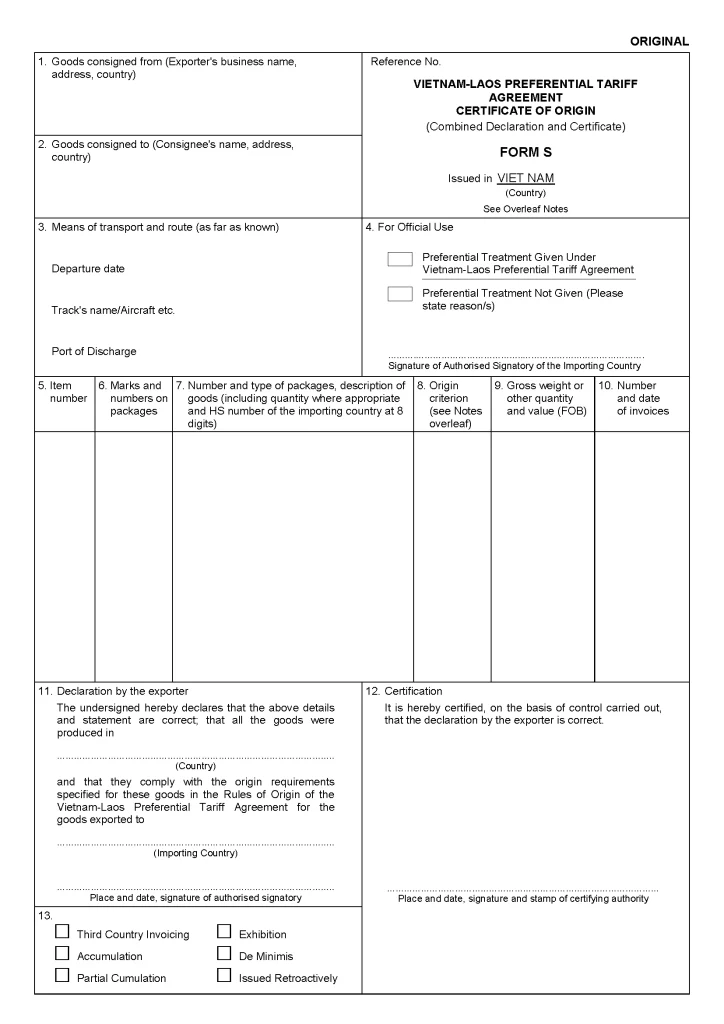
C/O Form S (Certificate of Origin Form S) is a preferential Certificate of Origin used for export shipments from Vietnam to Laos. This document is issued by organizations authorized by the Ministry of Industry and Trade of Vietnam and serves to certify that the exported goods are of Vietnamese origin and comply with the origin rules specified in Appendix 5 of Circular 04/2010/TT-BCT.
C/O Form S is a preferential C/O, meaning that goods imported into Laos with a valid Form S may enjoy special preferential import tariffs, including 0% duty rates for many products, under the Vietnam – Laos Bilateral Trade Agreement.
Example: A company exports construction materials to Laos. Without a valid C/O Form S, the goods may be subject to normal import duties. With a valid Form S, import tariffs may be reduced to 0% under the bilateral agreement, helping Vietnamese products remain more competitive than products from Thailand or China.
Authorities authorized to issue C/O Form S:
- Regional Import-Export Management Offices under the Ministry of Industry and Trade in different provinces and cities of Vietnam
1.2 Roles and Benefits of C/O Form S
C/O Form S is not only an administrative document but also carries important commercial and legal value. With Form S, Vietnamese goods imported into Laos can enjoy special preferential tariff rates, helping businesses improve price competitiveness in the Lao market.
Besides tariff preferences, C/O Form S also provides several important benefits:
- Proof of legal origin — Lao Customs authorities use Form S to confirm that goods are genuinely manufactured in Vietnam and not involved in origin fraud
- Support for L/C payment — banks often require a Certificate of Origin in the shipping document set
- The Vietnam Trade Office in Laos encourages businesses from both countries to use C/O Form S to maximize tariff benefits under the updated bilateral trade agreement
1.3 Download C/O Form S Template
Besides C/O Form S, there are many other types of Certificates of Origin (C/O), such as C/O Form B, C/O Form E, etc. Each type has different characteristics, so businesses should clearly understand each form to avoid confusion.
You can download the C/O Form S templates here:
- Download the C/O Form S template
- Download the Application Form for C/O Form S
- Download the Appendix for C/O Form S
2. Should You Use C/O Form S or C/O Form D for Exports to Laos?
This is one of the most confusing issues for many exporters.
Since Laos is an ASEAN member, businesses exporting goods from Vietnam to Laos can use either:
- C/O Form S — under the Vietnam – Laos Bilateral Trade Agreement
- C/O Form D — under the ASEAN Trade in Goods Agreement (ATIGA)
| Criteria | C/O Form S | C/O Form D (ATIGA) |
|---|---|---|
| Agreement | Vietnam – Laos Bilateral Agreement | ASEAN Multilateral Agreement (ATIGA) |
| Applicable Market | Only Vietnam ↔ Laos | All 10 ASEAN countries |
| Tariff Preferences | Special preferential rates (may be higher) | ATIGA preferential rates |
| Origin Criteria | RVC ≥ 40% or CTC | RVC ≥ 40% or CTC |
| Issuing Authority | Ministry of Industry and Trade (Regional Import-Export Offices) | Ministry of Industry and Trade |
| Current Usage | ⚠️ Gradually decreasing | ✅ More commonly used |
When should businesses use C/O Form S instead of C/O Form D?
- When tariff preferences under the Vietnam – Laos agreement are more favorable than ATIGA for specific HS codes
- When the Lao importer or Lao Customs specifically requires Form S
- When goods do not satisfy Form D origin criteria but still qualify under Form S rules (rare cases)
Important practical note: Since ATIGA is broader and more comprehensive, C/O Form S is now used less frequently than before. In most export cases to Laos, Form D is usually the more practical option because it is more widely accepted and consistently applied. However, businesses should carefully check tariff schedules and HS codes before deciding which C/O type to use.
3. How to Fill Out C/O Form S
| Box No. | Field Name | Instructions |
|---|---|---|
| 01 | Exporter | Full name and address of the exporter in Vietnam — must match the customs declaration |
| 02 | Consignee | Name and address of the consignee in Laos |
| 03 | Departure date | Departure date, transportation method, and export checkpoint |
| 04 | For official use | Leave blank — completed by the issuing authority |
| 05 | Item number | Sequential number of each product item |
| 06 | Marks & numbers | Shipping marks and package numbers according to actual packaging |
| 07 | HS Code | 6-digit HS code of the finished product |
| 08 | Origin criterion | ⚠️ Most important field — enter: P / W + HS / PC x% |
| 09 | Gross weight/FOB | Gross weight and FOB value — must match the Invoice and B/L |
| 10 | Invoice | Commercial invoice number and issue date |
| 11 | Declaration | Place, date, and signature of the authorized representative |
| 12 | Certification | Completed and stamped by the issuing authority — do not fill in |
| 13 | Remarks | Tick the appropriate box: “Third-country Invoicing”, “Issued Retroactively”, or “Accumulation” |
4. What Documents Are Included in the C/O Form S Application Dossier?
4.1 Trader Registration Dossier (Submitted Once)
- Application form for C/O issuance (according to the Ministry of Industry and Trade’s template)
- Enterprise registration certificate (notarized copy)
- Specimen signature of the person authorized to sign the C/O
- List of manufacturing facilities and expected products applying for C/O
4.2 Dossier for Each Shipment
Required documents include: application form for C/O Form S according to the prescribed template; original completed C/O Form S; export customs declaration (notarized copy or electronic version with QR code); commercial invoice; bill of lading or certified copy; Regional Value Content (RVC) calculation sheet and HS code declaration for input materials and finished products; material purchase invoices and import customs declarations for imported materials (if any)
5. Procedures for Applying for C/O Form S (5 Steps)
Step 1 — Register Trader Account
Register on the ecosys.gov.vn system. Submit the first-time trader dossier including specimen signature, business registration certificate, product list, and manufacturing facility information.
Step 2 — Declare Shipment Information
Fill in all information in the electronic C/O Form S declaration: product description, HS code, quantity, weight, FOB value, origin criterion, export checkpoint.
Step 3 — Submit the Dossier via the System
Upload all documents to ECOSYS. All documents must be digitally signed and submitted directly to the ECOSYS system for the C/O issuing authority to verify the information.
Step 4 — Dossier Review by the Issuing Authority
The C/O issuing authority may approve the C/O and notify the collection time; request additional missing documents; request re-verification of information; refuse issuance according to the cases specified in Decree 31/2018/ND-CP; or request an inspection of the manufacturing facility.
Step 5 — Receive the C/O and Send It to the Partner
Receive the original C/O Form S (1 original copy + archived copy). Send it together with the shipment or separately to the Lao partner according to the agreement.
6. Frequently Asked Questions About C/O Form S
How long is C/O Form S valid?
Normally 12 months from the date of issuance. However, businesses should verify the specific requirements applicable to each shipment according to Lao Customs regulations.
Laos is an ASEAN member — can Form D be used instead of Form S?
Yes — and in many cases Form D (ATIGA) may provide better tariff preferences. Businesses should review tariff schedules based on each HS code to select the most beneficial C/O type for the shipment.
Can businesses apply for C/O Form S after the goods have been exported?
Yes, but businesses must apply for a retrospective C/O and mark “Issued Retroactively” in Box 13. The procedure is more complicated and may not always be accepted.
7. Exporting Goods to Laos — Comprehensive Support from 3W Logistics
Vietnam and Laos share a border of more than 2,300 km with multiple international border gates. Cross-border road transport is the most optimal solution for exports to Laos — fast, flexible, and without the need for transshipment through seaports.
3W Logistics supports businesses exporting to Laos with the following services:
- Cross-border transportation – Vietnam – Laos routes via Lao Bao, Cau Treo, and Na Meo border gates. Full customs clearance support at both export and import checkpoints
- Customs declaration – consultation on the appropriate C/O type (Form S or Form D), and verification of document validity before shipment
- Sea freight – supplementary solutions for shipments to Laos via Da Nang Port or Cua Lo Port
- Warehousing & distribution – storage and cargo preparation before cross-border export
The 3W Logistics team has experience handling export shipments to Laos, Cambodia, and China — ready to advise on the most suitable C/O type and support businesses in preparing compliant documentation from the beginning.
CONTACT INFORMATION:
Head Office – 3W Logistics Ho Chi Minh City Branch
Address: 34 Bach Dang Street, Tan Son Hoa Ward, Ho Chi Minh City
Hotline: +84 28 3535 0087
____________________________
3W Logistics Hanoi Branch
Address: 8A Lot 28 Le Hong Phong Street, Gia Vien Ward, Hai Phong
Hotline: +84 24 3202 0482
____________________________
3W Logistics Hai Phong Branch
Address: 81A Tran Quoc Toan Street, Cua Nam Ward, Hanoi
Hotline: +84 225 355 5939
____________________________
3W LOGISTICS CO., LTD – We here serve you there!
Email: quote@3w-logistics.com
Website: www.3w-logistics.com

Hello, I’m Nguyen Phuong Nhan (Ms. Nina)
I currently serve as Trade Lanes Supervisor at 3W Logistics, with more than 10 years of experience in international logistics and freight forwarding.
My primary responsibility is developing and managing global logistics partnerships, building strategic trade lanes, and working closely with overseas agents to provide reliable and competitive transportation solutions for customers.
I regularly collaborate with agents and logistics partners worldwide to explore new business opportunities, negotiate freight rates, develop trade routes, and support import-export shipments. I also work closely with our sales team to design logistics solutions tailored to specific markets and customer requirements.
My expertise includes Ocean Freight, Air Freight, Trade Lane Development, Global Agent Network Management, International Logistics Solutions, and Import-Export Support.
Through the articles I share on the 3W Logistics website, I aim to provide practical insights into the international logistics industry, global transportation trends, overseas agent cooperation, and effective logistics strategies that help businesses optimize their supply chain operations.
I believe that strong global partnerships and well-developed trade lanes are essential to delivering sustainable logistics solutions and long-term value to customers worldwide.


