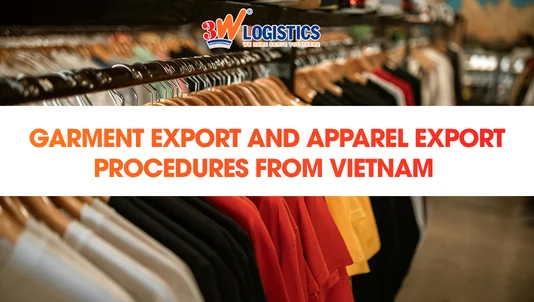
Garment export and apparel export procedures from Vietnam to global markets.
Vietnam is currently among the top 3 largest textile and garment exporters in the world, with export turnover exceeding USD 44 billion in 2024 — in which clothing export plays a key role.
However, to ensure smooth customs clearance, regulatory compliance, and cost optimization, businesses must clearly understand the full garment export procedures, from documentation and HS codes to customs processes.
This guide walks you through A–Z steps of garment export, helping you execute your first shipment efficiently.
1. Legal Policies for Garment Export
1.1 Are there special requirements for clothing export?
According to Decree 187/2013/ND-CP, clothing is not listed as prohibited or conditionally restricted export goods. This means that garment export activities are generally free and do not require specialized licenses.
Eligible exporters include:
- Vietnamese enterprises (LLC, JSC, registered household businesses)
- Foreign-invested enterprises (FDI)
- Branches authorized to conduct import-export activities
As long as the business has a valid business registration for import-export or trading, it is legally qualified to conduct clothing export.
1.2 Notes on counterfeit and trademark infringement
One of the biggest legal risks in garment export is related to counterfeit or trademark-infringing products.
Under intellectual property laws, businesses must not export products that:
- Use logos or trademarks without authorization
- Apply designs that may cause confusion with protected brands
- Use copyrighted images or symbols without permission
If violations are suspected, customs authorities may:
- Suspend customs clearance
- Request proof of trademark authorization
- Impose penalties or confiscate/destroy goods
To minimize risks in clothing export, businesses should:
- Check labels and branding before production and packing
- Ensure products have clear and legal origins
- Maintain complete authorization and processing contracts
2. HS Code and Taxes in Garment Export
2.1 How to look up HS Code for clothing export
Garment export products from Vietnam are mainly classified under:
- Chapter 61: Knitted or crocheted apparel
- Chapter 62: Non-knitted apparel
Businesses should not guess HS codes based on product names. Recommended lookup tools:
- Vietnam Customs: customs.gov.vn
- VNACCS/VCIS system
- Official classification consultation with customs authorities
2.2 Garment export tax in 2026
Good news for exporters: export tax for clothing export in Vietnam is mostly 0%.
However, the key factor affecting pricing is import tax in the destination market.
2.3 FTA tax incentives for garment export
Vietnam has multiple Free Trade Agreements (FTAs) offering tax advantages for garment export.
Key condition: Products must meet rules of origin, such as:
- “Two-stage rule” (fabric → cut & sew → finished product)
- HS code transformation (CTH)
Note: If using imported fabric (e.g. from China), businesses must carefully check eligibility before applying for C/O.
3. Required Documents for Garment Export
Preparing accurate documentation is critical in garment export procedures, directly affecting clearance speed and costs.
3.1 Commercial documents
- Sales Contract: Defines terms, price, Incoterms, payment
- Commercial Invoice: Declares shipment value
- Packing List: Details packaging, weight, dimensions
- Bill of Lading / Airway Bill: Issued by carrier
3.2 Additional documents
- Certificate of Origin (C/O): Required for FTA benefits
- Quality certificates (if required)
- Labeling & fabric composition documents
- Authorization letter (if using forwarder)
4. 6-Step Customs Process for Garment Export
Step 1: Contract signing & document preparation
- Sales Contract
- Commercial Invoice
- Packing List
- Shipping booking confirmation
Step 2: Electronic customs declaration (VNACCS)
Submit export declarations online via VNACCS using authorized software.
Step 3: Customs inspection channels
Declarations are classified into Green, Yellow, or Red channels depending on risk level.
Step 4: Packing, labeling & port delivery
- Pack goods into containers or cartons
- Apply shipping marks (Made in Vietnam, size, material, SKU)
- Deliver to port warehouse (CY/CFS) or airport cargo terminal
Step 5: Apply for Certificate of Origin (C/O)
Issued by MOIT or VCCI within 1–3 working days if documents are complete.
Step 6: Finalization & document retention
- Receive Bill of Lading / Airway Bill
- Complete customs clearance on VNACCS
- Store all documents for at least 5 years
5. Comparison of Clothing Export Methods
Before starting garment export, one of the most critical decisions is choosing the right export model. Each method involves different levels of risk, profit margins, and operational requirements — choosing the wrong one can directly impact cash flow and legal compliance.
5.1 Direct Commercial Clothing Export
The exporter purchases materials, manufactures products, and sells finished goods to overseas buyers. All risks and profits belong to the exporter.
Best for: Businesses with strong capital, stable orders, and a goal of maximizing profit margins in clothing export.
5.2 Processing Trade (Outsourced Garment Export)
The foreign buyer provides materials (fully or partially), while Vietnamese manufacturers handle production and receive a processing fee.
Advantages: Low risk, minimal capital requirement
Disadvantages: Lower profit margin
This is currently the most common garment export model in Vietnam, especially for factories producing for global brands.
5.3 FOB Export (Free On Board)
The seller is responsible until the goods are loaded onto the vessel at the export port. After that, all costs and risks are transferred to the buyer.
This is the most widely used Incoterm in clothing export from Vietnam to markets like the US and EU.
5.4 CIF Export (Cost, Insurance and Freight)
The seller covers shipping and insurance costs to the destination port.
Advantages: Higher selling price
Challenges: Requires logistics expertise and cost control
Comparison Table of Garment Export Methods
| Criteria | Commercial | Processing | FOB | CIF |
|---|---|---|---|---|
| Capital Required | High | Low | Medium | Medium |
| Profit Margin | Highest | Lowest | Medium | Medium–High |
| Risk Level | High | Low | Medium | Higher than FOB |
| International Shipping | Buyer | Buyer | Buyer | Seller |
| Raw Materials | Seller | Buyer | Seller | Seller |
| Best For | Established businesses | Factories | Most exporters | Experienced exporters |
| Customs Complexity | Full process | Additional processing contract | Standard | Standard + insurance |
Which option is best for small or new exporters?
FOB is the safest choice. The buyer handles international shipping, while you only need to ensure timely delivery to the export port. Risks are clearly defined and procedures remain manageable.
If you are working with foreign brands, processing trade garment export helps reduce working capital pressure and inventory risks — but requires careful handling of imported materials and customs settlement.
6. Common Mistakes in First-Time Clothing Export
Most issues in garment export do not come from complex regulations, but from avoidable mistakes. Below are the most common errors and how to prevent them.
Mistake 1: Incorrect HS Code declaration
Using the wrong HS code (e.g. confusing Chapter 61 vs 62) can lead to penalties and higher inspection risk.
Solution: Always verify HS codes via official customs systems or consult a customs broker.
Mistake 2: Not applying for C/O
Without a Certificate of Origin, import duties in markets like the EU can reach up to 12%, instead of 0% under FTAs.
Solution: Confirm C/O requirements and applicable form (EUR.1, Form B, etc.) during contract stage.
Mistake 3: Incorrect labeling
Each market has different labeling requirements (e.g. US, EU, Japan). Non-compliance may lead to shipment rejection.
Solution: Confirm labeling requirements before production, not just before shipment.
Mistake 4: Inconsistent documents
Mismatch between Invoice, Packing List, and customs declaration can delay clearance.
Solution: Cross-check all documents before submission.
Mistake 5: Missing cut-off time
Late cargo delivery results in missed flights/vessels and potential penalties.
Solution: Deliver cargo at least 4 hours before cut-off and reconfirm schedule.
Mistake 6: Poor document retention
Failure to store documents can cause issues during audits or VAT refund claims.
Solution: Keep all export documents for at least 5 years.

7. FAQ – Clothing Export Questions
Do you need a license for garment export?
No. Clothing export is considered a free export activity in Vietnam. No special license or pre-export quality inspection is required.
Can second-hand clothing be exported?
No. Used clothing is prohibited for export under Vietnamese regulations. Only brand-new products are allowed in garment export.
How does clothing export via e-commerce platforms work?
- B2C export: Individual shipments via DHL, FedEx, UPS. Simple procedures for low-value goods.
- Bulk export (FBA/FBL): Ship goods to overseas warehouses (e.g. Amazon). Requires full customs declaration and possibly C/O.
In summary, garment export becomes simple when properly prepared and supported by experienced logistics partners.
If you need support for clothing export procedures — from customs declaration and C/O application to international shipping — 3W Logistics is ready to help you expand into global markets.
CONTACT INFORMATION
3W Logistics – Ho Chi Minh Head Office
Address: 34 Bach Dang, Tan Son Hoa Ward, Ho Chi Minh City
Hotline: +84 28 3535 0087
3W Logistics – Hanoi Branch
Address: 8A Lot 28 Le Hong Phong, Gia Vien Ward, Hai Phong
Hotline: +84 24 3202 0482
3W Logistics – Hai Phong Branch
Address: 81A Tran Quoc Toan, Cua Nam Ward, Hanoi
Hotline: +84 225 355 5939
3W LOGISTICS CO., LTD – We here serve you there!
Email: quote@3w-logistics.com
Website: www.3w-logistics.com

Hello, I’m Nguyen Phuong Nhan (Ms. Nina)
I currently serve as Trade Lanes Supervisor at 3W Logistics, with more than 10 years of experience in international logistics and freight forwarding.
My primary responsibility is developing and managing global logistics partnerships, building strategic trade lanes, and working closely with overseas agents to provide reliable and competitive transportation solutions for customers.
I regularly collaborate with agents and logistics partners worldwide to explore new business opportunities, negotiate freight rates, develop trade routes, and support import-export shipments. I also work closely with our sales team to design logistics solutions tailored to specific markets and customer requirements.
My expertise includes Ocean Freight, Air Freight, Trade Lane Development, Global Agent Network Management, International Logistics Solutions, and Import-Export Support.
Through the articles I share on the 3W Logistics website, I aim to provide practical insights into the international logistics industry, global transportation trends, overseas agent cooperation, and effective logistics strategies that help businesses optimize their supply chain operations.
I believe that strong global partnerships and well-developed trade lanes are essential to delivering sustainable logistics solutions and long-term value to customers worldwide.


