

1. What is C/O Form VJ?
1.1 Definition of C/O Form VJ
C/O Form VJ (Certificate of Origin Form VJ) is a certificate confirming that goods originate from Vietnam and qualify for preferential tariff treatment under the Vietnam – Japan Economic Partnership Agreement (VJEPA), as regulated by Circular No. 10/2009/TT-BCT and its subsequent amendments.
C/O Form VJ is a bilateral certificate of origin applicable only to trade between Vietnam and Japan. When goods are exported to Japan with a valid C/O Form VJ, Japanese importers may apply for preferential EPA tariff rates instead of the normal MFN tariff rates, helping reduce import costs and improve the competitiveness of Vietnamese products.
1.2 Legal Basis for Issuing C/O Form VJ
The VJEPA Agreement was signed on December 25, 2008 and officially came into force on October 1, 2009. This was the first bilateral economic partnership agreement signed by Vietnam, marking an important milestone in trade relations between Vietnam and Japan. Since then, C/O Form VJ has become an important tool helping Vietnamese goods access the Japanese market with competitive tariff rates.
The current legal basis for issuing C/O Form VJ includes:
- Circular No. 10/2009/TT-BCT dated May 18, 2009 on VJEPA Rules of Origin
- Circular No. 06/2011/TT-BCT amending Circular No. 10/2009/TT-BCT
- Circular No. 38/2015/TT-BTC and Circular No. 39/2018/TT-BTC regarding customs procedures
- Decree No. 31/2018/ND-CP detailing the Law on Foreign Trade Management regarding rules of origin
- Circular No. 05/2018/TT-BCT regulating origin of exported and imported goods
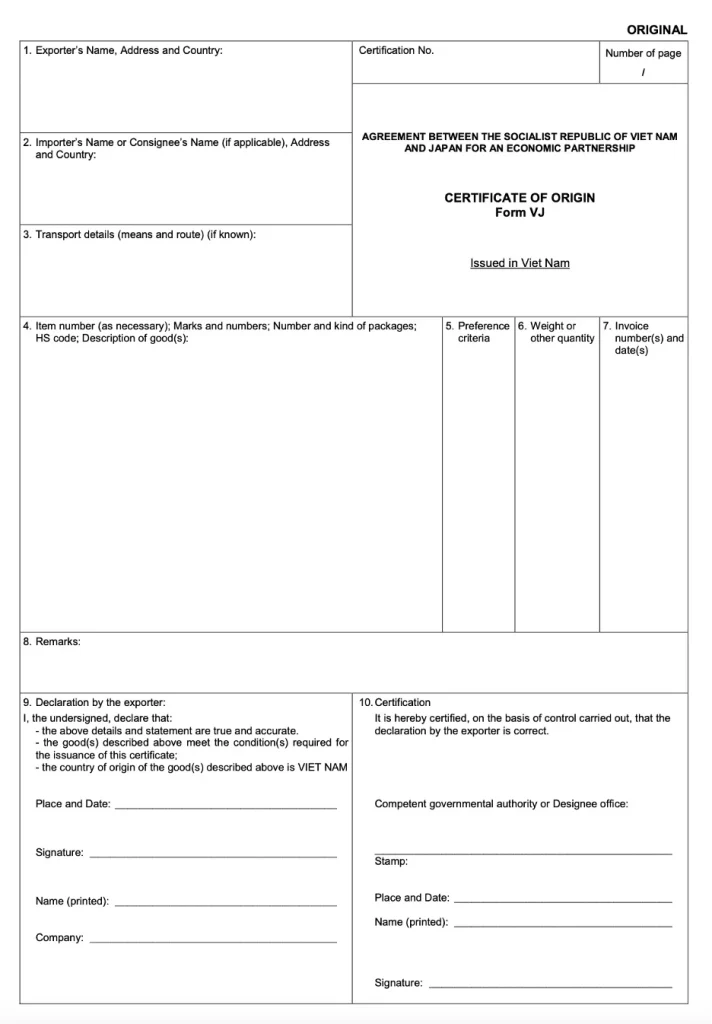
Download the C/O Form VJ sample here
1.3 Difference Between C/O Form VJ and Other Types of C/O
In practice, Vietnam issues various types of certificates of origin depending on each free trade agreement. The comparison table below helps businesses distinguish C/O Form VJ from other common forms:
| C/O Form | Agreement | Destination Market | Notes |
|---|---|---|---|
| Form VJ | VJEPA | Japan | Vietnam – Japan bilateral agreement |
| Form AJ | AJCEP | Japan | ASEAN – Japan agreement |
| Form D | ATIGA | ASEAN | ASEAN intra-regional trade |
| Form E | ACFTA | China | ASEAN – China agreement |
| Form RCEP | RCEP | 15 member countries | Includes Japan, more flexible rules |
| Form B | GSP | EU, USA, Australia… | Unilateral preferential scheme |
| Form AI | AIFTA | India | ASEAN – India agreement |
💡 Important Note: Since January 1, 2022, the RCEP Agreement has taken effect, allowing exports to Japan to use RCEP C/O in parallel with or as an alternative to C/O Form VJ/AJ. Businesses should compare tariff preferences under each agreement to choose the most beneficial option.Learn more:
2. Conditions for Obtaining C/O Form VJ
To obtain C/O Form VJ, goods must satisfy the rules of origin under VJEPA. There are two main criteria:
2.1 WO Criterion — Wholly Obtained
Goods are considered wholly obtained in Vietnam if all materials and production processes originate entirely in Vietnam, including:
- Minerals extracted from Vietnam’s territory or waters
- Plants grown and harvested in Vietnam
- Animals born and raised in Vietnam
- Products obtained from live animals in Vietnam
- Products obtained through hunting, trapping, or fishing in Vietnam
- Waste and scrap collected from manufacturing activities in Vietnam
- Goods produced entirely from the above products in Vietnam
2.2 PE Criterion — Partially Produced
This is the most common case. Goods using imported materials may still qualify as Vietnamese origin if they satisfy one of the following rules:
- The finished product must fall under a different HS heading from imported materials
- Or a different HS chapter
- Or a different HS subheading
- Businesses should check Appendix I of Circular 10/2009 for product-specific requirements
- RVC ≥ 40% under the Build-Up method
- Or RVC ≥ 60% under the Build-Down method
- Calculated based on FOB value
- Some products may require higher RVC thresholds
2.3 Product Specific Rules (PSR)
In addition to the above criteria, some products are subject to Product Specific Rules (PSR) listed in Appendix I of Circular No. 10/2009/TT-BCT. Businesses should identify the correct HS code to determine the applicable origin criteria.
2.4 Minimal Operations Not Conferring Origin
Certain simple processing activities performed in Vietnam are not sufficient to confer Vietnamese origin, including:
| Non-qualifying Operations | Practical Examples |
|---|---|
| Preservation during transport and storage | Cold storage, anti-moisture treatment |
| Simple packaging or repackaging | Repacking imported goods |
| Simple cleaning or sorting | Washing imported vegetables for re-export |
| Simple labeling or logo attachment | Adding “Made in Vietnam” labels without manufacturing |
| Simple mixing operations | Mixing water with imported chemicals |
| Simple assembly | Assembling imported parts with screws only |
| Slaughtering animals | Slaughtering imported livestock |
However, transshipment through a third country is still accepted if:
- The goods do not undergo any manufacturing or processing activities in the transit country
- The goods remain under the supervision of the customs authority of the transit country
- Only unloading, reloading, or storage activities necessary for preservation or onward transportation are carried out
In transshipment cases, businesses must additionally prepare a Through Bill of Lading or a certificate issued by the customs authority of the transit country confirming that the goods were not altered.
3. Authorities Authorized to Issue C/O Form VJ
C/O Form VJ is issued by the Ministry of Industry and Trade (MOIT) through authorized agencies in Vietnam. Exporters may submit applications to:
- Regional Import-Export Management Offices under MOIT in major cities such as Hanoi, Ho Chi Minh City, Da Nang, Can Tho, and Hai Phong
- Industrial Zone and Export Processing Zone Management Boards (for enterprises operating within industrial parks)
- The electronic C/O issuance system at: ecosys.gov.vn (Vietnam’s eCOSys system managed by MOIT)
Online application is recommended: Most exporters now apply for C/O Form VJ through the ecosys.gov.vn system to save time and reduce paperwork. Online processing is usually 30–50% faster than direct submission.
4. Required Documents for C/O Form VJ Application
The application dossier for C/O Form VJ includes the following documents:
4.1 First-Time Application Documents (Trader Registration)
- C/O application form signed and stamped by the authorized person
- Certified copy of the Business Registration Certificate
- List of export products applying for C/O Form VJ
- Production process and regional value content calculation (if applying under VA criteria)
- Specimen signature of the authorized signatory for C/O applications
- Company seal specimen
4.2 Documents Required for Each Shipment
- C/O application form (according to the prescribed template)
- Completed C/O Form VJ (01 original + 02 copies)
- Export customs declaration (certified copy)
- Commercial Invoice – copy
- Bill of Lading / Airway Bill – copy
- Declaration of Origin
- List of raw materials and inputs used for production
- Invoices for domestic materials or import declarations for imported materials (if applicable)
5. Detailed Procedures for Obtaining C/O Form VJ
Step 1: Trader Registration (First-Time Applicants)
Step 2: Declare Information on the eCOSys System
Log in to ecosys.gov.vn → Select “Create New C/O Form VJ” → Fill in exporter information, consignee details, product description, HS code, origin criteria, port of loading, destination port, B/L number, invoice number, weight, FOB value, and other required fields.
Step 3: Upload Supporting Documents
Scan and upload required documents including export customs declarations, commercial invoices, bills of lading, and raw material declarations (if required). Accepted format: PDF, maximum 5MB per file.
Step 4: Submit the Application and Wait for Approval
After submission, the Import-Export Management Office will review the application. Processing time is usually 3 working hours for complete and compliant dossiers. If documents are missing or incorrect, the authority will request revisions or additional information.
Step 5: Receive the Original C/O Form VJ
Once approved, the exporter receives notification and collects the original C/O Form VJ bearing the official stamp and signature. Some local authorities also support postal delivery upon request.
Step 6: Send the C/O with Export Documents
The original C/O Form VJ is sent to the Japanese importer together with the export document set (Invoice, B/L, Packing List, etc.). The importer submits the C/O to Japan Customs to obtain EPA preferential tariff treatment. The C/O may be submitted after cargo arrival, but no later than 12 months from the issuance date.
6. How to Complete C/O Form VJ
C/O Form VJ contains numbered fields that must be completed accurately. Below is the declaration guide:
| Box No. | Field Name | Declaration Instructions |
|---|---|---|
| 1 | Exporter’s Name, Address and Country | Full English name, address, and country of the Vietnamese exporter. Must match the Commercial Invoice and customs declaration. |
| 2 | Reference No. | Reference number assigned by the issuing authority. Usually left blank for system-generated input. |
| 3 | Consignee’s Name, Address and Country | Full name, address, and country (Japan) of the importer. Must match the sales contract. |
| 4 | Means of Transport and Route | Transportation method (By Sea / By Air) and shipping route. Example: “By Sea – From Ho Chi Minh City Port to Tokyo Port”. |
| 5 | Item Number | Product item number (01, 02, etc.). Each row corresponds to one product item. |
| 6 | Marks and Numbers of Packages | Shipping marks and package numbers. If none, enter “N/M” or “No Marks”. |
| 7 | Number and Type of Packages; Description of Goods | Package quantity and type (carton, pallet, etc.). Goods description must be detailed and specific in English. |
| 8 | HS Code | 6-digit HS code based on WCO classification. Japan-specific HS codes should be checked through NACCS. |
| 9 | Quantity and Weight | Total quantity and gross weight. Units must match the Invoice and Packing List. |
| 10 | Number and Date of Invoice | Commercial Invoice number and issue date. Must match attached documents exactly. |
| 11 | Origin Criterion | Applicable origin criteria: “A” (WO), “B” (RVC/VA), “C” (CTC), or “D” (Specific Manufacturing Process). |
| 12 | FOB Value | FOB value of the shipment in USD. Mandatory when applying under RVC criteria. |
| 13 | Declaration by the Exporter | Place, date, signature, and company stamp of the exporter. Must be signed only after all fields are completed. |
| 14 | Certification | Completed by the issuing authority. Exporters must not fill in this field. |
Origin Criteria Used in Box 11
| Code | Criteria | Application Conditions |
|---|---|---|
| A | Wholly Obtained (WO) | 100% Vietnamese-origin materials and production |
| B | Regional Value Content (RVC) | Regional value content ≥ 40% |
| C | Change in Tariff Classification (CTC) | HS code transformation according to VJEPA rules |
| D | Specific Manufacturing Process | Specific production processes required for certain products |
7. Preferential Tariff Benefits of C/O Form VJ
The biggest advantage of C/O Form VJ is that Vietnamese goods can enjoy EPA preferential tariff rates instead of normal MFN rates when imported into Japan.
| Product Category | MFN Tariff (%) | EPA/VJ Tariff (%) | Savings |
|---|---|---|---|
| Seafood (shrimp, fish) | 3.5 – 10 | 0 – 3.5 | High |
| Textiles & Garments | 5.8 – 10.9 | 0 – 5.6 | High |
| Footwear | 6.0 – 30 | 0 – 4.0 | Very High |
| Wood & Furniture | 0 – 5.4 | 0 | Medium |
| Electronics & Components | 0 – 5 | 0 | Low |
| Coffee, Pepper, Cashew | 0 – 10 | 0 | Medium |
| Tropical Fruits & Vegetables | 2 – 20 | 0 – 3 | High |
EPA tariff lookup: Exporters can check specific EPA tariff rates by HS code on the Japan Customs website at customs.go.jp or through the NACCS system.
8. Direct Consignment Requirements
One important condition for the validity of C/O Form VJ is the Direct Consignment Rule. Goods must be transported directly from Vietnam to Japan without passing through a third country.
However, transshipment through a third country is still accepted if:
- The goods do not undergo any manufacturing or processing activities in the transit country
- The goods remain under customs supervision in the transit country
- Only unloading, reloading, storage, or preservation activities are carried out for transportation purposes
In cases of transshipment, exporters must provide additional supporting documents such as a Through Bill of Lading or a certificate issued by the customs authority of the transit country confirming that the goods remained unchanged.
9. Retrospective Issuance of C/O Form VJ
In certain situations, businesses may apply for C/O Form VJ after the goods have already been exported. This is referred to as a Retrospective C/O. Applicable cases include:
- The original C/O was lost or damaged during transportation
- Technical errors or unintentional omissions occurred in the original C/O
- The C/O was not issued before exportation due to administrative oversight
A retrospective C/O must be marked “ISSUED RETROACTIVELY” in Box 12 or elsewhere on the certificate and may only be issued within 12 months from the export date.
10. Verification and Authentication of C/O Form VJ
Japanese Customs authorities have the right to request verification of C/O Form VJ if there are doubts regarding its authenticity or validity. The verification process includes:
Consequences if C/O Form VJ is rejected: The Japanese importer must pay the full MFN tariff retroactively from the import date plus late payment penalties. In cases involving fraud, the Vietnamese exporter may be blacklisted and suspended from obtaining C/O issuance rights for a certain period.
11. Common Mistakes When Declaring C/O Form VJ
| Common Error | Consequence | Prevention Method |
|---|---|---|
| Incorrect HS code declaration | C/O does not match Japanese customs declaration and may be rejected | Check Japanese HS codes (8–9 digits) and confirm with the importer before submission |
| Incorrect origin criterion in Box 11 | C/O becomes invalid and may be fully rejected | Review Appendix I of Circular 10/2009 and carefully calculate VA content before declaration |
| Mismatch between C/O and Invoice/B/L information | Customs verification may be required, causing clearance delays | Cross-check all information fields before submission |
| Insufficient product description | Difficulty identifying the goods, requiring additional explanation | Provide detailed commercial names, composition, and main usage |
| Submitting C/O after the 12-month validity period | C/O becomes invalid and tariff preference cannot be applied | Monitor issuance and expiration dates carefully and submit promptly upon cargo arrival |
| Violation of direct consignment rules | C/O may be rejected despite valid origin status | Use a Through B/L for transshipment and retain all supporting documents |
| Signature or seal does not match registered specimen | C/O may be rejected immediately upon submission | Update registered signatures and seals whenever changes occur |
12. Comparison Between C/O Form VJ and RCEP C/O for Exports to Japan
Since 2022, exporters have had the additional option of using RCEP C/O when exporting goods to Japan. The appropriate choice depends on the characteristics of each shipment.
| Comparison Criteria | C/O Form VJ (VJEPA) | RCEP C/O |
|---|---|---|
| Scope of application | Only Vietnam – Japan | 15 RCEP member countries including Japan |
| Accumulation rule | Bilateral accumulation (Vietnam + Japan) | Multilateral accumulation among 15 members |
| VA content requirement | RVC ≥ 40% | RVC ≥ 40% with more flexible treatment for RCEP-origin materials |
| Preferential tariff rate | According to the VJEPA schedule | According to the RCEP schedule, sometimes lower than VJ rates |
| Treatment of materials from other ASEAN countries | Not counted toward Vietnamese content | Counted if originating from RCEP member countries |
| Current popularity | Widely used and familiar | Increasingly popular for multinational supply chains |
When should businesses use RCEP C/O instead of C/O Form VJ? This is beneficial when products contain significant materials sourced from ASEAN countries such as Thailand, Malaysia, or Indonesia, or from China and South Korea — all RCEP members. In such cases, those materials may count toward origin content calculations, making it easier to satisfy the RVC requirement.
13. Frequently Asked Questions About C/O Form VJ
Can businesses apply for C/O Form VJ before exportation?
Yes. Businesses may apply for C/O Form VJ before the goods are physically exported, provided that the export customs declaration has already been cleared. In practice, most exporters apply for the certificate simultaneously with or immediately after export customs clearance to ensure a complete document set.
Can one C/O Form VJ cover multiple products?
Yes. A single C/O Form VJ may include multiple products within the same shipment, as long as all items satisfy the applicable rules of origin. Each product should be listed separately with its corresponding HS code and origin criterion.
Can foreign-invested enterprises (FDI) in Vietnam obtain C/O Form VJ?
Yes. Foreign-invested enterprises legally operating in Vietnam are fully eligible to obtain C/O Form VJ, provided that the exported goods satisfy VJEPA rules of origin. Origin is determined based on the place of production rather than the nationality of the company.


