
What is C/O Form AANZ? Vietnam Export Regulations
Australia and New Zealand are currently among Vietnam’s key export markets with strong demand for imported goods. To improve competitiveness and minimize tariff costs when entering these two markets, understanding What is C/O Form AANZ is essential for all logistics and import-export businesses.
Beyond the basic definition, the rules of origin and customs declaration procedures for C/O Form AANZ contain many specific requirements. Let’s explore the latest regulations and the proper declaration process according to the Ministry of Industry and Trade below.
1. What is C/O Form AANZ?
C/O Form AANZ (Certificate of Origin – AANZ Template), also known as the AANZ Certificate of Origin, is a document certifying the origin of goods under the ASEAN–Australia–New Zealand Free Trade Area Agreement (AANZFTA).
Simply put, when Vietnamese enterprises export goods to Australia or New Zealand (and vice versa), C/O Form AANZ acts as a “trade passport” that allows imported goods to enjoy preferential import tax rates under AANZFTA commitments instead of standard MFN tariff rates.
Practical example: A furniture manufacturer in Binh Duong exports wooden products to Sydney. With a valid C/O Form AANZ, the shipment may qualify for a 0% import duty instead of the normal MFN tariff rate — saving hundreds of millions of VND per container.
2. What is AANZFTA? Who benefits from it?
AANZFTA (ASEAN-Australia-New Zealand Free Trade Area) is a free trade agreement between the 10 ASEAN countries, Australia, and New Zealand. The agreement officially came into force in 2010 and has undergone several updates, including the Second Protocol Amendment, effective from April 21, 2025.
Member countries eligible to use C/O Form AANZ:
| Group | Countries |
|---|---|
| ASEAN | Brunei, Cambodia, Indonesia, Laos, Malaysia, Myanmar, Philippines, Singapore, Thailand, Vietnam |
| Oceania | Australia, New Zealand |
Goods exported from one member country to another member country may use C/O Form AANZ, provided that the goods satisfy the rules of origin and direct consignment requirements.
3. When is C/O Form AANZ required?
Businesses should apply for C/O Form AANZ when:
- Exporting goods from Vietnam to Australia or New Zealand (or to any ASEAN member under AANZFTA)
- Seeking to benefit from preferential tariff rates lower than standard MFN duties
- The goods meet the origin criteria stipulated under AANZFTA
Important note: If goods do not satisfy origin requirements or are transported through a third country without valid transshipment documents, the C/O Form AANZ will not qualify for tariff reductions or exemptions.
4. Rules of origin for obtaining C/O Form AANZ
This is the most important section enterprises should understand.
Under AANZFTA regulations, goods must satisfy one of the following criteria:
WO – Wholly Obtained
Goods are produced entirely from materials originating within a member country. This criterion commonly applies to agricultural products, seafood, minerals, etc. It is considered the strictest origin criterion and is rarely met by industrial products.
CTH/CTSH – Change in Tariff Heading/Sub-heading
Imported materials must undergo a change in HS classification at the 4-digit heading level or 6-digit sub-heading level compared to the finished product.
Example: textile yarn (HS Chapter 54) woven into finished fabric (HS Chapter 52) → qualifies under the CTH criterion.
RVC – Regional Value Content
Goods must contain at least 40% regional value content generated within the AANZFTA region (calculated based on FOB value). This is the most common criterion for industrial goods, electronics, and machinery.
PSR – Product Specific Rules
Some products are subject to specific rules listed in the Annexes of the Agreement. Enterprises must review the product HS code to determine the correct applicable criterion.
Accumulation
Materials originating from multiple AANZFTA member countries may be accumulated when calculating regional value content. This provides significant advantages for ASEAN-wide supply chains.
Practical tip: To identify the applicable criterion for your product, enterprises should review the 6-digit HS code in the Product Specific Rules Annex of AANZFTA or contact the regional Import-Export Management Office.
5. C/O Form AANZ template and declaration contents
The C/O Form AANZ template is stipulated in Appendix V-A of Circular 31/2015/TT-BCT (amended by Circular 07/2020/TT-BCT and Circular 02/2024/TT-BCT).
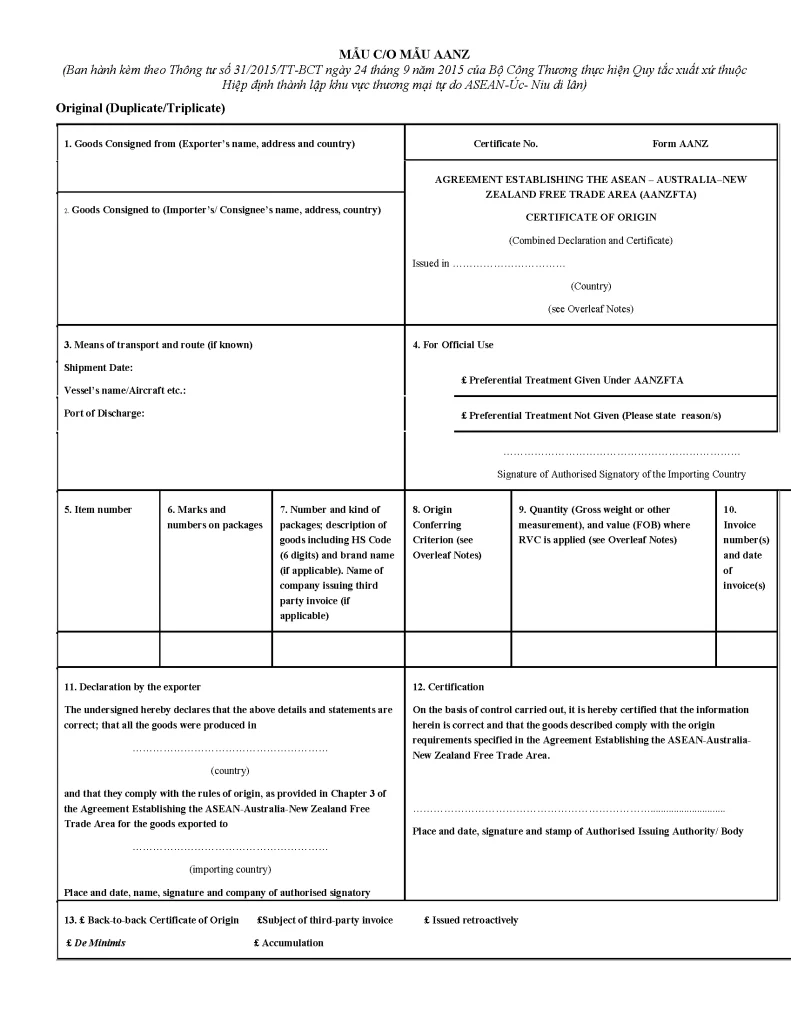
Download the C/O Form AANZ template here
Learn more: What is C/O?
5.1 General requirements
- The form must be completed in English and typed
- The information must match customs declarations and supporting documents
- No erasures or direct corrections are allowed
5.2 Instructions for completing C/O Form AANZ
| Box No. | Required Information |
|---|---|
| Box 1 | Exporter’s name, address, and country (Vietnam) |
| Box 2 | Consignee/importer’s name, address, and importing country |
| Box 3 | Departure date, means of transport, loading port, and discharge port |
| Box 4 | Reserved for issuing authority (leave blank) |
| Box 5 | Item number |
| Box 6 | Marks and numbers on packages |
| Box 7 | Package quantity, detailed product description, HS code, and brand name if applicable |
| Box 8 | Origin criterion (WO / CTH / CTSH / RVC…) |
| Box 9 | Gross weight and FOB value (mandatory for RVC criterion) |
| Box 10 | Commercial invoice number and issue date |
| Box 11 | Exporter’s declaration |
| Box 12 | Certification by the issuing authority (stamp and signature) |
5.3 C/O reference number
The reference number consists of 13 characters, divided into 5 groups:
- Group 1: Exporting country code – “VN”
- Group 2: Importing country code (AU = Australia, NZ = New Zealand)
- Group 3: Year of issuance
- Group 4: Issuing authority code
- Group 5: Sequential C/O number
Example: VN-AU25/03/00123 – C/O number 123 issued in 2025 for exports to Australia by the Ho Chi Minh City Regional Import-Export Management Office.
5.4 Important notes for Box 8 (Origin Criteria)
- Use “WO” if the goods are wholly obtained
- Use “CTH” or “CTSH” depending on the required tariff classification change
- Use “RVC [X]%” and declare the FOB value in Box 9 if applying the regional value content criterion
- If the invoice is issued by a third party, tick the box “Subject of third-party invoice”
- For back-to-back certificates, tick the box “Back-to-Back Certificate of Origin”
6. Required documents for applying for Form AANZ
To obtain a Certificate of Origin under AANZFTA, enterprises must prepare the following documents:
- Application form for C/O issuance (submitted via ecosys.gov.vn or directly)
- Completed Form AANZ signed and stamped by the exporter
- Export customs declaration (certified copy after customs clearance)
- Commercial invoice (certified copy with signature and company stamp)
- Packing List (signed and stamped)
- Bill of Lading/Airway Bill or equivalent transport documents (certified copy)
- Bill of materials showing HS codes of imported inputs and finished products
- Material consumption norms (signed and stamped)
- Manufacturing process documents (certified copy)
- Import declarations and supplier invoices (if imported materials are used)
Note: For export goods that are not subject to customs declaration requirements, exporters are not required to submit customs declarations. However, if the customs declaration has been completed but customs procedures are still pending, the applicant may submit this document within 15 days from the issuance date.
7. Procedures for obtaining Form AANZ (Updated 2025)
Step 1: Register trader profile
If the enterprise has never applied for a Certificate of Origin before, it must first register a trader profile on the ecosys.gov.vn system or at the authorized issuing office. The profile includes company information, exported products, manufacturing process details, and related documents.
Step 2: Submit the application
After registration, enterprises may:
- Access ecosys.gov.vn to submit documents online
- Or submit the dossier directly to the registered issuing authority
Step 3: Verification by the issuing authority
Depending on the application status, the exporter may receive one of the following results:
| Result | Description |
|---|---|
| ✅ Approval | The issuing authority confirms the issuance schedule |
| 📋 Request for additional documents | Additional supporting documents are required |
| 🔍 Request for clarification | The exporter must re-check specific information |
| ❌ Rejection | The application is rejected under Decree 31/2018/ND-CP |
| 🏭 Factory inspection request | Inspection conducted under Article 28 of Decree 31/2018/ND-CP |
Step 4: Receive and use the certificate
Once issued, the certificate should be attached to the export documentation set so the importer can declare it to customs authorities in the destination country and receive preferential tariff treatment under AANZFTA.
8. Authorities authorized to issue Form AANZ in Vietnam
In Vietnam, the certificate is issued by two main systems:
- Ministry of Industry and Trade (MOIT) – through 19 regional Import-Export Management Offices nationwide (Hanoi, Ho Chi Minh City, Da Nang, Binh Duong, Dong Nai, etc.)
- Vietnam Chamber of Commerce and Industry (VCCI) – selected branches authorized to issue certificates under AANZFTA
Certain Export Processing Zone and Industrial Zone Management Boards are also authorized by the Ministry of Industry and Trade to issue certificates locally.
9. Direct consignment requirements
For preferential treatment to apply, goods must be transported directly from the exporting country to the importing country in accordance with Article 4 of Decree 31/2018/ND-CP.
If goods are transshipped through a third country outside AANZFTA, the exporter must prepare:
- A Through Bill of Lading
- Certification from customs authorities in the transit country confirming that the goods were not altered or further processed
- Evidence showing the economic or geographical necessity of transshipment
10. Common mistakes when declaring Form AANZ
| Common mistake | Consequence | Solution |
|---|---|---|
| HS code does not match the customs declaration | Application rejection and loss of tariff preference | Carefully verify HS codes before submission |
| FOB value omitted when using RVC criterion | Certificate becomes invalid | Always declare FOB value when applying RVC |
| Insufficient product description | Import customs authorities may request clarification | Provide detailed descriptions and brand names if applicable |
| Direct erasures or corrections on the certificate | Certificate may be cancelled and reissued | Cross out incorrect information and add certified amendments |
| Late submission after shipment departure | Possible rejection or retrospective issuance process | Submit documents before or immediately after export |
Latest update: Second Protocol Amendment (2025)
From April 21, 2025, the regulations and procedures related to Form AANZ have been updated under the Second Protocol Amendment of AANZFTA.
Key changes include:
- Updated certificate templates and declaration procedures
- Expanded implementation of electronic Certificates of Origin (eCO)
- Adjustments to Product Specific Rules (PSR)
- Enhanced origin verification and inspection mechanisms
Exporters should use the latest template version for shipments from April 21, 2025 onward. The newest form can be downloaded from ecosys.gov.vn or obtained from regional Import-Export Management Offices.
Frequently Asked Questions (FAQ)
How long is Form AANZ valid?
The certificate is generally valid for 12 months from the date of issuance. After expiration, it can no longer be used to claim preferential tariffs.
Can exporters apply after shipment departure?
Yes. Retrospective issuance may be allowed in certain special circumstances, subject to approval and supporting explanations from the issuing authority.
What is the difference between Form AANZ and CPTPP certificates?
Both may be used for exports to Australia. However, tariff schedules and origin rules differ between AANZFTA and CPTPP. Exporters should compare the applicable tariff benefits before selecting the most suitable certificate.
Can multiple products be declared on one certificate?
Yes. If additional space is required, exporters may continue on the supplementary declaration sheet specified in Appendix V-B. If certain items do not qualify for preferential treatment, customs authorities may indicate the affected items in the corresponding boxes.
Conclusion
Form AANZ is an important tool helping Vietnamese exporters optimize tariff costs when shipping goods to Australia, New Zealand, and ASEAN member countries.
To maximize benefits, enterprises should:
- Verify HS codes and applicable origin criteria for each product
- Prepare complete supporting documents before export
- Use the latest certificate template under the 2025 Protocol Amendment
- Maintain full records of raw materials and production processes for post-clearance audits
This article is compiled based on Circular 31/2015/TT-BCT, Circular 07/2020/TT-BCT, Circular 02/2024/TT-BCT, and the latest updates under the Second Protocol Amendment of AANZFTA (2025).
Comprehensive Form AANZ application services at 3W Logistics
Handling origin certification procedures independently can expose exporters to legal and compliance risks due to the complexity of RVC calculations and HS code verification under the latest AANZFTA amendments.
3W Logistics is a leading logistics and customs brokerage company in Vietnam, providing comprehensive solutions to help businesses process origin documents quickly and accurately.
3W Logistics offers key advantages for exporters shipping to Australia and New Zealand:
- Specialized experts: The team has extensive experience with Product Specific Rules (PSR) and optimizing material declarations to maximize regional value content.
- Stable global transportation network: As a reputable NVOCC, 3W Logistics maintains strong partnerships with major shipping lines, ensuring competitive freight rates and stable cargo space for Australia and New Zealand routes, including both LCL and FCL services.
- Fast document processing: 3W Logistics supports exporters in completing documentation, declaring information through EcoSys/VCCI systems, and obtaining certificates within 1–2 working days while minimizing DEM/DET storage costs.
Businesses seeking to optimize tariff benefits and ensure safe international transportation are encouraged to contact 3W Logistics for full-service consultation and support.
CONTACT INFORMATION
Head Office – 3W Logistics Ho Chi Minh Branch
Address: 34 Bach Dang Street, Tan Son Hoa Ward, Ho Chi Minh City
Hotline: +84 28 3535 0087
3W Logistics Hanoi Branch
Address: 81A Tran Quoc Toan Street, Cua Nam Ward, Hanoi
Hotline: +84 24 3202 0482
3W Logistics Hai Phong Branch
Address: 8A Lot 28 Le Hong Phong Street, Gia Vien Ward, Hai Phong
Hotline: +84 225 355 5939
3W LOGISTICS CO., LTD – We here serve you there!
Email: quote@3w-logistics.com
Website: www.3w-logistics.com

Hello, I’m Nguyen Phuong Nhan (Ms. Nina)
I currently serve as Trade Lanes Supervisor at 3W Logistics, with more than 10 years of experience in international logistics and freight forwarding.
My primary responsibility is developing and managing global logistics partnerships, building strategic trade lanes, and working closely with overseas agents to provide reliable and competitive transportation solutions for customers.
I regularly collaborate with agents and logistics partners worldwide to explore new business opportunities, negotiate freight rates, develop trade routes, and support import-export shipments. I also work closely with our sales team to design logistics solutions tailored to specific markets and customer requirements.
My expertise includes Ocean Freight, Air Freight, Trade Lane Development, Global Agent Network Management, International Logistics Solutions, and Import-Export Support.
Through the articles I share on the 3W Logistics website, I aim to provide practical insights into the international logistics industry, global transportation trends, overseas agent cooperation, and effective logistics strategies that help businesses optimize their supply chain operations.
I believe that strong global partnerships and well-developed trade lanes are essential to delivering sustainable logistics solutions and long-term value to customers worldwide.


