

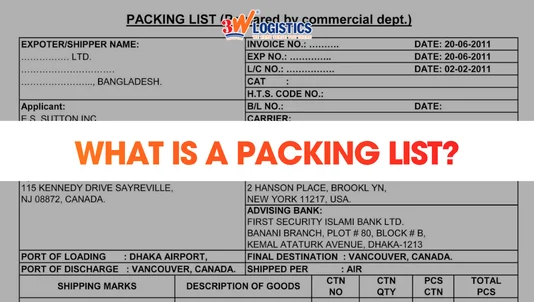
What Is a Packing List? Definition, Purpose & Real-World Examples
Packing List is a document prepared by the seller that itemizes the packing method, number of packages, weight, and dimensions of an export-import shipment. It is one of the essential documents in an export-import dossier, helping all parties cross-check and verify goods accurately throughout shipping and customs clearance.
Many newcomers to import-export often confuse a Packing List with a Commercial Invoice, and are unclear on the different types of packing lists or what content must be included. The article below sets out the full definition, purpose, common packing list types, required content, and key points to note when preparing one.
1. What Is a Packing List?
A Packing List, abbreviated P/L, is a document prepared by the seller/exporter that describes in detail the packing method, quantity, weight, and dimensions of each package in an export-import shipment.
In terms of content, a Packing List looks similar in layout to a Commercial Invoice, but it does not show the unit price, goods value, or payment information — it focuses entirely on the packing method and actual quantity of the shipment.
Real-world example: An export shipment of clothing consists of 50 cartons, each containing 100 dress shirts. The Packing List will clearly itemize: a total of 50 cartons, the net weight and gross weight of each carton, and each carton’s dimensions, so the receiver overseas can cross-check upon receipt without needing to open every carton to recount.
2. The Role of a Packing List in Import-Export
A Packing List serves as an information bridge between the seller, the buyer, the carrier, and the customs authority, helping the entire delivery process run transparently and accurately. Note: the Packing List is not listed as a mandatory document under Article 16 of Circular 38/2015/TT-BTC on the basic customs dossier, but in practice it is almost always requested by the customs authority and the carrier for cross-checking, especially for shipments with multiple product types or numerous packages.
- Cross-checking during handover: the receiver uses the Packing List to count the actual number of packages and detect shortages or damage that occurred during shipping.
- Supporting customs declaration: it is an important document in the customs dossier, helping the customs authority cross-check it against the Commercial Invoice and Bill of Lading when inspecting the shipment.
- Supporting the carrier in issuing the bill of lading: shipping lines/airlines rely on the information in the Packing List to issue an accurate Bill of Lading or Airway Bill.
- Optimizing shipping costs: accurate weight and dimension information allows transparent freight calculation, avoiding disputes over surcharges.
- Serving as a basis for insurance claims and disputes: if goods are lost or damaged during shipping, the Packing List is an important reference for cross-checking and filing an insurance claim.
3. Characteristics of a Packing List
A Packing List’s defining characteristic is that it focuses on describing the physical information of the shipment (quantity, weight, dimensions), without showing financial elements such as unit price or total payment value.
- No payment information: unlike a Commercial Invoice, a Packing List does not record the unit price, goods value, or payment currency.
- Prepared at the same time as the Commercial Invoice: usually drafted in parallel by the same documentation team on the seller’s side to ensure consistency.
- Can be prepared by the seller or an authorized party: the cargo owner (seller) has the right and obligation to prepare the Packing List, but may authorize a forwarder to do so instead.
- Information must match the Commercial Invoice and Bill of Lading exactly: this is a mandatory requirement to avoid raising suspicion during customs declaration.
4. Common Types of Packing Lists
There are 3 common types of Packing Lists used in import-export today, differing mainly in the level of detail and whether the seller’s name is shown.
- Detailed Packing List: the most common type, showing full, detailed information about the goods in each package, making it easy for the buyer to check upon receipt.
- Neutral Packing List: does not show the name of the seller/original manufacturer, typically used in intermediary transactions when the seller does not want to reveal the original supplier’s information to the end buyer.
- Packing and Weight List: similar in content to a Detailed Packing List, but with an added detailed weight breakdown for each item or package.
5. Mandatory Content on a Packing List
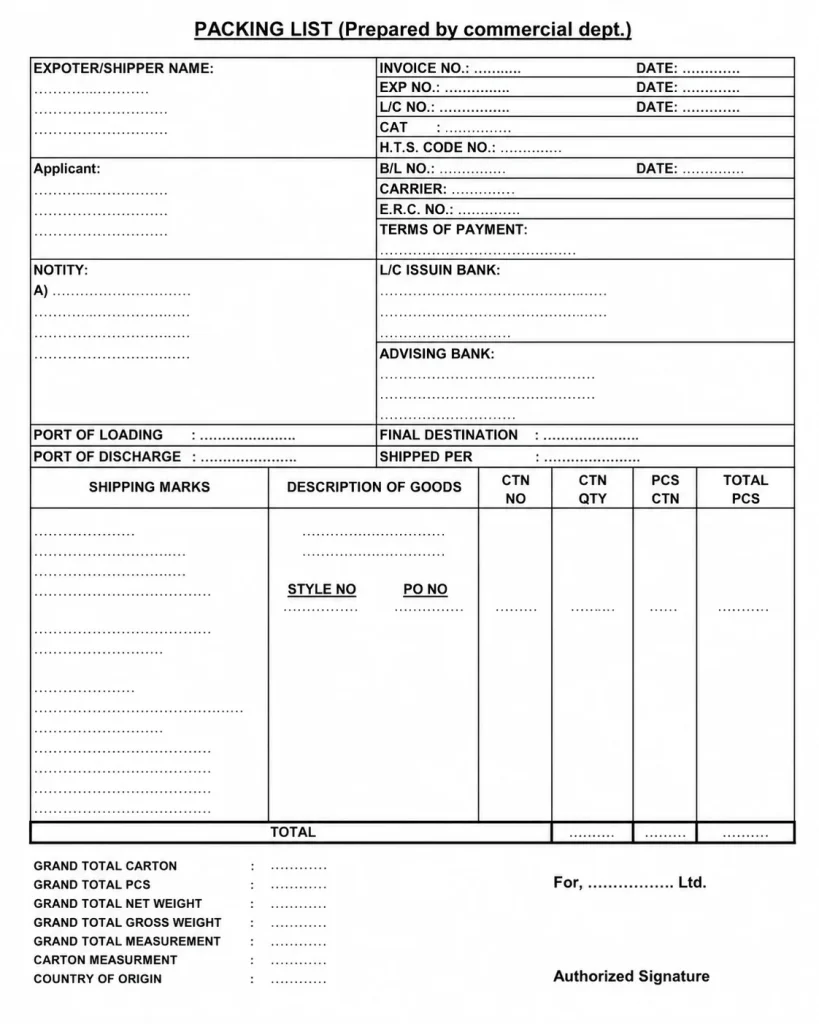
A complete Packing List should display party information, document information, packing details, and shipping information to ensure it is accepted during customs declaration and cargo handover.
- Seller and buyer information: company name, address, contact details (except on a Neutral Packing List, which omits the seller’s name).
- Packing List number and date: usually the same as or close to the number and date of the related Commercial Invoice.
- Description of goods: product name, model code, quantity per package.
- Number of Packages: total cartons, packages, or pallets in the shipment.
- Net Weight/Gross Weight: the actual weight of the goods and the weight including packaging.
- Dimensions of each package: length, width, and height of each carton/package, used to calculate cubic meters (CBM) for freight costing.
- Shipping information: Bill of Lading number, port of loading/discharge, vessel/flight name (if available at the time of preparation).
- Signature: the signature and title of the seller’s authorized representative.
6. CBM Formula Based on Packing List Information
The dimension information on a Packing List is the direct basis for calculating converted volume (CBM – Cubic Meter), one of the two main factors (along with weight) that determine sea, road, and air freight costs.
Formula for calculating the CBM of a single package:
CBM = Length (m) × Width (m) × Height (m)
Formula for calculating the total CBM of a multi-package shipment:
Total CBM = CBM of 1 package × Total number of packages
Real-world example: A package measuring 1.2m x 1m x 1m, with a shipment of 50 identical packages. CBM of 1 package = 1.2 x 1 x 1 = 1.2 CBM. Total CBM of the shipment = 1.2 x 50 = 60 CBM. This is the exact figure a forwarder uses to quote sea/road freight for an LCL shipment.
Note: For air freight, cost is usually calculated based on volumetric weight (Volumetric Weight = Length x Width x Height (cm) / 6,000), which is then compared against the actual weight (Gross Weight) on the Packing List — whichever is greater is used to calculate the freight charge.
7. Distinguishing a Packing List from a Commercial Invoice
A Packing List focuses on describing the packing method and actual quantity of the shipment, while a Commercial Invoice focuses on the commercial value and serves as the basis for payment.
| Criteria | Packing List | Commercial Invoice |
|---|---|---|
| Main purpose | Describes packing method, quantity, weight, and dimensions of the goods | Confirms the transaction value, serving as the basis for payment |
| Value information | Does not show unit price or goods value | Must show the unit price and total value of the goods |
| Role in payment | Not used for payment | The main basis for the buyer to pay the seller |
| Distinctive information | Net/gross weight, dimensions of each package | Unit price, total amount, Incoterms, payment method |
A further distinction from the Bill of Lading: While a Commercial Invoice shows the transaction value, a Bill of Lading is a document of title issued by the carrier, confirming receipt of the goods for transport. A Packing List has no title or transport-law function like a Bill of Lading — it only describes in detail the contents of the shipment that the Bill of Lading represents.
8. Guide to Preparing a Packing List
Preparing a Packing List should follow a sequence from party information and document number/date to detailed packing information for each package, ensuring an exact match with the Commercial Invoice before handing it to the carrier.
- Fill in seller and buyer information: accurate company name, address, and contact details as stated in the contract (skip this for a Neutral Packing List).
- Fill in the document number and date: should be synchronized with or clearly reference the related Commercial Invoice number.
- List the goods in detail by package: describe the product name and quantity in each carton/package/pallet.
- Fill in weight and dimensions: clearly state the Net Weight, Gross Weight, and length/width/height of each package.
- Calculate the total number of packages, total weight, and total volume (CBM): sum the figures across all packages in the shipment.
- Fill in shipping information (if available): Bill of Lading number, port of loading/discharge, mode of transport.
- Sign for confirmation: an authorized person on the seller’s side signs and states their title, certifying that the packing information is accurate.
Note: The figures for number of packages and weight on the Packing List must match the Bill of Lading and customs declaration exactly; any discrepancy can cause the shipment to be pushed into the yellow or red channel during clearance.
9. Common Mistakes When Preparing a Packing List
The most common mistakes when preparing a Packing List are discrepancies against the Commercial Invoice and Bill of Lading, missing weight/dimension information, or confusing the different packing list types.
| Common Mistake | Consequence | How to Fix It |
|---|---|---|
| Quantity/weight discrepancy vs. the Commercial Invoice and B/L | Pushed into the yellow/red channel, extending physical inspection time | Cross-check the figures across all three documents before sending them to the carrier |
| Missing weight or dimension information | The carrier lacks sufficient basis to calculate freight, possibly applying an inaccurate rate | Record the Net Weight, Gross Weight, and dimensions of each package in full |
| Confusing the different Packing List types | Accidentally revealing the original supplier’s information when a Neutral Packing List was required | Determine the correct type of packing list required by the transaction before drafting the document |
| Not updating shipping information after changes | Mismatched port of loading/discharge or Bill of Lading number, causing difficulty during cross-checking | Update the Packing List immediately whenever the schedule or Bill of Lading changes |
Real-world example: An exporter recorded a lower total weight on the Packing List than the actual weight due to a unit conversion error, causing the shipment to be re-weighed at the port, where the discrepancy was discovered and the goods were held for additional inspection before clearance.
10. Frequently Asked Questions About the Packing List (FAQ)
Is a Packing List required in the customs dossier?
No law lists the Packing List as a mandatory document in the basic customs dossier, but in practice it is almost always requested by the customs authority and the carrier for cross-checking quantities, especially for shipments with multiple product types or numerous packages.
Who is responsible for preparing the Packing List?
The seller (cargo owner) has the right and obligation to prepare the Packing List, but may authorize a forwarder company to do so instead in certain cases.
Does a Packing List need to show the unit price of the goods?
No. A Packing List only describes the quantity, weight, and dimensions of the packing; it does not show the unit price, value, or payment information like a Commercial Invoice.
When is a Neutral Packing List used?
A Neutral Packing List is used in intermediary transactions, when the seller does not want to reveal the original manufacturer’s/supplier’s information to the end buyer.
Do the Packing List and Commercial Invoice need to match?
Yes. The quantity and description of goods on the Packing List must match the Commercial Invoice and Bill of Lading exactly, to avoid raising suspicion during customs declaration.
Does a Packing List need the buyer’s signature?
Not necessarily. A Packing List only needs the signature and title of the seller’s authorized representative to confirm the packing information.
Can an incorrect Packing List be corrected?
Yes, a revised or replacement Packing List can be issued, but this must be done before registering the customs declaration to avoid affecting clearance.
What should businesses keep in mind when preparing a Packing List?
Businesses should carefully cross-check the figures against the Commercial Invoice and Bill of Lading, fully record the weight and dimensions of each package, and update the information immediately whenever shipping details change.
3W Logistics – Supporting Import-Export Documentation
Preparing an accurate Packing List that matches the Commercial Invoice and Bill of Lading is an important factor in fast customs clearance. 3W Logistics works alongside import-export businesses to standardize documentation and minimize errors during customs declaration.
- Experienced documentation team: Reviews and cross-checks the Packing List against the Commercial Invoice and Bill of Lading before declaration, reducing the risk of yellow/red channel classification.
- Accurate weight and volume calculation support: Helps businesses optimize shipping costs based on actual packing information.
- Consulting on choosing the right Packing List type: Helps businesses determine the correct type of packing list required for each transaction.
Businesses needing consulting on the Packing List and other export-import documents, please contact 3W Logistics directly for support.
CONTACT INFORMATION:
Head Office – 3W Logistics Ho Chi Minh Branch
Address: 34 Bach Dang, Tan Son Hoa Ward, Ho Chi Minh City
Hotline: +84 28 3535 0087
3W Logistics Hanoi Branch
Address: 81A Tran Quoc Toan, Cua Nam Ward, Hanoi
Hotline: +84 24 3202 0482
3W Logistics Hai Phong Branch
Address: 8A Lot 28 Le Hong Phong, Gia Vien Ward, Hai Phong
Hotline: +84 225 355 5939
3W LOGISTICS CO., LTD – We here serve you there!
Email: info@3w-logistics.com
Website: www.3w-logistics.com

Hello, I’m Nguyen Phuong Nhan (Ms. Nina)
I currently serve as Trade Lanes Supervisor at 3W Logistics, with more than 10 years of experience in international logistics and freight forwarding.
My primary responsibility is developing and managing global logistics partnerships, building strategic trade lanes, and working closely with overseas agents to provide reliable and competitive transportation solutions for customers.
I regularly collaborate with agents and logistics partners worldwide to explore new business opportunities, negotiate freight rates, develop trade routes, and support import-export shipments. I also work closely with our sales team to design logistics solutions tailored to specific markets and customer requirements.
My expertise includes Ocean Freight, Air Freight, Trade Lane Development, Global Agent Network Management, International Logistics Solutions, and Import-Export Support.
Through the articles I share on the 3W Logistics website, I aim to provide practical insights into the international logistics industry, global transportation trends, overseas agent cooperation, and effective logistics strategies that help businesses optimize their supply chain operations.
I believe that strong global partnerships and well-developed trade lanes are essential to delivering sustainable logistics solutions and long-term value to customers worldwide.


