
What is a consignee? All the knowledge you need in import and export
Consignee, abbreviated as Cnee, is the individual or organization designated to receive cargo on a Bill of Lading (B/L) or Airway Bill (AWB). The Consignee appears in the second field of the transport document and is the only party with the legal right to collect the shipment at the port of destination.
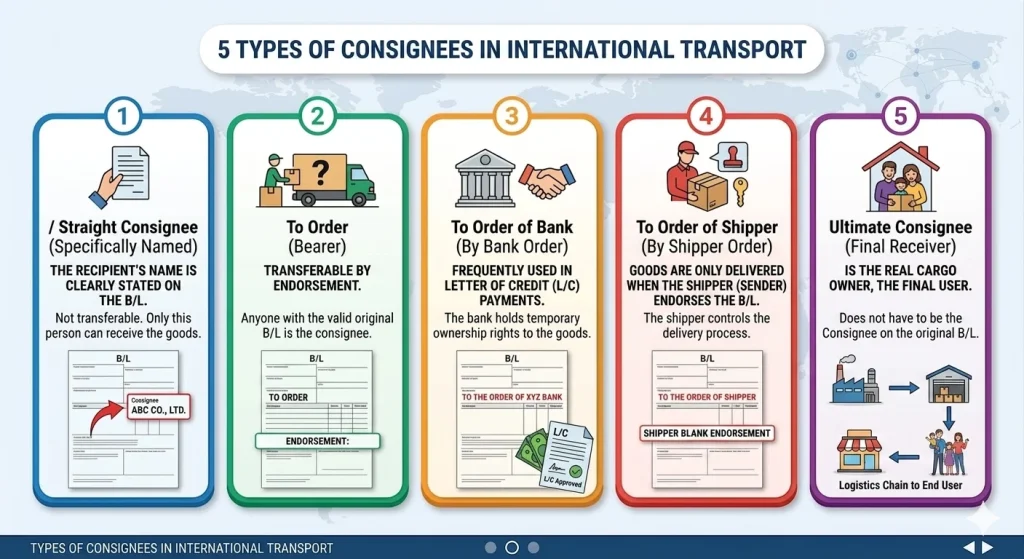
The Consignee differs from the Notify Party in that the Consignee holds the legal right to take delivery of the cargo, while the Notify Party is simply notified upon arrival and has no such legal right. In international trade practice, there are five main types of Consignee: Named Consignee (Straight), To Order, To Order of Bank, To Order of Shipper, and Ultimate Consignee – each suited to different payment methods and transaction structures.
1. What is a Consignee? Exact Definition and Abbreviation
A Consignee is the individual or organization designated to receive goods under a transport document (Bill of Lading – B/L or Airway Bill – AWB). This is the party with the legal right to collect the shipment at the port or airport of destination, and to whom the shipping line or airline delivers the cargo directly or via a Delivery Order (D/O).
In day-to-day import/export operations, Consignee is abbreviated as Cnee. You will encounter this term in emails exchanged with freight forwarders, in carrier booking note instructions, and in international trade finance document sets.
Why does the Consignee matter so much? Because whoever controls the Consignee information on the original bill of lading controls the shipment. Furthermore, the roles between the consignee and the shipper will involve prepaid shipping and freight collection, which the consignee doesn’t always pay for. This creates the legal foundation for the entire international trade transaction – from payment through to cargo release at the port of destination.
Important note: The Consignee is not always the Buyer in the sales contract. In many transactions, particularly those involving Letter of Credit (L/C) payment, the Consignee on the bill of lading is the issuing bank, not the importing company. Confusing these two roles is one of the most common mistakes made by those new to import/export.
2. 5 Common Types of Consignee on a Bill of Lading
Not all bills of lading record the Consignee in the same way. Depending on the payment method and transaction requirements, there are five commonly encountered types of Consignee:
| Type of Consignee | Definition | How to Write on the B/L | Suitable Payment Method | Transferable? |
|---|---|---|---|---|
| Named / Straight Consignee | A specific company or individual is named. Only the named party has the right to collect the cargo. | Full company name + address + tax ID (e.g.: ABC Import Co., Ltd, 123 Nguyen Hue, HCM City) | TT (wire transfer), D/A, D/P | No |
| To Order | A bearer bill of lading — the right to collect cargo belongs to whoever holds the duly endorsed original. | TO ORDER or TO THE ORDER OF | Flexible — commonly used in open account transactions | Yes (by endorsement) |
| To Order of Bank | The issuing or nominated bank controls the bill of lading until the payment obligation is fulfilled. | TO ORDER OF [BANK NAME] (e.g.: TO ORDER OF VIETCOMBANK) | L/C (Letter of Credit) | Yes (after bank endorsement) |
| To Order of Shipper | The Shipper retains control of the shipment until transfer. Used when the Shipper wants to secure payment before releasing title. | TO ORDER OF [SHIPPER NAME] or TO ORDER OF SHIPPER | D/P, documentary collection | Yes (Shipper endorses) |
| Ultimate Consignee | The final recipient in the distribution chain, distinct from an import agent or intermediary. Critical in export control and trade compliance. | Entered in a separate field or in the description (e.g.: ULTIMATE CONSIGNEE: XYZ Retail Corp) | All methods, especially for controlled goods | No (this is the final destination) |
What is an Intermediate Consignee?
An Intermediate Consignee is an intermediary in the distribution chain — typically an import agent, logistics company, or regional distributor — that receives the cargo on behalf of the Ultimate Consignee. This concept is especially important for export-controlled goods (controlled goods), where regulatory authorities require declaration of both the Intermediate and Ultimate Consignee to prevent cargo from being diverted to unauthorized third parties.
3. Where Does the Consignee Appear on a Bill of Lading and How to Fill It In Correctly
On a standard Bill of Lading, the Consignee field is the second box from the top, positioned directly below the Shipper field and above the Notify Party field. This is a fixed position on virtually all bill of lading templates issued by major carriers such as Maersk, MSC, CMA CGM, COSCO, and Evergreen.
The Consignee field must include the following information:
- Full company or individual name, correctly spelled and matching the business registration certificate or passport
- Full address: house/unit number, street name, ward/commune, district, city/province, country
- Tax Identification Number (TIN) for businesses — mandatory for customs clearance in Vietnam
- Phone number and email (not required on the B/L but recommended so the carrier/agent can make contact when needed)
Practical examples:
For a Named (Straight) Consignee bill of lading, the Consignee field is filled as follows:
ABC TRADING CO., LTD
123 Nguyen Hue Street, Ben Nghe Ward, District 1, Ho Chi Minh City, Vietnam
TIN: 0123456789
Tel: +84 28 1234 5678
For a To Order of Bank bill of lading in an L/C transaction, the Consignee field simply reads:
TO ORDER OF JOINT STOCK COMMERCIAL BANK FOR FOREIGN TRADE OF VIETNAM (VIETCOMBANK)
A critical mistake to avoid: even if you are holding the original bill of lading, if the Consignee name on the B/L does not match the company presenting itself to collect the cargo, the carrier and customs authority will refuse to release it. Title to the goods is tied to the Consignee information on the original bill of lading, not to whoever physically holds the document.
4. Consignee in an AWB (Airway Bill)
This is a distinction that even experienced import/export professionals sometimes get wrong. An Airway Bill (AWB) is not a document of title — meaning it does not represent ownership of the goods the way a sea B/L does.
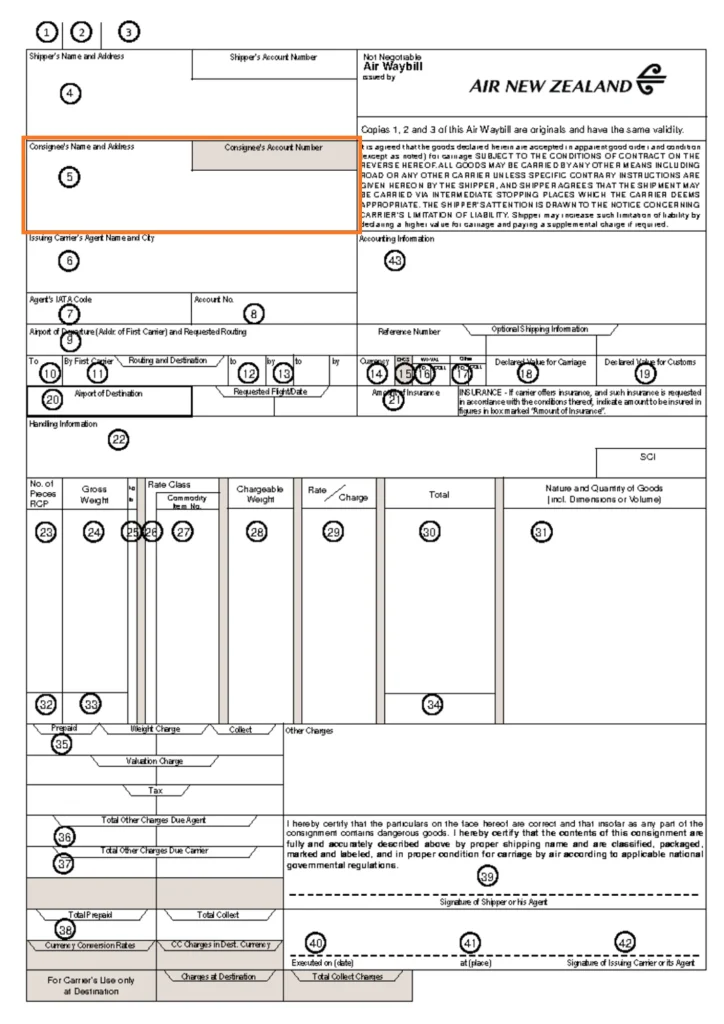
The practical consequence: the Consignee named on the AWB can collect the cargo at the destination airport without presenting the original AWB. The airline will proactively contact and deliver to the Consignee based on pre-declared information. This is both an advantage (fast, no need to wait for original documents) and a risk (if the Consignee is entered incorrectly, the cargo may be delivered to the wrong party and is far harder to recover than with a B/L).
| Criteria | B/L (Sea Bill of Lading) | AWB (Airway Bill) |
|---|---|---|
| Legal nature | Document of title — represents ownership of the goods | Not a document of title — only a contract of carriage and receipt |
| Original document required to collect cargo? | Yes — original B/L must be presented (or Telex Release / Sea Waybill) | No — Consignee can collect without the original AWB |
| Transferable? | Yes (with a To Order bill of lading) | No — AWB is non-negotiable |
| Transit time | Longer (sea freight) — original documents typically arrive before the cargo | Faster — cargo arrives before documents; Consignee collects immediately |
| Risk of incorrect Consignee | Cargo held at port; amendment required | Cargo may already have been delivered; far harder to recover |
| Suitability for L/C payment | Well-suited — bank controls the cargo via the original B/L | Limited — L/C via AWB requires special clauses (Airway Bill L/C) |
| Arrival notification mechanism | Notify Party is informed by the shipping line | Consignee is contacted directly by the airline to collect the cargo |
An important practical note: in cross-border e-commerce, pharmaceuticals, and electronics — industries that frequently ship by air — a solid understanding of the AWB Consignee mechanism helps prevent situations where cargo arrives at the airport with no one to collect it, generating airport storage charges that are substantially higher than seaport equivalents.
5. Consignee vs. Notify Party: Key Differences
The Notify Party is the party that the shipping line or airline notifies when a shipment arrives at the destination port or airport. This is an informational mechanism, not a legal mechanism relating to ownership. Many people incorrectly assume the Notify Party can collect the cargo — this is only true when the Notify Party is also the Consignee, or when they hold a valid power of attorney from the Consignee.
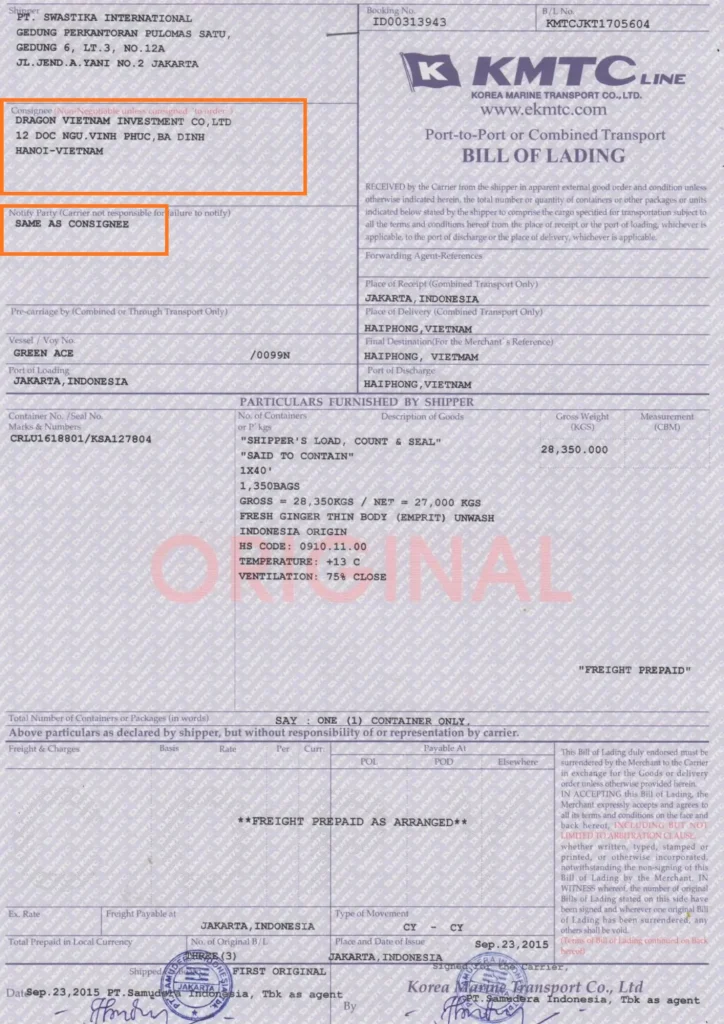
| Criteria | Consignee | Notify Party |
|---|---|---|
| Legal right to collect cargo | Yes — holds legal title or right to take delivery | No — notification only, no legal right to collect |
| Role in L/C transactions | Issuing bank (controls the B/L until payment) | Importing company (the actual buyer) |
| Role in TT transactions | Importing company (buyer) | Same as Consignee, or a designated contact |
| When are the two the same? | Only in straightforward TT transactions where there is no bank intermediary | |
When Consignee differs from Notify Party: In an L/C transaction, the Consignee is typically the issuing bank (e.g. “TO ORDER OF VIETCOMBANK”), while the Notify Party is the actual importing company. The bank controls the bill of lading until the importer fulfills its payment obligation, at which point the bank endorses the B/L and transfers the right to collect the cargo to the importing company.
6. Consignee vs. Buyer | Shipper vs. Seller
One of the most confusing areas for newcomers to international trade is the overlap between roles in the sales contract, the transport document, and the L/C. The table below clarifies each role:
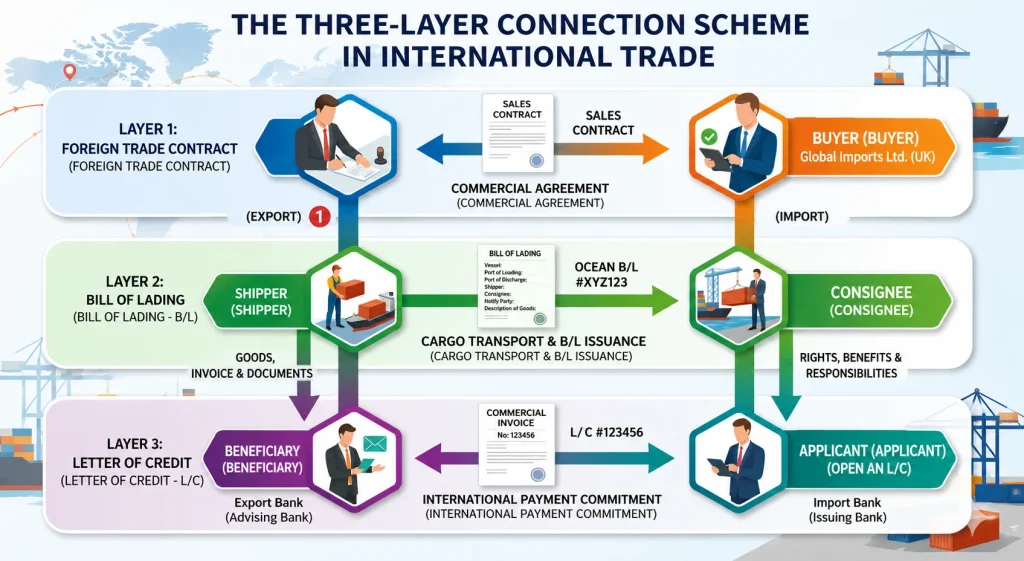
| Document | Selling / Sending Party | Buying / Receiving Party | Notes |
|---|---|---|---|
| Sales Contract | Seller | Buyer | Defines obligations, Incoterms, and payment terms |
| Transport Document (B/L / AWB) | Shipper | Consignee | Establishes legal rights over the shipment during transit |
| L/C (Letter of Credit) | Beneficiary | Applicant | Defines payment obligations and document presentation conditions |
When does Consignee = Buyer? In a straightforward TT transaction, Seller = Shipper and Buyer = Consignee. Everything is direct: the buyer is the receiver, with no intermediary.
When does Consignee differ from Buyer? In bank-intermediated trade finance — especially under an L/C — the issuing bank guarantees payment on behalf of the buyer. The bank requires the bill of lading to be issued to its order (“To Order of [Issuing Bank]”) so it can control the cargo until the buyer performs its obligation. In this case:
- Seller = Shipper = Beneficiary (the same company)
- Issuing Bank = Consignee on the B/L
- Buyer = Applicant = Notify Party on the B/L
The Buyer actually receives the cargo only after the bank endorses the back of the original B/L, transferring the right of collection to the Buyer.
7. Consignee in L/C Transactions — Critical Points
In transactions settled by Letter of Credit (L/C), filling in the Consignee on the B/L exactly as required by the L/C is a prerequisite for the document set to be accepted for payment. Typically, the L/C will specify that the Consignee on the transport document must be stated as “To Order of [Name of Issuing Bank]”.
The reason: the issuing bank guarantees payment on behalf of the buyer. To ensure the cargo is not released to a third party before the buyer pays, the bank requires control of the bill of lading. Only when the importer makes full payment or signs acceptance of the draft (depending on whether the L/C is at sight or usance) will the bank endorse the B/L and transfer the right of delivery.
The bill of lading flow in an L/C transaction:
- Shipper issues B/L with Consignee: “To Order of [Issuing Bank]”
- Shipper presents the document set to the Advising/Nominated Bank
- Advising Bank examines documents and forwards them to the Issuing Bank
- Issuing Bank examines, pays or accepts if documents are compliant
- Issuing Bank endorses the B/L and releases it to the importer
- Importer uses the endorsed original B/L to collect cargo at the port of destination
A common and costly mistake: some inexperienced Shippers enter the importer’s company name directly in the Consignee field instead of specifying the bank’s order. The result: the issuing bank refuses payment because the documents are discrepant (non-compliant with the L/C terms).
Advisory from 3W Logistics: “If the Consignee on the B/L does not match the L/C requirement — for example, the importer’s company name is entered instead of ‘To Order of [Issuing Bank]’ — the bank will reject payment and issue a discrepancy notice. This is one of the most frequent L/C errors we handle weekly for our clients. Once a discrepancy is raised, the Shipper must seek a waiver from the Buyer or request an amendment — both are time-consuming and can cause the presentation period to be missed.”
8. Risks and Common Errors When the Consignee Is Filled In Incorrectly
After more than ten years supporting clients with import/export documentation, the 3W Logistics team has witnessed many situations where cargo was held, documents were rejected, and shipments became stranded at port — all because the Consignee information on the bill of lading was entered incorrectly. Below are four typical scenarios and how to prevent them.
Scenario 1: Company Name or Address Entered Incorrectly
Description: The Consignee company name on the B/L is misspelled or the address does not match the business registration (e.g. “ABC CO” instead of “ABC TRADING CO., LTD”).
Consequence: Customs refuses clearance because the B/L information does not match the declaration. Cargo is held at port, generating daily container detention and demurrage charges.
Prevention: Always copy the company name directly from the Certificate of Business Registration. Ask the Consignee to provide the exact name and address in writing before the booking is confirmed.
Scenario 2: Consignee Entered as an Individual Instead of a Company
Description: In some B2C transactions or sample shipments, the contact person’s name is entered as the Consignee instead of the company name.
Consequence: In Vietnam, an individual without a corporate tax identification number cannot complete formal commercial import procedures. The shipment is detained and must either be re-imported under personal import rules (higher tax rates) or re-exported.
Prevention: Clarify at the booking stage: if the recipient is an individual, determine the import purpose and appropriate clearance method before confirming the Consignee.
Scenario 3: Incorrect Consignee in an L/C Document Set
Description: The Shipper enters the importing company’s name in the Consignee field instead of “To Order of [Issuing Bank]” as required by the L/C.
Consequence: The issuing bank refuses payment and issues a discrepancy notice. The Shipper must contact the Buyer for a waiver or request a B/L amendment from the carrier — both take time and may exceed the L/C presentation period.
Prevention: Always read the L/C fields 46A (Documents Required) and 47A (Additional Conditions) carefully before completing transport document information. Print the B/L-related L/C conditions as a checklist for the documentation team to cross-check against.
Scenario 4: Consignee Becomes Insolvent After B/L Is Issued
Description: While cargo is in transit (typically 20–45 days for sea freight), the company named as Consignee declares insolvency or ceases operations.
Consequence: The cargo arrives at the port of destination with no party legally entitled to collect it. The Shipper cannot easily reclaim the goods because the B/L has already been issued. Complex legal disputes arise; the cargo may ultimately be seized or auctioned.
Prevention: For new counterparties or high-value transactions, conduct a credit check on the Consignee before loading. Consider using L/C or advance TT payment to manage risk.
Note from 3W Logistics: “Every error involving the Consignee on a bill of lading is more costly than you expect — not just the amendment fee of a few hundred dollars, but daily storage charges, cargo risk, and damage to business relationships. Our documentation team always verifies Consignee information at the Draft B/L stage, before the carrier issues the final document. This is a safety check that many in-house teams tend to skip.”
9. Frequently Asked Questions About Consignee (FAQ)
1. What is a Consignee in import/export?
A Consignee is the individual or organization designated to receive cargo on a transport document (B/L or AWB). This is the party with the legal right to collect the shipment at the port or airport of destination. The Consignee appears in the second field of the bill of lading, directly below the Shipper information. The Consignee is not necessarily the buyer in every transaction — in L/C payments, the Consignee is typically the issuing bank.
2. What is the abbreviation for Consignee?
Consignee is abbreviated as Cnee in trade documents and day-to-day import/export communications. You will see this abbreviation in forwarder emails, booking notes, and instructions from international shipping lines.
3. What is the difference between a Consignee and a Notify Party?
The Consignee holds the legal right to collect the cargo, while the Notify Party is simply the party the carrier notifies upon arrival — the Notify Party has no right to take delivery. In L/C transactions, the Consignee is typically the issuing bank, while the Notify Party is the actual importing company. The two are only the same in straightforward TT transactions.
4. Is the Consignee the same as the Buyer?
Not necessarily. In a TT transaction, the Consignee typically matches the Buyer. However, in an L/C transaction, the Consignee on the bill of lading is the issuing bank, not the importing company. The Buyer only gains the right to collect the cargo after the bank endorses the B/L, transferring title to the importer.
5. What is a “To Order” Consignee?
“To Order” is a bearer form of bill of lading, in which the right to collect the cargo belongs to whoever holds the duly endorsed original. A To Order bill of lading is freely transferable and is suited to transactions that require flexibility in transferring title to the goods. It is the most common form in L/C transactions, often combined with “To Order of [Bank]”.
6. What is an Ultimate Consignee?
The Ultimate Consignee is the final actual recipient in the distribution chain, as opposed to the Intermediate Consignee (an agent or intermediary). This concept is particularly important in the export control of controlled or dual-use goods, where regulatory authorities require full disclosure of the final destination of the cargo.
7. What should I do if the Consignee on a B/L is entered incorrectly?
You must initiate an Amendment (bill of lading correction) through the carrier or freight forwarder as soon as the error is identified — ideally before the cargo departs the origin port. If original B/Ls have already been issued, all originals must be surrendered before the amendment can proceed. Contact your forwarder or carrier immediately for guidance on the procedure and amendment fees. Do not allow the cargo to arrive at the destination port before the correction is complete, as port storage charges will begin to accrue.
10. How 3W Logistics Supports Clients with Bill of Lading Documentation
3W Logistics is an FMC-licensed OTI-NVOCC with a surety bond, authorized to issue its own House Bills of Lading and to file AMS/ISF (for US-bound cargo) and E-Manifest (for Canada-bound cargo) under 3W’s own SCAC code. This makes the process of shipping to the United States and Canada through 3W Logistics significantly smoother.
The documentation team at 3W Logistics Co., Ltd works alongside import/export businesses at every step of bill of lading and trade document processing. Our specific services include:
- Advising on the correct Consignee and Notify Party for each payment method (TT, L/C, D/P, D/A) and the requirements of each carrier or airline
- L/C document set review (Documentary Check) — cross-referencing every L/C clause against the document set before presentation to the bank, minimizing discrepancies
- Bill of lading amendment processing when corrections are needed to the Consignee, Notify Party, cargo description, or other B/L or AWB details
- Customs declaration support and Delivery Order (D/O) processing at Cat Lai, Tan Cang, Hiep Phuoc, and ICD/depot facilities throughout Ho Chi Minh City and nationwide
For further reading on related transport documents, see: What is a Telex Release? When to Use It and the Risks to Know — a detailed explanation of how the original bill of lading is replaced by cable release in modern trade.
Head Office – 3W Logistics Ho Chi Minh City Branch
Address: 34 Bach Dang Street, Tan Son Hoa Ward, Ho Chi Minh City
Hotline: +84 28 3535 0087
____________________________
3W Logistics Hanoi Branch
Address: 81A Tran Quoc Toan Street, Cua Nam Ward, Hanoi
Hotline: +84 24 3202 0482
____________________________
3W Logistics Hai Phong Branch
Address: 8A Lot 28 Le Hong Phong Street, Gia Vien Ward, Hai Phong
Hotline: +84 225 355 5939
____________________________
3W LOGISTICS CO., LTD – We here serve you there!
Email: quote@3w-logistics.com
Website: www.3w-logistics.com

Ms. Apple is the CCO (Chief Commercial Officer) at 3W Logistics, with over 10 years of experience in sales and business operations management.
At 3W Logistics, Ms. Apple is responsible for commercial strategy, corporate customer development, managing a team of more than 50 sales professionals, and improving business performance in the logistics sector.
With practical experience in sales management and market development, Ms. Apple shares professional insights on business logistics solutions, international transportation, freight forwarding, customer management, trade lane development, and growth strategies in the logistics industry.


