

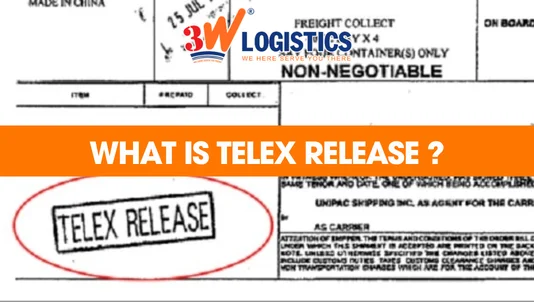
Telex Release is an electronic notification method used by a shipping line or its agent at the port of loading to inform its office or agent at the port of discharge, confirming that the full set of original Bills of Lading (Original B/L) has been surrendered and cancelled by the shipper, thereby allowing the consignee to take delivery of the cargo at the destination port without presenting the original Bill of Lading. This is a widely used solution when cargo arrives at the destination port before the original shipping documents reach the buyer – an extremely common situation in modern international trade.
1. What Is Telex Release?
Telex Release is also referred to as a Surrendered B/L in many international logistics documents, or simply as a telex release B/L or B/L surrendered in everyday industry communication. In essence, it is not a new type of Bill of Lading but rather a Bill of Lading handling process, specifically, the process of surrendering the original B/L at the port of origin and electronically notifying the port of destination to release the cargo.
The term “Telex Release” originated in the era before email became widespread, when internal notifications between shipping line offices were transmitted via telex machines. Although telex technology has long been obsolete, the term has persisted in the logistics industry to this day.
In standard international trade transactions, the traditional cargo release process requires the consignee to present the original Bill of Lading (Original B/L) at the destination port, as the original B/L is a document of title – whoever holds it has the right to take delivery of the goods. However, shipping routes are becoming increasingly shorter (especially intra-Asia routes such as Vietnam–China, Vietnam–Singapore), while bank document processing and postal courier times can take 5–10 days, resulting in a situation where cargo has arrived at port but the original documents have not yet reached the buyer. Telex Release was developed to solve exactly this problem.
Important Note: Telex Release can only be executed when the Bill of Lading has been issued as an Original B/L – typically in a set of 3 originals. The shipper must return all issued original copies to the shipping line at the port of origin before the carrier issues the telex release instruction to the destination port. If only a partial set of originals is returned, the shipping line will not process the telex release.
2. The Role of Telex Release in International Trade
Telex Release serves as a bridge that resolves the timing conflict between the speed of cargo transportation and the speed of document circulation in the global supply chain. Specifically, it fulfills the following key roles:
| ROLE | DETAILED DESCRIPTION |
|---|---|
| Fast cargo release | Allows the consignee to take delivery immediately upon vessel arrival without waiting for the original documents to arrive by courier – reducing container dwell time at port and avoiding costly detention & demurrage fees. |
| Substitute for original B/L in trusted transactions | In long-standing business relationships, trusted partnerships, or intra-group transactions, telex release eliminates the need to send original documents via international courier – saving costs and eliminating the risk of document loss. |
| Supports T/T payment (Telegraphic Transfer) | When the buyer pays by prepaid T/T or open account (T/T after shipment), telex release is the natural choice since there is no need to control the document of title through a bank. |
| Supply chain optimization | Particularly important for fast-moving goods (FMCG, electronic components, raw materials) where every day spent waiting for documents means a day of production line disruption or lost sales opportunity. |
| Handling intra-company transactions | Multinational corporations shipping goods between their own subsidiaries frequently use telex release, as these are internal transactions – there is no payment risk and no need for a document of title. |
3. When Should You Use Telex Release?
Not every transaction is suited to telex release. Below are situations where telex release should and should not be used in practice:
Situations Where You SHOULD Use Telex Release
- 100% prepaid T/T: The buyer has paid in full before the goods are shipped – the seller has no payment risk and can issue the telex release as soon as full payment is confirmed.
- Short shipping routes (cargo arrives before documents): Intra-Asia routes such as Vietnam–China (3–5 days), Vietnam–Singapore (3–4 days), Vietnam–Hong Kong (4–5 days) – cargo typically arrives before the original documents sent by courier.
- Long-standing, high-trust trading relationships: When both parties have traded for many years with a solid payment history – the risk of non-payment is very low.
- Intra-group (intercompany) transactions: Shipments between a parent company and its subsidiaries, or between branches within the same group.
- Open account with an approved credit limit: When the buyer has an approved trade credit limit and a track record of on-time payment.
- Perishable goods requiring urgent delivery: Fresh produce, pharmaceuticals requiring cold storage – every day of delayed delivery equals a day of lost cargo value.
Situations Where You Should NOT Use Telex Release
- L/C payment (Letter of Credit): In an L/C transaction, the original B/L is a mandatory document required for bank payment – telex release cannot be used (see the legal risk section for details).
- New buyers with no transaction history: High risk of non-payment – the seller should retain control of the cargo by holding the original B/L.
- Ongoing commercial disputes: When there is a dispute over quality, quantity, or contract terms – the original B/L is a critical control instrument.
- High-value goods with significant fraud risk: For shipments worth millions of USD, the risk of losing control of the cargo after telex release is too great.
4. Confusion Between Telex Release and Express Release
This is one of the most common points of confusion in the Vietnamese logistics industry. Both Telex Release and Express Release allow the consignee to take delivery without an original B/L, but the underlying processes, the timing of issuance, and the risk profiles of the two are entirely different.
What Is Express Release?
Express Release – also known as a Sea Waybill (SWB) or Waybill B/L is a type of Bill of Lading issued from the outset in a non-negotiable format. No original copies are printed at all; this is the most fundamental difference from telex release. The consignee takes delivery simply by presenting identification documents (passport or business registration certificate) matching the consignee name on the B/L.
| Criteria | Telex Release | Express Release (Sea Waybill) |
|---|---|---|
| Original B/L issued | Yes – originals are issued, then the shipper surrenders them for cancellation | No originals are issued from the start |
| Decision timing | After the original B/L has been issued – the shipper decides to surrender later | At the time of booking – decided before issuance |
| Negotiability | Negotiable before surrender | Non-negotiable from the outset |
| Additional fees | Typically incurs a surrender fee (telex release fee): USD 50–150 | Usually no additional fee or a lower fee |
| Flexibility to change consignee | Consignee can be changed before surrender (via endorsement) | Difficult to change consignee after issuance – requires a paid amendment |
| Suitable for L/C payment | Not suitable after surrender | Not suitable – L/C always requires original B/L |
| Prevalence in Vietnam | Very common | Common and growing – more prevalent on short intra-Asia routes |
| How cargo is collected at destination | Present identity documents + telex release confirmation from the carrier | Present ID or business registration matching the consignee name |
Summary to avoid confusion: Telex Release means “an original B/L is issued, then surrendered and cancelled, with an electronic notification sent to the destination port.” Express Release means “no original B/L is issued in the first place.” The end result is the same – the consignee takes delivery without an original – but the process, timing, and flexibility are entirely different. If you are unsure about the final consignee or need flexibility after the B/L has been issued, telex release offers more options. If everything is confirmed from the start, express release is simpler and less costly.
5. Advantages and Limitations of Telex Release
| Advantages | Limitations |
|---|---|
| The consignee can take delivery as soon as the vessel berths without waiting for the original documents – avoiding costly container detention & demurrage charges. | The shipper loses control of the cargo the moment the telex is issued – it is impossible to stop delivery if the buyer has not yet paid. |
| Eliminates the risk of original documents being lost in postal transit – a lost set of original B/Ls can trigger serious legal disputes. | A surrender fee (telex release fee) is charged by the carrier – typically USD 50–150 per shipment. Small individually, but the total adds up significantly for shippers with many monthly shipments. |
| Saves the cost of courier/postal services for sending original documents – especially on short intra-Asia routes where courier fees can sometimes rival the freight cost. | Not compatible with L/C transactions – banks always require the presentation of original B/Ls for payment under an L/C. |
| More flexible than express release – the shipper can decide to surrender after the original B/L has already been issued, while retaining the right to transfer/endorse beforehand. | Relies on timely coordination among multiple parties – the carrier at the port of origin, the agent at the destination port – errors or delays can cause cargo to be held at the destination. |
| Widely accepted by most major shipping lines and port systems globally – no special agreement is required. | Does not carry the same legal weight as an original B/L in certain maritime disputes – courts in some jurisdictions (particularly common law countries) may not recognize a telex release as equivalent evidence of cargo ownership. |
6. The Telex Release Process From A to Z
Below is the complete telex release process in the correct practical sequence, with each party’s role and specific responsibilities clearly defined:
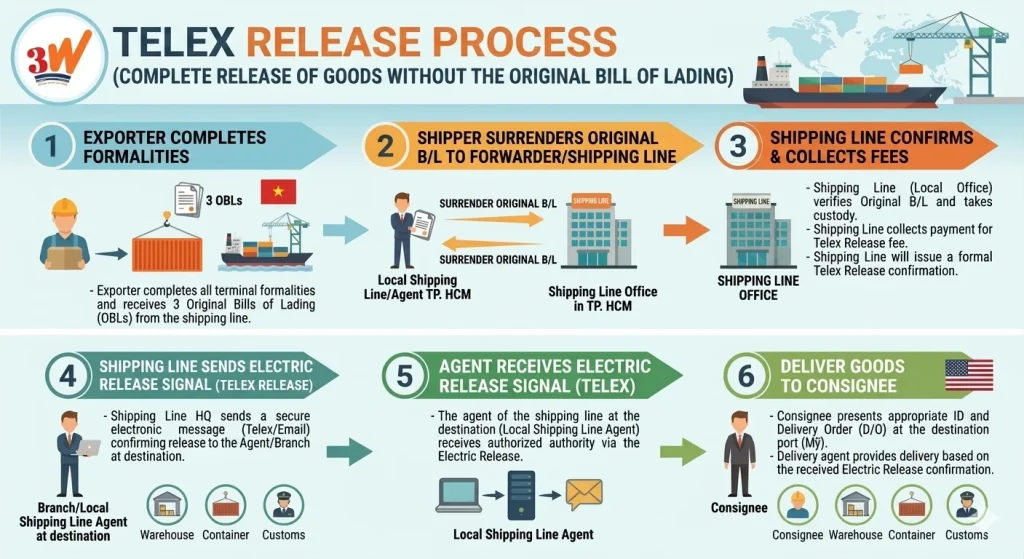
- Shipper and consignee agree to use telex release: Both parties agree on a payment method compatible with telex release (typically T/T) and clearly specify this arrangement in the sales contract or Purchase Order before booking the vessel.
- Shipper books the vessel and requests issuance of an Original B/L: The shipper (or their freight forwarder) books the vessel with the carrier; the carrier issues the original Bill of Lading (Original B/L) – typically 3 original copies and delivers them to the shipper or forwarder.
- Shipper reviews and approves the B/L: The shipper verifies all information on the B/L (commodity description, quantity, consignee, notify party, port of loading, port of discharge, freight terms, etc.). Any discrepancies must be corrected via amendment before proceeding to the next step.
- Consignee makes payment (per agreed terms): For prepaid T/T: the consignee transfers funds; the shipper confirms full receipt. For deferred T/T: both parties comply with the agreed credit terms. This is the most critical step in protecting the shipper’s interests.
- Shipper surrenders the full set of original B/Ls to the carrier: The shipper (or forwarder) brings all issued original copies (typically 3/3 originals) to the carrier’s office at the port of origin; completes the telex release request form; and pays the surrender fee (telex release fee).
- Carrier confirms receipt and cancels the originals: The carrier verifies that the complete set of originals has been returned; stamps “SURRENDERED” on the originals; updates internal records; and sends the telex instruction (electronic notification) to its office or agent at the destination port, confirming the surrender.
- Carrier’s destination port office receives the telex instruction: The carrier’s office or agent at the destination port receives the surrender notification and updates its system to allow the consignee to take delivery without presenting an original B/L.
- Consignee completes the cargo collection process: The consignee (or their customs broker) visits the carrier’s office at the destination port; presents identity documents and the surrender confirmation; receives the Delivery Order (D/O) from the carrier; completes customs clearance formalities and collects the cargo at port.
Note on timing: From the moment the carrier at the port of origin receives the original B/Ls to the time the telex instruction is updated in the destination port system typically takes 1–2 business days. If the cargo has already arrived at the destination before the telex is processed, the container will begin accruing port storage charges (free time is typically 3–7 days, depending on the port). Therefore, shippers should surrender the originals and request the telex release as early as possible – ideally before the vessel departs or immediately after it sails.
7. Legal Risks and Key Considerations When Using Telex Release
Telex release is a convenient tool, but it comes with legal and practical risks that users need to fully understand before applying it:
Risk of Losing Control of Cargo
This is the most significant risk. Once the shipper has surrendered the originals and the carrier has issued the telex instruction, full control of the cargo passes to the consignee. The shipper no longer has any legal mechanism to prevent the consignee from taking delivery — even if the consignee has not yet made payment. This is why telex release is only safe when payment has already been secured or when the payment risk has been thoroughly evaluated.
Risk When the Consignee Changes or Becomes Insolvent
If the consignee becomes bankrupt or is involved in a legal dispute after the telex release has been issued, the cargo at the destination port may be frozen by a court or seized by the consignee’s creditors. The shipper has virtually no mechanism to recover the goods.
Risk of Document Fraud
Although rare, there have been cases of fraud in which a third party impersonated legitimate parties to take delivery after a telex release was issued. This is why some carriers require more rigorous consignee identity verification before issuing a Delivery Order.
Telex Release Cannot Replace Original B/L in L/C Transactions
| Situation | Key Consideration |
|---|---|
| L/C payment | Under no circumstances should telex release be used. The issuing bank under an L/C always requires a full set of original B/Ls for payment under UCP 600. If the B/L has already been surrendered, the bank will reject the document set and the shipper will not receive payment. |
| Maritime disputes | In international maritime disputes, certain courts (particularly common law jurisdictions) do not recognize telex release as having equivalent legal standing to an original B/L. The original B/L remains a stronger legal instrument. |
| Cargo insurance | Some insurance companies require an original B/L when settling cargo insurance claims. Confirm with your insurer before switching to telex release for high-value shipments. |
| Import into certain specific countries | Certain countries (particularly in the Middle East and Africa) have customs regulations requiring the presentation of an original B/L for import clearance. Confirm with your counterpart and local forwarder at the destination before applying telex release. |
Safety principle when using Telex Release: Only issue a telex release after confirming that payment has been fully received (for T/T), or after thoroughly assessing and deliberately accepting the buyer’s credit risk. Never surrender under pressure from the buyer if payment has not been secured. For high-value shipments or new relationships, always use original B/Ls sent by courier – courier costs are far smaller than the risk of losing cargo.
8. Comparing Telex Release With Other Document Control Methods
| Criteria | Original B/L (Courier) | Telex Release | Express Release (Sea Waybill) | eB/L (Electronic Bill of Lading) |
|---|---|---|---|---|
| Original issued | Yes – sent by courier to the consignee | Yes → surrendered and cancelled | No | No – fully electronic |
| Delivery speed | Slow – wait 3–7 days for courier | Fast – 1–2 business days | Fastest – immediate | Fast – instant after confirmation |
| Suitable for L/C payment | Yes – standard for L/C | No | No | Gradually being accepted (eUCP) |
| Cost | Courier fee: USD 30–80 | Surrender fee: USD 50–150 | Usually no additional fee | eB/L platform fee: USD 50–200 |
| Cargo control | Highest – holding the original = controlling the cargo | Control is lost after surrender | No control from the outset | Control maintained via digital platform |
| Prevalence in Vietnam | Very common (L/C) | Very common (T/T) | Common (short routes) | Developing – still limited |
Frequently Asked Questions About Telex Release
What is Telex Release and how is it different from an original B/L?
What is the difference between Telex Release and Express Release?
How much does a Telex Release fee cost?
Can Telex Release be used for L/C transactions?
How long does it take for Telex Release to take effect at the destination port?
What does the consignee need to do to collect cargo under a Telex Release?
9. Conclusion
In summary, Telex Release is an important and widely used logistics tool in modern international trade:
- It allows the consignee to take delivery without an original B/L – solving the problem of cargo arriving before documents on short trade lanes.
- It is only safe when payment is already secured (prepaid T/T, trusted relationships, intra-group transactions) – do not use it when payment is uncertain.
- It must be clearly distinguished from Express Release: telex release involves issuing an original B/L and then surrendering it; express release involves no original B/L being issued at all.
- It must never be used for L/C transactions – banks always require original B/Ls for payment.
- The surrender fee is USD 50–150 per shipment and takes 1–2 business days to take effect at the destination – plan ahead to avoid demurrage.
How Does 3W Logistics Support Its Clients?
Whether you are importing or exporting under T/T, L/C, or Open Account terms, selecting the right Bill of Lading handling method (original B/L, telex release, or express release) and executing the process correctly are the determining factors for on-time delivery and the protection of both parties’ interests. 3W Logistics provides comprehensive support at every stage related to Bills of Lading and telex release:
- Advisory on the appropriate B/L handling method: Based on your payment terms, trade lane, and relationship with your trading partner, our team advises whether to use an original B/L sent by courier, a telex release, or an express release – to prevent loss of cargo control or delivery delays.
- End-to-end Telex Release processing: From reviewing the B/L and coordinating with the carrier to surrender the originals, to tracking the telex instruction through to the destination port and confirming that the consignee is able to collect the D/O – 3W handles everything.
- L/C document coordination and international payment support: For L/C transactions, 3W assists in preparing a compliant document set that meets UCP 600 requirements and reviews it before bank presentation to avoid discrepancies that delay payment.
- Risk advisory and interest protection: Particularly for clients transacting with a new counterpart for the first time, 3W advises on appropriate document control methods to safeguard the shipper’s interests throughout the shipment.
- Complete import/export documentation handling: Bill of Lading, Certificate of Origin, electronic customs declarations, packing list, commercial invoice, and all related documents – 3W provides full support from booking through to final delivery.
A note from 3W Logistics’ practical experience: The most common mistake we encounter is shippers issuing a telex release before receiving full payment because the buyer pressures them with “the cargo has arrived, please surrender.” Once the telex release is issued, the shipper completely loses control of the goods, if the buyer subsequently fails to pay, there is no legal mechanism to recover the cargo. The non-negotiable rule: only telex release after payment is confirmed in your account, or after the credit risk has been thoroughly assessed and deliberately accepted. Contact 3W Logistics if you need guidance on a safe Bill of Lading handling process.
Address: 34 Bach Dang Street, Tan Son Hoa Ward, Ho Chi Minh City
Hotline: +84 28 3535 0087
____________________________
3W Logistics Hanoi Branch
Address: 81A Tran Quoc Toan Street, Cua Nam Ward, Hanoi
Hotline: +84 24 3202 0482
____________________________
3W Logistics Hai Phong Branch
Address: 8A Lot 28 Le Hong Phong Street, Gia Vien Ward, Hai Phong
Hotline: +84 225 355 5939
____________________________
3W LOGISTICS CO., LTD – We here serve you there!
Email: quote@3w-logistics.com
Website: www.3w-logistics.com

Ms. Apple is the CCO (Chief Commercial Officer) at 3W Logistics, with over 10 years of experience in sales and business operations management.
At 3W Logistics, Ms. Apple is responsible for commercial strategy, corporate customer development, managing a team of more than 50 sales professionals, and improving business performance in the logistics sector.
With practical experience in sales management and market development, Ms. Apple shares professional insights on business logistics solutions, international transportation, freight forwarding, customer management, trade lane development, and growth strategies in the logistics industry.


