
What is a Seaway Bill? When Should Use It And The Issuance Process?
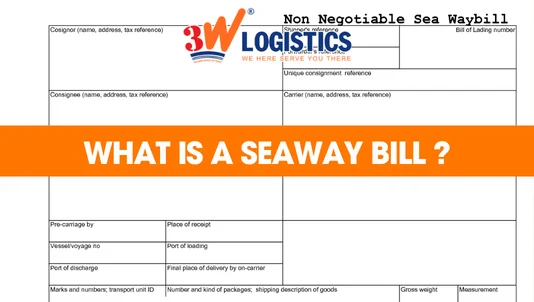
Seaway Bill (Sea Waybill) also known as a non-negotiable sea transport document is a type of maritime transport document that does not function as a document of title (non-negotiable document). It is issued from the outset with no original copies whatsoever; the consignee simply needs to present an identity document or business registration certificate matching the name on the document to collect the cargo. This solution is increasingly popular in modern international trade, particularly on short intra-Asia routes and in intra-group transactions, where speed of cargo release matters more than document ownership control.
1. What Is a Seaway Bill?
Seaway Bill, formally known as a Sea Waybill (SWB), is also referred to as an Express Release B/L, Express B/L, Waybill, or in some cases a Non-negotiable B/L in the international logistics industry.
At its core, a Seaway Bill is evidence of the contract of carriage and a receipt for the goods, but it is not a document of title. This is the most fundamental and important distinction from Bill of Lading.
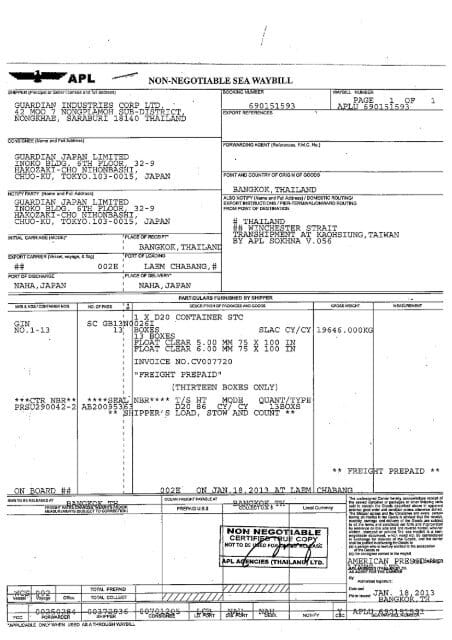
Unlike an Original B/L, which is negotiable and grants whoever holds the original the right to collect the cargo, or a Telex Release – which is the process of issuing originals and then surrendering them for cancellation – a Seaway Bill has no original copies from the very beginning. Cargo is delivered directly to the named consignee without any surrender or courier procedure.
Important note: A Seaway Bill and a Telex Release produce the same practical outcome – the consignee collects the goods without presenting an original B/L. However, the underlying processes are entirely different: a Seaway Bill never has an original copy, while a Telex Release starts with originals which are then cancelled. Confusion between these two concepts is one of the most common mistakes in the logistics industry. Section 5 of this article compares all three types in detail so you can tell them apart clearly.
2. Characteristics and Legal Nature of a Seaway Bill
Logistics professionals need to be well-acquainted with the specific characteristics and legal properties of a Seaway Bill:
| CHARACTERISTIC | DETAILED DESCRIPTION |
|---|---|
| No original copies (Non-negotiable) | No original copies are printed or issued; the document exists solely as a non-negotiable instrument and is typically marked “NON-NEGOTIABLE” on its face. |
| Fixed Consignee (Named Consignee) | The consignee’s name is fixed at the time of issuance and cannot be transferred to a third party by endorsement, unlike an Order B/L. |
| Evidence of Contract of Carriage | A Seaway Bill serves as evidence of the contract of carriage between the shipper and the carrier, and as a receipt confirming the carrier has taken the goods but it does not evidence ownership of the goods. |
| Not a Document of Title | This is the most important legal point: a Seaway Bill does not represent ownership of the goods. No one can pledge or transfer cargo through a Seaway Bill. |
| Shipper’s Right to Change Consignee | The shipper retains the right to instruct the carrier to change the consignee or redirect the cargo, but only before the vessel arrives at the destination port and before the consignee has taken delivery. |
| Immediate Issuance, Immediate Cargo Release | No waiting for courier, no surrender required – as soon as the vessel arrives at the destination port, the consignee can proceed with collection immediately. This is the greatest speed advantage of a Seaway Bill. |
3. When SHOULD and SHOULD NOT You Use a Seaway Bill?
Situations Where You SHOULD Use a Seaway Bill
- Intra-group / intercompany shipments: Transporting goods between a parent company and its subsidiaries, or between branches within the same multinational group – no payment risk, no need to control document ownership.
- 100% T/T payment in advance: When the buyer has paid in full before the goods are shipped, the shipper carries no payment risk and no longer needs to retain control of the cargo through the bill of lading.
- Short intra-Asia routes where cargo arrives before documents: Routes such as Vietnam – China (3–5 days), Vietnam – Singapore (3–4 days), Vietnam – Japan (5–7 days), where cargo typically arrives before original documents can reach the consignee.
- Low-value, low-risk cargo: When the shipment value does not justify the cost and time of processing an original B/L.
- Long-standing, high-trust trading relationships: When both parties have transacted for many years with a strong payment history and high level of mutual trust.
- Perishable goods requiring urgent collection: Fresh produce, pharmaceuticals requiring cold storage, every day of delay in collection is a direct financial loss.
- Cost savings and process simplification: A Seaway Bill incurs no surrender fee (unlike a Telex Release) and no courier cost, making it ideal for businesses with frequent high-volume small shipments.
Situations Where You SHOULD NOT Use a Seaway Bill
- L/C (Letter of Credit) payment: Banks operating under UCP 600 standards require a full set of original B/Ls – a Seaway Bill is not accepted for L/C settlement.
- New buyers with no transaction history: High risk of non-payment – retain control of the cargo through an original B/L.
- Selling cargo in transit: A Seaway Bill is non-transferable – it cannot be used to sell goods to a third party while the shipment is at sea.
- High-value cargo with significant dispute risk: For shipments worth millions of USD, an original B/L provides stronger legal recourse in the event of a dispute.
- Importing into markets that require an original B/L: Some countries in the Middle East and Africa have customs regulations requiring an original B/L for import clearance – always confirm with the local partner at the destination country in advance.
- Consignee not yet confirmed: If the final buyer has not been determined at the time of shipment, do not use a Seaway Bill – the consignee is fixed and cannot be changed as flexibly as with an original B/L.
4. The Complete Seaway Bill Issuance and Cargo Collection Process from A to Z
The Seaway Bill process is significantly simpler than an Original B/L or Telex Release because there is no step involving the issuance and handling of original copies:
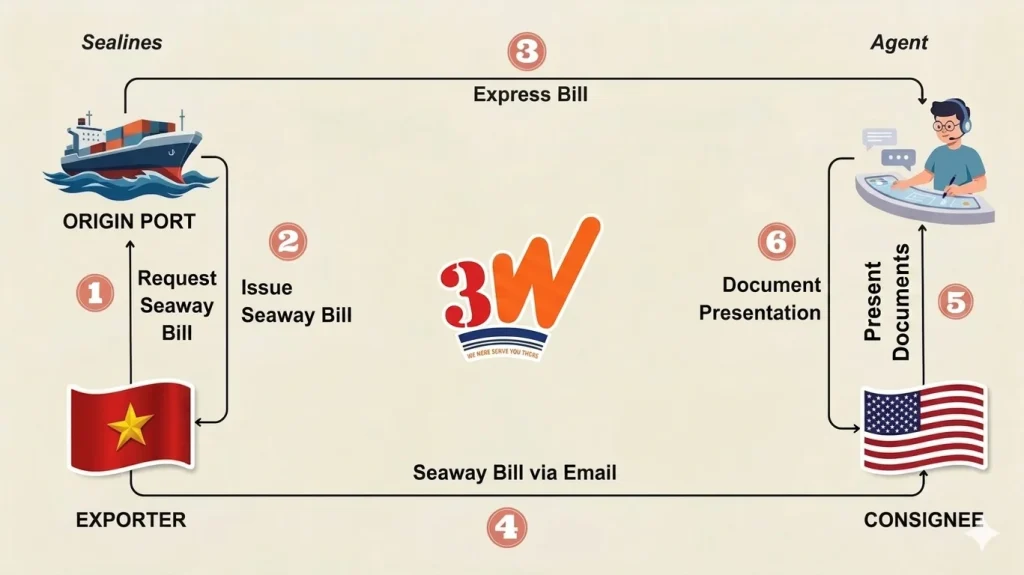
- Shipper and consignee agree to use a Seaway Bill: Both parties align on the document method in the sales contract or Purchase Order. The shipper should confirm that payment has been received or that the credit risk has been accepted before agreeing to use a Seaway Bill.
- Shipper (or forwarder) books the vessel and requests a Seaway Bill: When booking, the shipper clearly specifies issuance of a Seaway Bill (Non-negotiable) instead of an Original B/L. Most major carriers support this option, with some using their own branding such as Express Release (Maersk), SeaWaybill (MSC), or Waybill (CMA CGM).
- The carrier issues the Seaway Bill: After the goods have been loaded on board, the carrier issues the Seaway Bill and sends it to the shipper or forwarder, typically as a PDF via email or through the carrier’s online portal. No physical printed copy is issued.
- Shipper reviews the Seaway Bill: Check all details: cargo description, quantity, consignee name, notify party, port of loading, port of discharge, freight terms, and on-board date. Request an amendment immediately if any errors are found – amending a Seaway Bill is generally simpler than amending an original B/L.
- Shipper sends the Seaway Bill and commercial documents to the consignee: The shipper emails the PDF Seaway Bill along with the Commercial Invoice, Packing List, Certificate of Origin, and any other required documents to the consignee – no courier, no postal service needed.
- Cargo arrives at destination – consignee completes collection procedure: The consignee (or their appointed customs broker) visits the carrier’s local office at the destination port; presents an identity document or business registration certificate matching the consignee name on the Seaway Bill; and collects the Delivery Order (D/O) from the carrier.
- Complete customs formalities and collect cargo: With the D/O in hand, the consignee files the import customs declaration and collects the cargo at the port as normal. The entire process from vessel berthing to receipt of the D/O can be completed within a few hours – significantly faster than waiting for an original B/L sent by courier.
Note on amendments: Unlike an original B/L, which is very difficult to amend once issued and handed to the shipper, a Seaway Bill can be amended more easily since there is no physical copy to retrieve. However, amendments still incur a fee (typically USD 30–80 depending on the carrier) and must be completed before the vessel arrives at the destination port.
5. Comparing Seaway Bill, Telex Release, and Original B/L
This is the comparison table most frequently sought by industry professionals – the three most common document handling methods in international trade, each suited to a different situation.
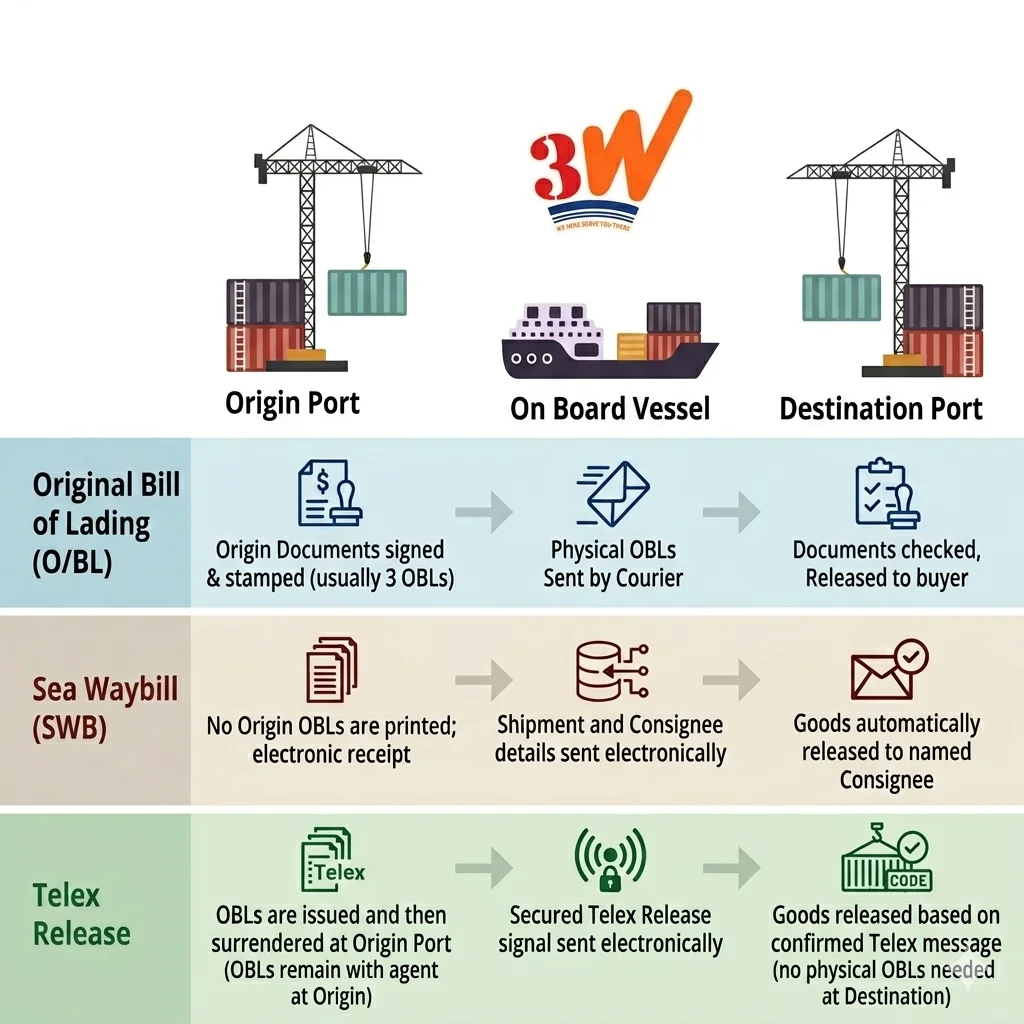
| Criteria | Original B/L | Telex Release | Seaway Bill |
|---|---|---|---|
| Original copies issued? | Yes – 3 originals | Yes, issued → then surrendered and cancelled | No — no originals from the outset |
| Document of Title | Yes – full document of title | Yes before surrender – lost after | No – never a document of title |
| Transferable / Negotiable? | Yes (Order B/L) – by endorsement | Yes before surrender – no after | No – consignee is fixed from the start |
| How to collect cargo at destination | Present original copies to the carrier | Verify identity + carrier telex confirmation | Present ID / business registration only |
| Cargo collection speed | Slowest – wait 3–7 days for courier | Fast – 1–2 days after surrender | Fastest – collect immediately upon vessel arrival |
| Additional costs | Courier fee: USD 30–80 | Surrender fee: USD 50–150 | Typically no additional fees |
| Suitable for L/C payment | Yes – UCP 600 standard | No | No |
| Shipper’s control over cargo | Highest – holding originals = holding control | Completely lost after surrender | Can change consignee before vessel arrives |
| Process complexity | Most complex – multiple handling steps | Medium – surrender required at origin port | Simplest – no special handling steps |
| Best suited for | L/C, new buyers, high-value cargo, long routes | T/T, trusted relationships, document flexibility needed | Prepaid T/T, intra-group, short routes, perishable goods |
A little-known fact about Seaway Bills: Although a Seaway Bill is not a document of title, the shipper retains one important privilege: the right of control, the shipper may instruct the carrier to change the consignee or redirect the cargo to another port at any time before the consignee takes delivery. This distinguishes it from a Telex Release, where the shipper completely loses the ability to intervene in cargo delivery once surrender is completed.
6. Advantages and Limitations of a Seaway Bill
| Advantages | Limitations |
|---|---|
| Fastest of all methods – the consignee can collect cargo as soon as the vessel berths, without waiting for any document procedures. | Not a document of title – cannot be used for L/C settlement or as collateral to pledge cargo for bank financing. |
| Completely eliminates the risk of losing original documents – since no originals exist, there is nothing to misplace, forge, or fall into the wrong hands. | Non-transferable – cargo in transit cannot be sold to a third party through a Seaway Bill. |
| Significant cost savings – no courier fee (USD 30–80), no surrender fee (USD 50–150); especially economical for businesses handling hundreds of shipments per month. | The shipper loses the ability to prevent the consignee from collecting cargo once it arrives at the destination port – if the consignee does not pay, recovering the goods is extremely difficult. |
| Streamlines the logistics process – no surrender step, no courier step, reducing document-handling workload for both shipper and consignee. | Some countries (Middle East, Africa) still require an original B/L for import customs clearance – a Seaway Bill is not accepted in these markets. |
| The shipper retains the right to change the consignee or redirect cargo before the consignee takes delivery – more flexible than a Telex Release in this regard. | Not suitable when the consignee is not yet confirmed at the time of issuance – the consignee name is fixed and difficult to change after issuance. |
| Easier to amend than an Original B/L – no physical copy needs to be retrieved; simply update the carrier’s system. | Lower legal standing than an Original B/L in some international maritime disputes – not the strongest legal instrument available. |
7. Legal Risks When Using a Seaway Bill
A Seaway Bill offers considerable convenience, but also comes with important legal and practical risks that shippers must carefully consider:
Payment Risk
This is the greatest risk when using a Seaway Bill. Since no original copies exist, the shipper has no legal instrument to prevent the consignee from collecting the cargo, even if payment has not been made. Once the cargo arrives at the destination port and the consignee can prove their identity matches the name on the Seaway Bill, the carrier is obligated to release the goods. The shipper cannot instruct the carrier to withhold the cargo except by court order.
Risk of Consignee Insolvency
If the consignee becomes insolvent or faces legal proceedings after the cargo has arrived at the destination port but before collection, the goods may be frozen by a court or the consignee’s creditors. In such cases, the shipper still has some protection through the right of control, but must act quickly before the consignee actually takes delivery.
Seaway Bill and L/C Payment
| Risk Scenario | Analysis and Key Notes |
|---|---|
| Using a Seaway Bill for an L/C transaction | Never do this. Under UCP 600 (the international L/C standard), banks only accept a full set of original B/Ls. A Seaway Bill will be rejected – the shipper will not be paid even though the goods have been delivered. |
| Consignee collects goods then refuses to pay | With a Seaway Bill, once the goods are in the consignee’s hands, the shipper loses all control. The dispute can only be resolved through civil litigation – costly and time-consuming, with no guarantee of recovering the payment. |
| Importing into a country that requires an original B/L | Some countries (Saudi Arabia, Nigeria, parts of North Africa) require an original B/L for import customs clearance. Using a Seaway Bill may cause the cargo to be held at the destination port, incurring demurrage and storage charges. |
| International maritime disputes | In common law court disputes involving cargo damage or shortage, an Original B/L typically carries stronger legal weight than a Seaway Bill. For high-value shipments or routes with a history of disputes, this warrants careful consideration. |
| Using a B/L as collateral for financing | Banks do not accept a Seaway Bill to pledge cargo as security for working capital loans – only an Original B/L can be used as collateral. |
Safe practice principle for using a Seaway Bill: Only use a Seaway Bill when at least one of the following three conditions is met: (1) payment has been received in full before the goods are shipped, (2) this is an intra-group transaction with no payment risk, or (3) the trading relationship has been verified over many years of transactions with a formal credit line in place. In any other situation, an Original B/L or at minimum a Telex Release with confirmed T/T payment – is the safer choice.
Frequently Asked Questions About Seaway Bills
What is a Seaway Bill and how does it differ from an original B/L?
How does a Seaway Bill differ from a Telex Release?
Can a Seaway Bill be used for an L/C transaction?
Does a Seaway Bill incur any fees? How much does it cost?
Can the shipper change the consignee on a Seaway Bill after it has been issued?
Are a Seaway Bill and an Express Release the same thing?
9. Conclusion
In summary, a Seaway Bill is a modern, simple, and efficient transport document solution for international trade transactions with a high degree of trust:
- No originals from the outset – the fastest and most cost-effective document handling method; the consignee can collect cargo as soon as the vessel berths.
- Not a document of title – cannot be used for L/C payment or transferred; only suitable for T/T and high-trust transactions.
- The shipper retains the right of control before the consignee takes delivery – more flexible than a Telex Release in this respect.
- Clearly distinguish from a Telex Release: a Seaway Bill never has originals; a Telex Release starts with originals which are then cancelled.
- The primary risk is loss of payment control – use only when payment has been received, it is an intra-group transaction, or the trading relationship has been thoroughly verified.
How Does 3W Logistics Support Its Clients?
Whether you are trading under T/T, L/C, or Open Account terms, choosing the right document method — Seaway Bill, Telex Release, or Original B/L and executing it correctly is what determines whether your cargo arrives on time and both parties’ interests are protected. 3W Logistics provides comprehensive support:
- Document method consultation: Based on your payment terms, trade route, relationship with your partner, and shipment value, the 3W team advises whether to use a Seaway Bill, Telex Release, or Original B/L to avoid the risk of losing cargo control or having an L/C payment rejected.
- Fast Seaway Bill issuance and processing: We coordinate with the carrier to issue the Seaway Bill with accurate information and deliver it to the consignee in time for them to prepare for collection as soon as the vessel arrives.
- Timely amendment support: We identify and resolve errors on the Seaway Bill promptly before the vessel reaches the destination port, helping avoid delays in cargo collection and demurrage charges.
- L/C and Original B/L document coordination: For L/C transactions, 3W assists in preparing a full set of original B/Ls in compliance with UCP 600 requirements and reviews them before presentation to the bank.
- Risk advisory and shipper protection: Especially for clients transacting with a new partner or entering a new market for the first time, 3W advises on the safest document control method available.
- End-to-end import/export document handling: From B/L and Certificate of Origin to electronic customs declarations and the full international payment document set – 3W supports you from A to Z.
A note from 3W Logistics’ practical experience: The most common mistake we encounter is businesses using a Seaway Bill with a new partner simply because the partner requests it – the usual justification being “it’s a short route, the cargo arrives faster than the documents, it’s more convenient.” When that partner then refuses to pay after collecting the goods, the shipper has no legal instrument left to hold the cargo. A Seaway Bill is an excellent tool in the right situation, but using it in the wrong situation can cause irreversible financial loss. Contact 3W Logistics for advice on the most appropriate document method for each shipment.

Ms. Apple is the CCO (Chief Commercial Officer) at 3W Logistics, with over 10 years of experience in sales and business operations management.
At 3W Logistics, Ms. Apple is responsible for commercial strategy, corporate customer development, managing a team of more than 50 sales professionals, and improving business performance in the logistics sector.
With practical experience in sales management and market development, Ms. Apple shares professional insights on business logistics solutions, international transportation, freight forwarding, customer management, trade lane development, and growth strategies in the logistics industry.


