

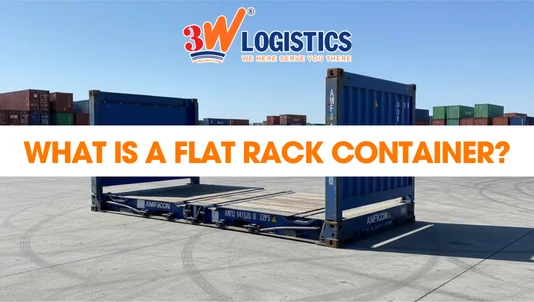
What Is a Flat Rack Container? Structure and practical applications
Flat rack container, also known as a Flat Rack Container (FR), is a specialized type of container with no roof and no side walls — only a solid steel floor and two fixed ends (or collapsible ends) — engineered specifically to transport oversized, overweight, and bulky cargo that cannot be loaded into a standard container from any direction. It is the most “open” container in the specialized container range, allowing cargo access from the top, both sides, and both ends.
1. What Is a Flat Rack Container?
A flat rack container is officially known as a Flat Rack Container, abbreviated as FR or cont FR in the logistics industry. It is a specialized variant of shipping containers, designed to solve the problem of cargo whose dimensions exceed the limits of any other container type – including the Open Top Container.
Unlike a standard container or an open top container — both of which still have side walls that restrict cargo width a flat rack container retains only the steel floor and two end walls, allowing cargo to protrude on both sides (over-width), extend upward with no height restriction from walls or roof (over-height), and with the foldable end type, even protrude beyond both ends of the container (over-length).
In Vietnam’s logistics industry, flat rack containers are commonly referred to as cont FR, container FR, flat bed container, or sometimes open-side container – although “open-side” more accurately refers to the Open Side Container, which is a separate container type altogether.
Common misconception: Many people in the industry – including experienced logistics professionals – often confuse Flat Rack Containers with Platform Containers. The two look very similar in photos because both are “flat,” both have no roof and no side walls. However, they are two entirely different container types in terms of structure, load capacity, and practical application. Section 6 of this article provides a detailed comparison so you’ll never mix them up again.
2. Detailed Structure of a Flat Rack Container
Primary material: Corten A/B steel (weathering steel) a special steel that naturally forms a protective rust layer on its surface, offering high corrosion resistance in marine environments without the need for continuous painting.
A flat rack container is made up of the following main components:
| COMPONENT | DETAILED DESCRIPTION |
|---|---|
| Load-bearing steel floor | Thick steel plate capable of withstanding extremely high concentrated loads; features a dense array of lashing rings distributed along the perimeter and center of the floor |
| Fixed end walls | Rigid steel walls at both ends of the container, bearing longitudinal forces and preventing cargo from sliding forward or backward during transport |
| Foldable end walls – optional | End walls that fold flat onto the floor, allowing multiple FR containers to be joined end-to-end for extra-long cargo, or folded flat when empty to save stacking space |
| Corner castings | 8 ISO-standard corner fittings at the 4 top and 4 bottom corners, enabling stacking, securing the container on vessels, and connecting to specialized lifting equipment (spreader bars) |
| Longitudinal and cross floor beams | I/H-section steel beam system reinforcing the underside of the floor, distributing concentrated loads from heavy cargo |
| Lashing rings & D-rings | Steel cargo securing rings welded firmly to the floor and end walls, each capable of withstanding up to 10 tonnes of pull force, arranged in accordance with ISO standards |
Two Common Types of Flat Rack
1. Fixed End Flat Rack (Fixed FR): End walls cannot be folded. More rigid, higher load capacity, more commonly available at depots in Vietnam. Suitable for cargo that does not protrude beyond the container length.
2. Foldable/Collapsible Flat Rack (Collapsible FR): End walls fold flat onto the floor. When empty, multiple containers can be folded and stacked together – typically 5 collapsible FRs equal the volume of 1 standard 20ft dry container. More flexible but rental costs are 10–20% higher.
3. Flat Rack Container Sizes
20-Foot Flat Rack Container
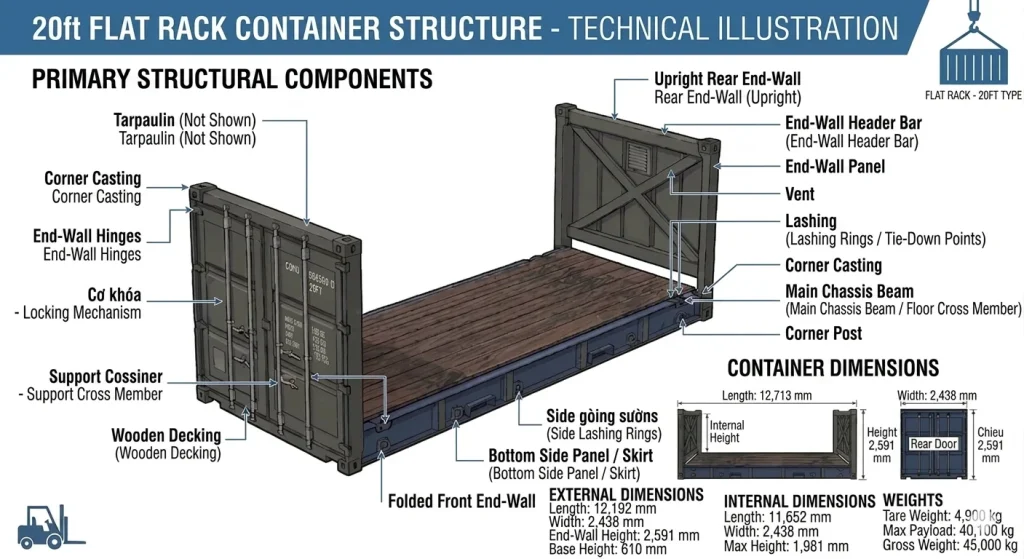
| Specification | FR 20FT Container | Practical Notes |
|---|---|---|
| External length | 6,058 mm (20′) | 20ft = 1 TEU (freight unit) |
| External width | 2,438 mm (8′) | ISO standard width — cargo may protrude wider |
| Floor height | ~210–250 mm | Height from ground level to the surface of the container floor |
| Fixed end wall height | ~2,233 mm | End wall height measured from the container floor |
| Internal floor length | ~5,620 mm | Usable distance between the two end walls |
| Internal floor width | ~2,228 mm | Actual usable floor width for cargo placement |
| Maximum payload | ~28,000–30,000 kg | Significantly higher than a standard 20ft dry container (~21,700 kg) |
| Tare weight | ~2,700–3,000 kg | Varies by manufacturer and whether fixed or collapsible FR |
| Stacking load | ~86,000 kg | Maximum stacking load on top of the container |
40-Foot Flat Rack Container
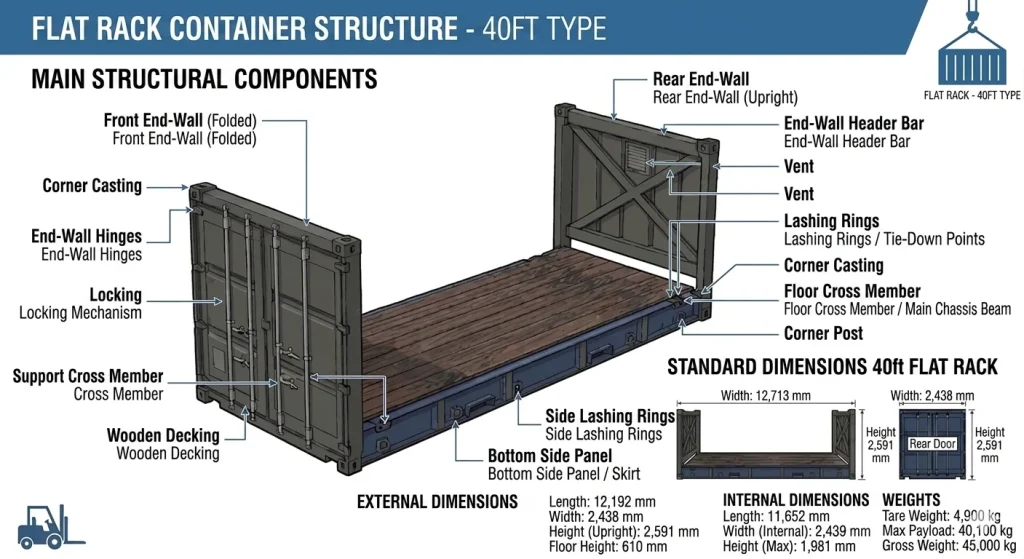
| Specification | FR 40FT Container | Practical Notes |
|---|---|---|
| External length | 12,192 mm (40′) | 40ft = 2 TEU (freight unit) |
| External width | 2,438 mm (8′) | ISO standard width |
| Floor height | ~210–250 mm | Equivalent to the 20ft FR |
| Fixed end wall height | ~2,014 mm | Slightly lower than the 20ft FR |
| Internal floor length | ~11,784 mm | Suitable for long cargo such as steel beams, large pipes, and wind turbine blades |
| Internal floor width | ~2,228 mm | Same for both 20ft and 40ft |
| Maximum payload | ~40,000–45,000 kg | Highest payload capacity among standard container types |
| Tare weight | ~5,000–5,500 kg | Heavier due to thicker floor and more reinforcement beams |
| Stacking load | ~86,000 kg | Same for both 20ft and 40ft |
Practical note on payload: The 40ft FR container can carry up to ~40-45 tonnes, but road transport regulations in Vietnam generally cap the total load at ~30 tonnes (vehicle + cargo + container). To transport cargo exceeding this limit by road, a special overweight vehicle permit must be obtained before moving the shipment.
4. Advantages and Limitations of Flat Rack Containers
| ✅ Advantages | ❌ Limitations |
|---|---|
| Cargo can be accessed from all directions: top, both sides, and both ends (collapsible FR) – maximum loading and unloading flexibility | Highest rental cost among container types 30–50% more expensive than a standard dry container |
| Allows cargo to protrude in both width and height (over-width, over-height) – handles shipments that even OT containers cannot accommodate | No weather protection whatsoever – cargo sensitive to rain, wind, or dust must be thoroughly wrapped before loading |
| Highest payload in the standard container range (40ft FR can reach ~40–45 tonnes) ideal for super-heavy cargo | Cargo protruding outside (over-width/over-height) incurs additional surcharges from shipping lines (Overwidth/Overheight Surcharge) and requires special declarations |
| Dense, high-capacity lashing ring system secures super-heavy cargo safely throughout the entire sea voyage | FR availability at depots in Vietnam is very limited booking 1–2 weeks in advance is typically required; 40ft FRs are scarcer than 20ft FRs |
| Collapsible FRs can be stacked 5-to-1 when empty significantly reducing the cost of returning empty containers to depots | Requires professional lashing techniques improper securing can result in cargo damage or serious accidents |
| Universally accepted under ISO standards worldwide suitable for multi-country import/export operations | Not suitable for standard boxed goods, liquids, temperature-sensitive cargo, or high-value goods prone to theft |
Practical note: With FR containers, the true cost of a shipment is often significantly higher than the container rental alone. OOG surcharges from the shipping line, professional lashing service fees, weather-protection wrapping, oversize road transport permits, and specialized cargo insurance all need to be factored into the total shipment cost from the very beginning.
5. What Types of Cargo Are Suitable for Flat Rack Containers?
Cargo RECOMMENDED for Flat Rack Containers
| Cargo Type | Specific Examples | Why It’s Suitable |
|---|---|---|
| Vehicles and heavy machinery | Trucks, agricultural tractors, road rollers, small to medium bulldozers | Vehicles can be driven on/off from both ends (collapsible FR); vehicle width often exceeds 2.4m |
| Structural steel | H-beams, large I-beams, steel structural frames, steel columns | Longer and wider than even a standard 40ft container; must be lifted from above |
| Super-heavy industrial equipment | Industrial reactors, large boilers, giant generator housings | Exceeds both the height and width of any standard container; FR payload is sufficient |
| Renewable energy equipment | Wind turbine blades, segmented turbine tower sections, large solar panel frames | Extreme dimensions; cannot be handled by any other conventional method |
| Port and construction equipment | Crane buckets, crane booms, large scaffolding frames, precast concrete elements | Irregular shapes that cannot fit into any walled container type |
| Large steel coils and pipes | Hot-rolled steel coils weighing 20–30 tonnes, steel pipes with diameter over 1.5m | Exceeds the payload of dry and OT containers; pipe diameter protrudes beyond container width |
| Boats and watercraft | Sailboats, motorboats, small work vessels, fiberglass boat hulls | Width exceeds standard container; requires crane lift from both sides |
Cargo NOT RECOMMENDED for Flat Rack Containers
- Standard boxed cargo (cartons, pallets): A standard dry container is both cheaper and offers better cargo protection using an FR for boxed goods is a serious waste of resources.
- Weather-sensitive cargo (electronics, pharmaceuticals, food): FRs provide zero protection against rain, moisture, or temperature – enclosed containers or reefer containers are mandatory.
- Liquid and bulk cargo: The flat floor has no enclosed walls – it is entirely unsuitable for liquids or bulk cargo.
- High-value, theft-prone goods: There is no security whatsoever – electronics, jewelry, and luxury goods should absolutely never be shipped on an FR.
- Cargo that fits in an Open Top Container: If the cargo only exceeds height but still fits within the container’s width, consider an OT Container first – it is cheaper and provides better cargo protection.
6. Flat Rack vs. Platform Container: Stop Confusing Them
This is one of the most common mix-ups in Vietnam’s logistics industry. At first glance, a Flat Rack Container and a Platform Container look nearly identical both have no roof, no side walls, and both appear to be “just a flat platform.” However, the two types are fundamentally different in terms of structure, load capacity, and practical use.
What Is a Platform Container (PL)?
A Platform Container (abbreviated: PL or Platform Flat) consists of nothing more than a completely flat steel floor – no end walls, no side edges, no vertical structure of any kind. It is essentially an “ISO-standard steel platform” with corner castings at the four corners, allowing it to be connected, secured, and stacked in accordance with international container standards.
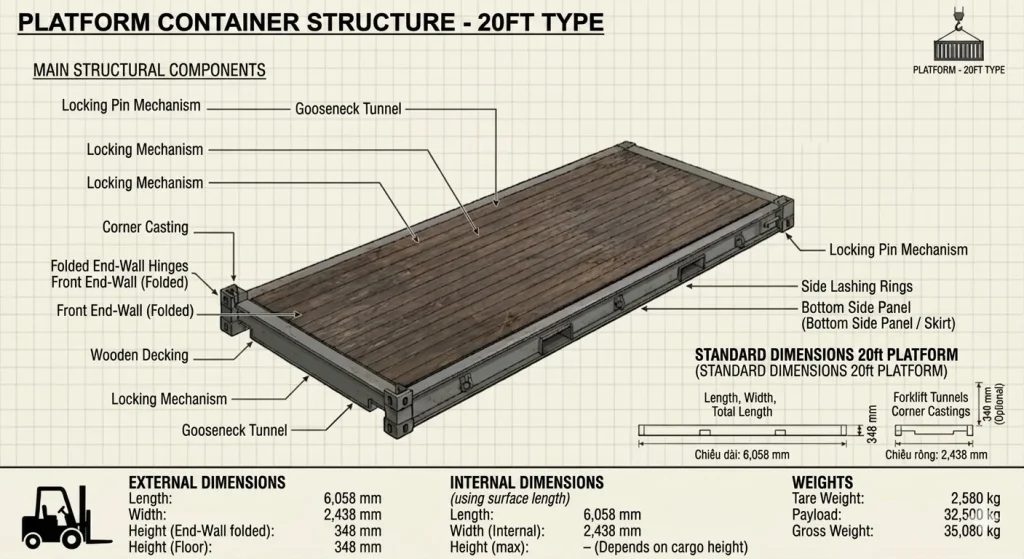
Platform Containers are designed for special cargo that even a Flat Rack cannot accommodate, because the FR’s end walls still get in the way. It is the most stripped-down container type possible — nothing but a floor with corner castings.
Typical applications of Platform Containers:
- Transporting enormous industrial modules (offshore modules, refinery skids) whose dimensions exceed all conventional limits
- Joining multiple platforms end-to-end to create a transport base for extremely long cargo
- Serving as a temporary lifting platform at ports or job sites for extremely heavy equipment
- Transporting bridge components, oversized bridge girders
Detailed Comparison: Flat Rack vs. Platform Container
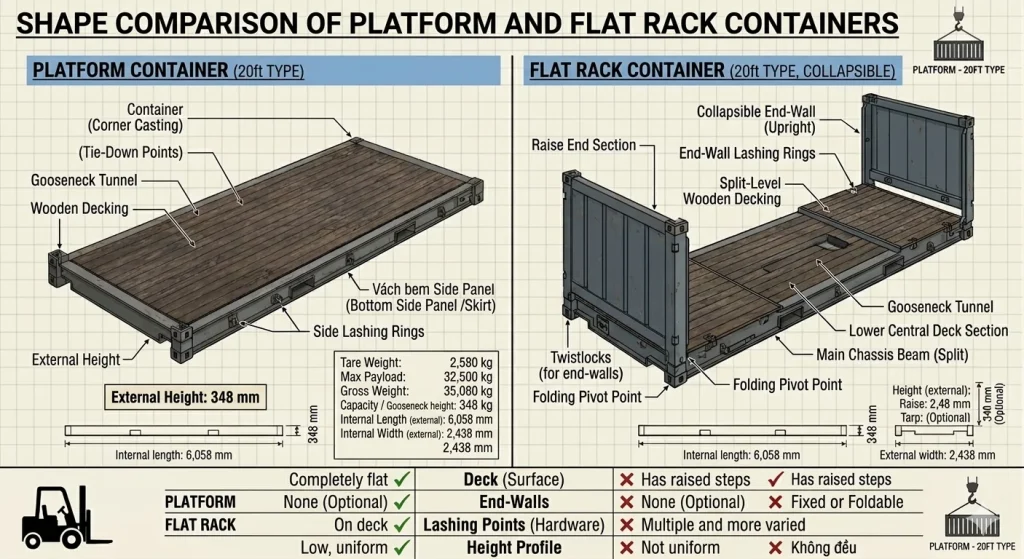
| Criteria | Flat Rack (FR) | Platform (PL) |
|---|---|---|
| Structure | Floor + 2 end walls (fixed or foldable) | Floor + corner castings only – NO end walls |
| Cargo length limit | Cargo may protrude beyond the floor (collapsible FR); end walls still impose some restriction | No limit – cargo can protrude freely from both ends |
| Cargo securing capability | Better: lashing rings on both the floor AND the end walls, providing more anchor points | More limited: lashing rings on the floor only |
| Typical payload (40ft) | ~40,000–45,000 kg | ~45,000–65,000 kg (depending on specialized design) |
| Availability in Vietnam | Relatively common – available at major depots | Very rare – primarily used in EPC and oil & gas projects |
| Relative rental cost | High (30–50% more than a dry container) | Very high – typically project-based, no fixed list price |
| Weather protection | No protection (cargo must be thoroughly wrapped) | No protection (cargo must be thoroughly wrapped) |
| Empty stacking capability | Collapsible FR: stack 5 units = 1 dry container; Fixed FR: cannot be stacked | Multiple units stack easily (no end walls to obstruct) |
| Primary applications | Vehicles, industrial machinery, structural steel, construction equipment | Massive industrial modules, super-long beams, EPC/oil & gas projects |
The bottom line to avoid confusion: Flat Rack has end walls (even if they fold down); Platform does not. Flat Rack is for standard heavy commercial cargo; Platform is reserved for extraordinary project cargo. If you are shipping machinery, vehicles, or structural steel, you almost certainly need a Flat Rack not a Platform.
7. Flat Rack vs. Other Container Types
| Criteria | Dry Container | Open Top (OT) | Flat Rack (FR) | Platform (PL) |
|---|---|---|---|---|
| Has a roof | Yes (steel) | Tarpaulin (removable) | No roof | No roof |
| Has side walls | Yes (steel) | Yes (steel) | No side walls | No side walls |
| Has end walls | Yes (+ rear doors) | Yes (+ rear doors) | Yes (fixed or foldable) | No end walls |
| Over-width cargo | Not possible | Not possible | Allowed | Allowed |
| Over-height cargo | Not possible | Allowed (tarp draped over cargo) | Allowed | Allowed |
| Max payload (40ft) | ~26,700 kg | ~26,700 kg | ~40,000–45,000 kg | ~45,000–65,000 kg |
| Relative rental cost | Lowest (baseline) | +15–25% | +30–50% | Highest – project-based |
| Availability in Vietnam | Very common | Common | Available but limited | Very rare |
The right container selection rule: If cargo fits through the rear doors → use a dry container. If cargo is too tall but fits within the width → use an Open Top (OT). If cargo is too wide or needs side access → use a Flat Rack. If cargo is too large even for a Flat Rack → it’s time for a Platform or a special project transport solution.
8. How to Load Cargo onto a Flat Rack Container Correctly
- Inspect the container before loading: Check the entire floor for cracks or deformation; ensure all lashing rings are intact and secure; confirm that end walls (for fixed FR) are not bent or warped; verify corner castings are undamaged.
- Calculate and plan load distribution: Weight must be distributed evenly across the entire floor. Do not concentrate the full load on a single point – check the floor’s point load specifications before loading heavy metal cargo.
- Lay dunnage and cushioning: Place hardwood dunnage boards or timber planks under the cargo to distribute the load, prevent sliding, and protect the container floor. For vehicles, use dedicated wheel chocks.
- Load cargo using appropriate equipment: Use a crane with a spreader bar to lift cargo evenly on both sides; or drive/push cargo on from both ends (collapsible FR). Always have a signal man guiding the lift – no one should stand under a suspended load.
- Secure the cargo (lashing): Use lashing straps, chain lashing, or wire rope lashing depending on cargo weight. The minimum number of securing points must comply with the IMO CTU Code: total lashing force ≥ cargo weight × vessel acceleration factor. Secure cargo in all three directions: longitudinal, transverse, and diagonal.
- Wrap and protect the cargo: Wrap the cargo in PE film, non-woven fabric, or specialized tarpaulin before lifting onto the container. Use rubber or wooden padding at all contact points between the cargo and lashing to prevent scratches.
- Final check before departure: All lashing is tight with no slack; cargo does not shift when gently pushed; any protruding cargo has been marked with signal flags per regulations; record all protrusion dimensions (over-width, over-height, over-length) for declaration to the shipping line.
9. Transport Considerations for Flat Rack Containers
Road Transport
When transporting a flat rack container by truck within Vietnam:
- Overall dimension limits: Total height (vehicle + container + cargo) must not exceed 4.2 m; total width must not exceed 2.5 m; total length must not exceed 20 m – a permit is required if any of these limits are breached.
- Oversize/overweight vehicle permit: Applications must be submitted to the provincial Department of Transport or the Vietnam Roads Administration at least 5–7 working days in advance. For extremely large cargo, an advance route survey may also be required.
- Escort vehicles (pilot cars) and police escorts: Mandatory for cargo exceeding certain size thresholds; some routes require a police escort during peak hours.
- Time-of-day restrictions: Oversized and overweight loads are typically only permitted to move at night or in the early morning on many urban roads.
Sea Transport
- Out of Gauge (OOG) declaration: Exact protrusion dimensions (in mm) for height, width, and length must be declared in the booking note and Bill of Lading (B/L). Discrepancies in the declared dimensions can result in the cargo being refused at the time of loading.
- OOG surcharges: Shipping lines charge separate surcharges for each dimension of protrusion: Overheight Surcharge (OHS), Overwidth Surcharge (OWS), and Overlength Surcharge (OLS). These surcharges can add up considerably – always request a quote from the shipping line early.
- Position on the vessel: FR containers with OOG cargo must be stowed on deck – they cannot be stowed in the ship’s hold. This increases exposure to sea spray and salt water; cargo must be wrapped more carefully than standard shipments.
- Cargo insurance: Marine insurance under ICC (A) clauses is strongly recommended for cargo on FR containers – ICC (C) is not advisable given the significantly higher risk of impact damage and weather exposure compared to enclosed containers.
- Shipping line OOG acceptance: Not all shipping lines accept OOG cargo on every route. Confirm the OOG limits a shipping line will accept before signing a sales contract with your counterpart.
Frequently Asked Questions About Flat Rack Containers
How is a flat rack container different from a standard container?
What is the maximum load capacity of a 40ft flat rack container?
What is the difference between a flat rack container and a platform container?
Can cars or machinery be shipped on a flat rack container?
Should I choose a 20ft or 40ft flat rack container?
How much does it cost to rent a flat rack container per month?
10. Conclusion
In summary, flat rack containers are an indispensable transport solution for special cargo logistics:
- No roof and no side walls – cargo can protrude in both width and height, handling shipments that Open Top (OT) containers still cannot accommodate
- Available in 2 main sizes (20ft and 40ft) with superior payload: ~28–30 tonnes for 20ft and ~40–45 tonnes for 40ft
- Clearly distinct from Platform Containers: FR has end walls, PL does not; FR is more widely available and suited to standard heavy commercial cargo
- Actual total costs include OOG surcharges, lashing services, and transport permits – all must be calculated from the outset
- All cargo on FR containers must be thoroughly wrapped before loading, as there is absolutely no weather protection
How Does 3W Logistics Support Customers?
Whether you are exporting industrial machinery, heavy vehicles, structural steel, or renewable energy equipment, choosing the right flat rack type, accurately calculating OOG surcharges, and preparing the correct lashing technique are decisions that directly impact the cost and safety of every shipment. 3W Logistics provides comprehensive support across every aspect of flat rack container logistics:
- Container type advisory: Based on actual cargo dimensions, weight, and characteristics, the 3W team advises whether to use a 20ft FR, 40ft FR, collapsible FR, or fixed FR or whether an OT container might be sufficient to reduce costs.
- FR container booking and vessel scheduling: 3W works directly with major shipping lines to book FR containers on time, confirm OOG acceptance limits on each route, and obtain accurate OOG surcharge quotes before the customer commits.
- Lashing technical support and heavy lift advisory: Guidance on safe lifting methods, the minimum number of securing points per IMO CTU Code standards, and the right type of lashing for the cargo weight and type ensuring cargo does not shift throughout the sea voyage.
- Full customs and documentation handling: Including OOG cargo declarations, certificate of origin (CO), phytosanitary permits (for used machinery), and preparation of a complete international payment document set.
- Container transport from warehouse to port: Coordinating suitable trailer trucks, arranging oversize transport permits, and organizing escort vehicles where required ensuring the FR container arrives at the port before the CY Closing Time.
- Shipment tracking and real-time updates: Regular tracking updates on vessel position, transit ports, and estimated ETA so customers can proactively arrange cranes, receiving equipment, and notifications to consignees.
A note from 3W Logistics’ practical experience: Many businesses using flat rack containers for the first time are surprised by a total cost far higher than initially expected because they failed to account for OOG surcharges from the shipping line, professional lashing service fees, weather-protection wrapping, and oversize road transport permits. Conversely, a number of cases involve using an FR when an OT container would have been entirely sufficient and considerably cheaper. To avoid both situations, contact 3W Logistics for the right advice from the start.
Address: 34 Bach Dang Street, Tan Son Hoa Ward, Ho Chi Minh City
Hotline: +84 28 3535 0087
____________________________
3W Logistics Hanoi Branch
Address: 81A Tran Quoc Toan Street, Cua Nam Ward, Hanoi
Hotline: +84 24 3202 0482
____________________________
3W Logistics Hai Phong Branch
Address: 8A, Lot 28, Le Hong Phong Street, Gia Vien Ward, Hai Phong
Hotline: +84 225 355 5939
____________________________
3W LOGISTICS CO., LTD – We here serve you there!
Email: quote@3w-logistics.com
Website: www.3w-logistics.com

Ms. Apple is the CCO (Chief Commercial Officer) at 3W Logistics, with over 10 years of experience in sales and business operations management.
At 3W Logistics, Ms. Apple is responsible for commercial strategy, corporate customer development, managing a team of more than 50 sales professionals, and improving business performance in the logistics sector.
With practical experience in sales management and market development, Ms. Apple shares professional insights on business logistics solutions, international transportation, freight forwarding, customer management, trade lane development, and growth strategies in the logistics industry.


