

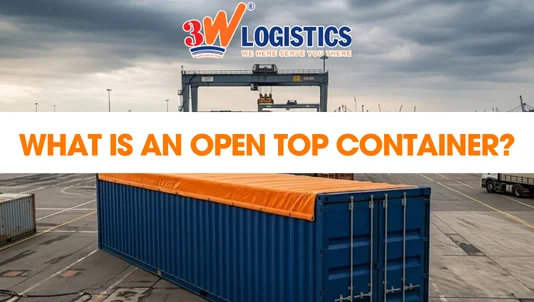
What Is an Open Top Container? Structure, role, and practical applications
Open Top Container (OT) is a type of shipping container with no fixed roof, instead covered by a removable waterproof tarpaulin. This design allows cargo to be loaded from above using a crane, making it ideal for oversized, extra-long, or heavy cargo such as industrial machinery, construction equipment, granite slabs, logs, or any goods that exceed the height of a standard container door.
1. What Is an Open Top Container?
Open Top Container, commonly abbreviated as OT or cont OT in the logistics industry, is a special variant of the standard dry container designed to solve the challenge of loading cargo that is too tall to fit through the rear doors.
Unlike a standard dry container with a fixed steel roof, or a reefer container with a refrigeration system, the open top container uses a bow/hoop system – removable curved steel arches – combined with a waterproof tarpaulin that covers the entire top opening.
Thanks to this structure, cargo can be lifted from above using a crane or rigging equipment, rather than being pushed or pulled through the rear doors as with a standard container. Other specialized container types include Flat Rack containers and tank containers designed for specific cargo needs.
2. Detailed Structure of an Open Top Container
Primary material: Corten A/B steel (also known as weathering steel) – a special steel that forms a protective rust layer on its surface, preventing deeper corrosion without the need for continuous paint coating.
An open top container is composed of 6 main components:
| COMPONENT | DETAILED DESCRIPTION |
|---|---|
| Load-bearing steel frame | Made from Corten steel (weather-resistant, high corrosion resistance), capable of bearing stacking loads up to 192 tonnes |
| Side panels | Corrugated steel panels that increase rigidity without adding significant weight |
| Steel floor | Steel plate or hardwood-covered steel, capable of bearing concentrated loads, equipped with lashing rings for cargo securing |
| Bows/Hoops | System of approximately 12 curved arch-shaped steel bars, removable for flexible loading and unloading |
| Waterproof tarpaulin | Heavy-duty canvas or PVC tarpaulin covering the entire top opening, secured with straps and buckles |
| Rear doors | Two steel doors with rubber gaskets, openable for rear cargo access |
3. Open Top Container Size Classifications
20-Foot Open Top Container
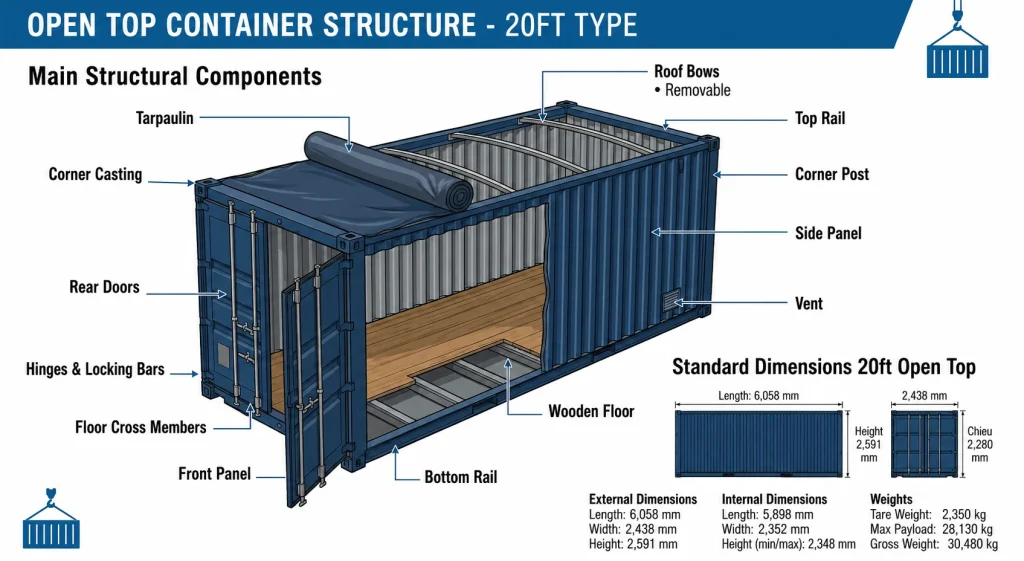
| Specification | 20FT Container (TEU) | Practical Notes |
|---|---|---|
| External length | 6,058 mm (20′) | 20ft = 1 TEU (freight unit) |
| External width | 2,438 mm (8′) | Standard ISO width |
| External height | 2,591 mm (8’6″) | Taller variant is High Cube (9’6″) |
| Internal length (usable) | ~5,895 mm | Minus front wall and rear door thickness |
| Internal width (usable) | ~2,350 mm | Minus side wall thickness on both sides |
| Internal height (at rear door) | ~2,280 mm | Usable interior height |
| Maximum payload | ~21,700 kg | Varies per unit — check CSC plate |
| Tare weight | ~2,300 kg | Weight of empty container |
| Capacity (CBM) | ~32.5 m³ | Usable interior volume |
Road transport height note: Cargo loaded in a 20ft OT container must not exceed 3.5 m measured from the container floor when transported by road (total height of vehicle plus cargo must not exceed 4.2 m).
40-Foot Open Top Container
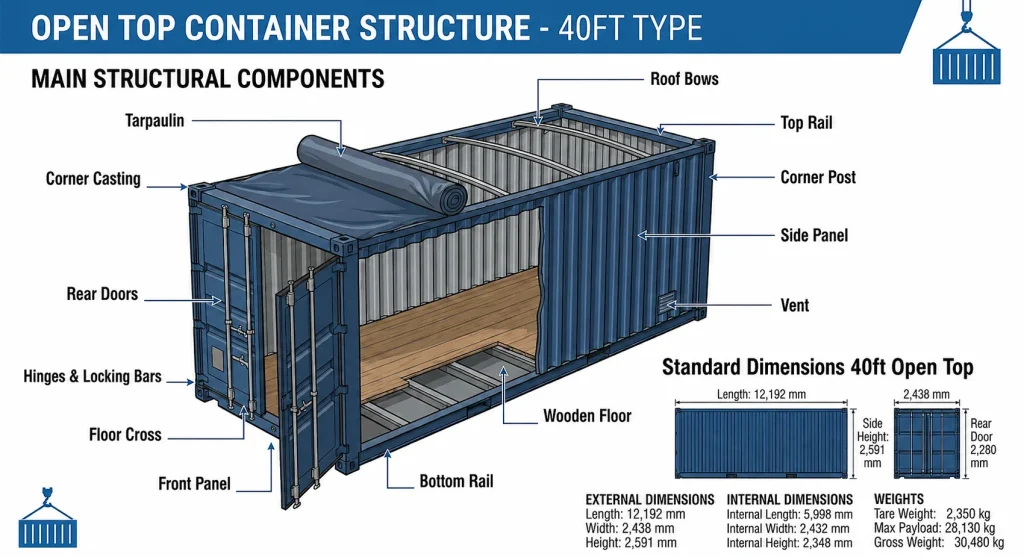
| Specification | 40FT Container (FEU) | Practical Notes |
|---|---|---|
| External length | 12,192 mm (40′) | 40ft = 2 TEU (freight unit) |
| External width | 2,438 mm (8′) | Same width for both 20ft and 40ft |
| External height | 2,591 mm (8’6″) | Taller variant is High Cube (9’6″) |
| Internal length (usable) | ~12,032 mm | Minus front wall and rear door thickness |
| Internal width (usable) | ~2,350 mm | Minus side wall thickness on both sides |
| Internal height (at rear door) | ~2,280 mm | Usable interior height |
| Maximum payload | ~26,700 kg | Varies per unit — check CSC plate |
| Tare weight | ~3,900 kg | Weight of empty container |
| Capacity (CBM) | ~65 m³ | Twice the volume of a 20ft OT |
40-Foot High Cube Open Top Container
The 40ft High Cube Open Top (40’HC OT) has an external height of 2,896 mm (9’6″) — 305 mm taller than the standard OT. The key advantage is a greater allowable cargo height, though rental/purchase costs are typically 10–15% higher than the standard 40ft OT. This variant is less common in the Vietnamese market.
4. Advantages and Limitations of Open Top Containers
| ✅ Advantages | ❌ Limitations |
|---|---|
| Top-loading via crane allows handling of cargo too tall for rear doors | Rental/purchase cost is 15–25% higher than a standard dry container |
| Accommodates oversized or extra-long cargo that cannot pass through rear doors | Tarpaulin does not seal as completely as a fixed steel roof – moisture-sensitive cargo requires additional packaging |
| Removable bow system offers flexibility to adjust for different cargo heights | Requires specialized lifting equipment (crane) for top loading – adds operational cost |
| Internationally accepted for sea freight under ISO standards | Not suitable for liquid cargo, temperature-controlled goods, or high-value theft-prone items |
| Suitable for both import/export and domestic transport as well as temporary storage | OT container availability at depots is lower than dry containers – advance booking required |
| Floor lashing rings allow secure cargo fastening to prevent movement during transit |
Practical note: Many online resources omit the limitations section. Based on real-world industry experience, we strongly recommend that shippers carefully evaluate the additional costs associated with crane requirements and moisture protection before committing to an OT container.
5. What Types of Cargo Are Suitable for Open Top Containers?
Cargo RECOMMENDED for Open Top Containers
| Cargo Type | Specific Examples | Why It’s Suitable |
|---|---|---|
| Large industrial machinery | Hydraulic presses, casting machines, CNC machines, large diesel engines | Too tall or heavy to push through rear doors |
| Construction equipment | Tower crane components, excavators, small bulldozers | Easier crane loading and unloading |
| Block-form building materials | Large granite slabs, marble tiles, stone blocks | Top-loaded using crane or chain hoist |
| Logs and round timber | Acacia, rubber, eucalyptus logs | Length exceeds what can pass through rear doors |
| Steel coils, beams, and pipes | Hot/cold-rolled steel coils, H-beams, large steel pipes | Heavy and long – top lifting is required |
| Large bundled or baled cargo | Industrial cable bundles, raw cotton bales, industrial fabric rolls | Dimensions exceed standard rear door size |
| Bulky raw agricultural goods | Large sugar sacks, bulk rice bales, rubber blocks | Saves loading time with crane handling |
| Energy equipment | Wind turbine blade sections, oversized solar panels | Cannot be handled through conventional loading methods |
Cargo NOT RECOMMENDED for Open Top Containers
- Moisture-sensitive goods (rice, flour, pharmaceuticals): The tarpaulin does not seal completely – risk of moisture infiltration. Standard dry containers are recommended instead.
- Liquid or bulk loose cargo: Liquids and loose granular materials require a fully sealed container or flexi-tank, OT containers are entirely unsuitable.
- Temperature-controlled cargo: Frozen food and cold-chain pharmaceuticals must use reefer containers.
- High-value, theft-prone goods: Electronics, jewelry, and similar items, the tarpaulin top is far more vulnerable to tampering than a fixed steel roof.
6. Open Top Container vs. Other Container Types
| Criteria | Dry Container | Open Top Container (OT) | Flat Rack | Open Side |
|---|---|---|---|---|
| Has a roof? | Yes (fixed steel roof) | Tarpaulin cover (removable) | No roof, no side walls | Steel roof, side walls open |
| Loading method | Through rear doors | From top or through rear doors | From top, both sides, and ends | From both sides or rear doors |
| Suitable cargo | Boxed goods, standard pallets | Tall, bulky, or overweight cargo | Oversized/overweight cargo, vehicles | Side-loaded cargo, long pallets |
| Relative rental cost | Lowest (baseline) | 15–25% higher | 30–40% higher | 20–30% higher |
| Rain protection | Complete (fixed steel roof) | Good (waterproof tarpaulin) | None | Good (has steel roof) |
| Prevalence in Vietnam | Very common | Common | Relatively uncommon | Very rare |
The open top container offers the best balance between loading flexibility and cargo protection for non-standard shipments. Flat Rack is preferable when cargo is too large to fit inside any container walls, while Open Side suits cargo that requires frequent lateral access.
7. Step-by-Step Cargo Loading and Tarpaulin Securing Process
- Inspect the container before loading: Check the floor, side walls, and rear door gaskets. Ensure there are no punctures, cracks, or loose components.
- Prepare the cargo: Package and pre-lash cargo before placing it inside. For heavy metal machinery, place wooden pallets on the floor to prevent sliding.
- Remove the bows/hoops: Remove all or part of the bows depending on cargo height. Store them carefully to avoid bending or warping.
- Lower cargo using crane: Use a crane or chain hoist with the correct rated slings or straps. Safety note: Never stand beneath suspended loads; a designated signal person must be present; verify the crane’s rated capacity before lifting.
- Secure cargo inside the container: Use lashing straps or wire ropes attached to floor and side wall lashing rings. Insert wooden dunnage to prevent shifting of heavy metal cargo.
- Reinstall bows and cover with tarpaulin: Reinstall all bows. Spread the tarpaulin evenly from end to end and tighten all straps and buckles along both sides of the container.
- Inspect tarpaulin before leaving the depot: Ensure it is taut with no folds that could collect rainwater; all buckles and straps are fully tightened; corners and edges are intact, especially where they contact the bow arches; for export shipments, apply lead seals (customs seals) as required.
8. Key Considerations for Open Top Container Transport
Road Transport
When transporting an open top container by truck within Vietnam:
- Height restrictions: Total height of vehicle plus cargo must not exceed 4.2 m on national highways. In practice: container floor height on a trailer is approximately 1.4–1.5 m, so cargo inside the container must be ≤ 2.7 m tall.
- Cargo protruding above the container rim: An Oversize/Overweight Vehicle Permit must be obtained from the provincial Department of Transport (DoT) or Vietnam Roads Administration at least 3–5 working days in advance.
- Escort vehicle (pilot car): Mandatory if cargo exceeds specific dimensional limits under current regulations.
Sea Freight
- Tarpaulin sealing: Before the container is loaded onto the vessel, the tarpaulin must be sealed with lead wire seals as required by the shipping line. Seal numbers must be recorded on the Bill of Lading (B/L).
- Customs declaration: OT containers with cargo overheight (protruding above the container rim) must be declared in the “Marks & Description” field of the B/L, specifying the exact protruding dimensions. Some carriers apply an Overheight Surcharge (OHS).
- Stowage position on vessel: Shipping lines typically stow OT containers on-deck rather than in the hold – increasing exposure to wave action and spray. A secure, well-fastened tarpaulin is critical.
- Cargo insurance: It is strongly recommended to purchase marine cargo insurance under ICC (A) clauses rather than ICC (C) for open top container shipments.
9. Alternative Applications of Open Top Containers Beyond Freight
Open top containers are not limited to cargo transport – their unique design enables a variety of practical uses:
- Outdoor storage for construction materials: Bows can be removed for easy crane loading/unloading; the tarpaulin protects steel, plastic pipes, bricks, and tiles from rain and sun.
- Temporary staging areas at construction sites: Heavy construction equipment can be craned in and out daily without disassembly – significantly reducing operational downtime.
- Temporary storage for large agricultural goods: Some agribusinesses use OT containers as temporary warehouses for fertilizer sacks or agricultural chemicals – loaded and unloaded by forklift from above.
- Conversion into unique spaces: The open top can be fitted with tempered glass or polycarbonate panels to create naturally lit workspaces, or used as a movable canopy structure for outdoor exhibitions.
Frequently Asked Questions About Open Top Containers
How is an open top container different from a standard container?
What is the maximum payload of an open top container?
Can an open top container be transported by road?
How much does it cost to rent an open top container for one month?
Is an open top container weatherproof?
Should I choose a 20ft or 40ft open top container?
10. Conclusion
In summary, the open top container is an indispensable shipping solution for specialized cargo:
- Enables top-down crane loading – solving the challenge of oversized and extra-tall shipments
- Available in two main sizes (20ft and 40ft) with maximum payloads of approximately 21,700 kg and 26,700 kg respectively
- Suitable for road transport, sea freight, and alternative applications such as temporary storage and construction site use
- Provides good rain protection via waterproof tarpaulin – additional moisture packaging required for sensitive cargo
How Does 3W Logistics Support Our Customers?
Whether you are exporting industrial machinery, construction equipment, timber logs, steel coils, or any other oversized cargo, selecting the right open top container size and loading method can make a significant difference in cost and risk for every shipment. 3W Logistics provides comprehensive support across every stage of the Open Top container process:
- Container type advisory: Based on actual shipment details (dimensions, weight, cargo height, route), our team advises whether a 20ft OT, 40ft OT, or other specialized equipment such as Flat Rack or Open Side is most appropriate – avoiding wasted space or payload limit violations.
- OT container booking and vessel scheduling: 3W works directly with major shipping lines (Maersk, MSC, CMA CGM, Evergreen, and others) to secure OT container bookings on time. Note that OT container availability at depots is typically lower than dry containers, so early booking is essential – particularly during peak export seasons.
- Heavy lift advisory and cargo securing support: Our technical team advises on crane/hoist lifting plans, optimal load distribution across the container floor, and proper lashing and dunnage techniques to prevent cargo movement or damage throughout the voyage.
- Full customs clearance and trade documentation handling: From electronic customs filing, Certificate of Origin (C/O), phytosanitary inspection permits (for timber and raw agricultural goods), to a complete set of international payment documents (B/L, Commercial Invoice, Packing List), 3W handles end-to-end documentation – including overheight cargo declarations where applicable.
- Pre-carriage (factory/warehouse to port): 3W coordinates container trucking from your facility to the port on time and ensures the OT container arrives before the CY Closing Time – with particular attention to route planning and transport permits for oversized cargo.
- Real-time shipment tracking and status updates: Once cargo is on board, 3W provides regular tracking updates on vessel position, transhipment ports, and estimated ETA – enabling customers to proactively arrange crane equipment at the destination and notify their partners.
A practical insight from 3W Logistics: Many first-time OT container users focus solely on cargo height and overlook payload limits – particularly for heavy metal cargo such as steel coils or stone blocks, where the actual weight can easily exceed the container’s payload capacity even when the volume appears less than full. Conversely, some customers book a 40ft OT for a small shipment simply because no 20ft OT was available in time, resulting in unnecessary cost. To avoid these common mistakes, contact 3W Logistics for the right advice from the start – saving both money and time.
Address: 34 Bach Dang Street, Tan Son Hoa Ward, Ho Chi Minh City
Hotline: +84 28 3535 0087
____________________________
3W Logistics Hanoi Branch
Address: 81A Tran Quoc Toan Street, Cua Nam Ward, Hanoi
Hotline: +84 24 3202 0482
____________________________
3W Logistics Hai Phong Branch
Address: 8A Lot 28 Le Hong Phong Street, Gia Vien Ward, Hai Phong
Hotline: +84 225 355 5939
____________________________
3W LOGISTICS CO., LTD – We here serve you there!
Email: quote@3w-logistics.com
Website: www.3w-logistics.com

Ms. Apple is the CCO (Chief Commercial Officer) at 3W Logistics, with over 10 years of experience in sales and business operations management.
At 3W Logistics, Ms. Apple is responsible for commercial strategy, corporate customer development, managing a team of more than 50 sales professionals, and improving business performance in the logistics sector.
With practical experience in sales management and market development, Ms. Apple shares professional insights on business logistics solutions, international transportation, freight forwarding, customer management, trade lane development, and growth strategies in the logistics industry.


