

What is high cube container? Classification, considerations for shipping height.
High Cube container, also known as an HC Container, is a shipping container with an external height of 9’6″ (2,896 mm) — 305 mm taller than a standard 8’6″ dry container (2,591 mm) — providing approximately 13% more internal volume without any change to the length or width. This design is particularly suited to light but bulky cargo that occupies significant volume, such as garments, furniture, electronics, packaged consumer goods, and any shipment that reaches its volume limit before approaching its maximum payload.
1. What Is a High Cube Container?
A High Cube container is abbreviated as HC or HQ, and sometimes referred to as a cont HC, 9’6″ container, or tall container in Vietnam’s logistics industry. It is not an entirely new container type but rather a taller variant of the standard dry container, designed to solve the problem of volume-limited cargo — shipments that fill the container by cubic meters well before reaching the weight limit.
Unlike a standard container with an internal height of approximately 2,280 mm, a High Cube container offers an internal height of approximately 2,585 mm — tall enough for a person to stand inside comfortably without ducking. While 305 mm may seem like a modest difference, its impact is significant: for garments in cartons, furniture, or consumer electronics
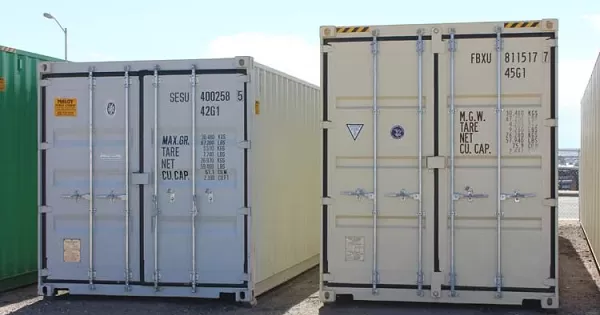
In practice, both in Vietnam and globally, the 40ft High Cube is the single most widely used container type across all container categories — more common than the standard 40ft dry container on many export routes, particularly for garments, footwear, furniture, and consumer goods.
Common misconception: Many people new to logistics confuse a High Cube container with an Open Top container because both are described as “taller than normal.” In reality, a High Cube is a fully enclosed container identical in structure to a standard dry container – simply 1 foot taller – while an Open Top has no fixed roof. There is also a lesser-known variant: the 45ft High Cube container – 5 feet longer than a standard 40ft container which Section 4 of this article covers in detail.
2. Detailed Structure of a High Cube Container
Primary material: Corten A/B steel (weathering steel) – identical to a standard dry container. The only structural difference is that all vertical components (side walls, front wall, rear doors) are 305 mm taller than their standard counterparts.
| COMPONENT | DETAILED DESCRIPTION |
|---|---|
| Load-bearing steel frame | Corten A/B steel capable of withstanding stacking loads up to 192 tonnes; ISO-standard corner castings at all 8 corners, fully compatible with all standard port handling equipment and truck chassis |
| Side panels | Corrugated steel panels 305 mm taller than standard container side panels; equivalent rigidity, with no reduction in lateral load-bearing capacity |
| Steel roof | Fully enclosed flat steel roof, identical to a standard dry container – this is the clearest structural distinction from an Open Top container, which has no fixed roof |
| Hardwood floor | Hardwood flooring (typically treated apitong or pine) over a steel base; features ISO-standard lashing rings – identical to a standard dry container in every respect |
| Rear doors | Two steel door panels 305 mm taller than standard, with rubber gaskets and cam lock system; door opening height ~2,585 mm – sufficient for a low-mast forklift to enter |
| Front wall | Solid steel front panel, 305 mm taller; features ISO-standard ventilation holes at the upper section to allow natural air circulation inside the container |
3. High Cube vs. Standard Dry Container: A Detailed Comparison
This is the choice most importers and exporters face: should I book a standard 8’6″ dry container or a 9’6″ High Cube? The answer depends entirely on the nature of the cargo and the comparison table below will help you decide quickly.
| Criteria | Standard Dry Container (8’6″) | High Cube Container (9’6″) |
|---|---|---|
| External height | 2,591 mm (8’6″) | 2,896 mm (9’6″) |
| Internal height (at rear door) | ~2,280 mm | ~2,585 mm |
| Internal volume (40ft) | ~67 m³ | ~76 m³ (+~13%) |
| Maximum payload (40ft) | ~26,700 kg | ~26,500 kg (slightly lower due to heavier tare) |
| Tare weight (40ft) | ~3,900 kg | ~4,150 kg (~250 kg heavier) |
| Total height: truck + container | ~4.0–4.1 m total | ~4.3–4.4 m total — road height limits apply |
| Relative freight cost | Baseline | 5–15% higher depending on route and shipping line |
| Availability in Vietnam | Very common | Very common – more widely used than standard 40ft on many export routes |
| Best suited for | Heavy, dense cargo – reaches payload before filling by volume | Light, bulky cargo – fills by volume before reaching payload |
Quick selection rule: If your cargo regularly “fills the container by volume but still has payload capacity to spare” – garments, footwear, furniture, plastics, consumer electronics – High Cube is the right choice, allowing more cargo per container and reducing the number of containers needed. If cargo “reaches its payload limit before filling the container” – steel, stone, heavy machinery – a standard dry container is sufficient and cheaper.
4. High cube container size classification
Most people are only aware of the 40ft High Cube, while two other sizes exist that are far less known: the 20ft High Cube and especially the 45ft High Cube – the longest container in the standard ISO container range.
20-Foot High Cube Container
| Specification | HC 20FT | Practical Notes |
|---|---|---|
| External length | 6,058 mm (20′) | 20ft = 1 TEU |
| External height | 2,896 mm (9’6″) | 305 mm taller than standard 20ft |
| Internal height | ~2,585 mm | 305 mm taller than standard 20ft (~2,280 mm) |
| Internal volume | ~37–38 m³ | ~15% more than standard 20ft (~33 m³) |
| Maximum payload | ~21,500 kg | Slightly lower than standard 20ft due to heavier tare weight |
| Availability in Vietnam | Limited | Scarce at depots; 40ft HC is significantly more common |
40-Foot High Cube Container
| Specification | HC 40FT | Practical Notes |
|---|---|---|
| External length | 12,192 mm (40′) | 40ft = 2 TEU — the most widely used container type globally |
| External width | 2,438 mm (8′) | ISO standard width |
| External height | 2,896 mm (9’6″) | 305 mm taller than standard 40ft |
| Internal length | ~12,032 mm | Identical to standard 40ft |
| Internal width | ~2,350 mm | Identical to standard 40ft |
| Internal height | ~2,585 mm | 305 mm taller than standard 40ft (~2,280 mm) |
| Internal volume | ~76 m³ | ~13% more than standard 40ft (~67 m³) |
| Maximum payload | ~26,500 kg | Varies by unit; check CSC plate |
| Tare weight | ~4,150 kg | ~250 kg heavier than standard 40ft (~3,900 kg) |
45-Foot High Cube Container – The Lesser-Known Size
The 45ft High Cube container (abbreviated: 45HC or PW – Pallet Wide) is the longest container in the standard ISO container range, with an external length of 13,716 mm (45′) and a height of 9’6″. It is a specialized container that rarely appears in Vietnam but is very widely used for intra-European road transport, particularly on European domestic trucking routes.
| Specification | HC 45FT | Practical Notes |
|---|---|---|
| External length | 13,716 mm (45′) | 1,524 mm (5 feet) longer than a 40ft container |
| External height | 2,896 mm (9’6″) | Standard HC height |
| Internal length | ~13,556 mm | Fits 33 Euro pallets (1,200 × 800 mm) – far more than a 40ft HC which fits only 25 pallets |
| Internal volume | ~86 m³ | The largest internal volume of any standard ISO container type |
| Maximum payload | ~27,600 kg | Rated as 2.25 TEU on many routes |
| Availability in Vietnam | Extremely rare | Very common within the EU; virtually unavailable at depots in Vietnam; some Asia-Europe routes are beginning to offer this type |
Note on 45ft containers in Vietnam: The 45ft HC is currently almost entirely unavailable at depots in Vietnam. If you need to export to the EU using a 45ft HC, contact the shipping line well in advance — some carriers such as Maersk and MSC have begun offering this type on Asia-Europe services, but availability remains limited.
5. Road Height Limits: Vietnam and Key Import Markets
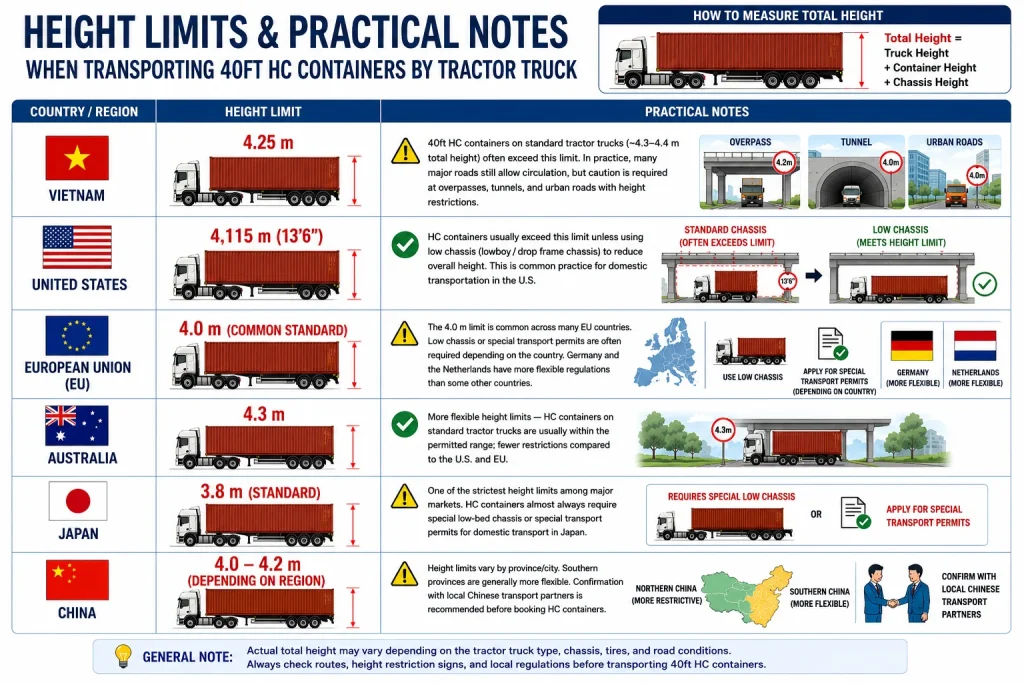
This is the most practically important point that many High Cube container users overlook. The 9’6″ (2,896 mm) external height of an HC container, combined with the height of a standard truck chassis (~1,400–1,500 mm), results in a total combined height of approximately 4.3–4.4 m – exceeding the legal road transport limit in many countries without a special permit.
| Country / Region | Height Limit | Practical Notes |
|---|---|---|
| Vietnam | 4.25 m | A 40ft HC on a standard truck chassis (~4.3–4.4 m total) typically exceeds this limit – in practice, many main roads can still be used, but caution is required at overpasses, underpasses, and urban roads with posted height restriction signs |
| United States | 4.115 m (13’6″) | HC containers almost always exceed this limit – a low-profile chassis (lowboy/drop frame chassis) is required to reduce the combined height; this is standard practice in the US and handled routinely |
| European Union | 4.0 m (common) | A 4.0 m limit is common across many EU member states; a low-profile chassis or special transport permit is required depending on the country; Germany and the Netherlands have somewhat more flexible regulations than some other EU members |
| Australia | 4.3 m | A more relaxed limit – an HC container on a standard truck chassis typically stays within the permitted height; fewer issues compared to the US and EU |
| Japan | 3.8 m (standard) | The strictest limit among major import markets – HC containers almost always require a special low-bed trailer or a special transport permit for inland transport in Japan |
| China | 4.0–4.2 m (by province) | Limits vary by province; southern provinces are generally more flexible; confirm with the local inland transport partner before booking HC for China destinations |
Practical solution: In markets with strict height limits such as the US and Japan, consignees typically use a low-profile chassis (low-bed/drop frame chassis) – a trailer with a platform 150–200 mm lower than a standard chassis – to reduce the total combined height to within the legal limit. The additional cost of a low-profile chassis over a standard chassis is already factored into domestic logistics costs in these markets. When booking HC containers for the US or Japan, always notify the consignee in advance so they can arrange the correct trailer type.
6. Cargo Types Best Suited to High Cube Containers
Cargo RECOMMENDED for High Cube Containers
| Cargo Type | Specific Examples | Why It’s Suitable |
|---|---|---|
| Garments and footwear | Boxed clothing in cartons, boxed shoes, rolls of fabric, fashion accessories | Light, high-volume cargo – typically fills the container by CBM long before reaching payload; HC allows 1–2 additional tiers of cartons |
| Furniture and wooden products | Knock-down tables and chairs, flat-pack shelving, boxed sofas, wooden doors, hardwood flooring | Some furniture packages exceed the ~2,280 mm height of a standard container – HC allows items to stand upright without tilting |
| Electronics and home appliances | Large-screen TVs, refrigerators, washing machines, air conditioning units, large audio equipment | Large appliances often come close to the height limit of a standard container – HC provides additional clearance and loading flexibility |
| Plastic goods and housewares | Plastic household items, storage bins, toys, plastic kitchen utensils | Light, bulky cargo – CBM is always the limiting factor, not weight; HC optimizes freight cost per CBM |
| Lightweight construction materials | Gypsum boards, insulation panels, long PVC pipes, acoustic materials | Some construction materials have package lengths or heights that fit within an HC but exceed the limits of a standard container |
| Packaged agricultural produce | High-stacked palletized rice bags, multi-tier boxed fruit, boxed seafood in foam containers | Tall pallets of agricultural cargo often reach the ceiling of a standard container – HC provides 30 cm of additional clearance for an extra tier or to prevent crushing when closing the doors |
| Light industrial parts and equipment | Wooden-crated machine parts, large medical devices, industrial printers | Wooden-crated equipment with a height that fits in HC but exceeds the standard container limit; payload is typically still well within HC capacity |
Cargo NOT RECOMMENDED or UNNECESSARY for High Cube Containers
- Heavy, high-density cargo (steel, stone, heavy machinery): These goods reach their payload limit before filling by volume – using an HC adds 5–15% to freight costs with no volume benefit whatsoever.
- Liquid and bulk cargo: Requires tank containers or specialized bulk containers – an HC does not address the requirements of these cargo types.
- Temperature-controlled cargo: Requires a reefer container; reefer HC units are not widely available in Vietnam’s market (although they exist technically).
- Shipments to Japan: If the consignee does not have a low-bed chassis available, confirm this before booking an HC to avoid unexpected costs at the destination.
7. Advantages and Limitations of High Cube Containers
| Advantages | Limitations |
|---|---|
| Approximately 13% more volume than a standard container of the same length – reduces the number of containers needed for light, bulky cargo | Freight cost 5–15% higher than a standard container – not worthwhile if the extra volume cannot be utilized |
| Allows cargo stacking 305 mm taller – accommodates many types of tall packaged goods that a standard container cannot accept | Total height of truck + HC (~4.3–4.4 m) may exceed road transport limits in many countries – consignees need a low-profile chassis or special permit |
| Fully compatible with the entire container logistics network – same ports, same vessels, same handling equipment as standard containers | Tare weight ~250 kg heavier than a standard container of the same size – a minor reduction in effective payload |
| Very common and readily available at depots in Vietnam – no need for the extended advance booking required for specialized container types | 20ft HC and 45ft HC are considerably scarcer than 40ft HC at depots in Vietnam |
| Fully enclosed like a standard dry container – excellent cargo protection against rain, dust, and theft throughout the voyage | Not suitable for heavy cargo – costs more but provides no benefit over a standard container |
8. How to Load Cargo into a High Cube Container Correctly
- Inspect the container before loading: Check the entire roof, side walls, floor, and rear doors for holes or cracks; ensure the rear door rubber gaskets are intact and sealing properly; inspect the timber floor for rot or damage; confirm the container interior is completely dry with no moisture present.
- Plan the cargo arrangement (cargo plan): Calculate the optimal number of cargo tiers based on the internal height of ~2,585 mm; place heavier items at the bottom and lighter items on top; verify the total weight does not exceed the payload; prepare a loading plan before beginning to load.
- Load from the front toward the rear doors: Start from the front wall and stack cargo evenly and securely; take advantage of the 2,585 mm internal height to fit additional tiers compared to a standard container; ensure the cargo remains balanced and does not lean laterally.
- Dunnage and cargo securing: Use dunnage bags (air bags), pallet locks, or padding materials to fill gaps and prevent cargo movement; for scratch-sensitive goods, add PE film or cardboard between packages.
- Verify the VGM (Verified Gross Mass): Weigh the packed container to confirm the actual total gross mass (VGM); submit the VGM to the shipping line before the deadline per SOLAS regulations – without a valid VGM declaration, the container cannot be loaded onto the vessel.
- Close and seal the doors: Close both rear door panels in the correct order (right panel first, then left); verify all cam locks are firmly engaged; apply the customs seal and buyer-specified seal; record the seal numbers on the Bill of Lading.
Frequently Asked Questions About High Cube Containers
How is a High Cube container different from a standard container?
How many CBM does a High Cube container hold?
Is freight for a High Cube container more expensive than a standard container?
Can a High Cube container be used at all ports?
Should I choose a standard 40ft container or a 40ft High Cube?
Is the 45ft High Cube container available in Vietnam?
10. Conclusion
In summary, High Cube containers are the optimal choice for light, bulky cargo that is constrained by volume rather than weight:
- Exactly 305 mm (1 foot) taller than a standard container – internal height ~2,585 mm vs ~2,280 mm; volume increases by ~13%
- Available in three sizes: 20ft HC (limited availability), 40ft HC (the most widely used container type globally), and 45ft HC (extremely rare in Vietnam, common within the EU)
- Best suited for garments, footwear, furniture, home appliances, plastic goods, and consumer electronics – cargo that fills by volume before reaching payload
- Total height of truck + HC (~4.3–4.4 m) requires attention to road limits in the US (4.115 m), EU (4.0 m), and Japan (3.8 m) – consignees need a low-profile chassis
- Freight rates only 5–15% higher than standard containers – typically well justified when the additional volume is fully utilized
How Does 3W Logistics Support Customers?
Whether you are exporting garments, footwear, furniture, electronics, or any other light, bulky cargo, choosing the right container type (HC or standard), accurately calculating the number of containers needed, and ensuring the consignee at destination has the right equipment are decisions that directly impact the cost and efficiency of every shipment. 3W Logistics provides comprehensive support across every aspect of High Cube container logistics:
- Container type advisory: Based on actual CBM, payload, and cargo characteristics, the 3W team advises whether to use HC or standard containers, and 20ft vs 40ft – avoiding the costly mistake of booking the wrong type and ending up with too many containers or insufficient volume.
- Loading plan optimization: Assistance with cargo arrangement planning (loading plan) to maximize the number of units per HC container, especially for palletized or irregularly shaped cargo.
- Container booking and vessel scheduling: 3W works directly with major shipping lines (Maersk, MSC, CMA CGM, Evergreen, ONE, etc.) to book HC containers on time, comparing HC vs standard freight rates on each route and advising the most cost-effective option.
- Destination height limit advisory: Proactively informing customers and consignees of low-profile chassis requirements in the US, Japan, and EU – preventing unexpected costs and delays at the destination.
- Full export/import documentation: Including VGM declaration, electronic customs filing, certificate of origin, and a complete international payment document set (B/L, Invoice, Packing List).
- Inland transport and shipment tracking: Coordinating suitable trailer trucks to ensure HC containers arrive at the port on time before the CY Closing Time, with real-time tracking updates throughout the voyage.
A note from 3W Logistics’ practical experience: The most common mistake with HC containers is booking High Cube for heavy cargo (steel, bricks, heavy machinery) – paying 5–15% more in freight with no volume benefit because the cargo reaches its payload limit before the container is full. The reverse also happens frequently: businesses shipping garments or furniture in standard containers end up booking extra containers because cargo hits the ceiling, when simply switching to HC would have resolved the problem entirely. Contact 3W Logistics for the right container recommendation from the very start.
Address: 34 Bach Dang Street, Tan Son Hoa Ward, Ho Chi Minh City
Hotline: +84 28 3535 0087
____________________________
3W Logistics Hanoi Branch
Address: 81A Tran Quoc Toan Street, Cua Nam Ward, Hanoi
Hotline: +84 24 3202 0482
____________________________
3W Logistics Hai Phong Branch
Address: 8A, Lot 28, Le Hong Phong Street, Gia Vien Ward, Hai Phong
Hotline: +84 225 355 5939
____________________________
3W LOGISTICS CO., LTD – We here serve you there!
Email: quote@3w-logistics.com
Website: www.3w-logistics.com

Ms. Apple is the CCO (Chief Commercial Officer) at 3W Logistics, with over 10 years of experience in sales and business operations management.
At 3W Logistics, Ms. Apple is responsible for commercial strategy, corporate customer development, managing a team of more than 50 sales professionals, and improving business performance in the logistics sector.
With practical experience in sales management and market development, Ms. Apple shares professional insights on business logistics solutions, international transportation, freight forwarding, customer management, trade lane development, and growth strategies in the logistics industry.


