
What is C/O Form VC? Vietnam Export Regulations
C/O Form VC is a certificate of origin issued under the Vietnam – Chile Free Trade Agreement (VCFTA). It is an important document that enables businesses to enjoy preferential tariff treatment when exporting goods to the Chilean market. The article below provides a comprehensive analysis, from the definition, issuance conditions, required documents and procedures, to detailed guidance on how to complete each field in the latest C/O Form VC template.
1. What is C/O Form VC? Definition and Role
1.1 Definition of C/O Form VC:
C/O Form VC (Certificate of Origin Form VC) is a certificate of origin used in bilateral trade between Vietnam and Chile, issued in accordance with the provisions of the Vietnam – Chile Free Trade Agreement (VCFTA).
In essence, What is C/O Form VC? It is a document certifying that exported goods truly originate from, are produced, or sufficiently processed in Vietnam according to the origin criteria agreed upon by both parties. When importers in Chile present a valid C/O Form VC to the local customs authority, the shipment will be entitled to preferential tariff rates under the VCFTA reduction schedule instead of being subject to normal MFN duties.
“Certificate of origin is an important document in international trade, certifying the place of production of goods and serving as the basis for goods to enjoy preferential tariffs under free trade agreements signed by Vietnam.”
— Ministry of Industry and Trade of Vietnam, Origin of Goods Information Portal
1.2 Role in Export Activities:
There are four main reasons why C/O Form VC is considered an indispensable document in Vietnam – Chile trade relations:
- Enjoy preferential tariffs: Import duties in Chile may be reduced to 0% for many product groups under VCFTA commitments, instead of normal MFN rates ranging from 6% to several dozen percent.
- Enhance the competitiveness of Vietnamese goods: Businesses can save on tariff costs, thereby reducing product prices and competing more effectively against goods from countries without FTAs with Chile.
- Meet customs clearance requirements: Chilean customs authorities require a valid C/O in order to grant preferential treatment. Without a C/O, goods may be subject to standard tariff rates or customs delays.
- Control origin and prevent trade fraud: C/O serves as a traceability tool that helps protect the reputation of Vietnamese products in international markets.
2. Legal Basis Governing C/O Form VC
The legal framework governing the issuance and use of C/O Form VC includes the following levels:
2.1 International Agreement Level
- Vietnam – Chile Free Trade Agreement (VCFTA), signed on November 11, 2011, effective from January 1, 2014. Chapter 3 of the Agreement stipulates the rules of origin applicable to goods traded between the two countries.
- Protocol on the Implementation of VCFTA Rules of Origin (Rules of Origin – ROO), attached to the Agreement, which specifies origin criteria, methods for calculating Regional Value Content (RVC), and origin certification procedures.
2.2 Domestic Legal Documents
| Legal Document | Content | Issuing Authority |
|---|---|---|
| Decree No. 31/2018/ND-CP | Detailed regulations on the Law on Foreign Trade Management regarding origin of goods | Government |
| Circular No. 05/2018/TT-BCT | Specific regulations on rules of origin under VCFTA, C/O Form VC template, and declaration guidelines | Ministry of Industry and Trade |
| Amending and Supplementary Circulars (if any) | Updates to lists, criteria, and procedures according to the Agreement implementation roadmap | Ministry of Industry and Trade |
| Customs Law No. 54/2014/QH13 | Regulations on customs procedures, inspection, and verification of C/O at border gates | National Assembly |
📌 Note: Businesses should regularly check the electronic portals of the Ministry of Industry and Trade and the eCOSys Electronic Origin Management System to stay updated with the latest legal regulations.
3. Scope of Application and Tariff Benefits
3.1 Scope of Application of C/O Form VC
C/O Form VC only applies to:
- Goods exported from Vietnam to Chile or from Chile to Vietnam.
- Goods meeting the rules of origin requirements under VCFTA regulations.
- Cases where importers wish to apply VCFTA preferential tariff rates at the customs authority of the importing country.
C/O Form VC does not apply to:
- Goods exported to third countries other than Chile.
- Goods that do not satisfy VCFTA origin criteria.
- Goods merely transiting through Chile without being imported into Chile.
3.2 Tariff Benefits under VCFTA
VCFTA creates one of the most attractive export markets in Latin America. Some product groups enjoying significant benefits include:
| Product Group | Normal MFN Tariff (Chile) | VCFTA Tariff (with C/O Form VC) | Schedule |
|---|---|---|---|
| Textiles and garments | 6% | 0% – 3% | According to category A/B/C |
| Footwear and leather bags | 6% | 0% | Eliminated immediately upon entry into force |
| Processed seafood | 6% | 0% | Eliminated immediately or after 5 years |
| Wood products and handicrafts | 6% | 0% | Eliminated immediately upon entry into force |
| Electronic components | 0% – 6% | 0% | Mostly eliminated immediately |
| Rice and agricultural products | 6% | 0% – 6% | TRQ quotas apply to certain products |
⚠️ Important: Chile applies a uniform MFN tariff rate of 6% to most imported goods. With a valid C/O Form VC, businesses may completely eliminate this tax burden, directly improving price competitiveness.
4. Origin Criteria for Issuance of C/O Form VC
To be granted a C/O Form VC, goods must satisfy one of the following origin criteria under VCFTA regulations:
4.1 Wholly Obtained Goods (WO – Wholly Obtained)
This criterion applies to goods entirely harvested, extracted, or produced in Vietnam without the use of any imported materials. This includes:
- Minerals and natural resources extracted in Vietnam.
- Crops and agricultural products harvested in Vietnam.
- Live animals born and raised in Vietnam.
- Products caught by vessels flying the Vietnamese flag in international waters.
4.2. Goods Produced Entirely in a Member Country (PE – Produced Entirely)
Goods manufactured entirely from materials originating in Vietnam or Chile to produce finished products.
4.3. Regional Value Content Criterion (RVC – Regional Value Content)
This is the most common criterion, applicable to goods using non-originating materials. Goods must achieve a minimum 40% RVC ratio according to one of the following methods:
Formula:
RVC = (FOB – VNM) / FOB × 100%
- FOB: FOB value of the goods
- VNM: Value of non-originating materials
Formula:
RVC = OM / FOB × 100%
- OM: Value of originating materials + direct labor costs + overhead costs + profit
- FOB: FOB value of the goods
4.4. Change in Tariff Classification Criterion (CTC – Change in Tariff Classification)
Finished goods must have a different HS code from all non-originating materials used in the production process. Depending on the regulations applicable to each product category:
- CC (Change in Chapter): Change at the 2-digit level (chapter).
- CTH (Change in Tariff Heading): Change at the 4-digit level (heading).
- CTSH (Change in Tariff Sub-Heading): Change at the 6-digit level (sub-heading).
4.5. Specific Process Criterion (SP – Specific Process)
Certain products require specific manufacturing processes as stipulated in the Annex on Rules of Origin under VCFTA.
5. Documents and Procedures for Applying for C/O Form VC
5.1. Authorities Authorized to Issue C/O Form VC
In Vietnam, C/O Form VC is issued by:
- The Ministry of Industry and Trade (through the online eCOSys system)
- Regional Import-Export Management Offices of the Ministry of Industry and Trade in Ho Chi Minh City, Hanoi, Da Nang, and other provinces
5.2. Application Dossier for C/O Form VC
Businesses are required to prepare a complete set of documents including:
| No. | Document | Quantity | Original/Copy | Notes |
|---|---|---|---|---|
| 1 | Application for C/O issuance (Prescribed Form) | 1 copy | Original | Fully completed, stamped, and signed |
| 2 | Completed C/O Form VC | 3 copies | Original | 01 original + 02 duplicate copies |
| 3 | Customs Export Declaration | 1 copy | Copy | With customs clearance confirmation |
| 4 | Commercial Invoice | 1 copy | Copy | Must match the information stated on the C/O |
| 5 | Bill of Lading / Airway Bill | 1 copy | Copy | Applicable if goods have already been exported |
| 6 | List of input materials / Import declaration of materials | 1 set | Copy | Attached with customs documents for imported materials (if any) |
| 7 | RVC calculation sheet (if applying RVC criterion) | 1 copy | Original | Attached with purchase invoices for materials |
| 8 | Trader registration dossier (first-time application) | 1 set | Original | Submitted only once; updated upon changes |
5.3. Application Process – Step-by-Step Procedures
Submission Deadline: Applications for C/O issuance may be submitted before or after exportation, but no later than 1 year from the export date. However, it is recommended to submit before or immediately after exportation to ensure the C/O reaches the importer before the shipment arrives at Chilean ports.
6. Detailed Instructions for Completing Each Box on C/O Form VC
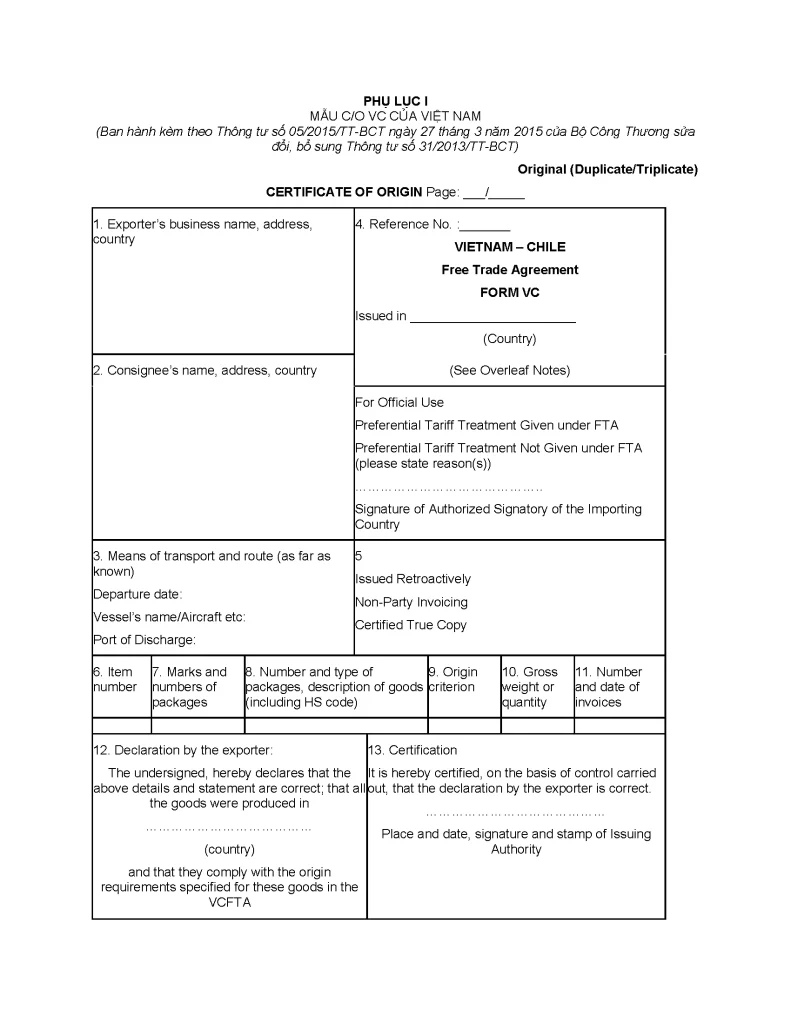
The C/O Form VC template consists of 13 main boxes. Below are detailed instructions for completing each field:
| Box No. | Document Field | Detailed Instructions |
|---|---|---|
| 1 | Exporter’s name, address and country | Enter the full name, address, and country of the exporter (Vietnamese company). The name and address must exactly match the commercial invoice and business registration. Country: Viet Nam. |
| 2 | Consignee’s name, address and country | Enter the name, address, and country of the consignee in Chile. If the buyer and consignee are different (for example, involving an intermediary), clearly specify the final consignee. Country: Chile. |
| 3 | Means of transport and route (as far as known) | Provide the transportation method and shipment route. Example: “By sea – Port of loading: Ho Chi Minh City, Viet Nam – Port of discharge: Valparaíso, Chile”. If transshipment occurs through a third-country port, specify the transshipment port. |
| 4 | For official use (Issued retroactively / Third Country Invoicing…) | This box is reserved for the issuing authority to stamp “Issued Retroactively”, “Third Country Invoicing”, or “Exhibition”. Businesses should tick the appropriate box if the shipment falls under a special circumstance. |
| 5 | Item number, marks and numbers on packages | State the item number, shipping marks, and package numbers. Information must match the invoice, packing list, and bill of lading. If goods are packed in multiple package types, list all corresponding marks. |
| 6 | Number and type of packages, description of goods | Describe the quantity, package type, and goods description. The description should be detailed enough to identify the goods without being excessively lengthy. Example: “500 cartons of Men’s Cotton T-shirts”. Avoid vague descriptions such as “Various goods”. |
| 7 | HS Code (Harmonized System Code) | Enter the HS code of the goods at the 6-digit level (international HS sub-heading) or as otherwise specified under VCFTA. This must be the HS code of the finished product, not the raw materials. Note: the HS code on the C/O must match the HS code on the export customs declaration. |
| 8 | Origin criterion | Indicate the applicable origin criterion for the shipment. Use the following symbols: – WO: Wholly Obtained – PE: Produced Entirely in a member country – RVC [XX]%: Regional Value Content (specify percentage, minimum 40%) – CTC: Change in Tariff Classification (CC / CTH / CTSH) – SP: Specific Process |
| 9 | Gross weight or other quantity | State the gross weight or other measurement units appropriate to the goods (e.g., pairs, liters, pieces). The unit of measurement must be clearly indicated (kg, MT, L, pcs…). Figures must match the invoice and packing list. |
| 10 | Invoice number and date | Enter the number and date of the commercial invoice corresponding to the shipment applying for the C/O. If multiple invoices exist, provide all invoice details. If the invoice is issued by a third party (third-country intermediary invoice), tick “Third Country Invoicing” in Box 4. |
| 11 | Declaration by the exporter | The exporter must sign and affix the company stamp here, certifying that the declared information is accurate and that the goods satisfy origin requirements. State the place, signing date, and name of the authorized signatory. The signature and stamp must be pre-registered with the Import-Export Management Office. |
| 12 | Certification | The authorized issuing authority (Ministry of Industry and Trade / Import-Export Management Office) will stamp and sign this box. Businesses must not complete this section; only authorized officers may certify it. |
| 13 | Third country invoicing / Back-to-Back / Others | This box is used for special information related to export methods such as third-country invoicing, Back-to-Back C/O, or other special notes required under VCFTA. Leave blank if no special information applies. |
7. Important Notes When Declaring C/O Form VC
7.1. Consistency of Documents
This is the most important principle. All information on the C/O Form VC must be fully consistent with related documents:
- The exporter’s and importer’s names and addresses on the C/O must match the commercial invoice.
- The invoice number and invoice date on the C/O must match the actual invoice.
- The HS code on the C/O must match the HS code declared on the export customs declaration.
- The quantity and gross weight on the C/O must correspond to the packing list and bill of lading.
7.2. Validity Period of C/O Form VC
C/O Form VC is valid for 12 months from the date of issuance. If the goods are not imported into Chile within this period, the importer must request a new C/O issuance or an extension in accordance with Chilean customs regulations.
7.3. Direct Consignment Requirement
Goods must be transported directly from Vietnam to Chile or only transit through a third country without being reprocessed or altered. In cases of transshipment, supporting documents from the customs authority of the transit country are required to confirm that the goods’ origin has not been changed.
7.4. Common Declaration Errors to Avoid
| Common Error | Consequence | Solution |
|---|---|---|
| HS code inconsistent with customs declaration | Chilean customs may reject preferential treatment and impose penalties | Carefully verify HS codes before submitting the application |
| Incorrect declaration of origin criterion (Box 8) | C/O may be rejected and preferential treatment denied | Refer to the VCFTA Rules of Origin Annex for each product category |
| Exporter information inconsistent with invoice | Customs authorities may suspect fraud and conduct investigations | Ensure complete consistency across all documents |
| Late submission of C/O application (after 1 year from export date) | C/O becomes invalid | Submit documents on time and closely monitor export schedules |
| Unregistered signature / company seal | Application dossier may be returned for supplementation | Register authorized signatures and seals with the Import-Export Management Office |
| Erasing or correcting information directly on the C/O | C/O will be cancelled and must be reissued | If errors occur, prepare an entirely new form |
Under no circumstances should businesses erase or alter information on a completed C/O form. If errors are discovered before submission, the company must cancel the incorrect form and complete a new one entirely.
— Regulations under Circular No. 05/2018/TT-BCT, Ministry of Industry and Trade
8. Comparison Between C/O Form VC and Other Types of C/O
Vietnam is currently a member of multiple FTAs, each having its own C/O form. Below is a comparison table between C/O Form VC and several commonly used forms:
| Criteria | C/O Form VC | C/O Form D (ASEAN) | C/O Form E (ASEAN-China) | C/O Form AK (ASEAN-Korea) |
|---|---|---|---|---|
| Applicable FTA | VCFTA | ATIGA | ACFTA | AKFTA |
| Market | Chile | ASEAN (9 countries) | China | South Korea |
| Issuing Authority | Ministry of Industry and Trade | Ministry of Industry and Trade | Ministry of Industry and Trade | Ministry of Industry and Trade |
| RVC Criterion | ≥ 40% | ≥ 40% | ≥ 40% | ≥ 40% |
| Validity | 12 months | 12 months | 12 months | 12 months |
| Submission System | eCOSys | eCOSys | eCOSys | eCOSys |
| Form Language | English | English | English/Chinese | English/Korean |
9. Download C/O Form VC and Related Legal Documents
Below are important documents businesses should refer to and download when applying for C/O Form VC:
9.1. Official C/O Form VC Template
The C/O Form VC template is issued under the Appendix of Circular No. 05/2018/TT-BCT of the Ministry of Industry and Trade. Businesses should download the latest version from official portals:
Download the C/O Form VC template here
Learn more:
- Definition and role of C/O in import-export activities
- C/O Form AANZ, C/O Form EUR.1, and other C/O types
9.2. Related Legal Documents
| Document Name | Content | Reference Source |
|---|---|---|
| Circular No. 05/2018/TT-BCT | Rules of origin and C/O Form VC template under VCFTA | vanban.chinhphu.vn |
| Decree No. 31/2018/ND-CP | Detailed regulations on the Law on Foreign Trade Management regarding origin of goods | vanban.chinhphu.vn |
| VCFTA Agreement (Full Text) | Full text of the Vietnam – Chile Free Trade Agreement | moit.gov.vn |
| VCFTA Rules of Origin Annex | List of origin criteria by HS code for each product category | moit.gov.vn |
| eCOSys User Guide | Instructions for submitting online applications for C/O issuance | ecosys.gov.vn |
10. Frequently Asked Questions About C/O Form VC (FAQ)
- Is it mandatory to submit C/O Form VC before goods are exported?No. Businesses may apply for a C/O before, during, or after exportation. However, if issued afterward (Issued Retroactively), the corresponding box in Box 4 must be checked, and the application must be submitted within 1 year from the export date. It is recommended to apply before or immediately upon export to ensure the C/O reaches the Chilean partner on time.
- If goods use imported materials from multiple countries, can they still qualify for C/O Form VC?Yes, provided that the finished goods satisfy one of the VCFTA origin criteria (commonly RVC ≥ 40% or the CTC criterion). Materials may originate from various countries as long as the value-added ratio in Vietnam meets the required threshold.
- Can a commercial invoice issued by a third party (not the Vietnamese exporter) be accepted?Yes. This is known as Third Country Invoicing. Businesses must tick the “Third Country Invoicing” box in Box 4 and provide the invoice issuer’s name and address in Box 13.
- Invoice information must still be declared in Box 10 as usual. Can C/O Form VC be issued electronically (e-C/O)?Vietnam is currently implementing an electronic C/O issuance system (e-C/O) through the eCOSys platform. However, acceptance of e-C/O in Chile depends on bilateral agreements within the VCFTA framework. Businesses should confirm with their Chilean partners or contact the Ministry of Industry and Trade for the latest updates.
- If Chilean customs authorities request origin verification, what should businesses do?When origin verification is requested, Chilean customs authorities will send an official request to the Vietnamese C/O issuing authority (the Ministry of Industry and Trade). Businesses must cooperate by providing complete supporting documents proving origin (material purchase invoices, RVC calculations, manufacturing processes, etc.) to assist the verification process. Verification procedures generally take up to 90 days from the request date.
- Can a lost or misplaced C/O Form VC be reissued?
3W LOGISTICS – EXPORT SERVICES TO CHILE
Chile is emerging as one of the fastest-growing markets in the world — and Vietnam–Chile trade turnover continues to increase strongly. To fully maximize VCFTA tariff incentives, export documentation — especially C/O Form VC — must be prepared accurately from the beginning.
3W Logistics provides comprehensive export support services to Chile:
Customs declaration & documentation consulting — advising on suitable RVC criteria for each shipment, verifying the validity of C/O Form VC before submission, and handling the entire export customs clearance process.
- Air freight — Vietnam–Chile routes suitable for urgent cargo, high-value goods, mobile phones, and electronic components
- Sea freight — Vietnam–Chile routes optimized for large FCL container shipments and LCL cargo
- Warehousing & distribution — storage and cargo preparation before export
- The 3W Logistics team is ready to advise on the most suitable C/O type, review documentation before submission, and handle all customs clearance procedures — helping goods reach Chile faster while benefiting from the correct tariff preferences.
CONTACT INFORMATION:
Head Office – 3W Logistics Ho Chi Minh City Branch
Address: 34 Bach Dang Street, Tan Son Hoa Ward, Ho Chi Minh City, Vietnam
Hotline: +84 28 3535 0087
____________________________
3W Logistics Hanoi Branch
Address: 8A Lot 28 Le Hong Phong, Gia Vien Ward, Hai Phong, Vietnam
Hotline: +84 24 3202 0482
____________________________
3W Logistics Hai Phong Branch
Address: 81A Tran Quoc Toan Street, Cua Nam Ward, Hanoi, Vietnam
Hotline: +84 225 355 5939
Email: quote@3w-logistics.comWebsite: www.3w-logistics.com

Hello, I’m Nguyen Phuong Nhan (Ms. Nina)
I currently serve as Trade Lanes Supervisor at 3W Logistics, with more than 10 years of experience in international logistics and freight forwarding.
My primary responsibility is developing and managing global logistics partnerships, building strategic trade lanes, and working closely with overseas agents to provide reliable and competitive transportation solutions for customers.
I regularly collaborate with agents and logistics partners worldwide to explore new business opportunities, negotiate freight rates, develop trade routes, and support import-export shipments. I also work closely with our sales team to design logistics solutions tailored to specific markets and customer requirements.
My expertise includes Ocean Freight, Air Freight, Trade Lane Development, Global Agent Network Management, International Logistics Solutions, and Import-Export Support.
Through the articles I share on the 3W Logistics website, I aim to provide practical insights into the international logistics industry, global transportation trends, overseas agent cooperation, and effective logistics strategies that help businesses optimize their supply chain operations.
I believe that strong global partnerships and well-developed trade lanes are essential to delivering sustainable logistics solutions and long-term value to customers worldwide.


