
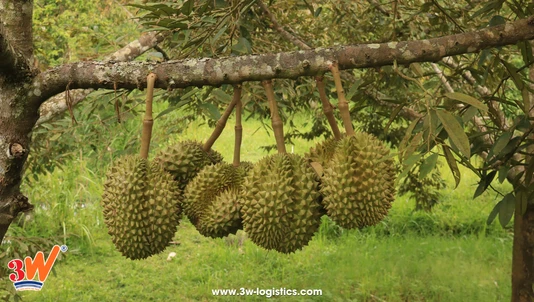
Vietnam is currently the number one durian supplier to the Chinese market, surpassing Thailand and Malaysia thanks to its geographic advantages, competitive logistics costs, and increasingly robust export policies. Since the official durian export protocol was signed in 2022, durian export to China has surged, making durian one of Vietnam’s billion-dollar agricultural export commodities.
Why Is China the Priority Market?
China has a population of over 1.4 billion with a rapidly expanding middle class, generating growing demand for premium tropical fruits. Durian is known as the “King of Fruits” in this market, particularly in major cities such as Shanghai, Beijing, and Guangzhou. Geographic proximity shortens transit time, preserves fresh fruit quality, and significantly reduces logistics costs compared to competing suppliers.
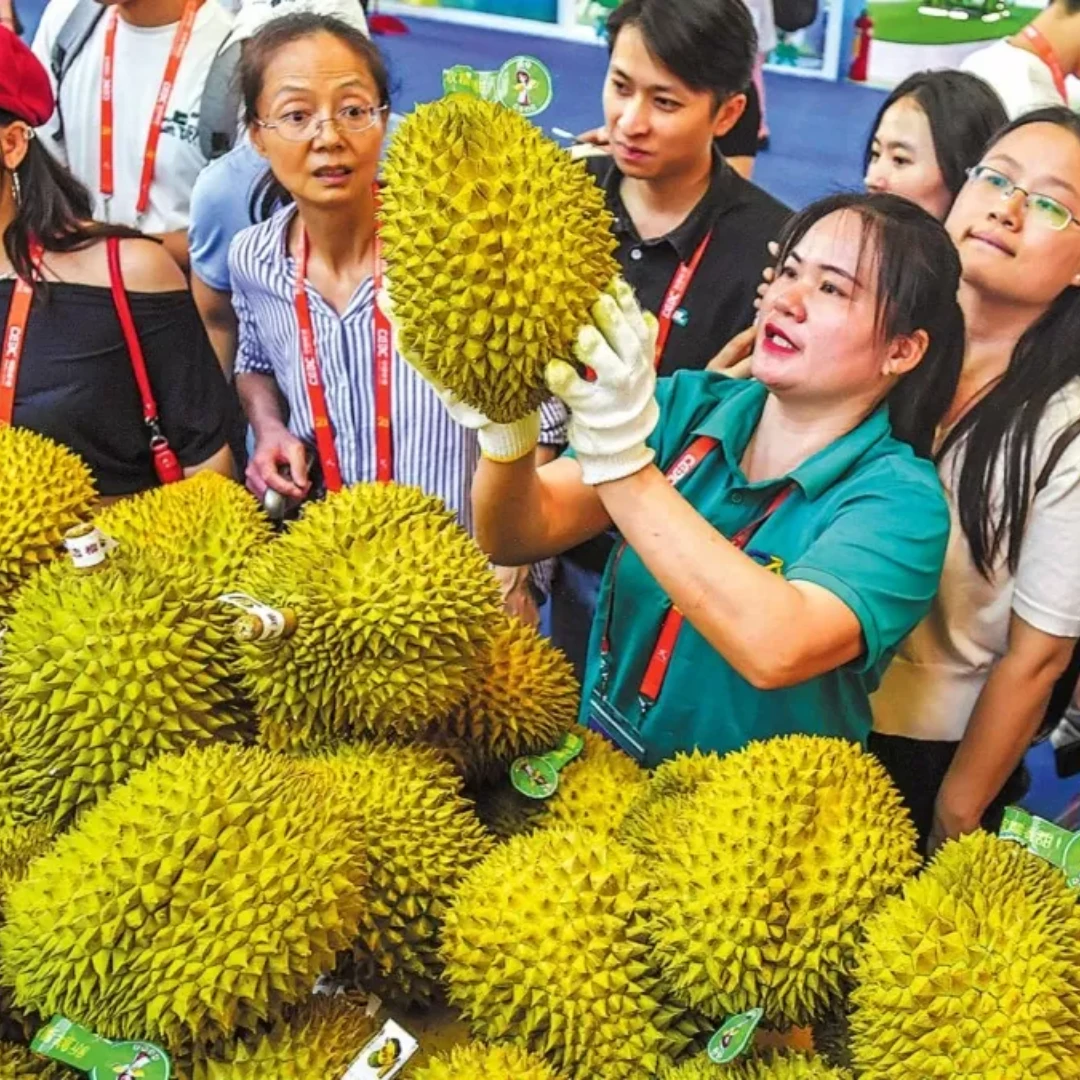
Key Durian Growing Regions in Vietnam:
The Central Highlands (Đắk Lắk, Lâm Đồng, Đắk Nông) is the largest growing region, followed by Bình Phước, Tiền Giang, and Đồng Nai. Each region has distinct soil conditions and harvest seasons, providing a near year-round supply for the durian export market.
Quick Market Comparison:
While China is the primary market for large-volume official-channel exports with fast customs clearance, durian export to the USA focuses on premium frozen and packaged products subject to strict FDA and USDA compliance. Durian export to Japan requires JAS certification and the most stringent pesticide residue (MRL) inspections, but in return offers significantly higher profit margins. Exporters with a sound strategy should target all three markets simultaneously to diversify risk.
Quality Standards for Durian Export to China
Meeting quality standards is the foundation that determines whether a shipment succeeds or fails. Understanding and fully complying with durian export standards is a prerequisite before negotiating prices or planning logistics.
Vietnam–China Protocol
Under the Protocol signed between Vietnam’s Ministry of Agriculture and Rural Development and China’s General Administration of Customs (GACC), durian for export must originate from officially registered and approved growing areas and packing facilities. This is not a one-time requirement but an ongoing compliance condition.
Fruit Quality Requirements:
Export durian must reach 75–85% ripeness (not overripe, to withstand transit), with a minimum fruit weight typically of 1.5 kg or above, intact shell with no cracks, and no signs of pests, disease, or mechanical damage. A flesh-to-seed ratio above 30% is highly valued, with preference given to varieties with thick flesh, low fiber content, and rich flavor.
Ri6 Durian for Export
Among Vietnamese durian varieties, Ri6 is the most favored by the Chinese market due to its distinctively rich, creamy flavor, uniformly golden flesh, small seeds, and strong aroma. Ri6 durian for export also benefits from high yields and good adaptability to the Central Highlands and Southeast regions. Other approved export varieties include Monthong (Thai-crossbred, large segments, milder flavor), Musang King (premium segment, higher price but limited volume), and select registered local varieties with approved growing area codes.
Growing Area Codes & Packing Facility Codes
These are mandatory and non-negotiable requirements since 2022. Each growing area must be assigned a code by the Plant Protection Department (Ministry of Agriculture and Rural Development) and registered with GACC. Similarly, each packing facility must hold its own code, comply with hygiene conditions, pest control measures, and maintain full traceability records. Shipments without a valid growing area code will be rejected at the Chinese port of entry.
Maximum Residue Limits (MRL)
GACC enforces MRL standards in accordance with Codex Alimentarius or China’s national standard GB 2763. Commonly exceeded active substances include chlorpyrifos, carbendazim, and imidacloprid. Exporters must conduct MRL testing at an accredited laboratory at least 7–10 days prior to shipment.
Packaging & Storage for Durian Export
1. Packaging for Durian Export
Export packaging is a technical requirement, not an option. For whole fresh durian, double-wall corrugated cartons (5-ply) with good compressive strength are used, typically holding 1–2 fruits per box depending on size, with PE foam or foam trays for shock absorption. For fresh durian segments and frozen durian, packaging must be airtight, using vacuum-sealed PE bags and moisture-resistant cartons.
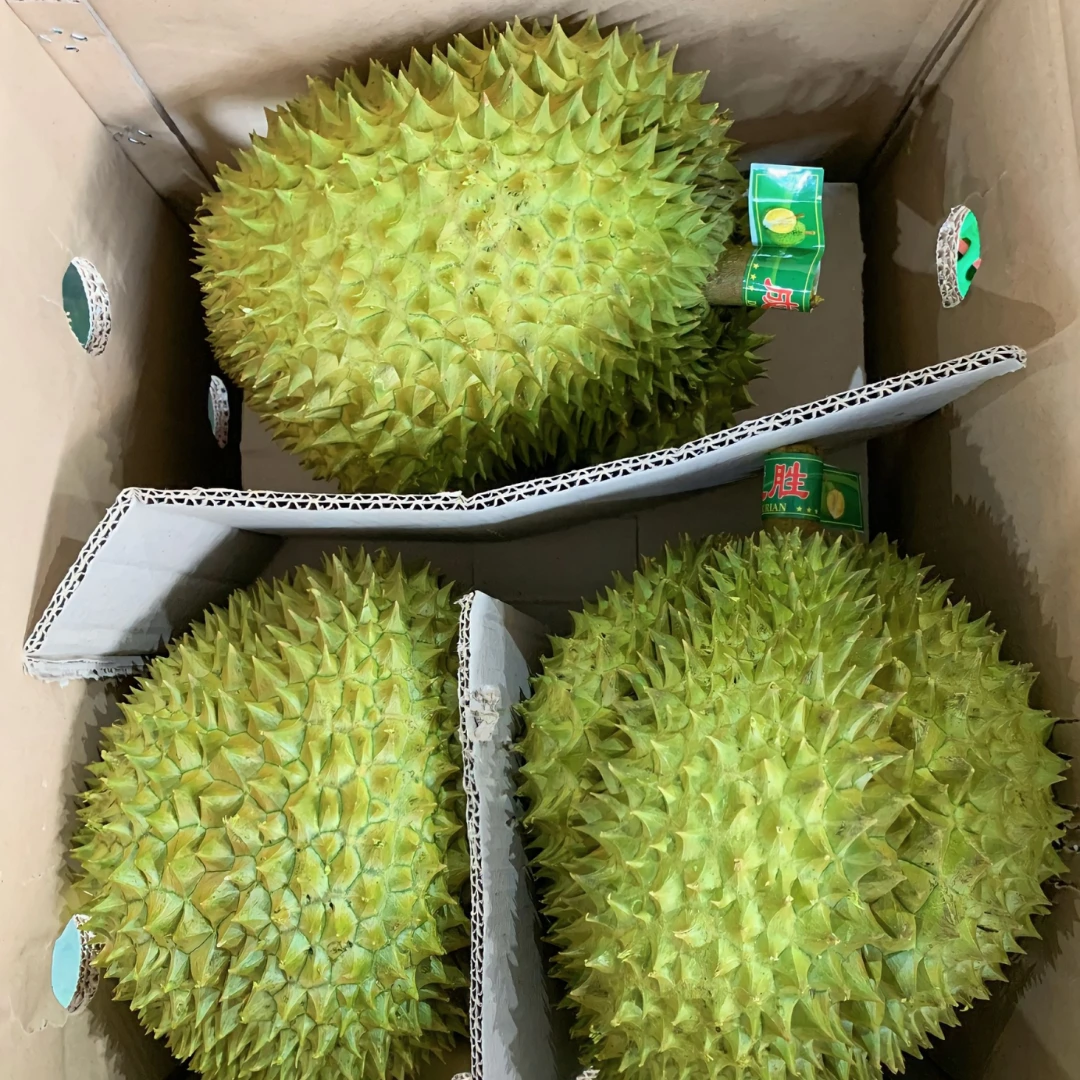
Mandatory label information (in Chinese):
Product name, variety, net weight, country of origin (Vietnam), growing area code, packing facility code, packing date, expiry date (for frozen products), and QR code for traceability. Any missing information may result in the shipment being held at Chinese customs.
2. Storage for Durian Export
Whole fresh durian: Store at 13–15°C with 85–90% relative humidity. Under these conditions, durian can maintain quality for 5–7 days — sufficient for overland transit through border crossings or short sea shipments to southern Chinese ports.
Frozen durian for export: This form is increasingly preferred as it completely eliminates shelf-life constraints. The IQF (Individual Quick Freezing) process freezes each durian segment individually, preventing clumping, preserving flavor and flesh texture. Storage and transit temperature must be maintained at -18°C, with a shelf life of 18–24 months. Reefer containers (20ft or 40ft) must have continuous temperature monitoring throughout the journey.
Comparison of the two forms:
- Criteria | Fresh Whole Fruit | Frozen
- Selling price | Higher | Lower but stable
- Shelf life | 5–7 days | 18–24 months
- Logistics requirement | Reefer container 13–15°C | Frozen container -18°C
- Risk level | High (season-dependent) | Lower
- Primary market | China (border crossing) | USA, Japan, and China online
Procedures & Process for Exporting Durian to China
(See the process diagram above)
Step 1: Register Growing Area Code & Packing Facility Code with GACC
Submit documentation to the Plant Protection Department – Ministry of Agriculture and Rural Development. The Department will conduct field inspections, then forward the list of registered growing areas and packing facilities to GACC for approval. Processing time typically takes 2–4 months. This step must be completed before all other steps.
Step 2: Sign a Foreign Trade Contract with the Chinese Buyer
The contract must clearly specify: product name and durian variety, packaging specifications, FOB or CIF price terms, payment method (L/C at sight or T/T 30% deposit – 70% prior to shipment is recommended), quality inspection terms, and dispute resolution clauses. Avoid contracts with payment terms upon arrival, as these carry very high risk.
Step 3: Harvesting, Grading, and Packaging to Standard
Harvest at the ripeness level specified in the contract. Grade at the registered packing facility, removing any substandard fruit. Package according to specifications, affix fully compliant Chinese-language labels, and attach QR traceability codes. Maintain shipment records (growing area, harvest date, responsible personnel) for inspection purposes.
Step 4: Phytosanitary Inspection – Obtain Phytosanitary Certificate
Contact the local Sub-Department of Plant Protection to register for inspection. Quarantine officers will inspect the shipment at the packing facility or consolidation point. Upon passing inspection, the Sub-Department issues a Phytosanitary Certificate — an indispensable document in the export filing. Processing time: 1–3 business days.
Step 5: Customs Clearance – Submit Export Declaration
Customs declaration is filed through the VNACCS/VCIS system. Required documents include: customs declaration form, foreign trade contract, commercial invoice, packing list, phytosanitary certificate, C/O Form E, and growing area/packing facility codes. For fresh agricultural products, priority should be given to fast-track clearance (green lane) to avoid quality deterioration from delays.
Step 6: Transportation
Three main routes are currently used to export durian to China: overland via border gate crossings (fastest and most common), sea freight from Cat Lai Port (Ho Chi Minh City) or Hai Phong Port (suitable for large volumes of frozen durian), and cross-border rail service being expanded in 2025–2026 (lower cost, medium transit time).
Step 7: Chinese Customs Clearance & Delivery to Buyer
Upon arrival at the Chinese port of entry, Chinese customs and quarantine authorities will inspect documents and conduct random sampling. If compliant, goods are cleared and handed over to the importer. If MRL violations or pest contamination are detected, the shipment may be held, treated, or returned.
Step 8: Payment & File Completion
Once goods are received, payment is processed according to contract terms. Retain all shipment records for a minimum of 3 years for internal control purposes and to facilitate retrieval in the event of disputes or post-clearance audits.
Export Documentation for Durian to China
A complete filing requires 7 mandatory documents:
- Sales Contract – bilingual (Vietnamese–Chinese or Vietnamese–English), with full signatures and company seals from both parties.
- Commercial Invoice & Packing List – detailed product description, unit price, total value, number of cartons, net/gross weight.
- Bill of Lading / Transport Document – depending on shipment mode (B/L for sea freight, CMR/AWB for road/air).
- C/O Form E – ASEAN–China Certificate of Origin, enabling preferential tariff treatment under the ACFTA agreement. Issued by the Vietnam Chamber of Commerce and Industry (VCCI) or provincial Department of Industry and Trade.
- Phytosanitary Certificate – issued by the Sub-Department of Plant Protection after cargo inspection.
- Growing Area Code / Packing Facility Code Certificate – issued by the Plant Protection Department and approved by GACC.
- Export Customs Declaration – confirmed clearance document from Vietnam Customs.
Border Gates & Transport Routes for Durian Export to China
Overland Transport to China
The four main border crossings used are Huu Nghi (Lang Son), Tan Thanh (Lang Son), Lao Cai, and Mong Cai (Quang Ninh). Huu Nghi border gate has the highest clearance capacity and most modern infrastructure. Transit time from southern growing regions to the border gate is approximately 2–3 days by refrigerated container truck.
Sea Freight to China
Export via Cat Lai Port (Ho Chi Minh City) or Hai Phong Port is suited for large volumes of frozen durian, typically destined for Guangzhou, Tianjin, or Shanghai. Transit time is 5–10 days depending on the destination port.
Cross-Border Rail to China
Cross-border rail services are being expanded in 2025–2026, presenting a cost-competitive option for frozen durian shipments to China’s inland provinces, where road distribution costs from seaports are high.
Cost and Transit Time Comparison:
- Route | Transit Time | Relative Cost | Best Suited For
- Overland (border gate) | 3–5 days | Medium | Fresh whole fruit
- Sea freight | 7–12 days | Lowest | Frozen, large volume
- Cross-border rail | 5–8 days | Low–medium | Frozen to inland China
Risks & Key Considerations When Exporting Durian to China
The risk of cargo rejection due to MRL exceedances is the greatest and most costly threat. A returned shipment not only results in loss of cargo value but may also lead to suspension of the growing area code.
Solution: Conduct MRL testing at an independent laboratory prior to shipment; establish a documented pesticide use protocol in compliance with VietGAP or GlobalGAP standards.
Sharp seasonal price fluctuations may render signed contracts unprofitable. The most effective mitigation is to negotiate long-term contracts with periodic price review clauses, or diversify into frozen durian to enable off-season exports.
Heightened inspection at Chinese border crossings, a legacy of previous import control policies, continues to affect random inspection procedures. Shipments may be held for 1–3 days for sampling, which can affect fresh durian quality. This buffer time must be factored into shipping schedules.
Selecting a reputable import partner is a critical success factor. Priority should be given to working directly with Chinese importers that have clear legal entity status and an established transaction history, rather than through intermediary traders without formal contracts.
Regarding payment: Always prioritize L/C (Letter of Credit) or T/T with a minimum 30% advance deposit. Shipment-before-payment arrangements (D/A, open account) must be strictly avoided with partners that have no established long-term transaction history.
Recommendations for Durian Exporters
Exporting durian to China in 2026 remains a golden opportunity for Vietnamese businesses and farmers, but requires more thorough preparation than ever before. The market is transitioning from “lenient” to “high-standard” with increasingly stringent controls from GACC.
Summary of the 8-step process:
- Register codes
- Sign contract
- Harvest & pack
- Phytosanitary inspection
- Customs clearance
- Transportation
- China customs clearance
- Payment.
Immediate action items:
If you have not yet obtained a growing area code and packing facility code, this is the top priority — without these two codes, the entire process cannot begin. Next, establish an on-farm MRL control protocol through a documented pesticide use log. Finally, identify and verify Chinese import partners through official channels such as the Vietnam Trade Office in China or relevant industry associations.
Exporters aiming for sustainable growth should invest concurrently in IQF freezing capacity to avoid full dependency on seasonal fresh durian, while gradually expanding into the US and Japanese markets to diversify risk and enhance brand value.
This article has been updated in accordance with GACC regulations and export policies effective as of Q1/2026. Exporters are advised to regularly monitor announcements from the Plant Protection Department and the Import-Export Department – Ministry of Industry and Trade for the latest updates.

Mr. William, Vietnamese name Vu Van Nho, is the CEO of 3W Logistics. In his leadership role, he is responsible for strategic development, business operations, and improving the company’s logistics service quality.
He has experience in logistics, import-export operations, and international transportation, especially in sea freight, air freight, inland transportation, customs procedures, and supply chain solutions for businesses.
With a practical business mindset and a customer-focused approach, Mr. William aims to develop 3W Logistics into a reliable, professional, and efficient logistics service provider for import-export companies in Vietnam.


