What is C/O Form AK? Latest Regulations and Declaration Guide
South Korea is one of Vietnam’s largest export markets, and C/O Form AK is an important certificate that helps goods enjoy preferential tariffs under the AKFTA Agreement.
However, many businesses still confuse Form AK with Form VK or incorrectly declare origin criteria, leading to rejection of tariff preferences.
This article explains everything: definition, comparison between Form AK vs Form VK, origin criteria, detailed box-by-box guidance, and a checklist to avoid common mistakes.
1. What is C/O Form AK?
1.1 Definition of C/O Form AK
C/O Form AK (Certificate of Origin Form AK) is a preferential certificate of origin issued for goods exported to South Korea under the ASEAN–Korea Free Trade Agreement (AKFTA).
This is a preferential C/O — with a valid Form AK, Vietnamese goods exported to Korea can enjoy special preferential import tariffs under AKFTA, including 0% tariffs for many products.
C/O Form AK issuance fee:
- New issuance: 30,000 VND/set.
- Re-issuance/amendment: 15,000 VND/set.
According to Circular 64/2025/TT-BTC issued by the Ministry of Finance, effective from July 1, 2025 to December 31, 2026.
Authorities authorized to issue C/O Form AK:
- Regional Import-Export Management Offices under the Ministry of Industry and Trade
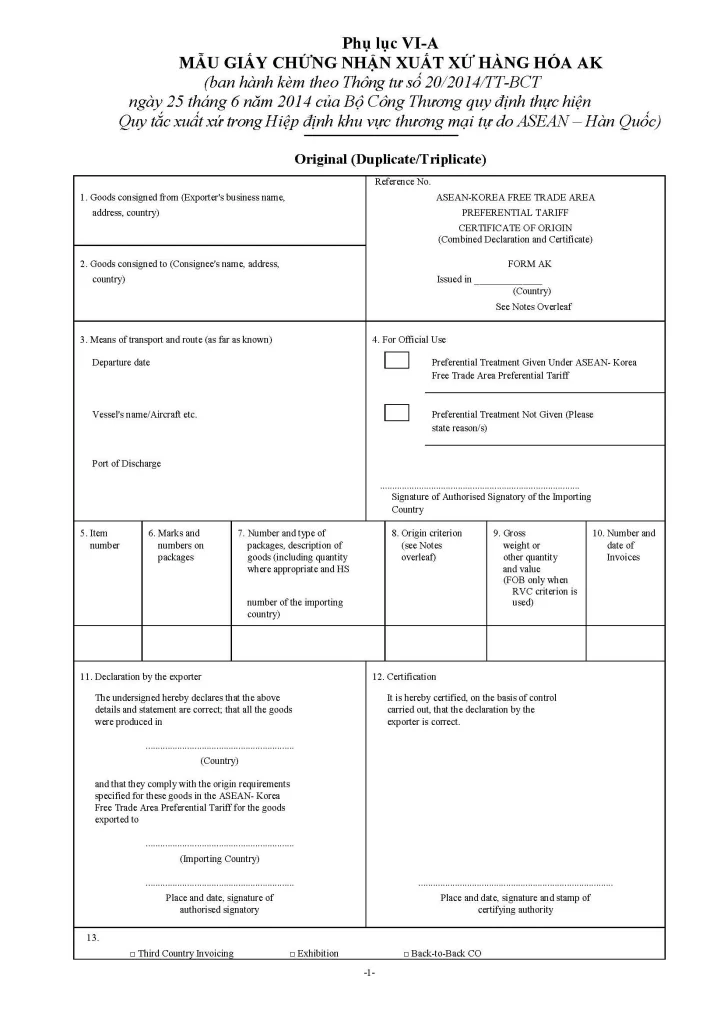
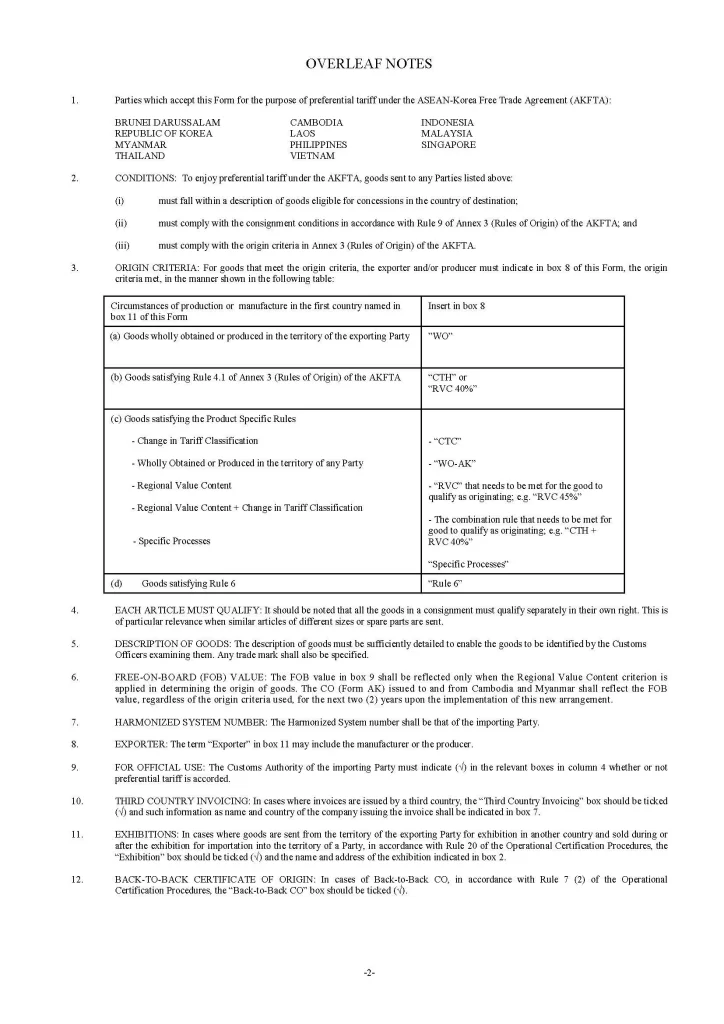
Download C/O Form AK here
Download the Application Form for C/O Form AK here
1.2 Legal Basis of C/O Form AK
| Legal Document | Content |
|---|---|
| Circular 20/2014/TT-BCT | Original regulation implementing Rules of Origin under the ASEAN–Korea Free Trade Agreement (AKFTA) |
| Circular 04/2024/TT-BCT | Issued on March 27, 2024 – amending and supplementing several provisions of Circular 20/2014/TT-BCT regarding Rules of Origin under AKFTA – latest effective regulation |
| Decree 31/2018/ND-CP | General legal framework on goods origin |
| Circular 40/2025/TT-BCT | Regulations on C/O issuance and self-certification of origin – currently effective |
2. Origin Criteria for Issuance of C/O Form AK
WO Criterion — Wholly Obtained
The entire product is produced and harvested 100% in Vietnam without using any imported materials. Applied to rice, coffee, seafood, agricultural products, and minerals.
Declared in Box 8: “WO”
RVC Criterion — Regional Value Content
According to Circular 04/2024/TT-BCT, non-wholly obtained goods are considered originating if they achieve at least 40% Regional Value Content (RVC) calculated based on FOB value.
Important note: Under AKFTA, the minimum RVC threshold may be 35%, 40%, or 45% depending on the specific product under the PSR (Product Specific Rules). Many businesses overlook this point by assuming the general threshold is always 40%.
Direct calculation method for RVC:
- RVC = (VOM/FOB) × 100%
Where: VOM = Value of originating materials used in the production process.
Indirect calculation method for RVC:
- RVC (%) = (FOB – Value of non-originating materials) / FOB × 100%
CTH Criterion — Change in Tariff Heading
Under AKFTA, goods must undergo a tariff classification change at the four-digit level (CTH), meaning the HS code at the 4-digit level of the finished product must differ from the HS code of imported materials.
PSR Criterion — Product Specific Rules
Some products have specific origin rules (PSR) that require RVC thresholds different from 40% or require specific manufacturing processes. Businesses should refer to Appendix II of Circular 20/2014/TT-BCT to determine the applicable PSR for their HS code.
3. Difference Between C/O Form AK and Form VK
This is the most common confusion among businesses, and many competitors fail to explain it clearly.
Vietnam has two separate FTAs with South Korea:
- AKFTA — ASEAN–Korea Agreement → use Form AK
- VKFTA — Vietnam–Korea bilateral agreement → use Form VK
Since VKFTA is a bilateral agreement, tariff preferences in Korea are often better than AKFTA for many product groups.
| Criteria | C/O Form AK (AKFTA) | C/O Form VK (VKFTA) |
|---|---|---|
| Agreement | ASEAN–Korea (multilateral) | Vietnam–Korea (bilateral) |
| Effective from | 2007 | 2015 |
| Tariff preference | According to AKFTA schedule | Often better than AKFTA for many products |
| Origin criteria | RVC ≥ 40% or CTH | RVC ≥ 40% or CTH (similar) |
| Issuing authority | Ministry of Industry and Trade | Ministry of Industry and Trade |
| Scope of application | Goods from any ASEAN country | Only goods originating in Vietnam |
Learn more: What is C/O?
4. Detailed Guide to Completing Each Box on C/O Form AK
C/O Form AK is issued on A4 paper in accordance with the template in Appendix VI-A attached to Circular 20/2014/TT-BCT. It may be issued in traditional paper form or electronic form. It must be completed in English and typed — handwriting is not allowed.
| Box No. | Box Name | Guidance |
|---|---|---|
| Box 1 | Exporter | Full name and address of the exporter in Vietnam – must match customs declaration |
| Box 2 | Consignee | Name and address of consignee in Korea |
| Box 3 | Departure | Means of transport, departure port/airport, departure date |
| Box 4 | Official use | Leave blank – completed by issuing authority |
| Box 5 | Item No. | Serial number of each product item |
| Box 6 | Marks | Shipping marks and package details |
| Box 7 | HS Code | HS code must contain at least the first 6 digits |
| Box 8 | Origin criterion | Most important box – indicate: WO / CTH / RVC X% |
| Box 9 | Gross weight/FOB | Gross weight and FOB value – must match Invoice and B/L |
| Box 10 | Invoice | Commercial invoice number and date |
| Box 11 | Declaration | Name of exporting country (Vietnam), importing country (Korea), place, date, signature |
| Box 12 | Certification | Signed and stamped by issuing authority – do not complete yourself |
| Box 13 | Remarks | Tick the appropriate special case |
Detailed instructions for Box 8 on C/O Form AK
| Criterion | Declared in Box 8 | Applicable Cases |
|---|---|---|
| WO | WO | Vietnamese agricultural products, seafood, minerals |
| RVC ≥ 40% (general criterion) | RVC 40% | Industrial goods, garments, electronics |
| RVC under PSR (35% or 45%) | RVC 35% or RVC 45% | Products with specific PSR rules |
| CTH | CTH | Manufactured goods using imported materials with HS heading change |
Detailed instructions for Box 13 on C/O Form AK
| Case | Declared in Box 13 | When Applicable |
|---|---|---|
| C/O issued after shipment | Issued Retroactively | Retroactive issuance within 12 months from shipment date |
| Exhibition goods | Exhibition | Goods displayed at exhibitions and later sold |
| Back-to-back C/O | Back-to-back C/O | Goods transshipped through a third ASEAN country |
| Third-party invoice | Third Party Invoicing | Invoice issued by a company in another country |
Special note on Back-to-back C/O under AKFTA: AKFTA requires the exporter name on the back-to-back C/O and the importer name on the original C/O to be identical. This condition restricts three-party trade but helps customs authorities strictly control cargo flow and ensure origin is not altered in the intermediary country.
5. Dossier for Applying for C/O Form AK
Trader Registration Dossier (Submitted Once)
- Application for C/O issuance (according to Ministry of Industry and Trade template)
- Business Registration Certificate (notarized copy)
- Specimen signature of authorized C/O signatory
- List of production facilities and intended products for C/O application
Dossier for Each Shipment
- Application for C/O Form AK + completed C/O form
- Export customs declaration (notarized copy)
- Commercial Invoice
- Bill of Lading (B/L) or Air Waybill (AWB)
- RVC calculation sheet (if imported materials are used)
- Import declarations for raw materials and sales contracts (if required)
6. Procedure for Applying for C/O Form AK (5 Steps)
Step 1 — Register a Trader Account
Register at ecosys.gov.vn. Submit the first-time trader registration dossier including specimen signatures, Business Registration Certificate, product list, and manufacturing facilities to the regional Import-Export Management Office.
Step 2 — Declare Shipment Information Online
Complete all C/O Form AK information on the eCOSYS system: product description, HS code (minimum 6 digits), quantity, weight, FOB value, and origin criteria.
Step 3 — Digitally Sign and Submit the Dossier
Digitally sign and submit the dossier via the eCOSYS system. The C/O issuing authority may accept electronic C/O certificates (digitally signed and stamped), which are recognized by Korean customs authorities.
Step 4 — Verification and Approval by the Authority
- Complete and valid dossier → issued within the same day
- Additional verification required → up to 3 days
- Factory inspection required → up to 7 days (with prior notice)
Step 5 — Receive the C/O and Send It to the Korean Partner
Receive the original C/O Form AK. Send it together with the shipment or send a scanned copy in advance via email so the Korean partner can prepare import customs procedures.
7. Frequently Asked Questions About C/O Form AK
How long is C/O Form AK valid?
Normally 12 months from the date of issuance. It must be submitted to Korean customs before expiration.
Should exporters to Korea use Form AK or Form VK?
It depends on the product HS code. Form VK (VKFTA) often provides better tariff preferences because it is a direct bilateral agreement between Vietnam and Korea. However, businesses should compare the tariff schedules under both agreements for each HS code.
What is special about Back-to-back C/O under AKFTA compared to other FTAs?
AKFTA requires that the exporter name on the back-to-back C/O and the importer name on the original C/O must be identical — a stricter condition compared to some other FTAs, intended to strictly control cargo flow and prevent origin alteration in intermediary countries.
Can businesses apply for C/O Form AK after the goods have been exported?
Yes — businesses may apply for a retroactive C/O (Issued Retroactively), which must be indicated in Box 13. The procedure is more complicated and may not always be accepted. It is recommended to apply for the C/O before or at the same time as export.
8. 3W Logistics – Export Services to South Korea
South Korea is a strategic export market for Vietnam, with bilateral trade turnover continuously growing. To maximize AKFTA or VKFTA tariff preferences, export documentation — especially C/O Form AK — must be accurate from the beginning.
3W Logistics provides comprehensive support for businesses exporting to Korea:
- Customs declaration & document consulting — advising whether Form AK or Form VK is more optimal for each shipment, checking C/O validity before submission, and handling all export customs procedures
- Air freight services — Vietnam–Korea routes suitable for urgent shipments, high-value goods, fashion products, and electronics
- Sea freight services — Vietnam–Korea shipping routes with frequent vessel schedules, optimizing costs for large FCL shipments and LCL cargo
- Warehousing & distribution — storage and cargo preparation before export
The 3W Logistics team has extensive experience handling exports to Korea, ready to advise on the most suitable C/O type and review documents before submission — helping shipments clear customs quickly and receive the correct tariff preferences.
CONTACT INFORMATION:
Head Office – 3W Logistics Ho Chi Minh Branch
Address: 34 Bach Dang Street, Tan Son Hoa Ward, Ho Chi Minh City
Hotline: +84 28 3535 0087
____________________________
3W Logistics Hanoi Branch
Address: 8A Lot 28 Le Hong Phong, Gia Vien Ward, Hai Phong
Hotline: +84 24 3202 0482
____________________________
3W Logistics Hai Phong Branch
Address: 81A Tran Quoc Toan, Cua Nam Ward, Hanoi
Hotline: +84 225 355 5939
Website: www.3w-logistics.com

Hello, I’m Nguyen Phuong Nhan (Ms. Nina)
I currently serve as Trade Lanes Supervisor at 3W Logistics, with more than 10 years of experience in international logistics and freight forwarding.
My primary responsibility is developing and managing global logistics partnerships, building strategic trade lanes, and working closely with overseas agents to provide reliable and competitive transportation solutions for customers.
I regularly collaborate with agents and logistics partners worldwide to explore new business opportunities, negotiate freight rates, develop trade routes, and support import-export shipments. I also work closely with our sales team to design logistics solutions tailored to specific markets and customer requirements.
My expertise includes Ocean Freight, Air Freight, Trade Lane Development, Global Agent Network Management, International Logistics Solutions, and Import-Export Support.
Through the articles I share on the 3W Logistics website, I aim to provide practical insights into the international logistics industry, global transportation trends, overseas agent cooperation, and effective logistics strategies that help businesses optimize their supply chain operations.
I believe that strong global partnerships and well-developed trade lanes are essential to delivering sustainable logistics solutions and long-term value to customers worldwide.


