
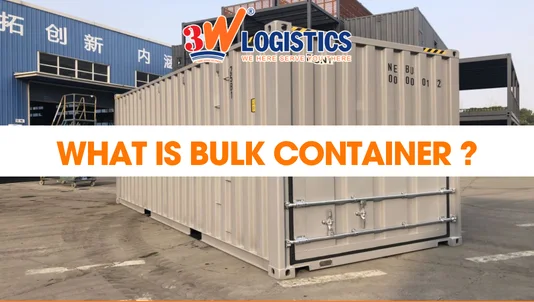
What is bulk container? Structure and transportation process of bulk cargo
Bulk container, also known as a Bulk Container or Dry Bulk Container, is a specialized type of container designed to transport cargo in granular, powder, or small-lump form – without individual packaging – including grains, fertilizers, minerals, sugar, salt, plastic pellets, and other bulk commodities that a standard dry container cannot directly accommodate. The defining feature of a bulk container is its system of top loading hatches and bottom discharge hatches, allowing cargo to be loaded from above via conveyor belt or hopper and discharged by gravity or pneumatic pressure.
1. What Is a Bulk Container?
A bulk container is officially known as a Bulk Container or Dry Bulk Container, sometimes referred to as a Bulk Cargo Container in international logistics. It belongs to the specialized container category and is purpose-built to solve the challenge of transporting large volumes of bulk cargo by container shipping – serving as an alternative to traditional bulk carrier vessels for small and medium-sized shipments.
Unlike a standard dry container, which only accepts bagged or boxed cargo through the rear doors, or a tank container, which handles liquids and gases, the bulk container addresses a distinct segment: granular, powder, and small-lump cargo that needs to be loaded and discharged in large quantities without intermediate packaging, while still taking full advantage of the existing container logistics network at ports and on shipping routes.
In Vietnam’s logistics industry, bulk containers are also referred to as bulk container, cont bulk, or sometimes confused with flexi-bag containers or bulk liner containers though these are entirely different technical solutions, which Section 6 of this article explains in detail.
Common misconception: Many people including experienced import/export professionals often confuse bulk cargo transported by container with bulk cargo transported by bulk carrier vessel. Both methods handle the same types of cargo but are completely different in terms of scale, cost, port requirements, and logistics flexibility. Section 7 of this article provides a detailed comparison to help you choose the right method for each shipment.
2. Detailed Structure of a Bulk Container
Primary material: Corten A/B steel (weathering steel) for the frame and body; thicker reinforced steel plate for the floor and side walls to withstand pressure from bulk cargo; some types feature a polymer or epoxy lining inside to prevent moisture and corrosion.
A bulk container is made up of the following main components:
| COMPONENT | DETAILED DESCRIPTION |
|---|---|
| Load-bearing steel frame | Corten A/B steel capable of withstanding stacking loads up to 192 tonnes; ISO-standard corner castings at all 8 corners, fully compatible with standard port handling equipment |
| Top loading hatches | Typically 2–3 square or round loading openings on the roof of the container, with watertight covers; bulk cargo is poured in from above via hopper or conveyor belt |
| Bottom discharge hatches | 2–3 discharge openings on the lower body of the container, allowing bulk cargo to flow out by gravity or with pneumatic assistance; equipped with valves to control discharge flow |
| Reinforced side panels | Thicker steel panels than standard dry containers, designed to withstand lateral pressure from granular or powder cargo when the container is fully loaded – especially critical for high-density cargo such as minerals and cement |
| Reinforced steel floor | Thick steel plate capable of handling high concentrated loads from heavy bulk cargo; no timber floor (unlike standard dry containers) to prevent moisture absorption and cargo cross-contamination |
| Interior liner — optional | Polymer, epoxy, or stainless steel lining on the interior walls; mandatory for food-grade cargo (grains, sugar) and powder chemicals to prevent moisture, corrosion, and ensure hygiene |
| Rear door — optional | Some bulk container designs retain the rear door for flexible use with both bagged and bulk cargo; certain specialized types omit the rear door entirely |
3. Bulk Container Sizes
20 Ft Bulk Container
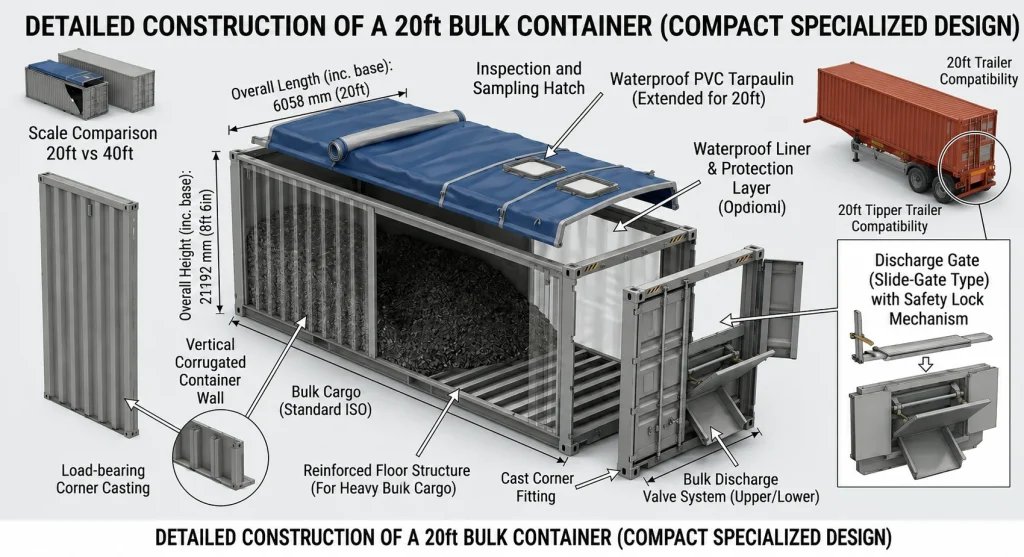
| Specification | Bulk Container 20FT | Practical Notes |
|---|---|---|
| External length | 6,058 mm (20′) | 20ft = 1 TEU (freight unit) |
| External width | 2,438 mm (8′) | ISO standard width |
| External height | 2,591 mm (8’6″) | ISO standard height |
| Internal volume | ~25–27 m³ | Lower than a dry container (~33 m³) due to thicker walls and floor |
| Maximum payload | ~21,000–24,000 kg | Varies by unit and cargo type; check the CSC plate |
| Tare weight | ~2,500–3,000 kg | Heavier than a dry container due to reinforced walls and loading/discharge hatch system |
| Number of top hatches | 2–3 hatches | Varies by manufacturer; each hatch typically ~400–500 mm in diameter |
| Number of bottom discharge hatches | 2–3 hatches | Discharge by gravity or pneumatic pressure assistance |
40 Ft Bulk Container
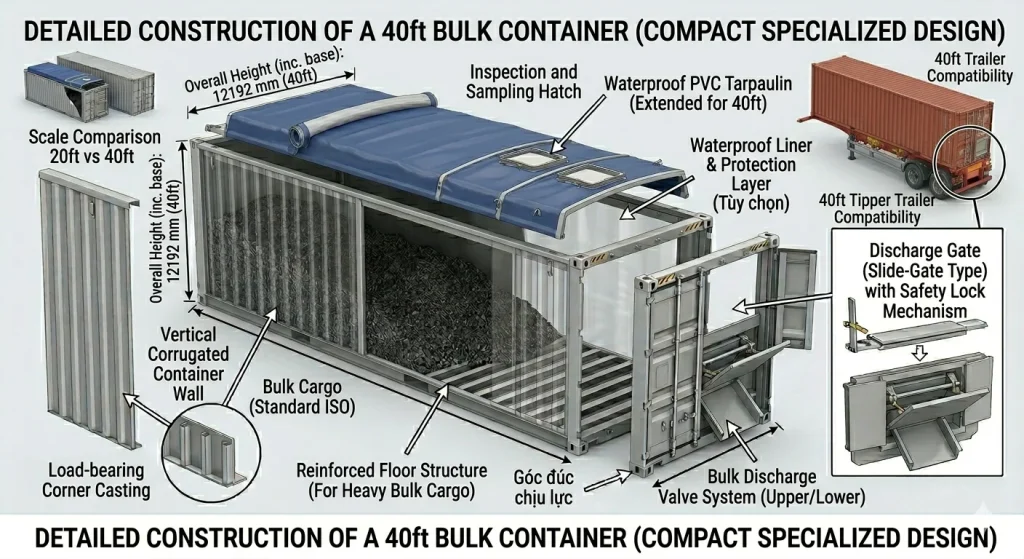
| Specification | Bulk Container 40FT | Practical Notes |
|---|---|---|
| External length | 12,192 mm (40′) | 40ft = 2 TEU (freight unit) |
| External width | 2,438 mm (8′) | ISO standard width |
| External height | 2,591 mm (8’6″) | ISO standard height |
| Internal volume | ~55–60 m³ | Approximately double the 20ft bulk container |
| Maximum payload | ~26,000–27,000 kg | Note Vietnam road transport total load limit of ~30 tonnes |
| Tare weight | ~4,000–4,500 kg | Heavier than a standard 40ft dry container (~3,900 kg) due to additional reinforcement |
| Number of top hatches | 3–5 hatches | More hatches to load cargo evenly along the container length |
| Number of bottom discharge hatches | 3–5 hatches | Evenly distributed for fast and uniform discharge |
Practical note on payload: Many high-density bulk commodities such as minerals, cement, and silica sand may reach the maximum payload limit when the container is only 60–70% full by volume. Never calculate load capacity based on container volume alone – always calculate from the specific density (bulk density) of each cargo type to avoid overloading.
4. Bulk Container Classification by Cargo Type
Not all bulk cargo can share the same container type. Depending on the physical and chemical properties of the cargo, hygiene requirements, and phytosanitary regulations, shippers must select the correct container type accordingly.
| Cargo Group | Specific Examples | Container Requirements | Special Notes |
|---|---|---|---|
| Grains and agricultural bulk | Loose rice, wheat, corn, soybeans, green coffee beans, black pepper | Bulk container with food-grade lining or bulk liner; or flexi-bag in dry container | Fumigation and phytosanitary inspection mandatory before export |
| Sugar, salt, fertilizer | Loose white/raw sugar, industrial salt, urea, DAP, granular NPK | Bulk container with anti-corrosion lining; some use bulk liner in dry container | Sugar and salt are highly hygroscopic – container must seal well; fertilizers are corrosive to steel |
| Minerals and construction materials | Silica sand, iron ore powder, cement clinker, ground limestone, kaolin | Heavy-duty reinforced bulk container; flexi-bag not suitable due to high density and abrasiveness | High density – payload limit is easily reached before the container is volumetrically full; calculate carefully before loading |
| Powder chemicals and plastic pellets | PE/PP/PVC plastic pellets, TiO2 powder, soda ash powder, industrial talc powder | Bulk container or flexi-bag depending on type; DG cargo requires IMDG-compliant bulk container | Plastic pellets commonly use flexi-bag; hazardous powder chemicals require specialized containers |
| Animal feed | Fish meal, meat and bone meal, soybean meal, rice bran, grain flour | Bulk container with food-grade lining or clean bulk liner | Fish meal has a strong odor – check cargo history carefully; risk of self-heating if moisture content is high |
Practical note on cargo history: Similar to tank containers, bulk containers used for food cargo (grains, sugar, animal feed) must have a clean cargo history – never previously used for toxic chemicals or strong-smelling cargo. Many importing countries require a cargo history certificate alongside phytosanitary documents at customs clearance.
5. Advantages and Limitations of Bulk Containers
| ✅ Advantages | ❌ Limitations |
|---|---|
| Transports bulk cargo without individual packaging – significantly reduces packaging costs, loading time, and maximizes actual cargo weight per trip | Very limited availability at depots in Vietnam – booking 2–4 weeks in advance is typically required; many routes do not have bulk containers readily available |
| Fully compatible with the existing container logistics network, same ports, same vessels, same trucks as standard containers, no specialized bulk terminals required | Cleaning after each shipment is mandatory, complex, and costly – especially when switching cargo types; this step cannot be skipped |
| Flexible shipment size – suitable for small and medium lots (under 500 tonnes) where bulk carriers are not economical or where no direct bulk carrier route exists | Container freight cost per tonne is higher than bulk carriers for large shipments (over 5,000 tonnes) – not cost-competitive at that scale |
| Better cargo protection than bulk carriers – cargo is sealed inside the container throughout the voyage, reducing the risk of cross-contamination, moisture damage, and cargo loss | Loading and discharge require specialized equipment (conveyor belts, hoppers, pneumatic blowers) – not all warehouses or factories have these on-site |
| Door-to-door delivery is achievable – the container can be trucked directly to the consignee’s factory or warehouse for on-site discharge | Actual internal volume is lower than a standard dry container of the same size due to thicker walls and floor |
| Suitable for cargo requiring protection from environmental contamination – fully sealed, with no exposure to outside air throughout the voyage | Not suitable for very heavy bulk commodities (ore, crushed stone) in large lots – container costs are far too high compared to bulk carriers at that scale |
6. Flexi-bag and Bulk Liner: Two Popular Alternative Solutions
In practice, a specialized bulk container is not always necessary. Two widely used alternatives flexi-bag and bulk liner – both placed inside a standard dry container are commonly used in Vietnam because they are easier to source and more cost-effective. Understanding the differences between all three options helps businesses choose the right solution for each cargo type.
What Is a Flexi-bag?
A flexi-bag (or flexitank) is a multi-layer polypropylene or polyethylene bag with a capacity of 16,000–24,000 liters, placed inside a standard 20ft dry container to carry liquid non-DG cargo such as edible oil, molasses, concentrated fruit juice, and wine. A flexi-bag is a single-use solution, it is disposed of after the cargo has been discharged.
What Is a Bulk Liner?
A bulk liner is a large woven fabric or plastic film bag lined inside a standard dry container, designed to hold dry bulk cargo in granular and powder form (grains, plastic pellets, granular fertilizers, powder chemicals). The bulk liner is anchored to securing points inside the container, forming a sealed chamber within a standard dry container. It is also a single-use solution.
| Criteria | Bulk Container | Bulk Liner (in Dry Container) | Flexi-bag (in Dry Container) |
|---|---|---|---|
| Suitable cargo type | Granular, powder, and small-lump bulk; including DG powder cargo | Non-DG granular and powder bulk | Non-DG liquid cargo |
| Reusable | Yes – multiple trips (after cleaning) | No – single use | No – single use |
| Availability in Vietnam | Very limited | Relatively common | Common |
| Relative cost | Highest – specialized container rental | Lower – add liner cost only (USD 200–400) | Lower – add bag cost only (USD 300–600) |
| Post-use cleaning | Mandatory – complex and costly | Remove liner and light clean of the dry container | Remove flexi-bag; no special cleaning required |
| Suitable for DG cargo | Yes (depending on bulk container type) | No | No |
| Common use in Vietnam | Minerals, powder chemicals, cement clinker | Loose rice, grains, plastic pellets, granular fertilizers | Edible oil, molasses, concentrated fruit juice |
Practical reality in Vietnam: Due to the scarcity of specialized bulk containers, most Vietnamese bulk export cargo is currently shipped using bulk liners (grains, plastic pellets) or flexi-bags (edible oil, molasses) inside standard dry containers. This is the more practical and cost-effective solution for the majority of small and medium exporters. Specialized bulk containers are typically reserved for minerals, cement clinker, or powder chemicals with specific technical requirements.
7. Bulk Container vs. Bulk Carrier Vessel: Which Should You Choose?
This is a question that many importers and exporters of bulk cargo frequently face but don’t always have clear criteria to answer. Bulk containers and bulk carrier vessels both handle the same types of cargo but serve two completely different segments in terms of scale, routing, and cost.
| Criteria | Bulk Container | Bulk Carrier Vessel |
|---|---|---|
| Optimal shipment size | Small to medium: 20 – 500 tonnes per shipment | Large: 5,000 – 200,000+ tonnes per shipment |
| Freight cost per tonne | Higher – but offset by packaging savings and door-to-door delivery | Significantly lower for large shipments |
| Port requirements | Standard container port – widely available | Specialized bulk terminal – less common |
| Routing flexibility | High – hundreds of container shipping routes worldwide | Lower – depends on bulk carrier routes and specialized terminals |
| Door-to-door delivery | Yes – container trucked directly to warehouse or factory | No – cargo must be transferred from port by other means |
| Protection from contamination | Good – cargo sealed inside container throughout the voyage | Weaker – ship holds exposed to sea air; risk of cross-contamination from previous cargo |
| Port handling time | Faster – follows fixed container vessel schedules | Longer – bulk cargo handling can take hours to days |
| Sailing frequency | High – multiple sailings per week on major routes | Lower – depends on chartering demand |
Shipment method selection guide: Shipments under 500 tonnes → bulk container or bulk liner/flexi-bag in dry container. Shipments between 500–5,000 tonnes → compare both options on total landed cost. Shipments over 5,000 tonnes with a suitable bulk terminal at destination → bulk carrier is generally more economical. However, if the cargo requires strong protection (high-quality grains, sensitive chemicals) or if the destination lacks a bulk terminal, containers remain the better choice even for larger shipments.
8. Phytosanitary Inspection and Fumigation Requirements for Bulk Export Cargo
This is the most distinctive and critical compliance step when exporting bulk agricultural commodities from Vietnam. Many shipments are held at the destination port or returned – not due to cargo quality issues but because phytosanitary and fumigation documents are missing or incorrect.
Phytosanitary Inspection (Phytosanitary Certificate)
Under the regulations of most countries importing agricultural bulk cargo (grains, seeds, coffee, pepper, etc.), cargo must be inspected and issued a Phytosanitary Certificate by Vietnam’s Plant Protection Department (PPD) prior to export. This certificate confirms that the cargo is free from pests, insects, and harmful microorganisms in accordance with ISPM (International Standards for Phytosanitary Measures).
Fumigation
Fumigation is the process of treating bulk cargo with pest-control chemicals to eliminate insects and weevils before export. In Vietnam, the most common methods are fumigation with Methyl Bromide (MB) or Phosphine (PH3).
- Methyl Bromide (MB): Highly effective with a short treatment period (24–48 hours); however, many countries such as the EU, Australia, and New Zealand are restricting or banning imports of MB-fumigated cargo due to its environmental impact.
- Phosphine / Aluminium Phosphide (PH3): More environmentally friendly and widely accepted in most markets; treatment period is longer (3–5 days) but is progressively replacing MB globally.
Required Phytosanitary and Fumigation Documents
| Document | Content | Issuing Authority |
|---|---|---|
| Phytosanitary Certificate | Certifies that the cargo has passed phytosanitary inspection and is free from pests in accordance with ISPM standards | Vietnam Plant Protection Department (PPD) |
| Fumigation Certificate | Certifies fumigation has been carried out: chemical type, concentration, treatment duration, temperature, and container numbers treated | PPD-licensed fumigation company |
| Certificate of Origin (CO) | Certifies the origin of the goods – mandatory for most markets and necessary to benefit from FTA tariff preferences | VCCI or Ministry of Industry and Trade depending on CO type |
| Quality/Quantity Certificate | Certifies the quality and weight of bulk cargo at the time of loading into containers – critical for resolving cargo disputes | Independent inspection company (SGS, Intertek, Bureau Veritas, etc.) |
| Cargo History Certificate | Records the previous cargo carried in the container – required by some markets for food-grade bulk shipments | Issued by the shipping line or container operator |
Timing note: Phosphine fumigation typically takes 3–5 days, while some markets (Australia, USA) require a minimum of 120 hours of treatment at a specified temperature. Fumigation must be scheduled at least 5–7 days before the CY Closing Time to avoid missing the vessel. Phytosanitary Certificates are generally valid for 21–30 days from the date of issue – ensure they do not expire before the cargo arrives at the destination port.
9. How to Load and Discharge Bulk Cargo in Containers Correctly
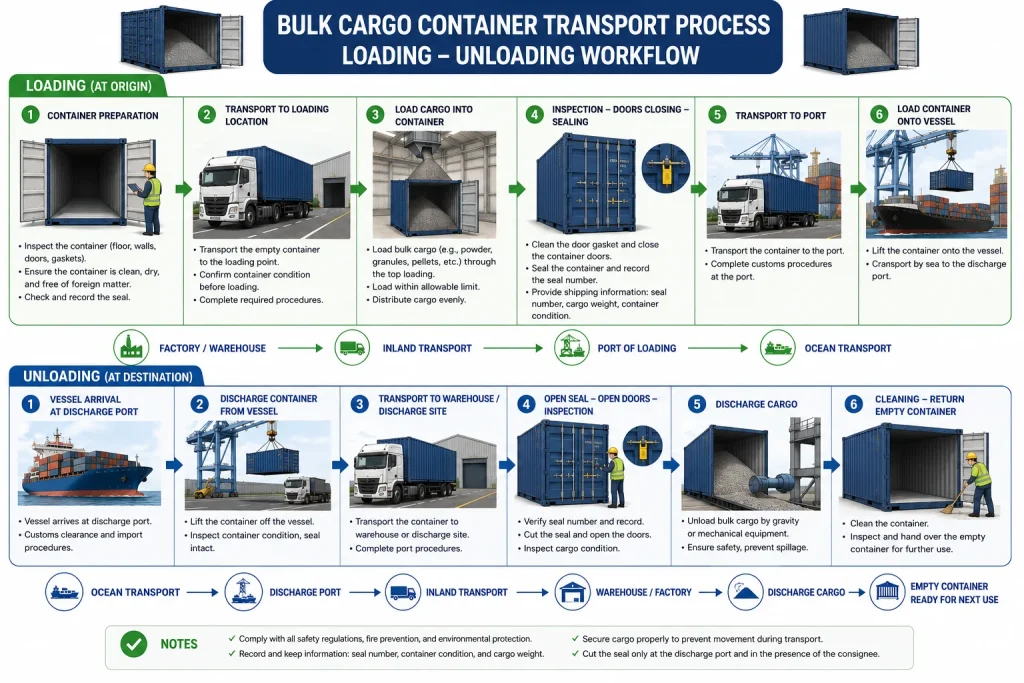
- Inspect the container before loading: Check that all top hatches and bottom discharge hatches open and close properly without sticking or leaking; inspect the entire container body for holes or cracks; if a liner is fitted, verify the liner is undamaged; for food cargo, confirm the cleaning certificate and a clean cargo history are available.
- Install the bulk liner (if using a liner in a dry container): Spread the liner evenly inside the container and anchor it securely to all attachment points; check that the liner is not twisted or folded before loading; ensure the liner mouth is correctly aligned with the loading hatch.
- Load cargo through the top hatches: Connect the hopper or conveyor belt to the loading hatch; load cargo evenly and gradually to avoid uneven lateral pressure on the side walls; monitor the fill level – do not exceed the permitted payload (weigh the container if necessary).
- Close and seal the loading hatches: Tightly close all hatch covers; inspect the gaskets for any gaps or leaks; apply customs seals and buyer-specified seals as required.
- Carry out fumigation (if required): Deliver the container to the fumigation facility at least 5–7 days before the CY Closing Time; ensure the container is fully sealed throughout the treatment period; open the container only after the quarantine period has elapsed and safety has been confirmed.
- Discharge cargo at destination: Open the bottom discharge hatches slowly; receive cargo via conveyor belt or allow it to flow freely into silos or storage; for sticky cargo (moist sugar, cement) pneumatic pressure or mechanical vibration may be needed to ensure complete discharge.
- Clean the container after discharge: Sweep out remaining cargo residue; wash and dry the container; for food cargo, clean to food-grade standards before returning the container to the depot.
Frequently Asked Questions About Bulk Containers
How is a bulk container different from a standard dry container?
What documents are required to export loose rice by container?
What is the difference between a bulk liner and a flexi-bag?
Should I use a container or a bulk carrier vessel to export bulk cargo?
How long does fumigation take and what does it cost?
How much does it cost to rent a bulk container per month?
10. Conclusion
In summary, bulk containers and container-based bulk cargo solutions are a flexible and effective choice for small and medium-sized bulk shipments:
- Specialized bulk containers feature top loading hatches and bottom discharge hatches with reinforced walls – best suited for minerals, cement clinker, and powder chemicals with specific technical requirements
- In Vietnam, bulk liners and flexi-bags inside standard dry containers are the more practical and widely used solutions for grains, plastic pellets, and non-DG liquid cargo
- Containers are optimal for shipments under 500 tonnes requiring door-to-door delivery; bulk carriers are more economical for shipments over 5,000 tonnes with bulk terminal access
- Agricultural bulk exports are required to have a Phytosanitary Certificate and Fumigation Certificate – preparation must begin at least 5–7 days before the CY Closing Time
- A clean cargo history is a mandatory requirement when using containers or liners for food-grade bulk cargo
How Does 3W Logistics Support Customers?
Whether you are exporting loose rice, grains, plastic pellets, fertilizers, minerals, or any other type of bulk cargo, choosing the right container solution (bulk container, bulk liner, or flexi-bag), preparing complete phytosanitary and fumigation documents on time, and coordinating the fumigation schedule around the vessel cut-off are the factors that determine whether your shipment arrives safely and on schedule. 3W Logistics provides comprehensive support across every aspect of bulk cargo container logistics:
- Solution advisory: Based on cargo type, volume, destination market, and budget, the 3W team advises whether to use a specialized bulk container, bulk liner, or flexi-bag in a dry container – or even a bulk carrier vessel if the shipment volume justifies it.
- Container booking and vessel scheduling: 3W works directly with major shipping lines and operators to book the right container type on time – noting that bulk containers are scarce and require 2–4 weeks advance booking; fumigation schedules are planned in coordination with the CY Closing Time from the outset.
- Phytosanitary inspection and fumigation coordination: Connecting customers with PPD-licensed fumigation companies, monitoring fumigation progress, and collecting complete Fumigation Certificates and Phytosanitary Certificates before the vessel cut-off.
- Full export/import documentation: Including CO preparation, electronic customs declaration, Quality Certificates in coordination with inspection companies, and a complete international payment document set (B/L, Invoice, Packing List).
- Inland transport from warehouse to port: Coordinating suitable trailer trucks and ensuring containers arrive at the port on time before the CY Closing Time – especially critical when fumigation is on a fixed schedule.
- Shipment tracking and real-time updates: Providing regular tracking updates and early notification to consignees so they can prepare discharge equipment and arrange phytosanitary inspection at the destination port.
A note from 3W Logistics’ practical experience: The two most common problems with bulk export shipments are: (1) Fumigation Certificates delayed due to insufficient time allocated for Phosphine treatment (3–5 days), causing the shipment to miss the vessel; and (2) cargo held at the destination port because the Phytosanitary Certificate has expired or does not meet the importing country’s specific requirements. Both problems are entirely avoidable with proper advance planning. Contact 3W Logistics early for bulk cargo transport planning and full documentation support.
Address: 34 Bach Dang Street, Tan Son Hoa Ward, Ho Chi Minh City
Hotline: +84 28 3535 0087
____________________________
3W Logistics Hanoi Branch
Address: 81A Tran Quoc Toan Street, Cua Nam Ward, Hanoi
Hotline: +84 24 3202 0482
____________________________
3W Logistics Hai Phong Branch
Address: 8A, Lot 28, Le Hong Phong Street, Gia Vien Ward, Hai Phong
Hotline: +84 225 355 5939
____________________________
3W LOGISTICS CO., LTD – We here serve you there!
Email: quote@3w-logistics.com
Website: www.3w-logistics.com

Ms. Apple is the CCO (Chief Commercial Officer) at 3W Logistics, with over 10 years of experience in sales and business operations management.
At 3W Logistics, Ms. Apple is responsible for commercial strategy, corporate customer development, managing a team of more than 50 sales professionals, and improving business performance in the logistics sector.
With practical experience in sales management and market development, Ms. Apple shares professional insights on business logistics solutions, international transportation, freight forwarding, customer management, trade lane development, and growth strategies in the logistics industry.


