

What is a Tank Container? Classification, T-Code, and IMO Regulations
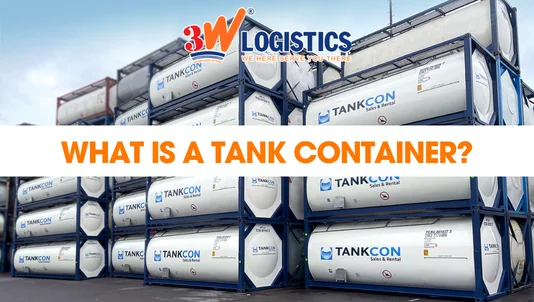
Tank Container (also known as an ISO Tank) is a specialized container designed to transport liquid, gaseous, or bulk powder cargo – including industrial chemicals, liquid food products, liquefied gases, and hazardous liquids that standard containers are completely unable to handle. The defining structure of a tank container is a cylindrical pressure vessel (shell) made of stainless steel or carbon steel, housed within a standard ISO steel frame, combined with a specialized system of valves, pipelines, and safety equipment tailored to each cargo type.
1. What Is a Tank Container?
The full English name is Tank Container, abbreviated as TC or ISO Tank in the logistics and chemicals industry. It is a special-purpose container belonging to the specialized container group, designed and manufactured to strict international standards for the safe transport of liquid and gaseous cargo that other container types cannot accommodate.
Unlike a standard container for packaged goods or a flat rack container that maintains temperature for frozen cargo, a tank container solves an entirely different challenge: transporting large volumes of liquid or gaseous cargo continuously without the need to package it in individual drums or cans saving packaging costs, reducing the risk of leakage, and maximizing capacity.
In Vietnam’s logistics industry, tank containers are also referred to as tank containers, ISO tanks, cont tanks, or sometimes container xitec in certain chemical and food industries.
Important Note: Tank containers have the most complex technical, legal, and safety requirements of all container types. Not every depot or shipping line can handle tank containers – especially for hazardous goods. Selecting the wrong tank type, declaring the wrong UN number, or lacking the required dangerous goods transport permit can result in serious legal and safety consequences.
2. Detailed Structure of a Tank Container
Shell material: 316L stainless steel for food-grade and sensitive chemical cargo; 304 stainless steel for standard chemicals; carbon steel with epoxy lining for certain specialty chemicals.
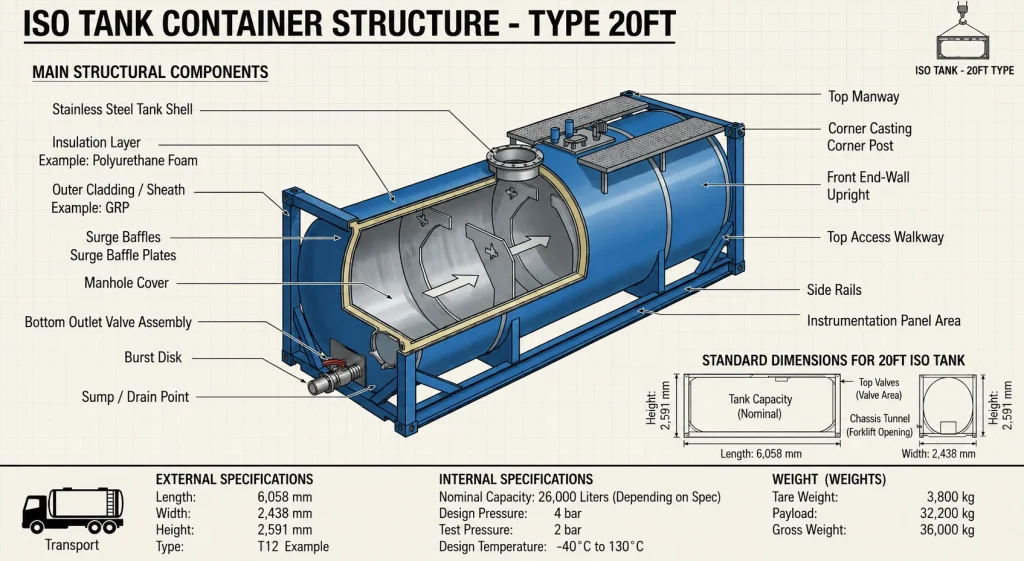
A tank container consists of the following main components:
| COMPONENT | DETAILED DESCRIPTION |
|---|---|
| Cylindrical pressure vessel (shell/vessel) | Horizontal cylindrical tank body made of stainless or carbon steel, designed to withstand internal pressure; typical capacity ranges from 14,000 to 26,000 liters depending on type |
| ISO steel frame | Steel frame surrounding the vessel, with ISO-standard corner castings at all 8 corners, allowing stacking, lashing on vessels, and road transport by truck chassis exactly like a standard container |
| Top manhole / inlet | Cleaning access hatch and top liquid loading inlet, equipped with a pressure relief valve (PRV) and vacuum valve to balance pressure during loading/unloading |
| Bottom outlet valve | Bottom discharge valve for draining liquid cargo, typically comprising a primary valve and a secondary valve/cap for double safety; removable for cleaning |
| Heating coil (optional) | Steam pipe or electric heating element wrapped around the vessel body, used to heat high-viscosity liquid cargo (palm oil, bitumen, molasses) to facilitate discharge |
| Insulation layer (optional) | Polyurethane foam or mineral wool insulation wrapped around the vessel to minimize temperature change during transport; mandatory for food-grade tanks and certain chemicals |
| Safety valves and measuring instruments | Includes a level gauge, pressure gauge, high-pressure relief valve (PRV), thermometer, and safety devices as required by IMO/IMDG standards |
3. Tank Container Classification by Size and Specifications
Tank containers have external dimensions equivalent to a standard 20ft ISO container, with the entire vessel housed within a 20ft steel frame. There are no widely-used 40ft tank containers in international trade – instead, large volumes of cargo typically use two 20ft tanks.
| Specification | Tank Container (20FT) | Practical Notes |
|---|---|---|
| External length (frame) | 6,058 mm (20′) | Standard 20ft ISO frame = 1 TEU |
| External width (frame) | 2,438 mm (8′) | Standard ISO width |
| External height (frame) | 2,591 mm (8’6″) | Standard ISO height |
| Vessel capacity | 14,000 – 26,000 liters | Varies by cargo type and manufacturer; most common is ~21,000–24,000 liters |
| Maximum fill level | 80–95% of capacity | 100% fill is not permitted — ullage space must be left for thermal expansion per IMO regulations |
| Maximum payload | ~20,000–26,000 kg | Depends on liquid density; check CSC plate and tank certificate |
| Tare weight | ~3,500–4,500 kg | Heavier than dry containers due to the vessel and valve system |
| Maximum allowable working pressure (MAWP) | 1.5 – 10 bar (depending on type) | T11 tank (standard chemicals): ~4 bar; liquefied gas tanks: up to 22 bar |
| Mandatory inspection cycle | 2.5 years and 5 years | Internal inspection every 2.5 years; full pressure test every 5 years per IMDG Code |
Note on ullage space: IMO regulations require that a void space (ullage) be left inside the vessel to allow liquid cargo to expand when temperatures rise during transport. The minimum ullage level depends on cargo type and thermal expansion coefficient – typically no more than 95% fill for standard cargo and no more than 90% for hazardous goods with high expansion rates.
4. Tank Container Classification by Cargo Type (T-Code)
This is the most significant difference between tank containers and all other container types: not every tank container can be used for every type of liquid cargo. The IMO T-Code classification system precisely specifies which tank type is authorized to carry which cargo, based on the hazard level of the goods.
| T-Code | Cargo Type | Specific Examples | Working Pressure |
|---|---|---|---|
| T1 – T4 | Low-hazard liquid goods | Some industrial alcohols, low-hazard chemicals, industrial cleaning agents | 1.5 – 2.65 bar |
| T11 | Most common industrial chemicals | Methanol, ethanol, xylene, toluene, diluted acetic acid, glycerine, diluted sodium hydroxide | 4 bar |
| T14 | High-hazard chemicals | Hydrochloric acid (HCl), phosphoric acid, highly corrosive chemicals | 4 bar |
| T50 | Pressure liquefied gases (LPG) | LPG (propane, butane), liquid ammonia (NH3), liquefied CO2 | 17.5 – 22 bar |
| T75 | Cryogenic liquefied gases | Liquid nitrogen (LN2), liquid oxygen (LOX), liquid argon, LNG (liquefied natural gas) | Rated down to -196°C |
| Foodgrade Tank | Food and beverage liquid cargo | Edible oils (palm oil, coconut oil), wine, beer, fruit juice, molasses, liquid milk | 316L steel, food-grade certified |
Critically important practical note: A tank container that has previously held industrial chemicals (even if thoroughly cleaned) must absolutely not be used for food cargo. Food-grade tanks must have a clean cargo history and a valid food-grade certificate. Freight forwarders must verify the cargo history certificate before booking a tank for food shipments.
5. ISO Tank vs. Non-ISO Tank: Key Differences
In practice, when people refer to a “tank container,” they typically mean an ISO Tank but Non-ISO Tanks also exist and have important differences that logistics professionals need to understand.
What Is an ISO Tank Container?
An ISO Tank is a tank container manufactured in full compliance with ISO 668 and ISO 1496-3 standards, with an ISO-standard steel frame and corner castings that allow multimodal transport: ocean freight, road transport by truck chassis, and depot stacking – exactly like a standard container. This is the most common type in international trade.
What Is a Non-ISO Tank?
A Non-ISO Tank (also known as a road tanker or non-ISO portable tank) is a liquid storage vessel of custom design that does not conform to ISO container dimensions and corner castings. This type is primarily used for domestic road transport (tanker trucks), cannot be stacked like an ISO tank, and is not directly compatible with port container handling equipment.
| Criterion | ISO Tank | Non-ISO Tank |
|---|---|---|
| Design standard | ISO 668 + ISO 1496-3 + IMDG Code | Non-ISO container standard |
| Multimodal transport | Yes – ocean, road, rail | Primarily domestic road only |
| Stacking at depot/vessel | Yes – fully compatible with port equipment | Cannot be stacked |
| Common capacity | 14,000 – 26,000 liters | 5,000 – 40,000 liters (more flexible) |
| Mandatory inspection | Per IMDG Code: 2.5 years and 5 years | Per national regulations |
| Suitable for import/export | Yes – international standard | No – domestic use only |
| Investment/rental cost | Significantly higher | Lower |
Conclusion: In international import/export, ISO Tank is the only option. Non-ISO Tanks are only suitable for domestic road transport by tanker truck. When someone says “rent a tank container for export,” they always implicitly mean an ISO Tank.
6. Advantages and Limitations of Tank Containers
| ✅ Advantages | ❌ Limitations |
|---|---|
| Transport large volumes of liquid cargo without needing individual drums or cans – significantly reducing packaging costs | Rental cost 40–80% higher than dry containers; cleaning costs after each use are also substantial |
| Reduces risk of leakage and contamination compared to packing in multiple drums or IBC containers – fully sealed system | Cleaning and certification process after each use is complex, time-consuming, and costly – especially when changing cargo type |
| Fully compatible with multimodal logistics systems – ocean, road, and rail transport just like a standard container | Requires special documentation, permits, and declarations for dangerous goods (DG) — much more complex than standard cargo |
| Can be equipped with heating and insulation systems, suitable for temperature-sensitive cargo during transport | Not every depot, port, or shipping line can handle ISO tanks – availability in Vietnam is limited and advance booking of 2–4 weeks is required |
| Long service life (15–20 years) when properly maintained and inspected – lower depreciation cost per shipment over time | Some cargo types cannot be fully discharged (heel), causing cargo loss and complex post-shipment cleaning issues |
| More economical than flexi-bags and drums for large shipments — break-even is typically reached at loads of 14,000 liters or more | High risk of “empty return” tanks often return to depot empty as suitable return cargo matching the tank type is hard to find |
Practical note: Tank cleaning costs after carrying hazardous goods or switching to a different cargo type can reach USD 300–800 per cleaning, depending on complexity. This cost is often not included in the initial tank rental price and surprises many businesses using tank containers for the first time. Always clarify who bears the cleaning cost at the time of contract negotiation.
7. Safety Regulations for Dangerous Goods Transport (IMO/IMDG)
Tank containers carrying dangerous goods (DG) operate within the strictest legal and safety framework in the entire logistics industry. Understanding these regulations is not only a legal requirement but also protects people and the environment.
Applicable International Legal Framework
IMDG Code (International Maritime Dangerous Goods Code): The IMO (International Maritime Organization) code governing sea transport of dangerous goods, updated every two years and mandatorily applicable in most IMO member states, including Vietnam. The IMDG Code defines 9 classes of dangerous goods (Class 1–9), and specifies packaging, labeling, declaration, and transport requirements for each class.
9 Dangerous Goods Classes per IMDG Code
| Class | Cargo Group | Examples Commonly Carried in Tanks | Complexity Level |
|---|---|---|---|
| Class 2 | Gases | LPG, liquid ammonia, CO2, liquefied chlorine gas | Very high – requires T50/T75 |
| Class 3 | Flammable liquids | Methanol, ethanol, acetone, xylene, toluene, industrial solvents | High – most common |
| Class 6.1 | Toxic substances | High-concentration methanol, certain liquid pesticides | Very high |
| Class 8 | Corrosive substances | Sulfuric acid, hydrochloric acid, caustic soda (NaOH), phosphoric acid | High – requires special tank material |
| Non-DG | Non-hazardous goods | Edible oil, glycerine, molasses, fruit juice, wine, liquid milk | Low – food-grade tank |
Mandatory Documentation for DG Cargo in Tanks
- UN Number and Proper Shipping Name: Each dangerous good has its own UN number (e.g., methanol = UN1230, sulfuric acid = UN1830). The correct UN number must be declared on all transport documents.
- Dangerous Goods Declaration (DGD): IMO-format dangerous goods declaration, must be signed by an authorized shipper holding a valid DG certificate.
- Tank Certificate and Inspection Report: Valid tank inspection certificate (within the 2.5-year and 5-year intervals). Shipping lines have the right to refuse loading if the tank is overdue for inspection.
- Material Safety Data Sheet (MSDS/SDS): GHS-standard chemical safety data sheet, must be provided to the shipping line and receiving agent.
- Cleaning Certificate: Tank cleaning certificate from the previous shipment, confirming the tank has been cleaned and is suitable for the new cargo type.
- Domestic Dangerous Goods Transport Permit: Under Vietnam’s Decree 34/2024/ND-CP, vehicles carrying dangerous goods must hold a Dangerous Goods Transport Permit and drivers must hold corresponding training certificates.
Important warning: Violations of IMDG regulations for dangerous goods transport can result in cargo being refused at the port, heavy fines from the shipping line and regulatory authorities, container detention at transshipment ports, and in serious cases, criminal prosecution. Do not attempt to handle DG documentation independently without experience — always work with a forwarder that holds DG certification.
8. Tank Container vs. Other Container Types
| Criterion | Dry Container | Reefer Container | Tank Container | Flexi-bag (in Dry) |
|---|---|---|---|---|
| Liquid cargo | Not directly (requires drums/cans) | Not directly | Yes – purpose-built | Yes – via inner plastic liner bag |
| Hazardous chemical cargo (DG) | Yes (packaged per IMDG) | Limited | Yes – purpose-built for liquid DG | Non-DG only |
| Temperature control | No | Yes (-30°C to +30°C) | Yes (heating, insulation – depending on tank type) | No |
| Liquid capacity (20ft) | Depends on packaging | Depends on packaging | 14,000 – 26,000 liters direct | ~16,000 – 24,000 liters |
| Packaging cost | High (drums, IBCs, cans) | High | No packaging cost | Low (single-use bag) |
| Rental cost (relative) | Lowest (baseline) | 50–100% higher | 40–80% higher | 30–40% less than tank |
| Prevalence in Vietnam | Very common | Common | Available but limited | Growing |
When should you choose a Tank over a Flexi-bag? A flexi-bag (plastic liner inside a dry container) is a cheaper alternative for large volumes of non-DG liquid cargo such as edible oil and molasses. However, flexi-bags are single-use and not suitable for DG cargo, heated cargo, or high-density cargo. For hazardous liquid cargo or cargo requiring high hygiene standards (dedicated food-grade), a tank container is the mandatory choice.
9. Correct Procedure for Loading and Discharging Tank Containers
- Pre-loading tank inspection: Verify the tank certificate is still valid; check the cleaning certificate from the previous shipment; inspect all valves, pipelines, and gaskets for leaks; confirm the tank type matches the required T-code for the cargo.
- Confirm UN number and material compatibility: Cross-reference the cargo’s UN number with the SDS to confirm the tank material (304 or 316L stainless steel) is compatible with the cargo; check that the previous cargo history presents no chemical conflicts.
- Top loading: Connect the loading pipeline to the top manhole; ensure the pressure relief valve is functioning normally; monitor the fill level via the level gauge – do not exceed the prescribed ullage level (typically 95% for non-DG, 90% for DG).
- Sealing and post-loading inspection: Tightly close and seal all valves and covers; inspect for leakage by visual observation and/or gas detection equipment; record all seal numbers in the transport documents.
- Dangerous goods labeling (if DG): Apply the correct diamond label per the IMDG Class on all four sides of the tank; attach placards as required; mount the UN number panel.
- Discharge at destination: Connect the discharge pipeline to the bottom outlet valve; open valves in the correct procedural sequence; use a pump or inert gas pressure (nitrogen) to assist discharge if needed; for high-viscosity cargo, apply pre-heating before discharge.
- Post-discharge tank cleaning: Fully drain the heel (residual cargo); rinse the vessel with hot water or an appropriate solvent depending on the previous cargo; obtain a cleaning certificate from a professional cleaning facility before returning the tank to the depot.
Frequently Asked Questions About Tank Containers
What types of cargo can a tank container carry?
How many liters can a tank container hold?
What is the difference between an ISO tank and a flexi-bag?
Is a special permit required to transport cargo in a tank container?
How much does it cost to rent a tank container per month?
Can a tank container be used to transport edible oil?
10. Conclusion
In summary, tank containers are an irreplaceable transport solution for liquid and gaseous cargo in the international logistics chain:
- Transport large volumes of liquid cargo (14,000–26,000 liters) without individual packaging – reducing costs and minimizing leakage risk
- Classified by T-Code (T11, T50, T75, food-grade, etc.) – not every tank is suitable for every liquid cargo type; the correct type must always be selected
- A clear distinction must be made between ISO Tanks (international multimodal use) and Non-ISO Tanks (domestic road transport only)
- Dangerous goods (DG) in tank containers require full compliance with the IMDG Code and Decree 34/2024/ND-CP – do not attempt to handle this independently without experience
- True costs include tank cleaning fees, DG surcharges, and transport permits — always calculate total cost before making a decision
How Does 3W Logistics Support Its Customers?
Whether you are exporting edible oil, industrial chemicals, molasses, solvents, or other liquid goods, selecting the right tank container type, preparing complete DG documentation, and ensuring IMDG Code compliance are the key factors determining the success and safety of your shipment. 3W Logistics provides comprehensive support across every aspect of tank container logistics:
- Consulting on the right tank type: Based on UN number, chemical properties, volume, and temperature requirements, 3W’s team advises on the correct T-code tank type, vessel material, and whether heating or insulation is needed – preventing wrong tank selection that could lead to cargo rejection.
- Tank booking and vessel scheduling: 3W works directly with reputable tank operators and major shipping lines to book tanks on time with valid cleaning certificates. Note that tank containers are scarcer than dry containers and require 2–4 weeks advance booking.
- Full DG documentation handling: Including drafting the Dangerous Goods Declaration (DGD), verifying the UN number, confirming tank certificate validity, preparing the MSDS, and completing the full set of international payment documents.
- Domestic dangerous goods transport permit application: Under Decree 34/2024/ND-CP, 3W assists in obtaining DG transport permits for truck chassis, ensuring full compliance before transporting from warehouse to port.
- Tank transport from warehouse to port: Coordinating appropriate truck chassis, ensuring drivers hold required DG certificates, and ensuring the tank arrives at port before CY Closing Time.
- Shipment tracking and real-time updates: Providing regular tracking updates on vessel position, ETA, and early notification to the receiving party to prepare for pumping/discharge and cargo sample analysis where required.
A note from 3W Logistics’ practical experience: Many businesses using tank containers for the first time are caught off guard by two issues: (1) tank cleaning costs and the time required to obtain a cleaning certificate take longer than expected, causing vessel schedule delays; (2) expired tank certificates are discovered at the port, resulting in cargo refusal and the need to urgently find a replacement tank. To avoid both situations, contact 3W Logistics for proper guidance and preparation from the outset.
Address: 34 Bach Dang Street, Tan Son Hoa Ward, Ho Chi Minh City
Hotline: +84 28 3535 0087
____________________________
3W Logistics Hanoi Branch
Address: 81A Tran Quoc Toan Street, Cua Nam Ward, Hanoi
Hotline: +84 24 3202 0482
____________________________
3W Logistics Hai Phong Branch
Address: 8A Lot 28 Le Hong Phong Street, Gia Vien Ward, Hai Phong
Hotline: +84 225 355 5939
____________________________
3W LOGISTICS CO., LTD – We here serve you there!
Email: quote@3w-logistics.com
Website: www.3w-logistics.com

Ms. Apple is the CCO (Chief Commercial Officer) at 3W Logistics, with over 10 years of experience in sales and business operations management.
At 3W Logistics, Ms. Apple is responsible for commercial strategy, corporate customer development, managing a team of more than 50 sales professionals, and improving business performance in the logistics sector.
With practical experience in sales management and market development, Ms. Apple shares professional insights on business logistics solutions, international transportation, freight forwarding, customer management, trade lane development, and growth strategies in the logistics industry.


