

Vietnam’s fruit export procedure is entering its most significant period of change to date, as the Government has issued Decree 38/2026/ND-CP and Resolution 36/2026/NQ-CP on the issuance and management of growing area codes and packing facility codes, moving toward full digitization – shifting from heavy administrative pre-inspection to a self-declaration – self-responsibility – increased post-audit model.
At the same time, China – Vietnam’s largest fruit consumption market – has applied GACC (General Administration of Customs of China) Order 280 from June 1, 2026, replacing Order 248, forcing businesses to review their entire facility registration and growing area code documentation before exporting.
As a multi-billion-dollar export industry with key products such as durian, dragon fruit, mango, banana, longan, lychee, rambutan, jackfruit, watermelon, and mangosteen, the fruit export procedure requires businesses to clearly distinguish between the traditional fruit group already permitted for mass export and the fruit group requiring a separately negotiated Protocol for each market, as these two groups have completely different documentation requirements and control levels.
The article below summarizes all the legal basis, HS codes, procedures, costs, and common risks in the fruit export procedure, updated according to regulations current as of September 2026.
1. Potential and Main Fruit Export Markets
Vietnam has fruit growing areas concentrated in the Mekong Delta (durian, dragon fruit, rambutan, longan, watermelon), the Central Highlands and Southeast region (durian, mango, banana), and the North (lychee, longan). China is currently the largest importing market, accounting for the majority of durian and dragon fruit export turnover; besides that, the US, EU, Japan, South Korea, and Australia continue to be markets with stringent technical requirements in the fresh fruit export procedure.
Each market applies a different level of control: China manages via growing area codes, packing facility codes, and a separate Protocol for each fruit type, and since 2024-2025 has tightened testing for Cadmium residue and the banned substance Auramine O (Vàng O) for durian and jackfruit; the US only permits fruit types with an existing bilateral protocol and requires mandatory irradiation treatment at an APHIS-approved facility; the EU, Japan, and South Korea focus on controlling pesticide residue limits (MRL) and quarantine treatment against fruit flies.
2. Legal Basis Governing the Fruit Export Procedure
| Legal Document | Regulatory Content |
|---|---|
| Law on Cultivation 2018 (31/2018/QH14) | General regulations on cultivation, growing areas, and crop products for consumption and export |
| Law on Plant Protection and Quarantine 2013 (41/2013/QH13) | Basis for issuing the export Phytosanitary Certificate; authority of the regional quarantine agency |
| Decree 38/2026/ND-CP | Regulates the issuance and management of growing area codes and packing facility codes for export purposes |
| Resolution 36/2026/NQ-CP | Full digitization of code issuance, based on the principle of self-declaration – self-responsibility – increased post-audit |
| Current phytosanitary quarantine circular (amending and supplementing Circular 33/2014/TT-BNNPTNT) | Documentation and process for issuing the export Phytosanitary Certificate; the issuing authority was renamed the Department of Crop Production and Plant Protection (Ministry of Agriculture and Environment) from July 1, 2025 |
| Decree 292/2026/ND-CP (effective from September 5, 2026, replacing Decree 69/2018/ND-CP) | General procedures for managing the import-export of goods; fruit is not on the list of banned exports |
Important new point to note: Decree 38/2026/ND-CP and Resolution 36/2026/NQ-CP move the entire issuance of growing area codes and packing facility codes into a digital environment, based on the principle that businesses self-declare and take responsibility for their data, while strengthening post-audit and connection with the agricultural traceability system. For the Chinese market specifically, GACC Order 280 (effective from June 1, 2026, replacing Order 248) requires packing/processing businesses to review their facility registration information under the new risk classification mechanism.
3. Conditions for Growing Areas and Packing Facilities
| Condition | Issuing/Managing Authority | Notes |
|---|---|---|
| Growing Area Code | Department of Crop Production and Plant Protection / Local Sub-Department | Mandatory for markets that require it (China, US, Japan, South Korea, EU); the code must still be valid and match the actual output |
| Packing House Code | Department of Crop Production and Plant Protection | Only fruit sourced from a growing area with the corresponding code may be packed; the packing code cannot be used to “legitimize” material of unclear growing-area origin |
| Business registration under GACC (Order 280) | General Administration of Customs of China | Mandatory for packing/processing facilities exporting to China, managed based on product and business risk level |
| Cadmium and Auramine O testing | GACC-accredited laboratory | Specifically mandatory for durian and jackfruit exported to China; the number of accredited labs remains limited, so testing should be scheduled early |
| GlobalGAP/VietGAP Certification | Independent certification body | Not legally mandatory, but most importers in the EU, Japan, and South Korea require it |
4. HS Code and Fruit Export Tax
Fresh fruit primarily falls under Chapter 08 – “Edible fruit and nuts; peel of citrus fruit or melons.” Correctly determining the HS code by species and product condition (fresh/frozen/dried) is an important step in the fruit export procedure to avoid errors in customs declaration.
| Fruit Type | HS Code (Vietnam) | Vietnam Export Tax | Notes |
|---|---|---|---|
| Fresh durian | 0810.60 | 0% | Strict control of Cadmium and Auramine O when exporting to China |
| Fresh dragon fruit | 0810.90 | 0% | Among the items subject to increased EU border inspection frequency for certain shipments |
| Fresh mango | 0804.50 | 0% | Exports to the US and Japan require additional quarantine treatment (irradiation/vapor heat treatment) |
| Fresh longan, lychee, rambutan | 0810.90 | 0% | Belongs to the traditional fruit group already permitted for export to China, but still requires a full growing area code and packing facility code |
| Fresh jackfruit, banana, watermelon | 0810.90/0803/0807.11 | 0% | Requires detailed lookup at the 8-digit subheading level according to species and packaging specification |
Practical note: Vietnam’s fruit export tax is currently 0% for most HS codes under Chapter 08. However, certain fruits such as durian and jackfruit require a passing Cadmium and Auramine O test result before customs clearance when exported to China – otherwise the shipment will be held pending testing or returned.
Each fruit type, in its different forms, will have a different HS code and tax rate – see more details on some specific fruits:
5. Specific Requirements by Export Market
| Market | Main Requirement | Notes |
|---|---|---|
| China | Growing area code, packing facility code matching the market; GACC registration under Order 280; Cadmium/Auramine O testing for durian and jackfruit | Certain fruits require a separate Protocol (durian, dragon fruit, passion fruit, jackfruit, pomelo) |
| US | APHIS Import Permit; irradiation treatment at an APHIS-approved facility with a monitor present | Only applies to fruits with an existing bilateral protocol (dragon fruit, mango, longan, rambutan, lychee, star fruit…) |
| EU | Phytosanitary Certificate, pesticide residue control (MRL) under EC 396/2005 | Certain items (dragon fruit, okra…) are on the list of increased border inspection frequency under Reg. (EU) 2019/1793 |
| Japan, South Korea | Vapor Heat Treatment to eliminate fruit flies, chemical residue control | Mandatory for mango and dragon fruit exported to Japan; requires an approved heat treatment facility |
6. Documentation Set for the Fruit Export Procedure
| Document | When to Prepare | Important Notes |
|---|---|---|
| Sales Contract, Invoice, Packing List | Before customs declaration | Clearly state Incoterms and the growing area/packing facility code, matching figures with the bill of lading |
| Phytosanitary Certificate | Before the goods leave the port, valid for approximately 14 days from the issue date | Issued by the Department of Crop Production and Plant Protection, must clearly state the corresponding growing area code and packing facility code |
| Cadmium/Auramine O test result slip (if applicable) | Before exporting to China (durian, jackfruit) | Only valid when issued by a GACC-accredited laboratory |
| Irradiation/vapor heat treatment certificate (US, Japan, South Korea) | Before exporting to a market that requires it | Only applies to fruits with an existing bilateral protocol and an approved treatment facility |
| Certificate of Origin (C/O) | After the export declaration is issued | Necessary to enjoy tariff preferences under FTAs (ACFTA, EVFTA, CPTPP, RCEP…) |
| Export Customs Declaration (VNACCS) | Before customs clearance | Declare the correct HS code according to species and storage specification |
7. Fruit Export Procedure Step by Step
Step 1: Determine the Target Market and Check the Applicable Protocol
The business determines the fruit type and export market, checking whether the item already has an official Protocol – this is the foundational first step in the fruit export procedure, determining the entire legal documentation set to be prepared afterward.
Step 2: Purchase from the Growing Area and Pack at a Facility with the Matching Code
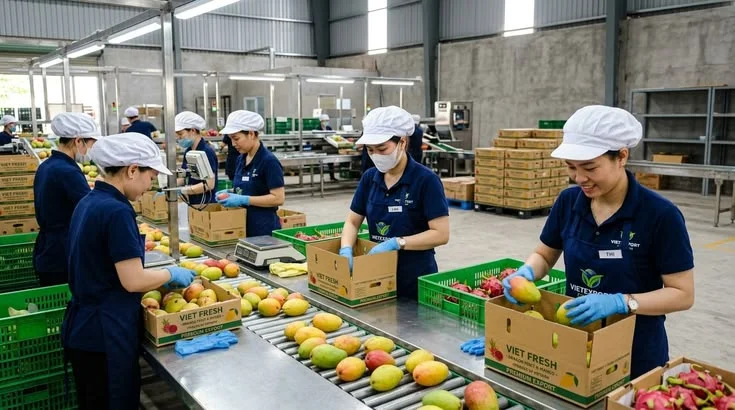
Raw material may only be purchased from a growing area that already has a code under Decree 38/2026/ND-CP, then packed at a facility with the corresponding code, ensuring the code is fully shown on the packaging and shipment documentation.
Step 3: Residue Testing According to Market Requirements
For durian and jackfruit exported to China, the business sends samples for Cadmium and Auramine O testing at a GACC-accredited laboratory; for the EU market, control pesticide residue against the regulated MRL threshold.
Step 4: Register Phytosanitary Quarantine and Apply for the Certificate
The business registers for export phytosanitary quarantine at the regional Sub-Department of Plant Quarantine, submitting documentation and product samples to be issued the Phytosanitary Certificate.
Step 5: Additional Treatment According to the Destination Market (Irradiation, Vapor Heat Treatment)
For the US market, the shipment is irradiated at an APHIS-approved facility with a monitor present; for Japan and South Korea, vapor heat treatment is applied to eliminate fruit flies before container loading.
Step 6: Finalize the Documentation Set and File the Export Customs Declaration
The business or forwarding company prepares the Invoice and Packing List, files the electronic customs declaration on the VNACCS/VCIS system, and attaches the Phytosanitary Certificate, test results (if applicable), and the appropriate C/O for the destination market’s FTA.
Step 7: International Transport and Import Clearance at the Destination Country
Once the declaration clears customs, the goods are handed over to the carrier by reefer container or air freight depending on the storage characteristics of each fruit type. The importer coordinates with customs, GACC, APHIS, or the quarantine authority at the destination country to complete import procedures.
8. Common Risks in the Fruit Export Procedure
| Risk | Manifestation | Prevention Method |
|---|---|---|
| Purchasing from a growing area without a code or with a suspended code | The Phytosanitary Certificate is not issued, export becomes impossible | Check the status of the growing area code and packing facility code on the system before purchasing |
| Cadmium/Auramine O residue exceeding the threshold (durian, jackfruit) | The shipment is held at the border gate, the packing facility’s code may be suspended | Test soil and fruit samples at the orchard before purchasing, schedule testing early |
| Exporting a fruit type without an existing bilateral protocol | The shipment is refused import at the destination border gate | Cross-check the list of fruits with an existing Protocol before signing a contract with a partner |
| Cold chain interruption during transport | Fruit over-ripens prematurely, quality declines upon arrival | Use standard-compliant reefer containers, monitor temperature throughout the journey |
FAQ – Frequently Asked Questions About the Fruit Export Procedure
Question 1: Which fruits require a separate Protocol before they can be exported?
Fruits such as durian, dragon fruit, passion fruit, jackfruit, and pomelo when exported to China, or mango, longan, rambutan, and lychee when exported to the US, require a bilaterally negotiated Protocol; longan, lychee, and rambutan belong to the traditional fruit group already recognized by China previously, so no renegotiation is needed.
Question 2: Why are durian and jackfruit subject to mandatory Cadmium and Auramine O testing?
From June 2024, China required Cadmium residue testing, and from January 10, 2025, applied mandatory Auramine O testing for Vietnamese durian after detecting several non-compliant shipments; this regulation was subsequently also applied to jackfruit.
Question 3: What is the current fruit export tax in Vietnam?
Fresh fruit under Chapter 08 enjoys a 0% export tax rate in Vietnam for most common HS codes.
Question 4: How do the growing area code and the packing facility code differ?
The growing area code confirms the origin of the cultivation area, while the packing facility code confirms the location of preliminary processing and packing; under Decree 38/2026/ND-CP, a packing facility is only permitted to pack fruit sourced from a growing area that already has a code, and the packing code cannot be used to legitimize raw material of unclear origin.
How Does 3W Logistics Support the Fruit Export Procedure?
As a freight forwarding company registered as an OTI-NVOCC with an FMC bond (Federal Maritime Commission) in the US, holding a SCAC Code to self-file AMS/ISF directly, along with experience handling fresh fruit exports to diverse markets, 3W Logistics provides a comprehensive service for businesses regarding the fruit export procedure – from growing area code consulting, coordinating testing, to the goods clearing customs at the importing country.
- Consulting on growing area codes, packing facilities, and market protocols: Guiding businesses to check the status of their codes, updating the list of fruits with an existing Protocol for each market.
- Support connecting for testing and applying for the Phytosanitary Certificate: Coordinating with the Department of Crop Production and Plant Protection and accredited laboratories so shipments are tested and certified on schedule.
- Updates on GACC, APHIS, and EU MRL policy changes: Closely tracking the rollout of Order 280, the list of fruits subject to increased inspection frequency, and new protocols to help businesses proactively plan their export approach.
- Booking and reefer container transport: Arranging sea transport by reefer container or air freight depending on the market, maintaining stable temperature for the fruit throughout the journey.
- Electronic customs declaration (VNACCS) and import procedures at the destination country: A professional team handles export declarations; as an OTI-NVOCC with FMC and SCAC Code status, 3W Logistics independently issues House Bills of Lading (HBL) and self-files AMS/ISF directly for shipments to the US.
Why choose 3W Logistics for your fruit export route: Unlike many intermediary forwarders who must go through a third-party agent, 3W Logistics is an OTI-NVOCC with a bond and direct FMC certification in the US, holding a SCAC Code that enables self-filing of AMS/ISF – helping shorten documentation processing time and reduce delay risk, which is especially important for fresh fruit with a short shelf life. With offices in Ho Chi Minh City, Hanoi, and Hai Phong, along with a team that stays closely updated on growing area code policy, GACC, and protocol changes for each market, 3W Logistics is a suitable choice for businesses that want to ensure their shipments clear customs on time and to standard from their very first export. – Ms. Apple, CCO 3W Logistics
Head Office – 3W Logistics Ho Chi Minh City Branch
Address: 34 Bach Dang, Tan Son Hoa Ward, Ho Chi Minh City
Hotline: +84 28 3535 0087
____________________________
3W Logistics Hanoi Branch
Address: 81A Tran Quoc Toan, Cua Nam Ward, Hanoi
Hotline: +84 24 3202 0482
____________________________
3W Logistics Hai Phong Branch
Address: 8A Lot 28 Le Hong Phong, Gia Vien Ward, Hai Phong
Hotline: +84 225 355 5939
____________________________
3W LOGISTICS CO., LTD – We here serve you there!
Email: info@3w-logistics.com
Website: www.3w-logistics.com

Ms. Apple is the CCO (Chief Commercial Officer) at 3W Logistics, with over 10 years of experience in sales and business operations management.
At 3W Logistics, Ms. Apple is responsible for commercial strategy, corporate customer development, managing a team of more than 50 sales professionals, and improving business performance in the logistics sector.
With practical experience in sales management and market development, Ms. Apple shares professional insights on business logistics solutions, international transportation, freight forwarding, customer management, trade lane development, and growth strategies in the logistics industry.


