
Vietnam’s banana export procedure is enjoying favorable conditions as banana consumption demand continues to rise across many regions of the world, from neighboring Asian markets to Europe, the Middle East, and Russia. As a tropical fruit item with a relatively long shelf life and ease of transport by road, sea, and air alike, Vietnamese fresh bananas are increasingly establishing their position thanks to stable quality and competitive pricing.
Each importing market sets its own quarantine requirements, quality standards, and registration procedures, which can easily confuse businesses that are not fully familiar with each destination’s regulations. The article below summarizes all the legal basis, HS codes, procedures, costs, and key differences to note when carrying out the banana export procedure to today’s most common markets.
1. Potential and Main Banana Export Markets for Vietnam
Bananas are commonly grown across many agricultural regions of Vietnam, concentrated heavily in the Mekong Delta, the Southeast region, the Central Highlands, and several northern mountainous provinces – each region has its own characteristic season and banana variety, creating a fairly stable year-round supply for the banana export procedure.
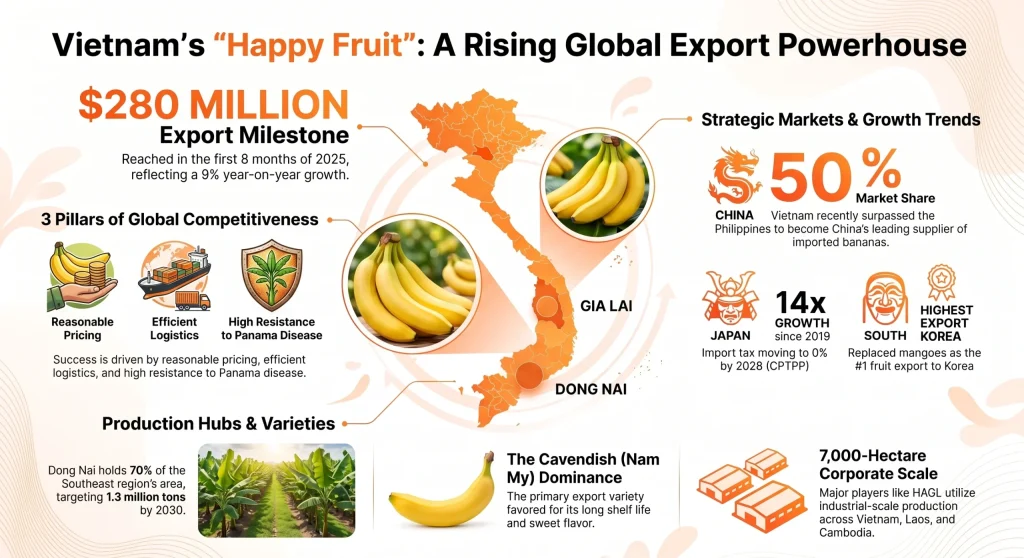
Each market offers its own opportunities and characteristics: China is the largest consumption market by volume thanks to geographic proximity and high demand; South Korea and Japan emphasize strict quarantine standards and attractive packaging; Russia and Eastern European countries favor competitively priced bananas in large volumes; the EU requires stringent pesticide residue standards; while the Middle East focuses heavily on shelf life and long-distance transport conditions.
2. Legal Basis Governing the Banana Export Procedure
| Legal Document | Regulatory Content |
|---|---|
| Decree 69/2018/ND-CP (replaced by Decree 292/2026/ND-CP from September 5, 2026) | Fresh bananas are not on the list of goods banned from export or requiring an export license, and may be freely exported to any market |
| Law on Cultivation 2018, Law on Plant Protection and Quarantine 2013 | General regulations on growing area codes and plant quarantine for exported agricultural products |
| Decree 38/2026/ND-CP (effective from January 24, 2026), Resolution 36/2026/NQ-CP (July 31, 2026) | Simplifying procedures, digitizing the process for issuing growing area codes and packing facility codes, applied uniformly across all markets requiring codes |
| Bilateral protocols specific to each market (e.g., the Protocol with China signed November 1, 2022) | Applied additionally for markets that have signed their own specific documents, detailing quarantine, code registration, and labeling requirements |
| Circular 38/2015/TT-BTC, amended by Circular 39/2018/TT-BTC | Customs procedures, customs inspection and supervision for exported goods |
This is the foundational legal framework applied generally when carrying out the banana export procedure; besides this, businesses need to also cross-check the specific regulations of each target market before signing a contract.
3. General Conditions for Growing Areas and Packing Facilities
| Condition | Issuing/Managing Authority | Notes |
|---|---|---|
| Growing area code | Department of Crop Production and Plant Protection | Mandatory for markets requiring traceability (China, South Korea, Japan); some European and Middle Eastern markets do not yet require it but it is a competitive advantage |
| Packing facility code | Department of Crop Production and Plant Protection | The facility must meet food safety and hygiene conditions and is subject to periodic inspection |
| GAP Certification (VietGAP/GlobalGAP) | Independent certification body | Not mandatory for every market, but nearly a prerequisite for the EU, South Korea, and Japan |
| Pre-approved exporter registration | Quarantine/customs authority of the importing country | Only applies to certain markets managed under an approved-list system such as China; most other markets do not require this step |
4. HS Code and Banana Export Tax
Fresh bananas fall under Chapter 08 – “Edible fruit and nuts,” heading 08.03 – “Bananas, including plantains, fresh or dried.” Correctly determining the HS code directly affects the import tax at the destination country and the speed of customs clearance.
| Product Type | HS Code (Vietnam) | Vietnam Export Tax | Import Tax Notes |
|---|---|---|---|
| Fresh bananas (Musa spp.) | 0803.90.10 | 0% | Most FTA markets with Vietnam apply 0% or a phased tariff reduction; check the specific tariff schedule for each country |
| Plantains | 0803.10 | 0% | Less common in commercial export activity |
| Dried bananas, fried bananas | 0803.90.90/2008.99 | 0% | Import tax follows the processed fruit category; check details by market |
Practical note: Vietnam’s banana export tax is currently 0% for most HS codes. However, the import tax at the destination country depends on the applicable FTA and the type of C/O the business presents (form E for ACFTA, form EUR.1 for EVFTA, form VK for VKFTA, form AJ for AJCEP…), so businesses should check the specific tariff schedule of each market before every shipment.
5. Quarantine Requirements and Specific Conditions by Market
This is the area of greatest difference between markets within the entire banana export procedure, as each place applies its own quarantine measures and standards to control pests and chemical residues.
| Market | Main Quarantine/Standard Requirement | Notes |
|---|---|---|
| China | Registration of growing area code and packing facility code approved by GACC; bananas must be unripe, harvested 10-16 weeks after flowering | Managed under a specific Protocol, requiring strict traceability |
| South Korea, Japan | Strict phytosanitary quarantine, pesticide residue control per a specific MRL list | Priority given to attractively packaged, uniformly sized bananas that meet premium consumer preferences |
| EU | Control of hundreds of pesticide residue criteria (MRL), GlobalGAP certification recommended | Fresh bananas enjoy a 0% tax rate under EVFTA with a valid EUR.1 form C/O |
| Russia, CIS countries | Standard phytosanitary quarantine, conformity certification under Eurasian Economic Union (EAEU) standards | Prefers large volumes and competitive pricing; long transport time requires careful ripeness control |
| Middle East | Standard phytosanitary quarantine, some countries require Halal certification if further processing is involved | Focuses on shelf life and cold chain conditions due to long transport distances |
6. Documentation Set for the Banana Export Procedure
| Document | When to Prepare | Important Notes |
|---|---|---|
| Sales Contract | Before harvesting and packaging | Clearly state Incoterms, packaging specifications, and ripeness level as required by the destination market |
| Commercial Invoice | After packaging, before customs declaration | The value must match the contract and the bill of lading |
| Packing List | Same time as the Invoice | Detail the number of packages, net/gross weight |
| Phytosanitary Certificate | Before the goods leave the port/border gate | Supplementary declaration content may vary depending on each market’s specific requirements |
| Growing area/packing facility code (if required by the market) | Before harvesting | Only mandatory for markets managed under an approved-list system such as China, South Korea |
| Certificate of Origin (C/O) | After the export declaration is issued | Necessary to enjoy tariff preferences under the FTA corresponding to the destination market |
| Export Customs Declaration (VNACCS) | Before customs clearance | Declare the correct HS code and customs value using the transaction value method |
7. Banana Export Procedure Step by Step
Step 1: Register the Growing Area Code and Packing Facility Code (If Required by the Market)
For markets managed under an approved-list system (China, South Korea), businesses work with the local Sub-Department of Crop Production and Plant Protection to register a suitable growing area code and packing facility code. For other markets, this step can be skipped, but it is recommended in order to build a long-term competitive advantage.
Step 2: Sign the Contract and Determine Standards Based on the Target Market
Agree with the importer on ripeness level, packaging specifications, any specific quarantine requirements, and delivery timing, to avoid confusing the regulations of different markets.
Step 3: Harvest, Sort, Pack, and Carry Out Phytosanitary Quarantine
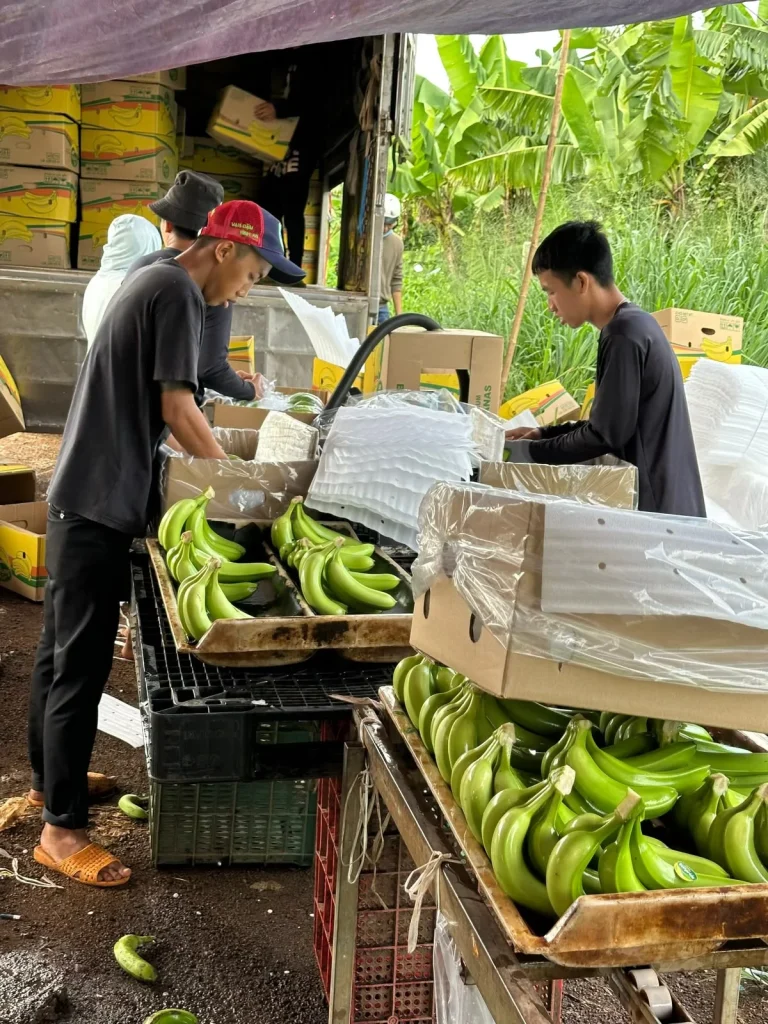
Harvest the bananas at the required ripeness (usually still green for distant markets requiring long transport), sort by size, pack according to the agreed specifications, then register for phytosanitary quarantine to obtain the Phytosanitary Certificate.
Step 4: Label According to the Market’s Specific Requirements (If Applicable)
For markets requiring specific labeling such as China, businesses add full information on the growing area code, packing facility code, and country of export on the packaging; for other markets, labeling follows standard commercial practice.
Step 5: Finalize the Documentation Set and File the Export Customs Declaration
The business or forwarding company prepares the Invoice, Packing List, and contract, files the electronic customs declaration on the VNACCS system, and attaches the phytosanitary certificate and the appropriate C/O for the destination market’s FTA.
Step 6: International Transport and Import Clearance at the Destination Country
Once the declaration clears customs, the goods are handed over to the carrier (by road, sea, or air depending on the market). The importer or agent at the destination country coordinates with the local customs and quarantine authorities to complete import clearance.
8. Banana Transport Routes and Methods
Since bananas have a relatively short shelf life, businesses need to choose a transport method suited to each market:
Road (border trade): Common for the Chinese market via the Lang Son, Lao Cai, and Mong Cai border gates, with transport time usually only 1-3 days, ideal for maximum freshness retention.
Sea transport by reefer container: Suitable for distant markets such as South Korea, Japan, Russia, the Middle East, and the EU, with transport time ranging from a few days to 20-30 days depending on the route; a stable temperature of around 13-14°C must be maintained throughout the journey to control the ripening rate.
Air transport: Less common due to high cost relative to cargo value, only used for small shipments needing urgent delivery or for testing new markets.
9. Time and Cost in the Banana Export Procedure
| Stage | Estimated Time | Notes |
|---|---|---|
| Register growing area and packing facility codes (if needed) | A few weeks to a few months (one-time) | Only applies to markets requiring an approved-list registration |
| Register and sample for phytosanitary quarantine | 0.5 – 1 day | Issuance of the Phytosanitary Certificate |
| Export customs declaration (VNACCS) | 0.5 – 1 day | Faster if the declaration is routed to the green channel |
| Road transport (China) | 1 – 3 days | Via northern border gates |
| Sea transport (South Korea, Japan) | 4 – 7 days | Requires stable temperature in the reefer container |
| Sea transport (EU, Middle East, Russia) | 15 – 30 days | Depends on the destination port; ripeness must be carefully controlled starting from the harvest stage |
Regarding costs, businesses need to budget for several items depending on the market and transport method, with quarantine costs and international freight typically accounting for the largest share:
| Cost Item | Reference Price | Notes |
|---|---|---|
| Phytosanitary quarantine, Phytosanitary Certificate issuance | 500,000 – 1,000,000 VND/shipment | Fixed fee per shipment, not calculated by weight |
| Export customs declaration fee | 800,000 – 1,500,000 VND/declaration | Depends on the customs brokerage service provider |
| Cold storage fee (if incurred while waiting for transport) | 150,000 – 300,000 VND/ton/day | Should be avoided by booking early, especially given bananas’ short shelf life |
Practical note: The cost and time figures above are for reference only and vary by season, market, and transport supply-demand conditions. Businesses should request a detailed, updated quote for each specific shipment from a logistics provider before finalizing their business plan.
10. Risk Notes in the Banana Export Procedure
| Risk | Manifestation | Prevention Method |
|---|---|---|
| Confusing requirements between markets | Missing growing area code, incorrect labeling specifications, or missing documents required by a specific market | Clearly confirm each market’s specific requirements before planning the export |
| Bananas over-ripening before arrival | Goods get bruised, lose value, or are refused by distant markets with long transport times | Control ripeness at harvest, maintain stable temperature in the reefer container throughout the journey |
| Incorrect HS code declared | Tax arrears collection, delayed customs clearance, need to amend the declaration | Carefully cross-check the HS code with a customs authority or a forwarder experienced in fresh fruit shipments |
| Pesticide residue exceeding the threshold | Goods held for inspection, increased risk of being placed on a warning list in demanding markets like the EU, Japan | Comply with pesticide pre-harvest interval periods, keep cultivation records, test residue levels periodically before harvest |
| Container shortage/delayed booking during peak season | Goods must be stored in cold storage while waiting for transport, incurring costs and reducing quality | Book early with a logistics provider that has partnerships with multiple carriers |
11. FAQ – Frequently Asked Questions About the Banana Export Procedure
Question 1: Which banana export markets require a mandatory growing area code?
A growing area code is mandatory for markets managed under an approved-list system such as China and South Korea. For the EU, Russia, and the Middle East, a growing area code is not yet legally mandatory but remains a competitive advantage and helps ensure origin transparency when inspection is required.
Question 2: What is the current banana export tax in Vietnam?
Fresh bananas (HS code 0803.90.10) enjoy a 0% export tax rate in Vietnam for most markets. The import tax at the destination country depends on the applicable FTA and the type of C/O the business presents; businesses should check the specific tariff schedule of each market before every shipment.
Question 3: What ripeness level should exported bananas reach?
The required ripeness depends on transport time: for nearby markets like China, bananas are typically harvested still green, around 10-16 weeks after flowering; for distant markets like the EU, Middle East, and Russia, they need to be harvested greener with strict temperature control to avoid over-ripening before arrival.
Question 4: How can I find out whether a market requires GAP certification?
Businesses should work directly with a logistics provider experienced in agricultural products, or communicate directly with the importer, to get accurate updates on each market’s requirements, since regulations can change over time and differ completely between importing countries.
How Does 3W Logistics Support the Banana Export Procedure?
As a freight forwarding company registered as an OTI-NVOCC with an FMC bond (Federal Maritime Commission) in the US, holding a SCAC Code to self-file AMS/ISF directly, along with many years of experience handling agricultural products and fresh fruit exports to diverse markets, 3W Logistics provides a comprehensive service for businesses regarding the banana export procedure – from market consulting, quarantine coordination, to the goods clearing customs at the importing country.
- Consulting on the target market and export conditions: Identifying the market suited to the growing area’s capacity, advising on each country’s specific quarantine requirements and codes, accurately determining the HS code, and calculating costs and risks in advance so businesses have complete figures before signing a contract.
- Support connecting for the Phytosanitary Certificate: Guiding businesses to properly prepare quarantine registration documentation, coordinating with plant quarantine authorities so shipments are sampled, inspected, and certified on schedule.
- Multimodal booking and transport: Arranging sea transport via reefer container, border-trade road transport, or air transport depending on the market, from Vietnam’s major ports and border gates to destinations worldwide, maintaining proper temperature for the bananas throughout the journey.
- Electronic customs declaration (VNACCS) and import procedures at the destination country: A professional customs declaration team handles export declarations and verifies HS codes and goods value; as an OTI-NVOCC with FMC and SCAC Code status, 3W Logistics independently issues House Bills of Lading (HBL) and self-files AMS/ISF directly for shipments to the US.
- Handling situations that arise upon arrival at the importing country: With an agent network across many markets, 3W Logistics can help businesses fully prepare documentation and quickly handle any additional requests from local customs and quarantine authorities.
Why choose 3W Logistics for your agricultural export route: Unlike many intermediary forwarders who must go through a third-party agent, 3W Logistics is an OTI-NVOCC with a bond and direct FMC certification in the US, holding a SCAC Code that enables self-filing of AMS/ISF – helping shorten documentation processing time and reduce delay risk. With offices in Ho Chi Minh City, Hanoi, and Hai Phong, along with a team experienced in handling agricultural products and fresh fruit exports to diverse markets, 3W Logistics is a suitable choice for businesses that want to ensure their shipments clear customs on time and to standard from their very first export. – Ms. Apple, CCO 3W Logistics
Head Office – 3W Logistics Ho Chi Minh City Branch
Address: 34 Bach Dang, Tan Son Hoa Ward, Ho Chi Minh City
Hotline: +84 28 3535 0087
____________________________
3W Logistics Hanoi Branch
Address: 81A Tran Quoc Toan, Cua Nam Ward, Hanoi
Hotline: +84 24 3202 0482
____________________________
3W Logistics Hai Phong Branch
Address: 8A Lot 28 Le Hong Phong, Gia Vien Ward, Hai Phong
Hotline: +84 225 355 5939
____________________________
3W LOGISTICS CO., LTD – We here serve you there!
Email: info@3w-logistics.com
Website: www.3w-logistics.com

Ms. Apple is the CCO (Chief Commercial Officer) at 3W Logistics, with over 10 years of experience in sales and business operations management.
At 3W Logistics, Ms. Apple is responsible for commercial strategy, corporate customer development, managing a team of more than 50 sales professionals, and improving business performance in the logistics sector.
With practical experience in sales management and market development, Ms. Apple shares professional insights on business logistics solutions, international transportation, freight forwarding, customer management, trade lane development, and growth strategies in the logistics industry.


