Vietnamese lychee is facing a significant opportunity to expand into the U.S. market as the tropical fruit category was added to the list exempt from additional reciprocal tariffs starting November 2025, alongside the recent APHIS approval of X-ray technology at the Toan Phat Irradiation Facility – running in parallel with gamma irradiation technology – nearly doubling processing capacity during the peak harvest season.
However, unlike traditional markets such as China, the lychee export procedure requires businesses to simultaneously meet domestic regulations (growing area codes, phytosanitary inspection, customs) as well as a series of strict requirements from the USDA-APHIS, particularly mandatory irradiation and strict control of pesticide residue levels.
The article below summarizes the entire process, standards, HS codes, costs, and common risks involved in the lychee export procedure, helping businesses proactively prepare documentation and avoid customs delays or shipment returns.
1. Export Potential for Lychee in Major Markets
According to the Vietnam Fruit and Vegetable Association, the country’s total fruit and vegetable export turnover in 2026 reached over USD 8.5 billion – the highest level ever recorded – with lychee being one of the key fresh fruit items approved for import by the U.S., alongside mango, dragon fruit, longan, rambutan, pomelo, and star apple.
Starting November 13, 2025, the U.S. removed a series of agricultural product groups including tropical fruits, coffee, tea, cocoa, and spices from the list subject to additional reciprocal tariffs under Executive Order 14257. This is a direct positive signal for the lychee industry, helping to reduce cost pressure and increase competitiveness compared to lychee imported from China, Mexico, and Israel into the U.S. market.
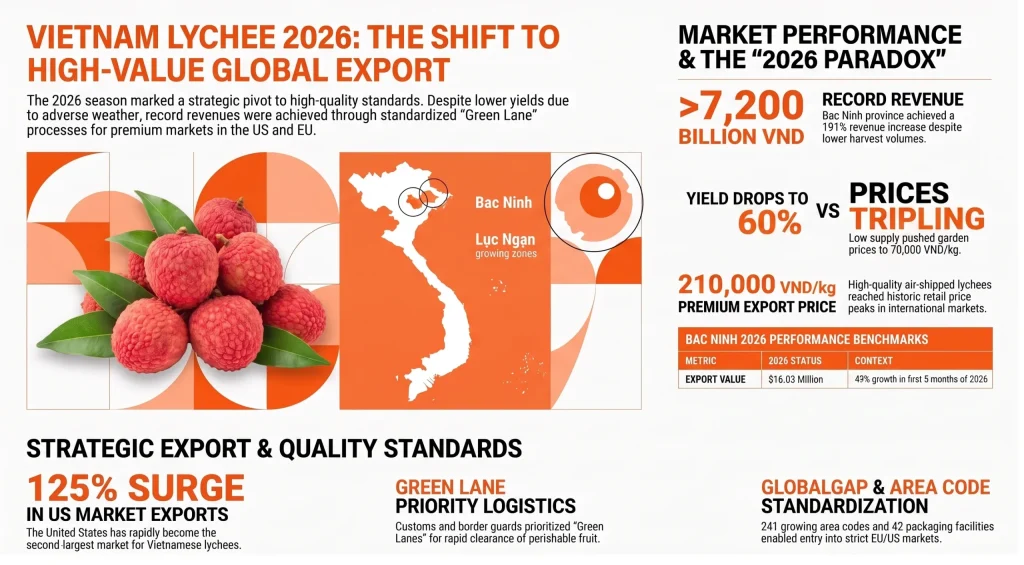
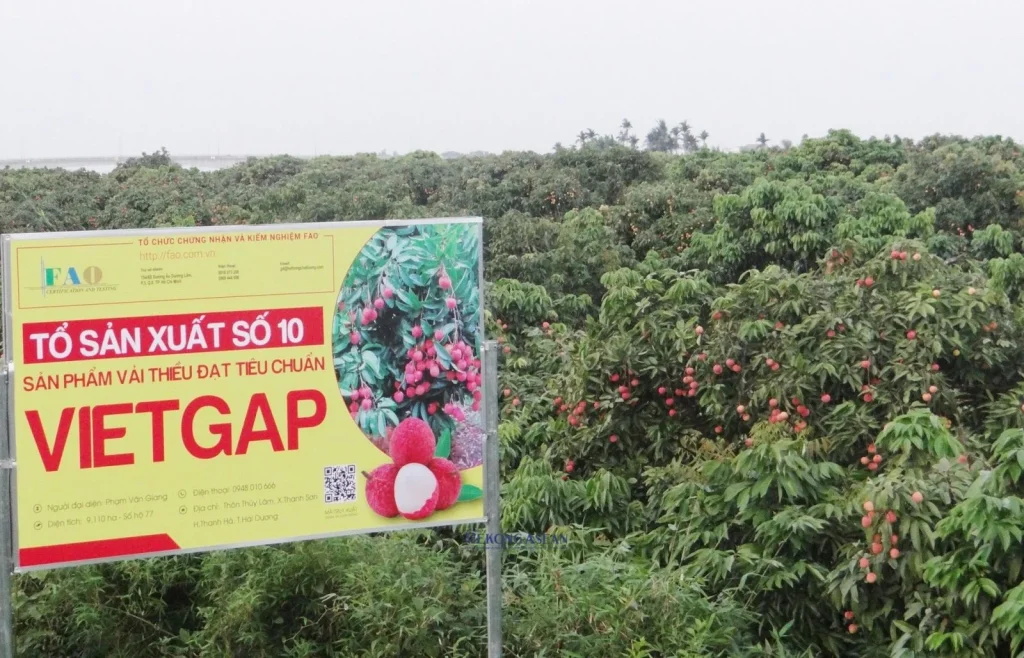
Regarding growing regions, most of the lychee volume for export is concentrated in Bac Giang (Luc Ngan, Tan Yen) and Hai Duong (Thanh Ha), where numerous growing areas have already achieved GlobalGAP and VietGAP certification. Previously, businesses had to transport lychee from the North to irradiation facilities in the South for processing, incurring additional cost and time – particularly problematic given lychee’s very short growing season. The recent expansion of irradiation capacity and processing technology is gradually resolving this bottleneck for exporting businesses.
2. What Standards Must Lychee Meet for Export?
Growing Area Standards
A prerequisite for lychee to be permitted for import is that the growing area must be registered with the Department of Crop Production and Plant Protection and monitored by APHIS under the “systems approach” specified in 7 CFR 319.56. Orchards can only be issued a growing area code if they are cultivated under GAP procedures (VietGAP, GlobalGAP) and do not use plant protection agents banned by the U.S. for this product, including Iprodione, Cypermethrin, Difenoconazole, Carbendazim, and Chlorothalonil.
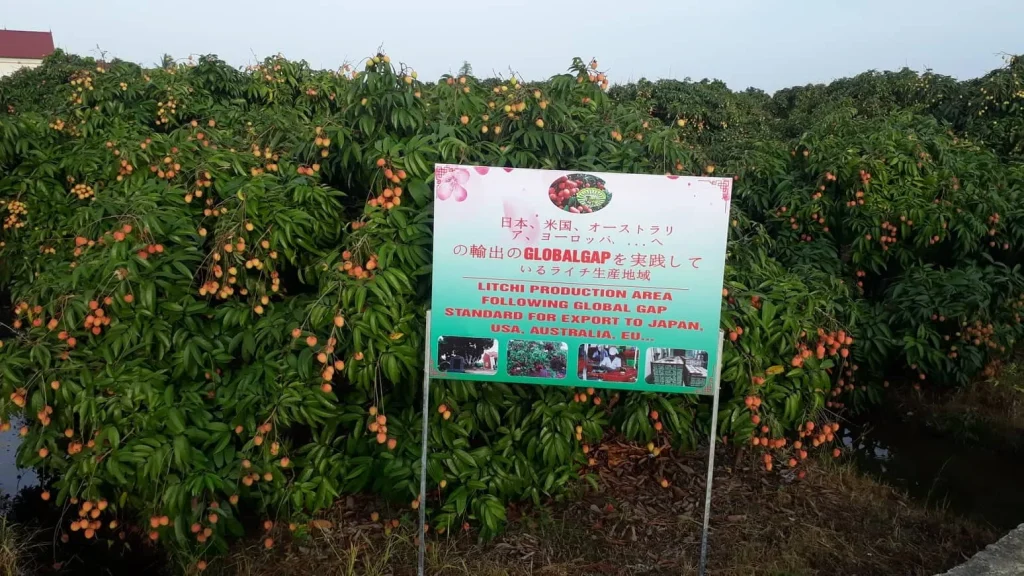
The Growing Area Code (GAC) is a mandatory requirement for tracing the origin of shipments during export phytosanitary procedures. Businesses need to select a source growing area with a valid, still-active code, to avoid rejection of the phytosanitary certificate due to unregistered or expired growing areas.
Size and Quality Standards (per CODEX Alimentarius)
| Size Grade | Diameter (mm) | Fruits/kg (reference) |
|---|---|---|
| Large | > 33 | < 33 |
| Medium | 29 – 33 | 33 – 42 |
| Small | 20 – 28 | 43 – 60 |
Practical note: Export lychee quality is assessed against CODEX STAN 293-2008, the international standard applicable to fresh lychee in commercial trade – classified into 3 quality grades (Extra, Class I, Class II), similar to other tropical fruits. Based on the practical experience of growing regions in Bac Giang and Hai Duong, the total soluble solids content in the fruit juice must not be below 17% to ensure sweetness and sensory quality by the time the product reaches U.S. consumers after a long transport journey.
Packaging Specifications and Standards
Lychee exported to the U.S. is typically packed in clusters or loose fruit in ventilated carton boxes, with common weights of 1kg, 2kg, or 4.5kg per box, lined with paper or perforated PE bags to allow moisture release and limit mold growth during long transport.
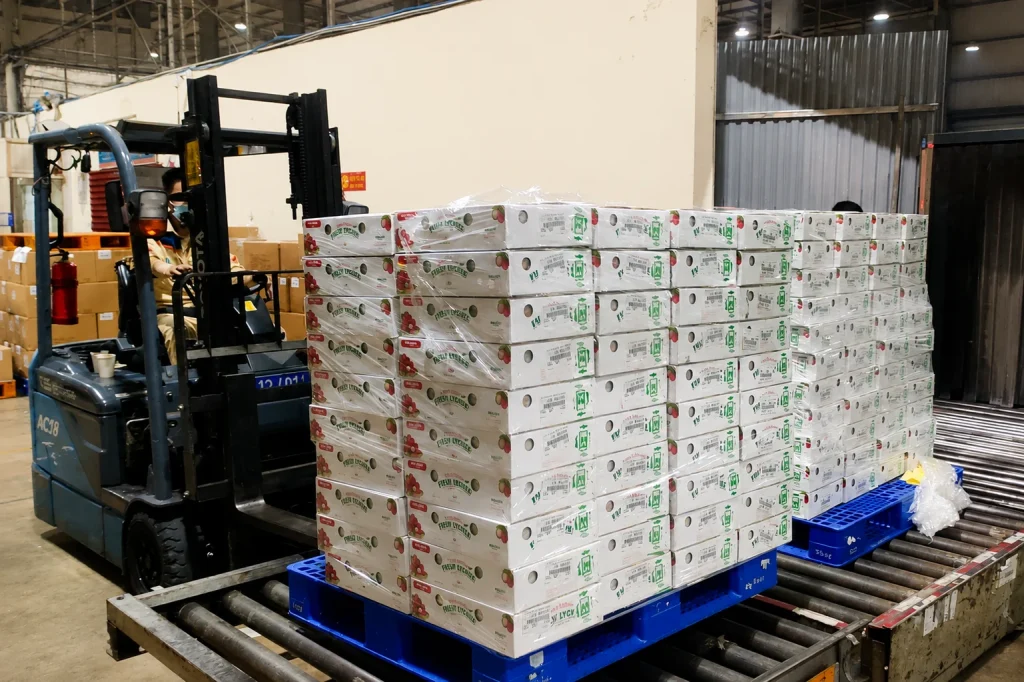
Packaging must clearly print: product name in English (Lychee/Litchi), country of origin (Product of Vietnam), growing area code, packing facility code, packing date, and the mandatory phrase “Treated by Irradiation” along with the Radura symbol as required by the FDA for irradiated food products. Pallets must undergo wood quarantine treatment per the ISPM 15 standard if wooden pallets are used.
Technical and Preservation Requirements
Phytosanitary Inspection
Each shipment must be inspected and certified by the plant quarantine authority, confirming the shipment is free from quarantine pests and meets all of the plant protection requirements of the United States.
Irradiation Process
This is a mandatory requirement with no exceptions for lychee imported into the U.S., similar to other lychee-exporting countries such as Thailand, China, Israel, and Mexico. The entire shipment must be irradiated at an APHIS-approved facility with a minimum absorbed dose of 400 Gy per 7 CFR Part 305, under the direct supervision of an APHIS officer stationed in Vietnam (preclearance). Businesses should note that excessive irradiation dosage may cause the lychee flesh to turn brown, affecting the product’s visual appeal.
Pesticide Residue Levels
Alongside irradiation, lychee must still meet the maximum residue limits (MRL) set by the FDA, strictly comply with pre-harvest withdrawal periods, and maintain records of pesticide use to support traceability when needed.
3. HS Code and Export Tax for Lychee export proceduce
Correctly determining the HS code directly affects the tax rate, specialized management policies, and customs clearance speed. Fresh lychee falls under Chapter 08 – “Edible fruit and nuts,” heading 08.10 – “Other fruit, fresh,” with a specific HS code dedicated to lychee under Vietnam’s Import-Export Tariff Schedule. For processed or preserved lychee (canned, dried), the HS code shifts to heading 20.08.
| Product Type | HS Code (Vietnam) | VN Export Tax | U.S. Import Tax Notes |
|---|---|---|---|
| Fresh lychee | 0810.90.20 | 0% | MFN tariff for fresh fruit under heading 0810.90 is generally 0%; as of November 13, 2025, tropical fruit was excluded from additional reciprocal tariffs on Vietnamese goods |
| Frozen lychee | 0811.90.xx | 0% | Requires re-verification based on actual catalogue/classification |
| Processed, canned lychee | 2008.99.10 | 0% | U.S. import tax under the processed fruit and vegetable category, requires detailed lookup on the HTS by ingredient composition |
Practical note: The tax rates listed above are for reference purposes only at the time this article was compiled. U.S. reciprocal tariff policy toward Vietnamese goods is still under continuous negotiation and adjustment. Businesses must look up the exact HS code on the U.S. HTS System (hts.usitc.gov) and the Vietnam General Department of Customs website before each shipment, and should work with an experienced logistics provider on the U.S. route to stay updated on current tax rates.
Real Tax Calculation Example for a Lychee Export Shipment
To help businesses visualize the impact of reciprocal tariff policy on shipment costs, the table below illustrates the calculation for a hypothetical 5-ton shipment of fresh lychee, FOB price of USD 4/kg, comparing before and after tropical fruit was excluded from additional reciprocal tariffs (November 13, 2025):
| Item | Calculation | Result |
|---|---|---|
| Shipment value (FOB) | Weight × Unit Price = 5,000 kg × $4/kg | $20,000 |
| Vietnam export tax | Shipment value × 0% | $0 |
| U.S. MFN import tax (code 0810.90.20) | Shipment value × 0% | $0 |
| Additional reciprocal tariff (before Nov 13, 2025) | Shipment value × 20% = $20,000 × 20% | $4,000 |
| Additional reciprocal tariff (from Nov 13, 2025 – tropical fruit excluded) | Shipment value × 0% | $0 |
| Total U.S. import tax payable (before Nov 13, 2025) | MFN Tax + Reciprocal Tariff = $0 + $4,000 | $4,000 |
| Total U.S. import tax payable (from Nov 13, 2025) | MFN Tax + Reciprocal Tariff = $0 + $0 | $0 |
As shown, for the same $20,000 shipment, tropical fruit being excluded from additional reciprocal tariffs starting November 2025 saves the importer approximately $4,000 in tax costs – a significant difference that directly affects the competitive selling price of Vietnamese lychee against other sources in the U.S. market. Businesses should apply this formula using their own actual FOB price and volume for each shipment to proactively negotiate selling prices with importing partners.
4. Documentation Required for the Lychee Export Procedure
| Document | When to Prepare | Important Notes |
|---|---|---|
| Sales Contract | Before harvest and packing | Clearly state Incoterms, packaging specifications, and quality grade per CODEX |
| Commercial Invoice | After packing, before customs declaration | Value must match the contract and bill of lading |
| Packing List | Same time as the Invoice | Record detailed package count, net/gross weight for each packaging type |
| Phytosanitary Certificate | Before the shipment reaches the port, after irradiation | Must include a supplementary declaration confirming the shipment has undergone irradiation as required by APHIS |
| Irradiation Certificate | Immediately after irradiation is completed | Must clearly state the minimum absorbed dose of 400 Gy, with confirmation from the APHIS preclearance officer |
| Certificate of Origin (C/O) | After the export customs declaration | Not mandatory for tariff preference, but recommended to prove origin if requested by U.S. customs |
| Ocean/Air Bill of Lading (B/L, AWB) | After container/cargo handover to the shipping line or airline | Carefully verify consignee information and destination port to avoid delays with AMS/ISF filing |
| Export Customs Declaration (VNACCS) | Before customs clearance | Declare the correct HS code and customs value using the transaction value method |
5. Lychee Export Procedure Workflow
Step 1: Register the Growing Area and Packing Facility
Businesses work with the local Department of Crop Production and Plant Protection (Bac Giang, Hai Duong) to register the growing area code and packing facility code as required by the U.S. market. Growing areas must be periodically monitored to maintain code validity.
Step 2: Sign the Contract and Plan Harvest and Packing
Agree with the U.S. importer on the quality grade per CODEX, fruit size, packaging specifications, and delivery timing to proactively schedule the harvest – especially important given that lychee’s growing season lasts only about 4-6 weeks per year.
Step 3: Inspection, Sampling, and Obtaining the Phytosanitary Certificate
Register for phytosanitary inspection with the relevant authority; inspection officers take representative samples to check for pests before proceeding to the irradiation step.
Step 4: Irradiation at an APHIS-Approved Facility
The shipment is transported to the irradiation facility and treated with a minimum absorbed dose of 400 Gy under the supervision of an APHIS preclearance officer in Vietnam. Once completed, the irradiation facility issues an irradiation certificate along with a shipment seal.
Step 5: Finalize Documentation and Declare Export Customs
The business or forwarder prepares the Invoice, Packing List, and contract, then files the electronic customs declaration on the VNACCS system, attaching the phytosanitary certificate and irradiation certificate.
Step 6: Booking Vessel/Flight and Domestic Transport to Port/Airport
Arrange reefer containers or air cargo pallets, maintaining a stable storage temperature for the lychee (typically 2-5°C) throughout the journey to minimize loss and skin discoloration.
Step 7: Export Customs Clearance and Handover to the Carrier
After the declaration is cleared (green, yellow, or red channel depending on the classification result), the shipment is delivered to the yard or handed over to the shipping line/airline for export.
Step 8: Import Customs Clearance in the U.S.
The importer or U.S. agent coordinates with CBP (U.S. Customs and Border Protection) and the FDA to inspect documentation, verify the irradiation certificate and phytosanitary certificate, before clearance and distribution to the market.
6. Routes and Transport Methods for Lychee from Vietnam to the U.S.
Lychee has a much shorter shelf life than many other tropical fruits, so businesses typically choose between two main methods:
Air freight: Preferred for small, high-value shipments that need to be delivered quickly within 1-3 days, ensuring maximum freshness. The drawback is significantly higher cost compared to sea freight, suitable for trial market orders or to meet lychee’s short harvest season.
Sea freight via reefer container: Suitable for large shipments departing from Hai Phong, Cat Lai (Ho Chi Minh City), and Da Nang ports to major U.S. ports such as Los Angeles, Long Beach, Oakland, Houston, New York/New Jersey, and Savannah. Transit time is typically 18-30 days depending on the destination port, requiring preservation technology such as sulfur dioxide (SO2) fumigation or MAP (Modified Atmosphere Packaging) combined with ethylene absorbers to limit skin browning and extend shelf life in the container.
Since lychee only retains good quality for about 7-10 days under ideal conditions, businesses need to carefully weigh cost against transit time, while working closely with logistics providers to book reefer container space early, to avoid space shortages during peak harvest season (typically May-June each year).
7. Timeline and Costs of the Lychee Export Procedure
The entire process, from harvest to arrival at a U.S. port, typically takes 20-35 days by sea, much shorter by air. Below is a detailed timeline for each stage:
| Stage | Estimated Time | Notes |
|---|---|---|
| Harvesting, sorting, packing | 1 day | Harvest in the early morning; pre-cool immediately after harvest to lower the fruit’s core temperature |
| Registration and phytosanitary sampling | 0.5 – 1 day | Pest inspection, issuance of the Phytosanitary Certificate |
| Transport to the facility and irradiation | 1 – 2 days | May take longer during peak season if the irradiation facility is over capacity |
| Export customs declaration (VNACCS) | 0.5 – 1 day | Faster if the declaration is routed to the green channel |
| Air transport to the U.S. | 1 – 3 days | Applies to small shipments requiring urgent delivery and maximum freshness |
| Sea transport (reefer container) | 18 – 30 days | Depends on the destination port: Los Angeles, Long Beach are faster; New York, Savannah take longer |
| U.S. import clearance (CBP/FDA) | 1 – 3 days | May take longer if routed for physical inspection or if the irradiation certificate is missing |
| Total time (sea freight) | Approximately 22 – 38 days | From harvest to customs clearance, ready for distribution in the U.S. |
| Total time (air freight) | Approximately 5 – 8 days | Suitable for small, high-value shipments requiring maximum freshness |
Regarding costs, businesses need to budget for various line items, with irradiation and international freight typically accounting for the largest share. The table below summarizes reference costs for a lychee export shipment to the U.S.:
| Cost Item | Reference Rate | Notes |
|---|---|---|
| Phytosanitary inspection, Certificate issuance | 500,000 – 1,000,000 VND/shipment | Fixed fee per shipment, not based on weight |
| Irradiation at an APHIS-approved facility | Approx. $0.8 – $1/kg (~20,000 – 25,000 VND/kg) | The largest cost item, specific to the U.S. route due to the requirement of APHIS preclearance officer supervision; price may vary by facility and shipment volume |
| Export customs declaration fee | 800,000 – 1,500,000 VND/declaration | Depends on the customs brokerage service provider |
| AMS/ISF filing fee for the U.S. | $30 – $50/shipment | Mandatory for sea shipments to the U.S., performed by an NVOCC with FMC bond |
| Cold storage fee (if delays occur waiting for vessel/irradiation) | 150,000 – 300,000 VND/ton/day | Best avoided by booking vessel space and irradiation schedule early, especially given lychee’s short season |
Practical note: The costs and timeframes listed above are for reference only, compiled from data published by irradiation facilities, shipping lines, and fruit exporting businesses at various points in time. International freight rates, irradiation fees, and surcharges at U.S. ports fluctuate continuously based on season, fuel prices, and reefer container supply-demand conditions. Businesses should request detailed, up-to-date quotes for each specific shipment from their logistics provider and irradiation facility before finalizing their business plan.
8. Risk Considerations in the Lychee Export Procedure
| Risk | Symptom | Prevention |
|---|---|---|
| Growing area does not meet requirements | Phytosanitary certificate rejected, unable to export on schedule | Verify growing area code validity before signing the contract; only purchase from areas registered with APHIS |
| Missing irradiation or insufficient dose | Shipment held, destroyed, or returned upon arrival at a U.S. port | Only work with APHIS-approved irradiation facilities; keep full irradiation certification records |
| Incorrect HS code declaration | Retroactive tax collection, delayed clearance, requires declaration correction | Carefully verify the HS code with a customs broker/forwarder experienced in fresh agricultural products |
| Cold chain break during transport | Skin darkening, moisture loss, spoilage upon arrival at port | Use certified reefer containers, monitor temperature throughout, combine with MAP packaging/ethylene absorbers |
| Pesticide residue exceeds limits | FDA holds the shipment for inspection, increased risk of Import Alert listing | Comply with pesticide withdrawal periods, maintain cultivation records, conduct periodic residue testing before harvest |
| Reefer container shortage during peak season | Shipment must be held in cold storage awaiting vessel space, incurring costs and reducing quality—particularly critical given lychee’s short season | Book early with a logistics provider that has partnerships with multiple shipping lines; plan ahead for the season |
9. FAQ – Frequently Asked Questions About the Lychee Export Procedure
Question 1: Is fresh lychee exported to the U.S. required to be irradiated?
Yes. Per APHIS regulations, all fresh lychee originating from Vietnam must undergo irradiation with a minimum absorbed dose of 400 Gy at an approved facility before export – there is no accepted alternative for this product.
Question 2: What is the current U.S. import tax on Vietnamese fresh lychee?
Fresh lychee, as a tropical fruit, generally carries a 0% MFN tariff under the U.S. HTS Schedule. As of November 2025, tropical fruit was also excluded from the additional reciprocal tariff applied specifically to Vietnamese goods. However, businesses should still verify the exact HS code and current tax rate at the time of export, as policy may change.
Question 3: How long can lychee be preserved during sea transport?
Under optimal cold storage conditions (approximately 2-5°C) combined with MAP packaging and ethylene absorbers, lychee can maintain quality for about 7-10 days – shorter than many other tropical fruits. Businesses should therefore carefully weigh sea versus air transport depending on the destination port and actual transit time.
Question 4: Can lychee be exported from a growing area without a code?
No. The growing area must be registered and monitored by the Department of Crop Production and Plant Protection as required by APHIS. Businesses need to proactively work with the local department in Bac Giang and Hai Duong to register the growing area code and packing facility code before planning to export.
Question 5: Besides irradiation, what else must lychee be inspected for before export?
The shipment must also be inspected to confirm it is free from quarantine pests, meet the maximum pesticide residue limits set by the FDA (5 banned active ingredients must not be used), and have a complete phytosanitary certificate issued by the Vietnamese quarantine authority, along with the supplementary declaration required specifically for the U.S. market.
How Does 3W Logistics Support the Lychee Export Procedure?
As a freight forwarding company registered as an OTI-NVOCC with FMC bond (Federal Maritime Commission) in the U.S., holding a SCAC Code to self-file AMS/ISF directly, with years of experience handling agricultural products and fresh fruit exports, 3W Logistics offers a comprehensive service package for businesses regarding the lychee export procedure – from growing area consultation and irradiation coordination through to customs clearance at U.S. ports.
- Consulting on export conditions and quality standard determination: Checking whether the growing area and packing facility meet APHIS requirements, accurately determining the HS code, and calculating costs and risks in advance (irradiation, quarantine, cold storage) so businesses have complete figures before signing a contract with a U.S. importer.
- Support in obtaining the Phytosanitary Certificate: Guiding businesses in preparing correct quarantine registration documentation, coordinating with the plant quarantine authority to ensure the shipment is sampled, inspected, and certified on time, with information 100% matching the Invoice, Packing List, and irradiation certificate—avoiding the risk of U.S. customs rejection due to missing or inconsistent quarantine paperwork.
- Coordinating the irradiation schedule at an APHIS-approved facility: Arranging shipment transport to the irradiation facility, tracking the process to ensure the minimum absorbed dose of 400 Gy is achieved and full certification is obtained before container loading—particularly important given lychee’s short season and the resulting surge in irradiation demand.
- Booking vessels and transport via reefer container to the U.S.: Arranging FCL or LCL shipping from Vietnam’s major ports (Hai Phong, Cat Lai in Ho Chi Minh City, Da Nang) to major U.S. ports (Los Angeles, Long Beach, Savannah, New York, Houston, Oakland) using specialized reefer containers to maintain the appropriate temperature and humidity for lychee throughout the journey.
- Electronic customs declaration (VNACCS) and AMS/ISF filing in the U.S.: A professional customs declaration team handles the export declaration, verifying the HS code and cargo value; and as an OTI-NVOCC with FMC bond and a SCAC Code, 3W Logistics directly issues its own House Bill of Lading (HBL) and self-files AMS/ISF—a mandatory requirement for goods to be cleared quickly upon arrival in the U.S., minimizing the risk of cargo holds due to late or non-compliant filing with CBP.
- Handling situations that arise upon arrival at U.S. ports: Lychee is a product consistently prioritized for inspection by U.S. customs and the FDA due to food safety concerns and mandatory irradiation requirements – 3W Logistics has an agent in the U.S. and can support businesses in preparing complete documentation (irradiation certificate, phytosanitary certificate, C/O) and quickly handling additional requests from CBP or the FDA.
- Shipment tracking updates and domestic transport in the U.S.: Regularly updating bill/tracking numbers for customers to monitor their shipment at all times; while coordinating with domestic transport partners in the U.S. equipped with refrigerated trucks to move goods from the port to cold storage or distribution points, ensuring lychee quality is maintained from port to final delivery point.
Why choose 3W Logistics for agricultural exports to the U.S.: Unlike many intermediary forwarders who must go through third-party agents, 3W Logistics is an OTI-NVOCC with direct FMC bond and certification in the U.S., holding a SCAC Code that allows self-filing of AMS/ISF – helping shorten documentation processing time and reduce delay risk compared to companies dependent on third-party agents. With offices in Ho Chi Minh City, Hanoi, and Hai Phong, and a team with hands-on experience handling agricultural products and fresh fruit requiring strict quarantine and irradiation requirements like lychee, 3W Logistics is the right choice for businesses wanting to ensure their shipment clears customs on time and to standard from their very first export to the U.S. market. – Ms. Apple, CCO 3W Logistics
Head Office – 3W Logistics Ho Chi Minh City Branch
Address: 34 Bach Dang, Tan Son Hoa Ward, Ho Chi Minh City
Hotline: +84 28 3535 0087
____________________________
3W Logistics Hanoi Branch
Address: 81A Tran Quoc Toan, Cua Nam Ward, Hanoi
Hotline: +84 24 3202 0482
____________________________
3W Logistics Hai Phong Branch
Address: 8A Lo 28 Le Hong Phong, Gia Vien Ward, Hai Phong
Hotline: +84 225 355 5939
____________________________
3W LOGISTICS CO., LTD – We here serve you there!
Email: quote@3w-logistics.com
Website: www.3w-logistics.com

Ms. Apple is the CCO (Chief Commercial Officer) at 3W Logistics, with over 10 years of experience in sales and business operations management.
At 3W Logistics, Ms. Apple is responsible for commercial strategy, corporate customer development, managing a team of more than 50 sales professionals, and improving business performance in the logistics sector.
With practical experience in sales management and market development, Ms. Apple shares professional insights on business logistics solutions, international transportation, freight forwarding, customer management, trade lane development, and growth strategies in the logistics industry.


