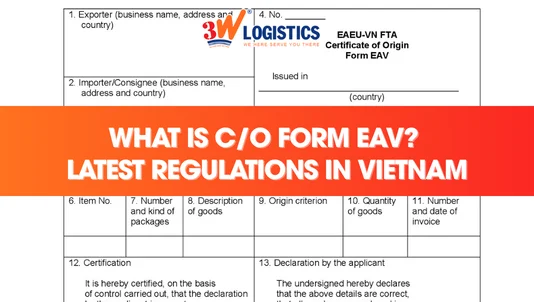
CO Form EAV in Vietnam: Procedures & Declaration Guide
The Eurasian Economic Union (EAEU), consisting of Russia, Belarus, Kazakhstan, Armenia, and Kyrgyzstan, represents a market of more than 180 million consumers with substantial import demand. Understanding what CO Form EAV is is therefore essential for any Vietnamese exporter planning to enter this region. Without a valid CO Form EAV, businesses cannot benefit from the preferential tariff treatment granted under the Vietnam–EAEU Free Trade Agreement (VN-EAEU FTA), the first FTA signed between Vietnam and the Eurasian Economic Union.
This article provides a comprehensive guide to CO Form EAV, including its definition, scope of application, origin criteria, required documents, application procedures, detailed box-by-box completion instructions, and the latest regulatory updates—helping businesses prepare compliant documentation from their very first export shipment.
1. What Is CO Form EAV?
CO Form EAV (Certificate of Origin Form EAV) is a certificate of origin issued for goods exported from Vietnam to member states of the Eurasian Economic Union (EAEU) under the framework of the Vietnam–Eurasian Economic Union Free Trade Agreement (VN-EAEU FTA). The abbreviation “EAV” stands for Eurasian – Vietnam, reflecting the bilateral nature of the agreement.
CO Form EAV is a mandatory document for Vietnamese exports to the five EAEU member states—Russia, Belarus, Kazakhstan, Armenia, and Kyrgyzstan—to qualify for preferential tariff treatment under the VN-EAEU FTA instead of standard MFN rates. Likewise, imports from EAEU countries into Vietnam also require valid proof of origin to enjoy preferential tariffs under the agreement.
Practical Example: A company exports leather shoes from Binh Duong to Moscow. Without a valid CO Form EAV, the shipment may be subject to Russia’s MFN import duty, which can reach 10–15% of the cargo value. With a properly issued CO Form EAV, the applicable tariff can be reduced under the VN-EAEU FTA schedule, potentially saving tens of thousands of dollars per container.
2. VN-EAEU FTA – The Legal Foundation of CO Form EAV
The VN-EAEU FTA was signed on May 29, 2015, in Astana, Kazakhstan, and officially entered into force on October 5, 2016. It was the first free trade agreement signed by the Eurasian Economic Union with a country outside the CIS region. CO Form EAV serves as the key instrument for implementing tariff preferences under this agreement.
| Information | Details |
|---|---|
| Agreement Name | Vietnam – Eurasian Economic Union Free Trade Agreement (VN-EAEU FTA) |
| Date Signed | May 29, 2015, Astana, Kazakhstan |
| Effective Date | October 5, 2016 |
| EAEU Member States | Russia, Belarus, Kazakhstan, Armenia, Kyrgyzstan |
| Applicable Certificate of Origin | CO Form EAV |
| Main Legal Documents | Circular 21/2016/TT-BCT; Circular 01/2024/TT-BCT (latest amendment) |
| Current Preferential Tariff Schedule | Decree 113/2022/ND-CP (2022–2027 period) |
| Average Preferential Import Tariff in Vietnam | 2.66% (2024), 2.36% (2025–2026), 2.34% (2027) |
| Issuing Authority in Vietnam | Ministry of Industry and Trade (via eCOSys and Regional Import-Export Management Offices) |
Vietnamese products with strong export potential to the EAEU under VN-EAEU FTA preferences include textiles and garments, footwear, seafood, agricultural products, machinery and electronic components, rubber, steel products, and pharmaceuticals.
Further Reading:
VCCI WTO Center – VN-EAEU FTA Overview
3. Scope of Application and Eligible Users of CO Form EAV
CO Form EAV applies to goods exported from Vietnam to any of the five EAEU member states and vice versa. Vietnamese businesses typically encounter CO Form EAV in the following two situations:
- Exports to the EAEU: Vietnamese exporters apply for CO Form EAV through the Ministry of Industry and Trade and include it in the shipping documents sent to importers in Russia, Belarus, Kazakhstan, Armenia, or Kyrgyzstan. Importers then submit the certificate to customs authorities to obtain VN-EAEU FTA tariff preferences.
- Imports from the EAEU into Vietnam: Vietnamese importers request a valid certificate of origin issued by the competent authority in an EAEU member state and submit it to Vietnamese Customs to qualify for preferential tariff treatment under Decree 113/2022/ND-CP.
Important Note: CO Form EAV is only valid for trade between Vietnam and the five EAEU member states. Exports to other post-Soviet countries such as Ukraine, Georgia, or Moldova are not eligible and require different certificates of origin or origin documentation according to the importing country’s regulations.
4. Origin Criteria for Obtaining CO Form EAV
Goods must satisfy the origin requirements set out in Circular 21/2016/TT-BCT (as amended by Circular 01/2024/TT-BCT). The VN-EAEU FTA provides four main origin criteria:
4.1 Wholly Obtained (WO)
Goods are considered wholly obtained in one Party in accordance with Article 4.4 of the VN-EAEU FTA.
The entire process of extraction, cultivation, harvesting, or production takes place in Vietnam. This criterion commonly applies to agricultural products, seafood, minerals, live animals and plants, and products manufactured entirely from domestic materials.
Origin criterion to be declared: WO
4.2 Produced Entirely (PE)
Goods are produced in one or both Parties (Vietnam and/or EAEU), and all materials used in production originate from one or both Parties. Both inputs and outputs originate within the VN-EAEU region, with no non-originating materials from third countries involved.
Origin criterion to be declared: PE
4.3 Product Specific Rules (PSR)
Goods are produced in one Party using non-originating materials but satisfy the Product Specific Rules set out in Annex 3 of the Agreement. This criterion is commonly applied to industrial goods, textiles, electronics, and chemical products that use imported materials but undergo substantial processing in Vietnam.
Depending on the product, PSR requirements may be based on Regional Value Content (RVC), Change in Tariff Classification (CTC), or a specific manufacturing process.
Origin criterion to be declared: PSR, together with the applicable rule.
4.4 Cumulation
The VN-EAEU FTA allows bilateral cumulation. Materials originating in an EAEU member state may be treated as Vietnamese-origin materials when calculating RVC or assessing CTC requirements. This mechanism enables Vietnamese manufacturers to use materials from Russia or Kazakhstan while still qualifying for CO Form EAV.
Important Note for Textile Products: Textile and garment exports to the EAEU generally follow the “double transformation” rule. Yarn and fabric must be produced in Vietnam or the EAEU, not merely cut and sewn. Businesses using fabric imported from China should carefully verify the PSR requirements applicable to each HS code before declaring origin.
5. Documents Required for CO Form EAV Application
Applications for CO Form EAV may be submitted to the regional Import-Export Management Offices under the Ministry of Industry and Trade or electronically through ecosys.gov.vn. The application dossier includes:
- Application for Certificate of Origin completed in the prescribed format, including shipment details, origin criterion, and destination EAEU member state.
- Completed CO Form EAV in English on A4 paper in accordance with Circular 21/2016/TT-BCT (01 original and 02 copies).
- Export Customs Declaration (certified copy or electronic declaration printed from VNACCS).
- Commercial Invoice (certified copy).
- Bill of Lading or Air Waybill (copy used to demonstrate direct consignment to the EAEU member state).
- Bill of Materials and Production Norms (required when applying PE or PSR criteria).
- Import Customs Declarations for Materials (if imported materials are used).
- RVC Calculation Sheet prepared and signed by the exporter (if the PSR requirement is based on RVC).
- Additional Declaration for CO Form EAV, mandatory when the shipment contains too many products to be listed within Boxes 6–10 of the main certificate.
Important Note: Both the CO Form EAV and any Additional Declaration must be completed in English and printed on A4 paper in the prescribed format. Any unused space in Boxes 6 to 10 must be crossed out to prevent later additions. This is a mandatory technical requirement, and failure to comply may result in immediate rejection of the application.
6. Step-by-Step Procedure for Obtaining CO Form EAV
The entire process may be completed through the eCOSys platform (ecosys.gov.vn) or by submitting paper documents directly to the regional Import-Export Management Offices. Document submission hours are 7:30–11:00 AM and 1:30–4:00 PM. Collection hours are 8:00–11:30 AM and 2:00–4:30 PM.
Step 1: Determine the Applicable Origin Criterion for Each HS Code
Review the six-digit HS code in the VN-EAEU FTA PSR Annex to identify the applicable criterion (WO, PE, or PSR). If the PSR requires a minimum Regional Value Content, calculate the RVC accordingly. This is the most critical step, as an incorrect origin criterion can invalidate the certificate regardless of whether the dossier is otherwise complete.
Step 2: Prepare the Supporting Documents and Complete CO Form EAV
Complete the CO Form EAV in English and gather all supporting documents. Verify consistency among the Commercial Invoice, Packing List, Customs Declaration, and information declared on the certificate, particularly HS codes, quantities, values, and invoice numbers.
Step 3: Submit the Application via eCOSys or in Person
Log in to ecosys.gov.vn, select CO Form EAV, enter shipment details, and upload scanned supporting documents. Alternatively, submit paper documents directly to the regional Import-Export Management Office during office hours.
Step 4: Review and Supplement Documents if Required
The reviewing officer may request additional documents or clarifications through the online system or by phone. Prompt responses help avoid delays that could affect vessel schedules. For first-time exporters or sensitive product categories, an on-site inspection of the manufacturing facility may be required.
Step 5: Receive and Verify the Issued CO Form EAV
Once approved, collect the original certificate in person or by post. Carefully review all information, especially the HS code (Box 8), origin criterion (Box 9), invoice details (Box 11), official stamp, and authorized signature before including the certificate in the shipping document package.
Step 6: Send CO Form EAV to the EAEU Importer
The original CO Form EAV should be sent together with the shipping documents to the importer in Russia, Belarus, Kazakhstan, Armenia, or Kyrgyzstan. The importer submits the certificate to customs authorities to obtain preferential tariff treatment under the VN-EAEU FTA. EAEU customs authorities may verify the authenticity of the certificate with the Ministry of Industry and Trade of Vietnam within three years.
Practical Example: A company exports two containers of processed coffee from Dak Lak to St. Petersburg. The shipment qualifies under the WO criterion and is submitted through eCOSys at 8:00 AM on Monday. The certificate is approved and issued by 3:00 PM the same day. The original CO Form EAV is couriered to the Russian importer together with the original shipping documents, allowing successful customs clearance under the VN-EAEU FTA preferential tariff regime.
Step 6: Sending the CO Form EAV to the EAEU Importer
The original CO Form EAV must be sent together with the shipping document set to the importer in Russia, Belarus, Kazakhstan, Armenia, or Kyrgyzstan. The importer will submit the C/O during customs clearance to obtain preferential tariff treatment under the VN-EAEU FTA. Customs authorities in EAEU member states may verify the C/O with Vietnam’s Ministry of Industry and Trade within a period of three years.
Practical Example: A Vietnamese company exports two containers of processed coffee from Dak Lak to St. Petersburg. The shipment qualifies under the WO origin criterion and the application is submitted through eCOSys at 8:00 AM on Monday. The C/O is approved and issued by 3:00 PM on the same day. The original C/O is then couriered to the Russian importer together with the original shipping documents, allowing the shipment to clear customs successfully under the preferential tariff rate provided by the VN-EAEU FTA.
Learn more: What is a Certificate of Origin (C/O)?, CO Form X, CO Form EUR.1 (UK), and more.
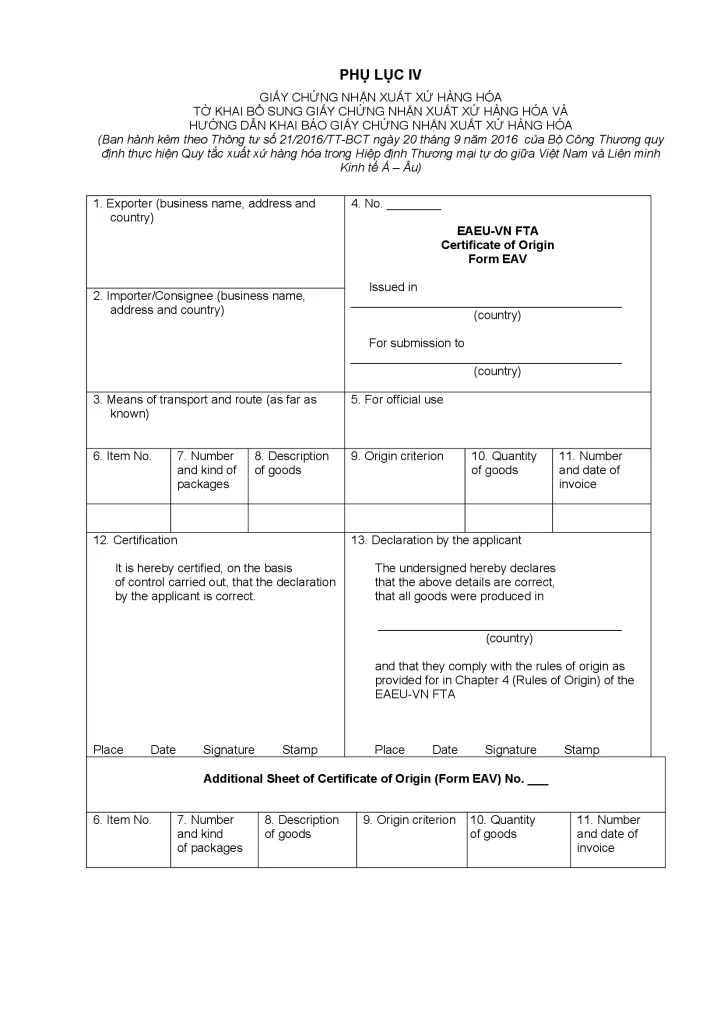
7. How to Complete CO Form EAV – Detailed Instructions for Each Box
CO Form EAV contains 13 information boxes. Any mistake—especially in Boxes 8, 9, and 11—can directly result in C/O rejection or denial of preferential tariff treatment by EAEU customs authorities.
| Box | Required Information | Important Notes |
|---|---|---|
| 1 | Full name and address of the exporter (Exporter/Consignor) | Must exactly match the legal name shown on the commercial invoice and export customs declaration. Use the complete business registration address. |
| 2 | Full name and address of the importer (Consignee/Importer) | Enter the full name and address of the importer in the EAEU member state. Do not leave blank or state “To Order”. |
| 3 | Means of transport and route | Indicate vessel/flight details and the ports or airports of departure and destination. Information must match the B/L or AWB. |
| 4 | For official use | Do not complete this box. It is reserved for the issuing authority. |
| 5 | Item number | Number items consecutively starting from 1. Each product should be listed separately. |
| 6 | Marks and numbers | Must match the Packing List exactly. Cross out any unused space. |
| 7 | Number and kind of packages; description of goods | Provide sufficient detail to identify the HS code. Include the importing country’s HS code and brand name if available. |
| 8 | HS tariff number of the importing country | Use the HS code applicable in the importing EAEU country, not Vietnam’s HS code. A 6-digit or 10-digit code may be required. Incorrect HS classification is the most common mistake. |
| 9 | Origin criterion | Clearly state: WO (Wholly Obtained), PE (Produced Entirely), or PSR (Product Specific Rules), together with the applicable requirement such as RVC xx%, CTH, or CTSH. Avoid vague abbreviations. |
| 10 | Quantity and weight | State total weight (kg) or other units of measure (pieces, liters, etc.). The actual shipment weight should not differ by more than 5% from the quantity declared on the C/O. |
| 11 | Invoice number and date | Must exactly match the commercial invoice submitted with the application. If the invoice is issued by a third-country parent company, specify the issuer’s name and address. |
| 12 | Declaration by the exporter | Sign, stamp, and indicate the place and date. The signature must match the specimen signature registered with the issuing authority. |
| 13 | Certification | Completed and stamped by the issuing authority. Exporters must not fill in this box. Verify the official stamp and signature upon receipt. |
Special Note on Box 8 – Importing Country HS Code: This is one of the key differences between CO Form EAV and many other C/O forms. CO Form EAV requires the HS code of the importing EAEU country (for example, Russia’s TN VED tariff code), not Vietnam’s HS code. Exporters should coordinate with the importer or customs broker in the destination country to confirm the correct classification before filing the application.
8. Latest Regulations on CO Form EAV
Circular No. 01/2024/TT-BCT of Vietnam’s Ministry of Industry and Trade, which amends Circular No. 21/2016/TT-BCT, is the latest legal instrument governing CO Form EAV. Key updates include:
- HS Code Update to AHTN 2022: The PSR Annex under the VN-EAEU FTA has been converted to the ASEAN Harmonized Tariff Nomenclature 2022 (AHTN 2022) to align with Vietnam’s current import-export tariff schedule. Exporters must use the updated HS classification when applying for C/Os from 2024 onward.
- Preferential Import Tariff Schedule for 2022–2027: Decree No. 113/2022/ND-CP sets out the VN-EAEU FTA tariff reduction roadmap, under which the average tariff rate decreases from 3.25% in 2022 to 2.34% by 2027. Businesses should review product-specific tariff rates to evaluate the actual benefits before applying for a C/O.
- Vietnam’s Tariff Elimination Commitments: Vietnam eliminated tariffs immediately upon the FTA’s entry into force in 2016 for approximately 53% of tariff lines originating from EAEU countries. Most of the remaining tariffs are being phased out by 2027. Certain sensitive sectors, including textiles, footwear, and wood products, remain subject to safeguard measures.
- Settlement in Local Currencies: The VN-EAEU FTA provides a framework for bilateral settlements in Vietnamese Dong (VND) and Russian Rubles (RUB). Exporters trading with Russia may negotiate contracts in Rubles, reducing dependence on the U.S. Dollar amid exchange-rate volatility and international sanctions.
9. Common Mistakes When Completing CO Form EAV
| Common Mistake | Consequence | Recommended Solution |
|---|---|---|
| Using Vietnam’s HS code instead of the importing EAEU country’s HS code in Box 8 | The C/O may be rejected by EAEU customs due to inconsistency with the destination country’s tariff schedule. | Confirm the applicable TN VED code (Russia) or equivalent EAEU tariff code with the importer before submission. |
| Incorrect origin criterion in Box 9 (e.g., declaring WO when imported materials are used) | May be considered origin fraud, resulting in retroactive duty collection, administrative penalties, or export restrictions. | Review the PSR requirements for the relevant HS code and calculate the actual RVC before selecting the criterion. |
| Invoice number in Box 11 does not match the actual commercial invoice | The C/O application may be returned for correction, causing shipment delays and potential DEM/DET charges. | Verify the final invoice number with the accounting department before filing the C/O application. |
| Failing to cross out unused space in Boxes 6–10 | The application may be rejected during document review. | Cross out all unused space before submission. |
| Actual shipment weight differs by more than 5% from the declared quantity on the C/O | EAEU customs may request verification or impose penalties. | Confirm the final shipment weight with the logistics team before issuing the C/O. |
| Completing the form in Vietnamese or mixing languages | The C/O becomes formally invalid and may be rejected immediately. | All information on CO Form EAV must be completed entirely in English. |
| Transit shipment without a Through Bill of Lading or transit certification | Violation of the direct consignment rule, rendering the C/O invalid. | Request a Through Bill of Lading from Vietnam to the EAEU destination and prepare supporting transit documents when applicable. |
10. Retroactive Issuance, Reissuance, and Additional Declaration for EAV C/O
CO Form EAV is valid for 12 months from the date of issuance. In addition to standard C/Os issued for individual shipments, the VN-EAEU FTA provides several flexible mechanisms:
- Retroactively Issued C/O: In cases of force majeure or technical issues, exporters may apply for a retroactive CO Form EAV within 12 months from the export date. The certificate must be marked “ISSUED RETROACTIVELY” and accompanied by an explanation.
- Certified True Copy: If the original C/O is lost or damaged, the issuing authority may provide a certified copy marked “CERTIFIED TRUE COPY.” This copy has the same legal validity as the original when presented to EAEU customs authorities.
- Additional Declaration: When a shipment contains too many products to be listed in Boxes 6–10 of the main certificate, an Additional Declaration must be completed and attached. It forms an integral part of the original CO Form EAV.
Document Retention: Exporters must retain all origin-related documents for at least 5 years from the issuance date. EAEU customs authorities, particularly Russia’s Federal Customs Service (FCS), may request origin verification during this period. Failure to provide supporting records may result in retroactive duty recovery.
Frequently Asked Questions (FAQ)
What is CO Form EAV and which countries does it apply to?
CO Form EAV (Certificate of Origin Form EAV) is the certificate of origin used for goods exported from Vietnam to the five member states of the Eurasian Economic Union (EAEU): Russia, Belarus, Kazakhstan, Armenia, and Kyrgyzstan. It enables importers to claim preferential tariff treatment under the VN-EAEU Free Trade Agreement.
Which HS code should be declared in Box 8 of CO Form EAV?
Box 8 requires the HS code used by the importing EAEU country (for example, Russia’s TN VED code), not Vietnam’s HS code. This is one of the most common declaration errors and should be confirmed with the importer before submission.
What origin criteria are commonly used under CO Form EAV?
The three main origin criteria are WO (Wholly Obtained), PE (Produced Entirely from originating materials), and PSR (Product Specific Rules). PSR is commonly used for manufactured products such as textiles, electronics, and industrial goods that contain non-originating materials.
How long is CO Form EAV valid?
CO Form EAV remains valid for 12 months from the date of issuance. After expiration, importers can no longer use the certificate to claim preferential tariff treatment under the VN-EAEU FTA.
What is the latest legal regulation governing CO Form EAV in Vietnam?
The latest regulation is Circular 01/2024/TT-BCT, which amends Circular 21/2016/TT-BCT and updates the Product Specific Rules (PSR) in accordance with AHTN 2022. Preferential tariff schedules are provided under Decree 113/2022/ND-CP.
Can CO Form EAV be issued if the invoice is issued by a third-country company?
Yes. Third-party invoices are accepted. The invoice number and date must be declared in Box 11, and the name and address of the invoice-issuing company must also be clearly stated.
11. Key Takeaways About CO Form EAV
CO Form EAV is essential for Vietnamese exporters seeking preferential tariff treatment in the EAEU market of over 180 million consumers. Businesses should remember the following:
- Determine the correct origin criterion (WO, PE, or PSR) based on the applicable Product Specific Rules under the VN-EAEU FTA.
- Declare the correct HS code in Box 8 according to the importing EAEU country’s tariff schedule, not Vietnam’s HS classification.
- Complete the certificate in English, strike through unused spaces in Boxes 6–10, and ensure consistency with invoices, packing lists, and customs declarations.
- Maintain origin documentation for at least 5 years to support potential verification requests from EAEU customs authorities.
3W Logistics – CO Form EAV and Vietnam–EAEU Export Support Services
Exporting to Russia and other EAEU countries involves complex requirements, from TN VED tariff classifications and origin cumulation rules to strict customs verification procedures. Errors in CO Form EAV can result in lost tariff benefits, customs delays, demurrage charges, and extended cargo inspections.
3W Logistics provides comprehensive support for Vietnamese exporters, helping businesses manage origin compliance and obtain valid CO Form EAV certificates efficiently.
- VN-EAEU Origin Expertise: Assistance with WO, PE, and PSR determination, RVC calculations, and confirmation of TN VED classifications with EAEU import partners.
- Vietnam–EAEU Transportation Network: Ocean freight, multimodal solutions, and rail services with support for Through Bills of Lading and direct transport requirements under the VN-EAEU FTA.
- Fast Documentation Processing: Early identification of documentation issues, timely amendments, and reduced risk of customs delays and additional logistics costs.
For CO Form EAV applications, origin consulting, or Vietnam–EAEU logistics services, contact 3W Logistics for professional support.
CONTACT INFORMATION
3W Logistics – Ho Chi Minh City Headquarters
Address: 34 Bach Dang Street, Tan Son Hoa Ward, Ho Chi Minh City, Vietnam
Hotline: +84 28 3535 0087
3W Logistics – Hanoi Branch
Address: 81A Tran Quoc Toan Street, Cua Nam Ward, Hanoi, Vietnam
Hotline: +84 24 3202 0482
3W Logistics – Hai Phong Branch
Address: 8A Lot 28 Le Hong Phong Street, Gia Vien Ward, Hai Phong, Vietnam
Hotline: +84 225 355 5939
3W LOGISTICS CO., LTD – We here serve you there!
Email: quote@3w-logistics.com
Website: www.3w-logistics.com

Hello, I’m Nguyen Phuong Nhan (Ms. Nina)
I currently serve as Trade Lanes Supervisor at 3W Logistics, with more than 10 years of experience in international logistics and freight forwarding.
My primary responsibility is developing and managing global logistics partnerships, building strategic trade lanes, and working closely with overseas agents to provide reliable and competitive transportation solutions for customers.
I regularly collaborate with agents and logistics partners worldwide to explore new business opportunities, negotiate freight rates, develop trade routes, and support import-export shipments. I also work closely with our sales team to design logistics solutions tailored to specific markets and customer requirements.
My expertise includes Ocean Freight, Air Freight, Trade Lane Development, Global Agent Network Management, International Logistics Solutions, and Import-Export Support.
Through the articles I share on the 3W Logistics website, I aim to provide practical insights into the international logistics industry, global transportation trends, overseas agent cooperation, and effective logistics strategies that help businesses optimize their supply chain operations.
I believe that strong global partnerships and well-developed trade lanes are essential to delivering sustainable logistics solutions and long-term value to customers worldwide.


