
What Is CO Form X? Vietnam Regulations and Application Process
Importing goods from Cambodia is becoming increasingly common in the supply chains of Vietnamese businesses. However, to benefit from preferential tariff treatment under free trade agreements, importers must ensure that their document sets include the correct and valid certificate of origin. What is CO Form X, and why is it a mandatory document for Cambodian goods exported under the relevant trade agreement frameworks, are questions that businesses should clarify from the contract negotiation stage.
This article provides comprehensive information about CO Form X, including its definition, scope of application, origin criteria, required documents, application procedures, form structure, and common mistakes—helping businesses proactively manage risks when importing goods originating from Cambodia.
1. What Is CO Form X?
CO Form X (Certificate of Origin Form X) is a certificate of origin issued by Cambodia, certifying that goods originate in Cambodia and satisfy the origin requirements stipulated under applicable free trade agreements involving Cambodia. In practice, CO Form X is most commonly associated with the Cambodia–China Free Trade Agreement (CCFTA).
The designation “X” is not a variable but a specific form code used by Cambodia under the relevant trade agreement framework. CO Form X is issued under the authority of the Ministry of Commerce of Cambodia through designated issuing agencies.
Practical Example: A Vietnamese company imports specialty rice from Cambodia for export to China under the CCFTA framework. If the shipment does not have a valid CO Form X, Chinese Customs may apply MFN tariff rates instead of preferential rates, resulting in additional costs that could amount to tens of thousands of U.S. dollars per container.
2. Scope of Application and Relevant Parties
CO Form X applies to goods of Cambodian origin. It is used when Cambodian exporters seek preferential tariff treatment for their products in importing countries under trade agreements to which Cambodia is a party. The key stakeholders include:
- Cambodian Exporters: Entities applying for CO Form X through the Ministry of Commerce of Cambodia.
- Vietnamese Importers (or importers in other countries): Recipients of CO Form X who submit it to customs authorities to obtain preferential tariff treatment.
- Vietnamese Businesses Purchasing Through Cambodian Intermediaries: Companies that should verify the validity of CO Form X to avoid customs clearance issues during re-export operations.
- Logistics Providers and Freight Forwarders: Service providers that assist in reviewing and validating origin documents before shipment.
Note: CO Form X is not the same as CO Form AK (used under the ASEAN–Korea Free Trade Agreement) or CO Form D (used under the ASEAN Trade in Goods Agreement). Each trade agreement has its own certificate of origin format, and these forms cannot be used interchangeably even when the goods originate in Cambodia.
3. Under Which Trade Agreement Is CO Form X Used?
Cambodia participates in several international trade agreements. The applicable certificate of origin depends on the destination country and the relevant trade agreement.
| Agreement | Full Name | Partner Countries | Applicable Certificate of Origin |
|---|---|---|---|
| ATIGA | ASEAN Trade in Goods Agreement | ASEAN Member States (including Vietnam) | CO Form D |
| ACFTA | ASEAN–China Free Trade Area | China | CO Form E |
| AKFTA | ASEAN–Korea Free Trade Area | South Korea | CO Form AK |
| AIFTA | ASEAN–India Free Trade Area | India | CO Form AI |
| AANZFTA | ASEAN–Australia–New Zealand Free Trade Area | Australia and New Zealand | CO Form AANZ |
| Cambodia–China Free Trade Agreement (CCFTA) | Cambodia–China Free Trade Agreement | China | CO Form X |
Important Note: CO Form X is primarily used under the Cambodia–China Free Trade Agreement (CCFTA), which entered into force on January 1, 2022. This was Cambodia’s first standalone bilateral free trade agreement outside the ASEAN framework and offers deeper tariff reductions than ACFTA for many product categories. Businesses should clearly identify the applicable trade agreement before selecting the appropriate certificate of origin.
Learn more about other types of Certificates of Origin: CO Form CPTPP, CO Form EAV, and other origin certification schemes.
4. Origin Criteria for Obtaining CO Form X
To qualify for CO Form X, goods must satisfy the applicable origin requirements under the relevant agreement (typically CCFTA). There are three primary origin criteria:
4.1 Wholly Obtained (WO)
The goods must be entirely grown, harvested, extracted, raised, caught, or produced in Cambodia. This criterion commonly applies to agricultural products, forestry products, fishery products, minerals, and products manufactured exclusively from Cambodian-origin materials. Such goods represent a significant portion of Cambodia’s exports to China and neighboring markets.
4.2 Regional Value Content (RVC)
The value added within Cambodia (and, where applicable, within member countries of the relevant agreement) must account for at least 40% of the product’s value, calculated using either the Build-Down or Build-Up method. This criterion is commonly applied to garments, footwear, furniture, and light industrial products manufactured in Cambodia.
4.3 Change in Tariff Classification (CTC)
The finished product must have a different HS classification from its non-originating inputs, either at the heading level (CTH – 4-digit) or subheading level (CTSH – 6-digit), according to the Product Specific Rules (PSRs) of the agreement. Some products may require a combination of RVC and CTC criteria.
Special Note on Cambodian Textile and Garment Products: Cambodia is one of Southeast Asia’s leading garment exporters. Cambodian textile products enjoy preferential access under various trade preference schemes, including EBA in the European Union. When exported to China under CCFTA, textile products must undergo substantial processing in Cambodia to qualify for preferential treatment. Trading companies and intermediaries should verify the actual production chain before accepting a CO Form X.
5. Authorities Authorized to Issue CO Form X in Cambodia
In Cambodia, CO Form X is issued by agencies authorized by the Ministry of Commerce of Cambodia (MoC). Cambodian exporters submit applications directly to these authorities. Vietnamese importers receive CO Form X from their Cambodian suppliers and cannot apply for it themselves.
| Issuing Authority | Scope of Authority | Remarks |
|---|---|---|
| Ministry of Commerce of Cambodia (MoC) – Phnom Penh Headquarters | Nationwide authority for all types of Certificates of Origin | Highest competent authority |
| Cambodia Chamber of Commerce (KCCI) | Certain Certificates of Origin under delegated authority | Often provides faster processing in provincial areas |
| Provincial Departments of Commerce | Certificates of Origin for local agricultural and forestry products | Commonly used in provinces bordering Vietnam and Thailand |
Important for Vietnamese Importers: Upon receiving CO Form X from a Cambodian supplier, importers should verify that the stamp and signature belong to an authorized issuing body whose specimen signatures and seals have been registered with the importing country’s customs authorities. A CO Form X issued by an unauthorized entity may be rejected by customs authorities in Vietnam, China, or other importing countries.
6. Required Documents for Applying for CO Form X (For Cambodian Exporters)
Cambodian exporters must submit their CO Form X application dossier to the Ministry of Commerce or an authorized issuing authority. Vietnamese importers should understand these requirements to ensure their suppliers prepare complete documentation and avoid shipment delays caused by rejected applications.
- Application Form for Certificate of Origin prescribed by the Ministry of Commerce of Cambodia, containing complete shipment information and origin criteria.
- Completed CO Form X (one original and two to three copies, depending on the issuing authority’s requirements).
- Cambodian Export Customs Declaration (Export Declaration, certified copy endorsed by Cambodian Customs).
- Commercial Invoice (copy stamped by the exporting company).
- Bill of Lading / Air Waybill (copy demonstrating that the goods are exported from Cambodia).
- Packing List (copy bearing the exporter’s company stamp).
- Bill of Materials and Production Cost Breakdown (required when claiming origin under RVC or CTC criteria).
- RVC Calculation Sheet prepared and certified by the Cambodian manufacturer (if the RVC criterion is applied).
- Supporting Documents for Raw Material Origin (such as import invoices and import customs declarations if materials are sourced from third countries).
- Export License (required for products subject to Cambodian export controls, such as timber, minerals, or specific agricultural commodities).
Note: For first-time applications, the Ministry of Commerce of Cambodia may require exporters to submit additional documents proving manufacturing capability (Production Capacity Declaration), including business registration certificates, factory layouts, and production equipment lists. Vietnamese importers are advised to request their Cambodian suppliers to apply for the Certificate of Origin at least 2–3 working days before vessel departure.
7. Step-by-Step CO Form X Application Process
The CO Form X application process is carried out by the Cambodian exporter. Vietnamese importers should understand the process to monitor progress and verify the validity of the certificate upon receipt.
Step 1: Determine the Applicable Origin Criterion
Based on the product’s HS code and the applicable trade agreement (CCFTA, ACFTA, or another framework), the exporter determines the appropriate origin criterion (WO, RVC, or CTC). This is the most critical stage, as an incorrect origin criterion can invalidate the certificate even if all supporting documents are complete.
Step 2: Prepare Documents and Complete CO Form X
The exporter completes the official CO Form X issued by the Ministry of Commerce of Cambodia and gathers all supporting documents required for submission. Particular attention should be paid to ensuring consistency between the Commercial Invoice, Packing List, and information declared on the Certificate of Origin.
Step 3: Submit the Application and Await Review
The exporter submits the dossier to the Ministry of Commerce of Cambodia or an authorized issuing authority. Processing generally takes 1–3 working days, and may be faster where electronic filing systems are available. Authorities may request additional documents or conduct on-site verification for certain products.
Step 4: Obtain the Original CO Form X
Once approved, the exporter receives the original CO Form X bearing the official stamp and signature of the issuing authority. The exporter should carefully review all information before including it in the document package sent to the importer.
Step 5: Send CO Form X to the Importer
The original CO Form X is sent together with the commercial documentation package, including the Commercial Invoice, Bill of Lading, Packing List, and Certificate of Origin. Documents may be delivered by courier or included in the original shipping documents. The Vietnamese importer should conduct a final review before submitting the certificate to customs authorities.
Step 6: Present CO Form X to the Importing Customs Authority
The importer submits CO Form X during customs clearance procedures. Customs authorities review the certificate and apply preferential tariff treatment if the document is valid. If there are doubts regarding authenticity or origin compliance, customs may initiate a verification request with the Ministry of Commerce of Cambodia. Businesses should retain the certificate and all supporting documents for at least five years.
Practical Example: A Vietnamese company imports raw cashew nuts from Kampong Speu, Cambodia, for processing and re-export to China. The Cambodian exporter submitted a CO Form X application under CCFTA to the Phnom Penh Chamber of Commerce on Monday and received the approved certificate by Wednesday, allowing it to be included in the shipping documents before the vessel’s weekend manifest cutoff. Thanks to the valid CO Form X, Chinese Customs applied a 0% preferential tariff instead of the standard 10% MFN rate, saving more than USD 15,000 on a shipment of 40 containers.
8. How to Review and Verify a CO Form X
Vietnamese importers should carefully review CO Form X immediately upon receiving the shipping documents and before cargo arrives at the destination port. Detecting errors late may result in demurrage, detention charges, and loss of preferential tariff treatment.
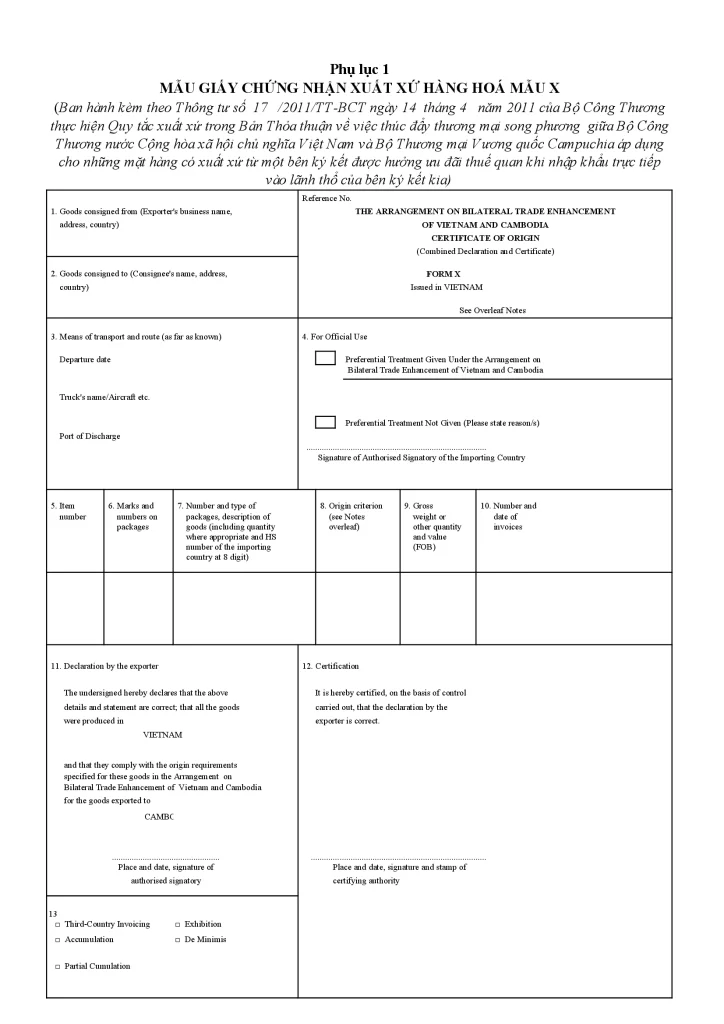
| Box / Field | Required Information | Verification Point |
|---|---|---|
| Box 1 – Exporter | Full name and address of the Cambodian exporter | Must match exactly with the Commercial Invoice and Cambodian export customs declaration |
| Box 2 – Consignee | Name and address of the consignee/importer | Must match the Commercial Invoice; “To Order” may be used where permitted under a Letter of Credit |
| Box 3 – Transport Details | Mode of transport, port of loading, and port of discharge | Must match the Bill of Lading and clearly identify the vessel, flight, or overland route |
| Box 4 – For Official Use | Reserved for the issuing authority | Must contain the official stamp and signature of the Cambodian issuing authority |
| Box 7 – Description of Goods | Detailed product description | Must be sufficiently detailed to determine the correct HS code; generic trade names should be avoided |
| Box 8 – HS Code | Six-digit HS code | Must match the HS code declared on the import customs declaration; HS code discrepancies are among the most common causes of rejection |
| Box 9 – Quantity and Weight | Quantity and gross/net weight | Must be consistent with the Commercial Invoice and Packing List; acceptable variance is generally within 5% |
| Box 10 – Invoice Number & Date | Invoice reference and issue date | Must match the actual Commercial Invoice exactly; invoice discrepancies frequently lead to rejection |
| Box 11 – Origin Criterion | Origin criterion (WO, RVC %, or CTC) | Must clearly indicate the correct criterion according to the applicable Product Specific Rule (PSR) |
| Box 12 – Declaration by Exporter | Exporter’s declaration and signature | Must include the signatory’s name, title, signature, and date, matching registered signature records |
| Box 13 – Certification by Issuing Authority | Official certification by the issuing authority | Must contain the official stamp, authorized signature, and issuance date |
Note: If minor errors are identified after the certificate has been issued, such as typographical mistakes or small quantity discrepancies, the exporter may apply for an amended Certificate of Origin before customs clearance. Correcting errors after cargo arrival is significantly more expensive and time-consuming.
9. Latest Developments Regarding CO Form X
Cambodia is actively digitizing its Certificate of Origin issuance system and expanding the application of the Cambodia–China Free Trade Agreement. Importers sourcing goods from Cambodia should stay informed of the following developments:
- Electronic Certificate of Origin (e-CO) System: The Ministry of Commerce of Cambodia has introduced electronic issuance systems for certain certificates of origin and export markets. Electronic CO Form X carries the same legal validity as paper certificates when issued and authenticated in accordance with official procedures. Vietnamese importers receiving e-COs should confirm acceptance requirements with Vietnamese Customs before shipment.
- Expansion of CCFTA Tariff Preferences: Since the agreement entered into force in 2022, tariff reductions have continued according to the implementation schedule. Many product categories reached a 0% tariff rate during 2024–2025, particularly agricultural products, seafood, and consumer goods. Businesses should review the latest CCFTA tariff schedules to determine the actual benefits available.
- Enhanced Origin Fraud Enforcement: Cambodian Customs and customs authorities in importing countries, particularly China and Vietnam, have intensified origin verification activities for products such as electronics, textiles, garments, and steel. Goods merely transshipped through Cambodia without substantial production activities may be denied preferential treatment and subject to legal penalties.
- RCEP and Its Impact on CO Form X: Cambodia is also a member of the Regional Comprehensive Economic Partnership (RCEP), effective from January 1, 2022. Businesses may consider using an RCEP Certificate of Origin instead of CO Form X for certain overlapping markets if the RCEP tariff treatment offers greater advantages.
10. Common CO Form X Errors and How to Avoid Them
| Common Error | Potential Consequence | Recommended Solution |
|---|---|---|
| HS code on the Certificate of Origin does not match the import customs declaration | Loss of preferential tariff treatment and application of MFN duties | Confirm the HS code with the Cambodian exporter before signing the contract and cross-check all related documents |
| Invoice number on the Certificate of Origin differs from the actual Commercial Invoice | Certificate may be rejected and require amendment or reissuance | Verify invoice details before the exporter submits the application |
| Goods are not genuinely produced in Cambodia (fraudulent transshipment) | Duty reassessment, administrative penalties, import restrictions, or criminal liability | Request manufacturing capability documentation and conduct supplier audits for high-value shipments |
| Incorrect Certificate of Origin type used (e.g., Form D or Form E instead of Form X) | Ineligibility for CCFTA preferential treatment | Determine the applicable trade agreement and certificate type during contract negotiations |
| Expired CO Form X (issued more than 12 months before customs clearance) | Certificate becomes invalid and preferential treatment is lost | Verify the issuance date immediately upon receipt and request reissuance if necessary |
| Goods transiting through Vietnam without a Through Bill of Lading | Violation of direct consignment requirements, resulting in invalidation of the certificate | Require the carrier or freight forwarder to issue a Through Bill of Lading from Cambodia to the final destination |
| Certificate issued by an unauthorized authority | Certificate may not be recognized by customs authorities | Verify the issuing authority against the official list authorized by the Ministry of Commerce of Cambodia |
Frequently Asked Questions About CO Form X (FAQ)
What is CO Form X and when is it used?
CO Form X is a certificate of origin issued by Cambodia, certifying that goods originate in Cambodia and meet the origin requirements of the applicable trade agreement. It is most commonly associated with the Cambodia–China Free Trade Agreement (CCFTA), which entered into force on January 1, 2022. CO Form X is used when Cambodian exporters seek preferential tariff treatment for their products in importing countries covered by the relevant trade agreement.
What is the difference between CO Form X and CO Form D?
CO Form D is used under the ASEAN Trade in Goods Agreement (ATIGA) for trade among ASEAN member states, including Vietnam, Cambodia, and other ASEAN countries. CO Form X is associated with the Cambodia–China Free Trade Agreement (CCFTA) or other bilateral trade arrangements involving Cambodia. Although both certificates may certify Cambodian-origin goods, they are not interchangeable.
Who issues CO Form X for Cambodian goods?
The Ministry of Commerce of Cambodia (MoC) and its authorized agencies, including the Cambodia Chamber of Commerce (KCCI) and provincial Departments of Commerce, are authorized to issue CO Form X. Vietnamese importers cannot apply for the certificate themselves and must obtain it from their Cambodian suppliers.
How long is CO Form X valid?
CO Form X is valid for 12 months from the date of issuance. If the certificate expires before customs clearance, the importer will not be able to claim preferential tariff treatment. Businesses should verify the issuance date immediately upon receiving the shipping documents.
How can I verify whether a CO Form X is genuine?
The following checks are recommended:
- Verify that the stamp and signature match the specimen records of authorized issuing authorities.
- Confirm the certificate number through the electronic verification system of the Ministry of Commerce of Cambodia, where available.
- Ensure the information on the certificate is consistent with the Commercial Invoice, Bill of Lading, and Packing List.
- Request supporting manufacturing capability documents from the exporter for high-value shipments.
Do Cambodian goods transiting through Vietnam to China require CO Form X?
Yes. If the importer wishes to benefit from CCFTA preferential tariff treatment in China, a valid CO Form X is required. The shipment must also comply with the direct consignment requirement, including the issuance of a Through Bill of Lading from Cambodia to China and evidence that the goods did not undergo alteration while transiting through Vietnam. Without these supporting documents, Chinese Customs may reject the certificate.
11. Conclusion – Key Points to Remember About CO Form X
CO Form X is a critical document when trading goods originating from Cambodia. Businesses should focus on the following four actions:
- Identify the correct Certificate of Origin type during contract negotiations — determine whether the shipment falls under CCFTA, ATIGA, ACFTA, or another trade agreement and request the appropriate certificate to avoid confusion with Form D, Form E, or other origin documents.
- Require Cambodian exporters to prepare complete origin documentation — including bills of materials, RVC calculation sheets, and manufacturing capability documents for first-time shipments. Ensure consistency between the Certificate of Origin, Commercial Invoice, and Bill of Lading.
- Review CO Form X carefully upon receipt — pay particular attention to the HS code (Box 8), origin criterion (Box 11), invoice number (Box 10), and issuing authority certification (Box 13). Early detection of errors allows amendments to be made before cargo arrival.
- Retain CO Form X and all supporting origin documents for at least five years — ensuring that records are available if customs authorities request verification and minimizing the risk of future duty reassessments.
This article is based on the Cambodia–China Free Trade Agreement (CCFTA), the ASEAN Trade in Goods Agreement (ATIGA), regulations issued by the Ministry of Commerce of Cambodia, and customs guidance relating to imported goods origin requirements.
3W Logistics – Cambodia Import Services and CO Form X Consultation
Incorrectly prepared CO Form X certificates or missing origin documentation can result in the loss of preferential tariff treatment, cargo detention at ports, demurrage and detention charges, and potential retroactive duty assessments. 3W Logistics is a professional logistics provider with more than ten years of experience in transportation and customs procedures across the Vietnam–Cambodia–China trade corridor, helping businesses manage origin compliance risks from contract signing through successful customs clearance.
- Specialized Expertise in Cambodian Origin Compliance: Our team possesses extensive knowledge of CCFTA, ATIGA, ACFTA, and Product Specific Rules (PSRs) applicable to Cambodia’s major export sectors, including agricultural products, garments, timber products, and footwear. 3W Logistics assists businesses in selecting the correct Certificate of Origin, verifying CO Form X validity before customs clearance, and resolving origin-related issues when they arise.
- Vietnam–Cambodia–China Transportation Network: With NVOCC capabilities, cross-border trucking services through major border gates such as Moc Bai, Hoa Lu, and Tinh Bien, as well as ocean freight solutions connecting Ho Chi Minh City and Cai Mep with major Asian ports, 3W Logistics ensures compliant Through Bills of Lading and supports transit certification requirements for Cambodian re-export cargo.
- Efficient Customs Clearance and Reduced Demurrage Risk: Experience handling hundreds of Cambodia-origin import shipments each year enables our team to identify documentation issues early, coordinate certificate amendments with Cambodian partners, and minimize the risk of cargo delays and port storage charges.
For businesses importing goods from Cambodia, seeking CO Form X consultation, or requiring Vietnam–Cambodia transportation services, contact 3W Logistics for a comprehensive logistics solution tailored to your supply chain needs.
CONTACT INFORMATION
3W Logistics – Ho Chi Minh City Headquarters
Address: 34 Bach Dang Street, Tan Son Hoa Ward, Ho Chi Minh City, Vietnam
Hotline: +84 28 3535 0087
3W Logistics – Hanoi Branch
Address: 81A Tran Quoc Toan Street, Cua Nam Ward, Hanoi, Vietnam
Hotline: +84 24 3202 0482
3W Logistics – Hai Phong Branch
Address: 8A Lot 28 Le Hong Phong Street, Gia Vien Ward, Hai Phong, Vietnam
Hotline: +84 225 355 5939
3W LOGISTICS CO., LTD – We here serve you there!
Email: quote@3w-logistics.com
Website: www.3w-logistics.com

Hello, I’m Nguyen Phuong Nhan (Ms. Nina)
I currently serve as Trade Lanes Supervisor at 3W Logistics, with more than 10 years of experience in international logistics and freight forwarding.
My primary responsibility is developing and managing global logistics partnerships, building strategic trade lanes, and working closely with overseas agents to provide reliable and competitive transportation solutions for customers.
I regularly collaborate with agents and logistics partners worldwide to explore new business opportunities, negotiate freight rates, develop trade routes, and support import-export shipments. I also work closely with our sales team to design logistics solutions tailored to specific markets and customer requirements.
My expertise includes Ocean Freight, Air Freight, Trade Lane Development, Global Agent Network Management, International Logistics Solutions, and Import-Export Support.
Through the articles I share on the 3W Logistics website, I aim to provide practical insights into the international logistics industry, global transportation trends, overseas agent cooperation, and effective logistics strategies that help businesses optimize their supply chain operations.
I believe that strong global partnerships and well-developed trade lanes are essential to delivering sustainable logistics solutions and long-term value to customers worldwide.


