
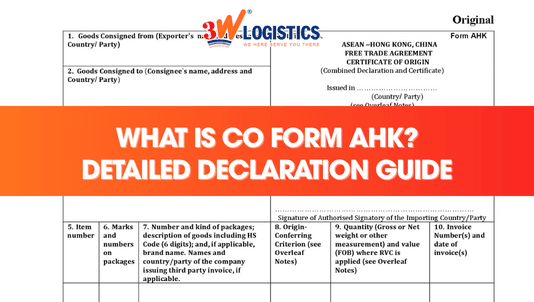
What Is CO Form AHK? Detailed Declaration Guide
Goods exported from Vietnam to Australia or New Zealand must have one important document to qualify for preferential import tariffs: CO Form AHK. This is the Certificate of Origin issued under the ASEAN–Australia–New Zealand Free Trade Agreement (AANZFTA), and it is a mandatory condition for the importing customs authority to accept preferential tariff treatment instead of the normal MFN tariff rate.
This article explains clearly what CO Form AHK is, the conditions required for goods to qualify, detailed instructions for completing each box on the certificate, the list of required documents, and common mistakes that may cause the application to be rejected.
1. What is CO Form AHK?
CO Form AHK (Certificate of Origin Form AHK) is a certificate of origin issued under the ASEAN–Australia–New Zealand Free Trade Agreement (AANZFTA). The name “AHK” originates from the coding system used in Vietnam for ASEAN (A), Australia (H), and New Zealand (K). When goods exported from Vietnam are accompanied by a valid CO Form AHK, importers in Australia or New Zealand can enjoy preferential import tariff rates instead of the higher normal MFN tariff rates.
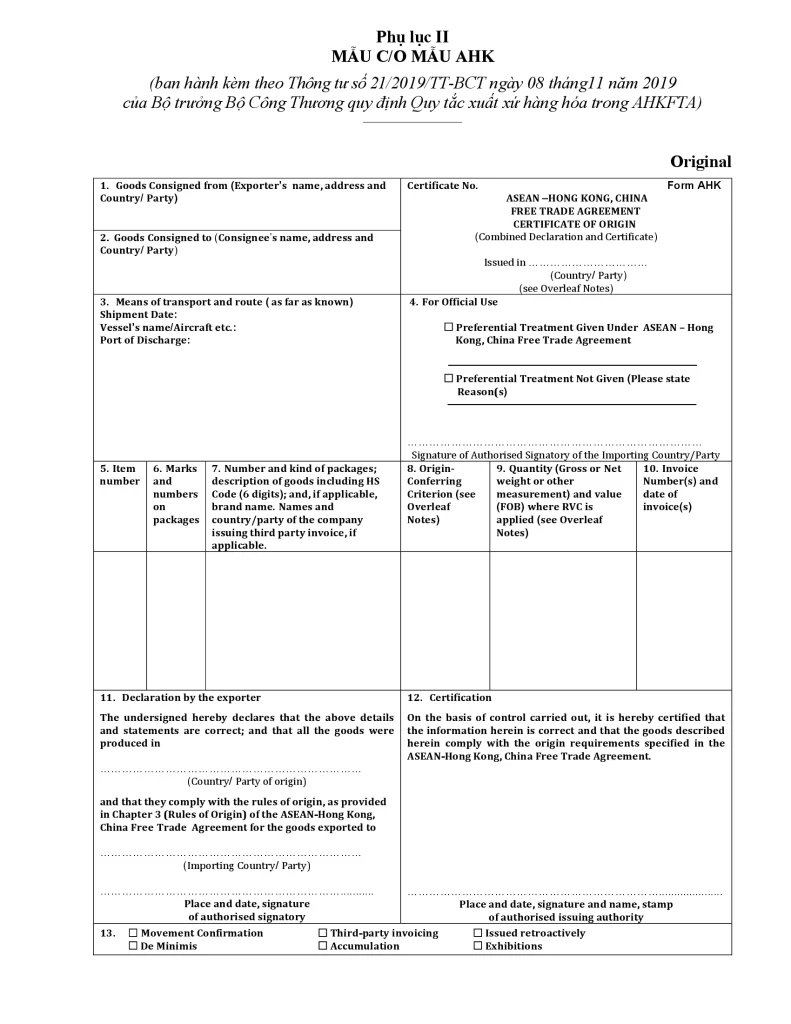
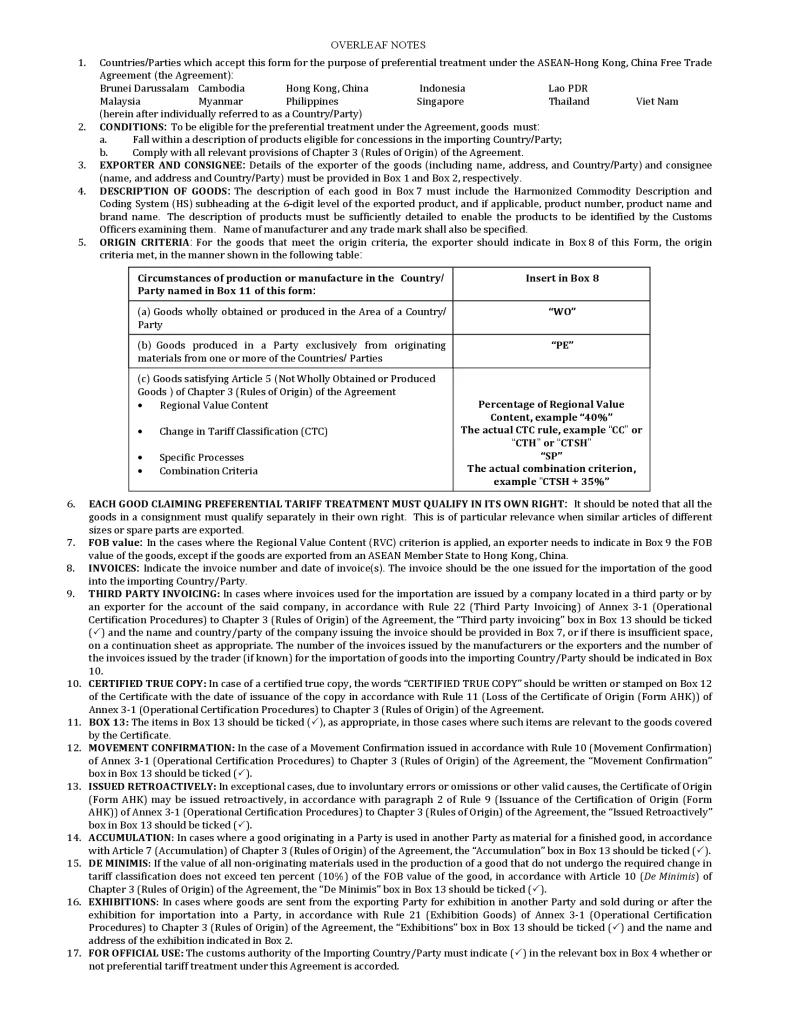
Download CO Form AHK template here
1.1 What is AANZFTA?
AANZFTA (ASEAN–Australia–New Zealand Free Trade Agreement) is a free trade agreement between the 10 ASEAN member countries and Australia and New Zealand, effective for Vietnam since January 1, 2010. AANZFTA creates a free trade area covering nearly 700 million consumers, with tariff reduction schedules gradually lowering duties to 0% depending on product groups. In 2023, AANZFTA was upgraded (Upgraded AANZFTA) with expanded commitments regarding rules of origin and technical standards.
1.2 Authorities Issuing CO Form AHK in Vietnam
In Vietnam, CO Form AHK is issued by the Ministry of Industry and Trade (MOIT) and authorized organizations — including the Vietnam Chamber of Commerce and Industry (VCCI) and provincial Departments of Industry and Trade — through the electronic C/O system at ecosys.gov.vn. The normal processing time is 1–3 working days from the time a complete and valid application is received.
Note: CO Form AHK is only valid for goods exported from Vietnam to Australia or New Zealand. In the opposite direction (imports from Australia/New Zealand into Vietnam), the certificate of origin used must be issued by the competent authority of the exporting country.
2. Conditions for Issuance of CO Form AHK
Goods are eligible for CO Form AHK only when they satisfy the Rules of Origin specified in Chapter 3 and Annex 2 of AANZFTA. Three main origin criteria apply depending on the product and HS code.
2.1 Wholly Obtained (WO) Criterion
Wholly Obtained (WO) applies to goods entirely produced in Vietnam or within the territories of AANZFTA member countries without using any non-originating materials. This criterion mainly applies to agricultural products, seafood, minerals, and products directly processed from these resources.
2.2 Regional Value Content (RVC ≥ 40%) Criterion
Regional Value Content (RVC) requires that at least 40% of the FOB value of the finished product originates from AANZFTA member countries. This is the most commonly applied criterion for manufactured goods using imported materials from outside the bloc.
Formula for calculating RVC using the Build-Down method (the standard method under AANZFTA):
RVC (%) = [(FOB Value − Value of Non-Originating Materials) ÷ FOB Value] × 100
Practical example: A Vietnamese company manufactures leather shoes exported to Australia. The FOB value per pair is USD 50. Leather imported from China (non-AANZFTA origin) costs USD 15. RVC = [(50 − 15) ÷ 50] × 100 = 70% — therefore the product qualifies for CO Form AHK under the RVC ≥ 40% criterion.
2.3 Change in Tariff Classification (CTC) Criterion
Change in Tariff Classification (CTC) is satisfied when the HS code of the finished product differs from the HS codes of all non-originating materials used during production at the chapter (2-digit), heading (4-digit), or subheading (6-digit) level — depending on the product-specific rules listed in Annex 2 of AANZFTA. The CTC criterion is suitable for manufacturing industries involving substantial transformation processes.
3. Special Cases When Applying for CO Form AHK
In addition to the three basic origin criteria, AANZFTA provides several special cases affecting the application and use of CO Form AHK.
- Origin Cumulation: Materials originating from any AANZFTA member country are considered originating materials when calculating RVC. Enterprises using materials from other ASEAN countries, Australia, or New Zealand can benefit from this rule.
- Third-Party Invoicing: When the commercial invoice is issued by a company in a third country (not Vietnam and not the importing country), CO Form AHK can still be issued, but invoice information must be declared in Box 7 and noted in Box 13.
- Retroactive Issuance: CO Form AHK may be issued after the export date in cases of unintentional omission. The exporter must provide a written explanation and prove that the goods met the origin criteria at the time of export.
- Back-to-Back CO: Applied when goods are transshipped through an intermediary AANZFTA member country before reaching the final importing country. The intermediary country issues a back-to-back CO based on the original CO issued in Vietnam.
4. Detailed Guide to Filling Out CO Form AHK
The CO Form AHK template consists of two pages: the front page contains the declaration boxes, while the back page is reserved for the issuing authority. All information must be completed in English, in uppercase letters, clearly and without erasures. Below is a detailed explanation of each box.
| Box No. | Declaration Content | Important Notes |
|---|---|---|
| Box 1 | Exporter’s name & address | State the exact legal company name and registered business address in Vietnam |
| Box 2 | Reference number (self-assigned by exporter) | May be left blank or include contract/invoice numbers for internal reference |
| Box 3 | Consignee’s name & address | Must match the importer information shown on the commercial invoice |
| Box 4 | Means of transport & route | State vessel/flight name, port of loading and port of discharge. Example: “BY SEA / HO CHI MINH PORT TO MELBOURNE PORT” |
| Box 5 | For official use | Leave blank — completed by the issuing authority |
| Box 6 | Item number | Number items sequentially if multiple products are declared on one CO |
| Box 7 | Invoice number & date | Must exactly match the commercial invoice. For third-party invoices, state the issuing company name clearly |
| Box 8 | HS code & description of goods | Use the 6-digit HS code under HS 2022. Product descriptions must be sufficiently detailed |
| Box 9 | Origin criterion | Declare applicable criterion: WO, RVC xx%, or CTC (CC/CTH/CTSH) |
| Box 10 | Quantity & weight | Must match the packing list and B/L. Clearly indicate units such as CBM, KGS, PCS |
| Box 11 | Packages & marks | State package quantity, packaging type, and shipping marks according to actual shipment details |
| Box 12 | Declaration by the exporter | Authorized company representative signs, stamps, and dates the declaration. The declaration date cannot be earlier than the export date |
| Box 13 | Certification by the issuing authority | Completed and stamped by the issuing authority. Leave blank |
Important note regarding Box 9 – Origin Criterion: This is the most important and most frequently completed incorrectly box. If using the RVC criterion, the actual RVC percentage must be stated, for example “RVC 55%”, not simply “RVC”. If using the CTC criterion, specify the exact level of tariff change: CC (Change in Chapter), CTH (Change in Tariff Heading), or CTSH (Change in Tariff Subheading).
5. Complete Application Dossier for CO Form AHK
Applications for CO Form AHK are submitted electronically through ecosys.gov.vn. Enterprises should prepare all required supporting documents before starting the online declaration process.
| Document | Purpose | Mandatory / Conditional |
|---|---|---|
| Commercial Invoice | Confirms FOB value and buyer/seller information | Mandatory |
| Packing List | Details quantity, weight, and packing specifications | Mandatory |
| Bill of Lading (B/L or AWB) | Confirms shipment from Vietnam to Australia/New Zealand | Mandatory |
| Export Customs Declaration | Confirms HS code and export value declared to customs | Mandatory |
| Bill of Materials (BOM) / Production Norms | Demonstrates compliance with RVC or CTC criteria | Mandatory for manufactured goods |
| Import Customs Declarations for Materials | Determines value and origin of non-originating materials | Mandatory for RVC criterion |
| Certificates of Origin for Input Materials | Proves originating status of materials from AANZFTA members for cumulation purposes | Conditional |
| Third-Party Invoice Explanation | Explains why the invoice is issued by a company in a third country | Conditional |
Important note: The Bill of Materials (BOM) must be updated for each shipment whenever material prices fluctuate significantly. The actual RVC percentage changes depending on material costs — an RVC calculation that exceeded 40% at the time of initial product registration does not guarantee compliance for future shipments.
6. Step-by-Step Procedure for Applying for CO Form AHK
The entire process for applying for CO Form AHK in Vietnam is conducted online through ecosys.gov.vn. Enterprises submitting applications for the first time must complete account registration in advance, while repeat export shipments of the same product may use previously registered product dossiers.
- Register a business account on ecosys.gov.vn using the company tax code and digital signature (USB token or remote digital signature). Companies without an account should complete this step at least 2–3 days in advance.
- Check the HS code and applicable origin criterion — review the product-specific rules of origin in Annex 2 of AANZFTA to determine whether the applicable criterion is WO, RVC, or CTC for the exported goods.
- Calculate and prepare the RVC worksheet (if applying the RVC criterion) — summarize all non-originating material costs, apply the Build-Down formula, and confirm that RVC ≥ 40%.
- Prepare all required documents according to the list in Section 5 — scan notarized copies or original documents as required by the issuing authority.
- Submit the online CO application on ecosys.gov.vn — complete all declaration boxes according to the instructions in Section 4 and upload supporting documents.
- Submit the electronic dossier and monitor the processing status through the online account. The issuing authority may request additional documents — enterprises should respond within 1 working day to avoid delays.
- Receive the approved CO Form AHK — download the electronic version or collect the hard copy with official stamp from the issuing authority, depending on the importing customs authority’s requirements.
- Send the CO Form AHK to the importer together with the shipping documents — the importer submits the certificate to Australian or New Zealand customs authorities to obtain AANZFTA preferential tariff treatment.
7. CO Form AHK and Other Types of C/O
Vietnam is a member of multiple FTAs, and each agreement uses a different Certificate of Origin form. Choosing the wrong C/O means the importer may not receive preferential tariff treatment. The table below compares CO Form AHK with other commonly used C/O forms for exports from Vietnam to Australia/New Zealand.
| Criteria | CO Form AHK (AANZFTA) | CO RCEP | CO Form AI (ASEAN–India) |
|---|---|---|---|
| Agreement | AANZFTA | RCEP | AIFTA |
| Applicable destination countries | Australia, New Zealand | 15 countries (ASEAN 10 + China, Japan, Korea, Australia, New Zealand) | India |
| Minimum RVC | 40% | 40% | 35% |
| Self-certification of origin | Yes (Approved Exporter) | Yes (Approved Exporter) | No |
| Back-to-back CO | Yes | Yes | Yes |
| Validity period | 12 months | 12 months | 12 months |
| Issuing authority (Vietnam) | MOIT / VCCI | MOIT / VCCI | MOIT / VCCI |
Note for exports to Australia: Enterprises may choose between CO Form AHK (AANZFTA) and CO RCEP for exports to Australia or New Zealand. Businesses should compare preferential tariff schedules under each FTA according to the specific HS code before deciding which C/O to use — in some cases, RCEP may provide better tariff preferences than AANZFTA for certain product groups.
See also: What is C/O Form VN CU?,…
8. Common Mistakes When Declaring CO Form AHK
Applications for CO Form AHK are often rejected — or later denied by importing customs authorities — due to one of the following common errors. Most of these mistakes can be completely avoided through careful review before submission.
- HS code mismatch between the CO and customs declaration: The HS code stated in Box 8 of the CO Form AHK must exactly match the HS code declared on the export customs declaration. Any discrepancy — even a single digit — may result in rejection by the importing customs authority.
- Incorrect origin criterion in Box 9: Declaring “WO” for products using imported materials, or failing to state the actual RVC percentage achieved. Box 9 must accurately reflect the criterion genuinely satisfied by the goods.
- Incorrect RVC calculation method: Using CIF value instead of FOB value in the formula, or omitting certain non-originating material costs. This may result in the actual RVC falling below 40% while still being declared as qualified — a serious compliance violation.
- Leaving third-party invoice information blank: When the invoice is issued by a company in Singapore, Hong Kong, or any third country, complete information must be declared in Box 7 and noted in Box 13. Failure to do so may render the CO invalid.
- Declaration date in Box 12 earlier than the export date: This violates document integrity requirements and may trigger origin fraud investigations.
- Failure to update the BOM when material prices fluctuate: RVC may fall below 40% when imported material prices increase significantly. Enterprises should recalculate RVC periodically — especially for materials with volatile pricing such as steel, plastics, and textiles.
9. Validity and Rules for Using CO Form AHK
CO Form AHK is valid for 12 months from the date of issuance. The importer must submit the certificate to Australian or New Zealand customs authorities within this validity period to obtain AANZFTA preferential tariff treatment. Several important usage rules should be noted:
- Direct Consignment Rule: Goods must be transported directly from Vietnam to Australia or New Zealand. If goods are transshipped through a non-AANZFTA country, customs documents from the transit country must prove that the goods did not enter domestic commercial circulation there.
- One CO for one shipment: Each CO Form AHK applies to only one Bill of Lading (B/L or AWB). Multiple shipments under the same contract require separate CO applications for each shipment.
- Submission for preferential treatment at import customs: The importer submits the original CO Form AHK (or certified electronic version) during customs clearance. Australian and New Zealand customs authorities accept electronic COs under the amended AANZFTA provisions.
- Post-clearance verification: Importing customs authorities may request origin verification within 5 years from the import date. Vietnamese exporters must retain all origin-related records for at least 5 years.
10. FAQ – Frequently Asked Questions About CO Form AHK
What is CO Form AHK and what is it used for?
CO Form AHK is a Certificate of Origin issued under the ASEAN–Australia–New Zealand Free Trade Agreement (AANZFTA). Importers in Australia or New Zealand use CO Form AHK to request preferential AANZFTA import tariffs instead of normal MFN tariff rates — helping reduce import costs and improve the price competitiveness of Vietnamese goods.
Where is CO Form AHK issued and how long does it take?
CO Form AHK is issued by the Ministry of Industry and Trade and authorized organizations such as VCCI through the electronic system at ecosys.gov.vn. Normal processing time is 1–3 working days after receiving a complete and valid dossier. Complex applications (new product registrations, RVC verification cases) may take an additional 1–2 days.
What is the minimum RVC required for CO Form AHK?
The minimum Regional Value Content required under the RVC criterion is 40% of the FOB value of the finished product. RVC is calculated using the Build-Down method: [(FOB − Value of Non-Originating Materials) ÷ FOB] × 100 ≥ 40%.
How long is CO Form AHK valid?
CO Form AHK remains valid for 12 months from the date of issuance. Importers must present the certificate to Australian or New Zealand customs authorities within this period. Expired COs are not accepted for preferential tariff claims.
Can CO Form AHK be issued after the goods have already been exported?
Yes. CO Form AHK may be issued retroactively in cases of unintentional omission. The exporter must provide a written explanation and prove that the goods satisfied the origin requirements at the time of export. The issuing authority reviews and decides on a case-by-case basis.
Can transshipped goods use CO Form AHK?
Yes, provided the Direct Consignment rule is satisfied. If the goods are transshipped through an AANZFTA member country, a Back-to-Back CO may be applied. If transshipment occurs through a non-AANZFTA country, customs documents from the transit country must prove that the goods did not enter domestic circulation there.
11. Summary: CO Form AHK Application Checklist
- Determine the correct HS code for the goods and review the applicable product-specific rule of origin (WO, RVC, or CTC) in Annex 2 of AANZFTA before exporting any new product line.
- Calculate RVC accurately using the Build-Down method and recalculate whenever raw material prices fluctuate by more than ±10% compared with the previous calculation.
- Prepare a complete dossier before accessing ecosys.gov.vn — missing documents will increase review cycles and extend processing time.
- Compare CO Form AHK with CO RCEP for every shipment exported to Australia/New Zealand — choose the C/O type providing the better preferential tariff treatment for the specific HS code.
This article is compiled based on the AANZFTA Agreement (signed on February 27, 2009 and effective in Vietnam from January 1, 2010), Circular No. 31/2013/TT-BCT, and amended regulations issued by the Ministry of Industry and Trade regarding procedures for issuing CO Form AHK. Reference documents are available at vanban.chinhphu.vn and moit.gov.vn.
CO Form AHK Application Services – 3W Logistics
Incorrect origin criteria declarations, inaccurate RVC calculations, or incomplete dossiers may lead to serious financial consequences: importers being charged MFN tariffs instead of AANZFTA preferential rates, contract disputes, or even post-clearance origin verification investigations. 3W Logistics is one of Vietnam’s leading international logistics providers, offering comprehensive CO Form AHK application services for exporters shipping to Australia and New Zealand.
- Expert C/O and FTA team: 3W Logistics specialists are experienced with all FTAs currently in force in Vietnam — including AANZFTA, RCEP, CPTPP, VIFTA, and bilateral agreements. We analyze rules of origin, determine the correct criterion for each HS code, calculate RVC, and prepare complete dossiers before submission through ecosys.gov.vn.
- Vietnam–Australia–New Zealand transport network: As a licensed NVOCC, 3W Logistics operates direct FCL and LCL services from Ho Chi Minh City and Hai Phong to Melbourne, Sydney, Auckland, and Wellington — ensuring transit times and transport documents comply with the Direct Consignment requirements of CO Form AHK.
- Parallel coordination to save time: Our internal process handles CO applications simultaneously with booking arrangements and shipping document preparation — reducing the total lead time from cargo readiness to CO issuance to just 1–2 working days in most cases.
Businesses requiring CO Form AHK application services, AANZFTA rules of origin consultation, or freight services to Australia and New Zealand are encouraged to contact 3W Logistics for a complete end-to-end solution.
Contact 3W Logistics – Free CO Form AHK Consultation
CONTACT INFORMATION:
Head Office – 3W Logistics Ho Chi Minh Branch
Address: 34 Bach Dang Street, Tan Son Hoa Ward, Ho Chi Minh City, Vietnam
Hotline: +84 28 3535 0087
3W Logistics Hanoi Branch
Address: 81A Tran Quoc Toan Street, Cua Nam Ward, Hanoi, Vietnam
Hotline: +84 24 3202 0482
3W Logistics Hai Phong Branch
Address: 8A Lot 28 Le Hong Phong Street, Gia Vien Ward, Hai Phong, Vietnam
Hotline: +84 225 355 5939
3W LOGISTICS CO., LTD – We here serve you there!
Email: quote@3w-logistics.com
Website: www.3w-logistics.com

Hello, I’m Nguyen Phuong Nhan (Ms. Nina)
I currently serve as Trade Lanes Supervisor at 3W Logistics, with more than 10 years of experience in international logistics and freight forwarding.
My primary responsibility is developing and managing global logistics partnerships, building strategic trade lanes, and working closely with overseas agents to provide reliable and competitive transportation solutions for customers.
I regularly collaborate with agents and logistics partners worldwide to explore new business opportunities, negotiate freight rates, develop trade routes, and support import-export shipments. I also work closely with our sales team to design logistics solutions tailored to specific markets and customer requirements.
My expertise includes Ocean Freight, Air Freight, Trade Lane Development, Global Agent Network Management, International Logistics Solutions, and Import-Export Support.
Through the articles I share on the 3W Logistics website, I aim to provide practical insights into the international logistics industry, global transportation trends, overseas agent cooperation, and effective logistics strategies that help businesses optimize their supply chain operations.
I believe that strong global partnerships and well-developed trade lanes are essential to delivering sustainable logistics solutions and long-term value to customers worldwide.


