

RCEP Certificate of Origin – Full Guide for Exporters
Every shipment crossing an RCEP border carries a hidden variable — the tariff rate applied at customs. CO RCEP (RCEP Certificate of Origin) is the document that unlocks preferential duty rates under the Regional Comprehensive Economic Partnership, cutting import costs for compliant exporters across 15 member economies.
This guide covers everything importers and exporters need to know about the RCEP Certificate of Origin: what it is, which goods qualify, how to apply, and how to avoid the mistakes that trigger rejection at customs.
1. What Is CO RCEP?
CO RCEP is the official proof-of-origin document issued under the Regional Comprehensive Economic Partnership Agreement. When a shipment is accompanied by a valid CO RCEP, the importing RCEP member country applies a preferential (reduced or zero) tariff instead of the standard MFN rate — directly lowering landed cost for buyers and improving price competitiveness for sellers.
1.1 Definition of RCEP Certificate of Origin
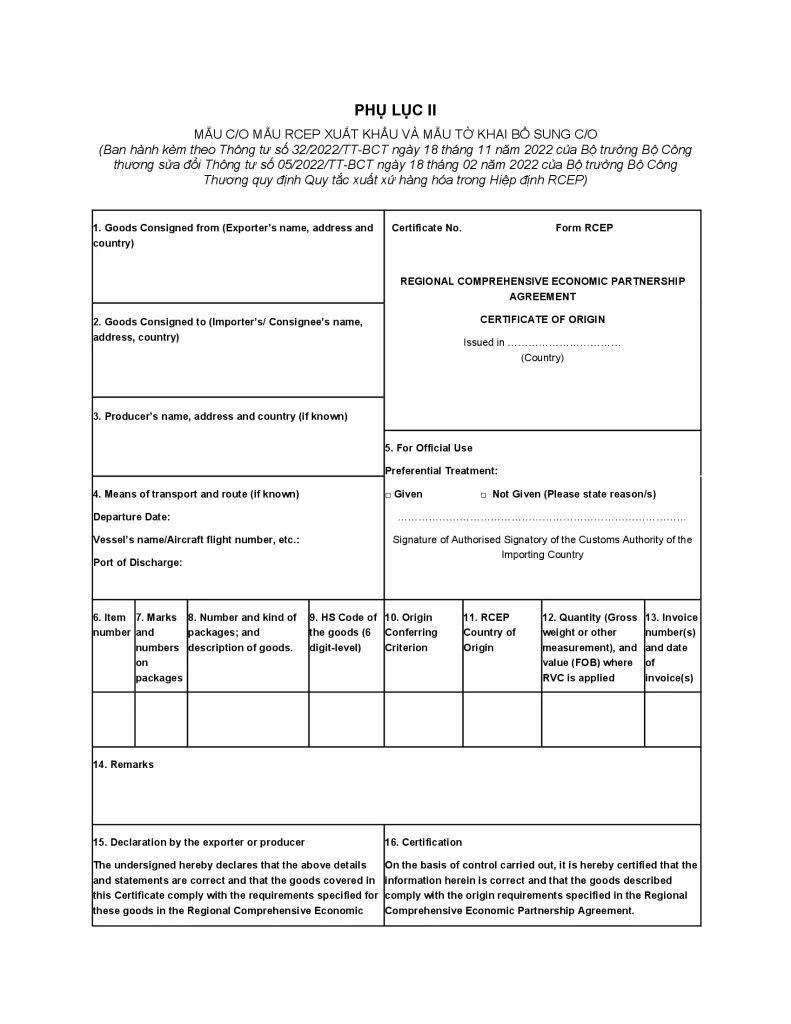
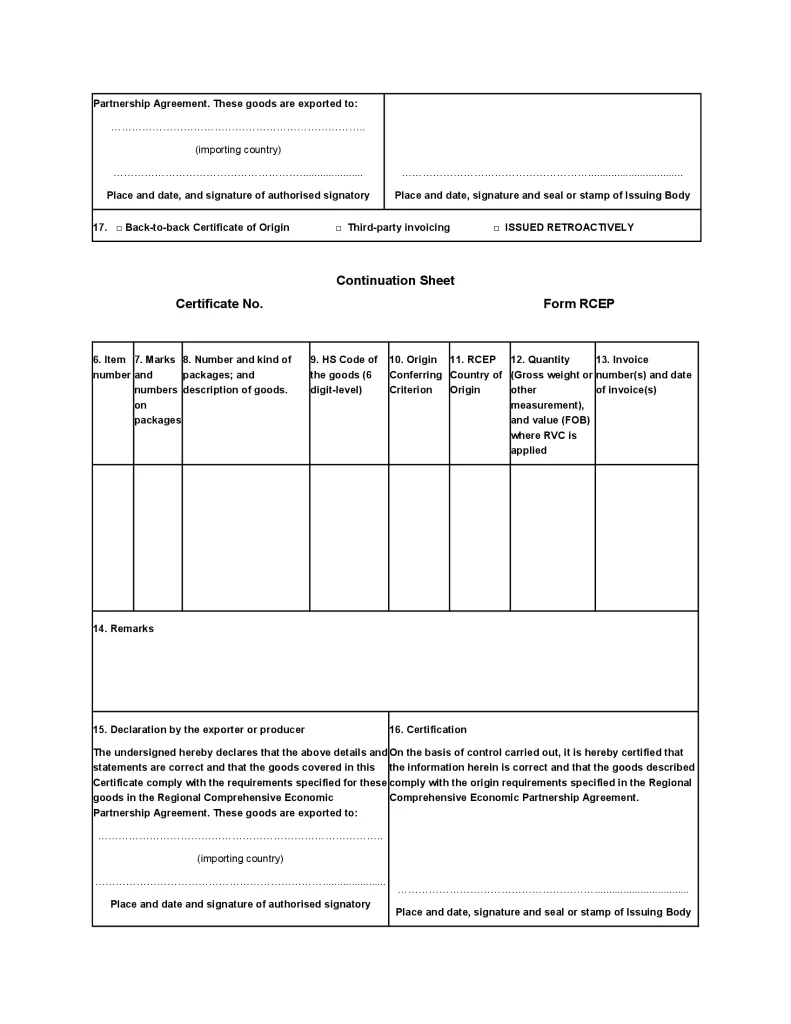
RCEP Certificate of Origin is a trade document certifying that goods meet the Rules of Origin requirements set out in the RCEP Agreement. It is the legal basis for an importer to claim preferential tariff treatment when clearing goods through customs in any of the 15 signatory economies.
The document is commonly referred to as CO RCEP, RCEP CO, or Form RCEP. Unlike generic certificates, it is specifically structured to capture the origin criteria, back-to-back provisions, and third-party invoicing declarations required by RCEP.
1.2 Who Issues CO RCEP in Vietnam?
In Vietnam, CO RCEP is issued by the Ministry of Industry and Trade (MOIT) through its network of authorized issuing bodies, including Vietnam Chamber of Commerce and Industry (VCCI) branches and MOIT provincial offices. Applications are submitted electronically via ecosys.gov.vn — Vietnam’s official e-CO platform.
Processing time is typically 1–3 working days for standard applications. Rush processing is available for certain shipment types subject to issuing-body approval.
Note: CO RCEP issued in Vietnam is only valid for exports from Vietnam to other RCEP member countries. The importing country’s customs authority makes the final determination on preferential tariff eligibility.
2. RCEP Member Countries Covered by CO RCEP
A CO RCEP is recognised across all 15 member economies of the Regional Comprehensive Economic Partnership. Preferential tariff schedules vary by bilateral pair — the tariff rate applied depends on both the exporting and importing country involved in the specific trade flow.
| Region | RCEP Member Countries |
|---|---|
| Southeast Asia (ASEAN) | Vietnam, Thailand, Indonesia, Malaysia, Singapore, Philippines, Myanmar, Cambodia, Laos, Brunei |
| Northeast Asia | China, Japan, South Korea |
| Oceania | Australia, New Zealand |
RCEP entered into force on 1 January 2022 for the first group of ratifying members. As of 2024, all 15 members have ratified the agreement, making CO RCEP applicable across the full membership. For the official tariff schedules by HS code and trading pair, refer to the Ministry of Industry and Trade portal.
Practical example: A Vietnamese garment manufacturer exporting to Japan can use CO RCEP to reduce the import tariff from Japan’s standard MFN rate to the RCEP preferential rate — which in many textile HS codes has been eliminated to 0% over the phase-down schedule.
3. Rules of Origin: When Does Your Product Qualify?
A product qualifies for CO RCEP only when it satisfies the Rules of Origin (ROO) specified in Chapter 3 of the RCEP Agreement. The ROO determine the minimum level of processing or content that must occur within RCEP member countries for the goods to be considered “originating.” Three primary criteria apply.
3.1 Wholly Obtained (WO) Criterion
Wholly Obtained (WO) goods are those produced entirely within one or more RCEP member countries, with no non-originating materials used at any stage. WO applies mainly to natural and primary products.
- Live animals born and raised within RCEP territory
- Agricultural, forestry, and fishery products harvested, picked, or caught within RCEP territory
- Minerals extracted or taken from RCEP territory
- Goods made exclusively from the above materials
3.2 Regional Value Content (RVC ≥ 40%)
Regional Value Content (RVC) requires that at least 40% of the FOB value of the finished good originates from RCEP member countries. RVC is the most commonly applied criterion for manufactured goods that use imported materials.
RVC is calculated using the Build-Down method as the standard approach under RCEP:
RVC (%) = [(FOB Value − Value of Non-Originating Materials) ÷ FOB Value] × 100
Example: A Vietnamese furniture manufacturer buys $30 USD worth of imported timber (non-originating) and sells the finished chair at $80 FOB. RVC = [(80 − 30) ÷ 80] × 100 = 62.5% — qualifies for CO RCEP under the RVC criterion.
3.3 Change in Tariff Classification (CTC)
Change in Tariff Classification (CTC) is satisfied when the HS code of the finished product differs from the HS code of all non-originating inputs used in production, at the chapter (2-digit), heading (4-digit), or subheading (6-digit) level — depending on the product-specific rule listed in RCEP Annex I.
CTC is especially relevant for processing industries where raw materials are transformed substantially enough to move between HS chapters. The applicable CTC level for each product must be verified against the RCEP product-specific rules table for the relevant HS code.
4. CO RCEP vs Other C/Os: Key Differences
Vietnam is a party to multiple FTAs, each with its own certificate of origin. Choosing the correct C/O form for a given shipment determines which preferential tariff applies — and the wrong form means forfeiting the tariff benefit entirely.
| Criteria | CO RCEP (Form RCEP) | CO Form D (ATIGA) | CO Form E (ACFTA) | CO Form CPTPP |
|---|---|---|---|---|
| Agreement | RCEP | ASEAN Trade in Goods Agreement | ASEAN–China FTA | CPTPP |
| Member Coverage | 15 countries (ASEAN 10 + China, Japan, Korea, Australia, NZ) | ASEAN 10 only | ASEAN 10 + China | 11 countries (excl. China, Korea) |
| Min. RVC | 40% | 40% | 40% | Varies by product |
| Self-Certification | Yes (Approved Exporter) | No | No | Yes |
| Back-to-Back C/O | Yes | Yes | Yes | Yes |
| Validity Period | 12 months | 12 months | 12 months | 12 months |
| Issuing Authority (VN) | MOIT / VCCI | MOIT / VCCI | MOIT / VCCI | MOIT / VCCI |
For shipments going to Japan or South Korea from Vietnam, CO RCEP may offer better preferential rates than legacy bilateral agreements — importers should compare the applicable duty schedule before deciding which C/O to claim.
Related articles: C/O Form EUR.1, C/O Form AHK,…
5. How to Apply for CO RCEP Step by Step
Applying for CO RCEP in Vietnam is done entirely online through the ecosys.gov.vn e-CO system. The process takes 1–3 working days under normal conditions. Below is the standard procedure for first-time and recurring applicants.
- Register a business account on ecosys.gov.vn using your enterprise tax code and digital signature (USB token or remote signing).
- Verify product eligibility — confirm the HS code for your goods and identify which Rules of Origin criterion applies (WO, RVC ≥ 40%, or CTC) using RCEP Annex I.
- Prepare the supporting dossier — commercial invoice, packing list, bill of lading (or airway bill), and production/cost statement demonstrating origin compliance.
- Complete the CO RCEP application form online — enter product details, HS code, declared origin criterion, FOB value, and consignee information for the importing RCEP country.
- Submit the application electronically. The issuing body reviews the dossier. For complex cases involving RVC calculation, an additional cost statement or factory audit may be requested.
- Receive the approved CO RCEP — download the certified electronic copy or collect the stamped paper original from the issuing office, depending on the importing country’s requirements.
- Attach CO RCEP to the shipment documents and ensure the importer presents it to customs in the destination country to claim preferential tariff treatment.
Note: CO RCEP can be issued retrospectively (after the shipment date) in cases of inadvertent error or technical reasons, provided the exporter can demonstrate the goods were originating at the time of export. A written declaration of the reason for retrospective issuance is required.
6. Required Documents for CO RCEP Application
The standard dossier for a CO RCEP application in Vietnam varies depending on whether the goods are wholly obtained or manufactured from imported materials. Below is the baseline document checklist applicable to most manufactured export goods.
| Document | Purpose | Required For |
|---|---|---|
| Commercial Invoice | Confirms sale terms, FOB value, buyer/seller details | All applications |
| Packing List | Details quantities, weights, packaging | All applications |
| Bill of Lading / Airway Bill | Confirms shipment from Vietnam to RCEP destination | All applications |
| Export Customs Declaration | Confirms HS code and declared export value | All applications |
| Production Cost Statement / BOM | Proves RVC ≥ 40% or CTC criterion is satisfied | Manufactured goods (RVC/CTC) |
| Import Customs Declarations for Raw Materials | Documents non-originating material inputs and their value | RVC applications |
| Supplier’s Certificate of Origin for Inputs | Proves originating status of input materials from RCEP members | When claiming cumulation |
| Third-Party Invoice Declaration | Required when invoice is issued by a party in a third country | Third-party invoicing cases |
Important: Issuing bodies may request additional documents during review. Maintaining a well-organised production cost file (updated per shipment) significantly reduces back-and-forth and speeds up approval time.
7. CO RCEP Validity & Usage Rules
A CO RCEP is valid for 12 months from the date of issuance. The importer must present it to the destination customs authority within this validity window to claim the preferential tariff. Key usage rules include:
- One CO per shipment: Each CO RCEP covers one bill of lading. Partial shipments require separate certificates unless a valid back-to-back arrangement is in place.
- Direct consignment rule: Goods must be transported directly from the exporting RCEP member to the importing RCEP member, or transshipped through a non-member country without entering domestic commerce there. Supporting documents (e.g., transit customs documents) are required for transshipment routes.
- Back-to-Back CO RCEP: Permitted when goods transit through an intermediate RCEP member. The intermediate country’s authority issues a Back-to-Back CO RCEP based on the original certificate — allowing efficient processing in multi-leg supply chains without losing origin status.
- Self-certification option: Exporters approved by MOIT as Approved Exporters may declare origin on the commercial invoice or other commercial document, replacing the need for a formal CO RCEP certificate. This streamlines repeat shipments significantly.
8. Common Mistakes When Applying for CO RCEP
Errors on CO RCEP applications lead to customs holds, tariff benefit denials, and in serious cases, post-clearance audits. The following are the most frequent mistakes Vietnamese exporters encounter — and the actions that prevent them.
- Wrong HS code declared: The HS code on the CO RCEP must match the HS code on the export customs declaration exactly. Any mismatch triggers rejection. Always verify the HS code against Vietnam’s current tariff schedule before filing.
- Incorrect RVC calculation: Many exporters miscalculate RVC by omitting certain non-originating material costs or using CIF rather than FOB values for non-originating inputs. Use the Build-Down formula and include all imported material costs regardless of when or how they were purchased.
- Missing third-party invoice declaration: When the commercial invoice is issued by a company in a third country (a common practice in triangular trade), the CO RCEP must include an explicit third-party invoicing declaration. Omitting this causes rejection at the destination customs.
- Applying the wrong C/O form: Using CO Form D or Form E for a shipment going to Japan — where RCEP may offer better rates — means the importer pays a higher tariff. Always compare available FTA rates before choosing which C/O to apply for.
- Failing the direct consignment rule: Goods routed through a non-RCEP country without proper transit documentation lose origin status. Always prepare transit customs documents for any transshipment legs.
Tip: Keep a standardised CO RCEP preparation checklist for each product category. Recurring exporters should audit their production cost statements quarterly to ensure the RVC figure remains accurate as material prices change.
9. FAQ – CO RCEP Frequently Asked Questions
What is CO RCEP used for?
CO RCEP (RCEP Certificate of Origin) is used to claim preferential tariff treatment when exporting goods to any of the 15 RCEP member countries. Without a valid CO RCEP, the importing country applies the standard MFN tariff rate, which is typically higher than the RCEP preferential rate.
What is the difference between CO RCEP and Form D?
CO RCEP covers 15 countries — the 10 ASEAN members plus China, Japan, South Korea, Australia, and New Zealand. Form D (CO Form D under ATIGA) covers only intra-ASEAN trade between the 10 ASEAN members. For shipments to Japan, Korea, Australia, or New Zealand, CO RCEP is the applicable certificate; Form D cannot be used for those destinations.
How long is a CO RCEP valid?
A CO RCEP is valid for 12 months from its date of issuance. The importer must present it to the destination country’s customs authority within this 12-month window. Expired certificates cannot be used to claim preferential tariffs, and a new certificate must be obtained if the goods have not yet been imported.
Can CO RCEP be issued after the shipment date?
Yes. CO RCEP can be issued retrospectively when there was an inadvertent error, technical problem, or administrative oversight. The exporter must provide a written explanation and demonstrate that the goods were originating at the time of export. Retrospective issuance is subject to approval by the issuing authority.
Who can self-certify origin under RCEP?
Exporters who have been approved by MOIT as Approved Exporters may self-certify origin on the commercial invoice or another commercial document, replacing the formal CO RCEP certificate. Self-certification simplifies the process for high-volume recurring exporters and reduces turnaround time.
Does CO RCEP cover goods transshipped through a third country?
Yes, provided the direct consignment rule is satisfied. Goods transshipped through a non-RCEP country are still eligible if they do not enter domestic commerce in the transit country, and the exporter can provide transit customs documents or a certificate from the transit country’s customs authority confirming the goods remained under customs control throughout.
10. Get CO RCEP Right — With 3W Logistics
Preparing a compliant CO RCEP application demands accurate HS classification, correct Rules of Origin analysis, and a complete supporting dossier. A single documentation error can result in tariff benefit denial, customs delays, or post-clearance penalties — costs that quickly outweigh any duty saving. 3W Logistics is a leading international freight and customs services provider in Vietnam, specialising in origin certification, FTA compliance, and end-to-end export logistics for Vietnamese manufacturers and trading companies.
- CO RCEP & C/O Expertise: Our customs and trade compliance team handles the full CO RCEP application process — from HS code verification and Rules of Origin analysis to dossier preparation and e-submission via ecosys.gov.vn. We manage CO RCEP, Form D, Form E, CPTPP, and all other Vietnam-applicable preferential C/O forms.
- Global Freight Network: As a licensed NVOCC operator, 3W Logistics provides direct FCL and LCL services on Vietnam–Japan, Vietnam–Korea, Vietnam–Australia, Vietnam–China, and other major RCEP trade lanes, ensuring your cargo reaches destination with the correct documentation in place.
- Fast Turnaround & Cost Control: Our in-house customs team coordinates CO applications in parallel with booking and documentation, reducing overall lead time. We actively identify the optimal FTA C/O form for each shipment — helping clients avoid overpaying tariffs due to using a suboptimal certificate.
For CO RCEP application support, FTA tariff analysis, or full-service export logistics, contact 3W Logistics today for a tailored consultation.
Contact 3W Logistics for CO RCEP Support
Summary: CO RCEP Action Checklist
- Verify HS code for your product and identify the applicable Rules of Origin criterion (WO, RVC ≥ 40%, or CTC) using RCEP Annex I before each new product line.
- Calculate RVC accurately using the Build-Down method, including all non-originating material costs at their correct CIF or import value.
- Prepare a complete dossier — commercial invoice, packing list, B/L, export declaration, and production cost statement — before submitting to ecosys.gov.vn.
- Compare FTA options for each destination market: CO RCEP may offer better tariff rates than legacy C/O forms for shipments to Japan, Korea, Australia, or New Zealand.
This article is compiled based on the RCEP Agreement (signed 15 November 2020), Chapter 3 – Rules of Origin, Annex I – Product Specific Rules, and Vietnam’s implementing regulations under Circular No. 05/2022/TT-BCT of the Ministry of Industry and Trade.
CONTACT INFORMATION:
Head Office – 3W Logistics Ho Chi Minh City Branch
Address: 34 Bach Dang Street, Tan Son Hoa Ward, Ho Chi Minh City
Hotline: +84 28 3535 0087
3W Logistics Hanoi Branch
Address: 81A Tran Quoc Toan, Cua Nam Ward, Hanoi
Hotline: +84 24 3202 0482
3W Logistics Hai Phong Branch
Address: 8A Lot 28 Le Hong Phong, Gia Vien Ward, Hai Phong
Hotline: +84 225 355 5939
3W LOGISTICS CO., LTD – We here serve you there!
Email: quote@3w-logistics.com
Website: www.3w-logistics.com

Hello, I’m Nguyen Phuong Nhan (Ms. Nina)
I currently serve as Trade Lanes Supervisor at 3W Logistics, with more than 10 years of experience in international logistics and freight forwarding.
My primary responsibility is developing and managing global logistics partnerships, building strategic trade lanes, and working closely with overseas agents to provide reliable and competitive transportation solutions for customers.
I regularly collaborate with agents and logistics partners worldwide to explore new business opportunities, negotiate freight rates, develop trade routes, and support import-export shipments. I also work closely with our sales team to design logistics solutions tailored to specific markets and customer requirements.
My expertise includes Ocean Freight, Air Freight, Trade Lane Development, Global Agent Network Management, International Logistics Solutions, and Import-Export Support.
Through the articles I share on the 3W Logistics website, I aim to provide practical insights into the international logistics industry, global transportation trends, overseas agent cooperation, and effective logistics strategies that help businesses optimize their supply chain operations.
I believe that strong global partnerships and well-developed trade lanes are essential to delivering sustainable logistics solutions and long-term value to customers worldwide.


