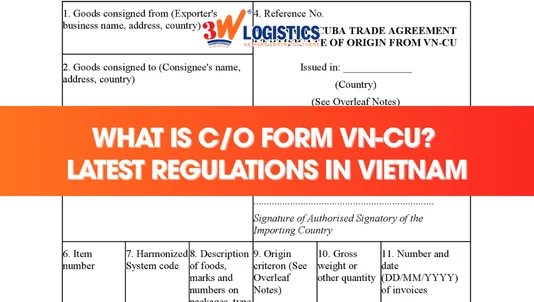
CO Form VN-CU: What Is It & How to Fill It Correctly
Exporters shipping goods from Vietnam to Cuba must present a valid CO Form VN-CU — the certificate of origin issued by Vietnam’s Ministry of Industry and Trade — to qualify for preferential tariff rates under the Vietnam–Cuba Bilateral Trade Agreement.
This guide covers everything in one place: what CO Form VN-CU is, which goods are eligible, what documents you need, and a field-by-field walkthrough of the declaration form — so your shipment clears Cuban customs without losing its tariff advantage.
1. What Is CO Form VN-CU?
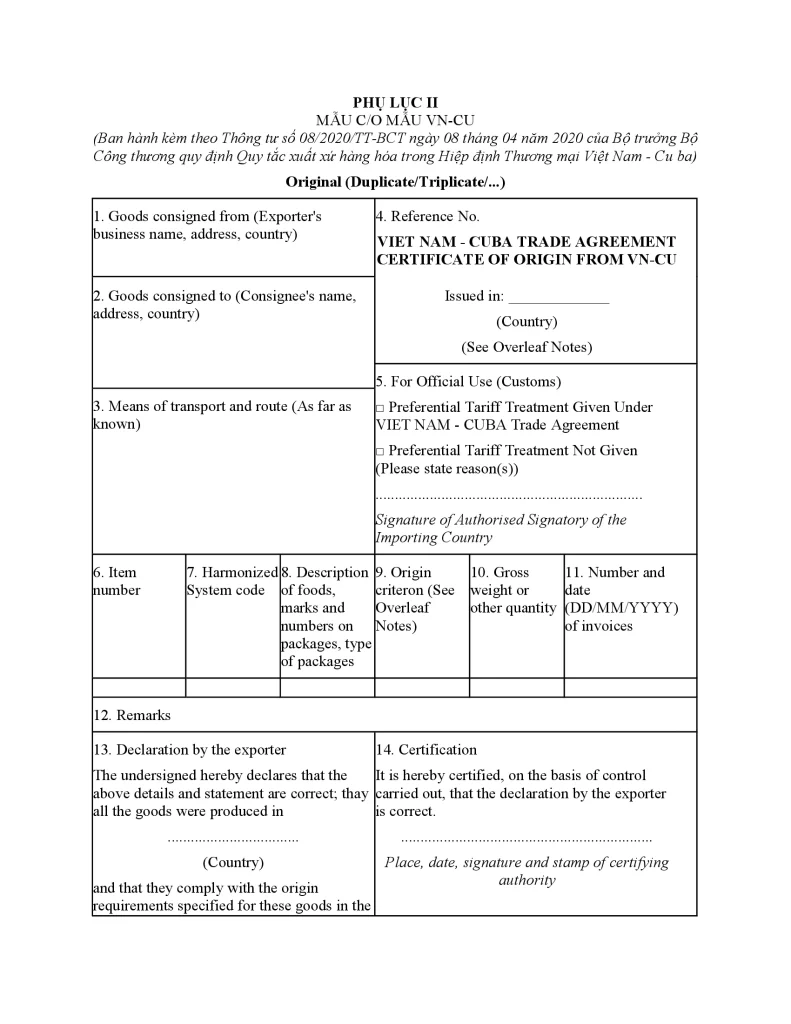
CO Form VN-CU (Certificate of Origin Form VN-CU) is an official trade document that certifies goods exported from Vietnam to Cuba meet the rules of origin defined under the Vietnam–Cuba Bilateral Trade Agreement. It serves as the legal basis for the Cuban importer to claim preferential duty rates at Cuban customs — instead of paying the standard MFN (Most Favoured Nation) tariff rate.
CO Form VN-CU is issued by the Import–Export Management Department under Vietnam’s Ministry of Industry and Trade (MOIT), or by MOIT-authorized bodies. The applicable form template, submission procedures, and origin criteria are governed by MOIT circulars on preferential certificates of origin and Decree 31/2018/NĐ-CP on rules of origin.
Note: CO Form VN-CU applies exclusively to goods exported from Vietnam to Cuba. Cuban exporters shipping goods into Vietnam use a separate C/O form issued by Cuban authorities. The two are not interchangeable.
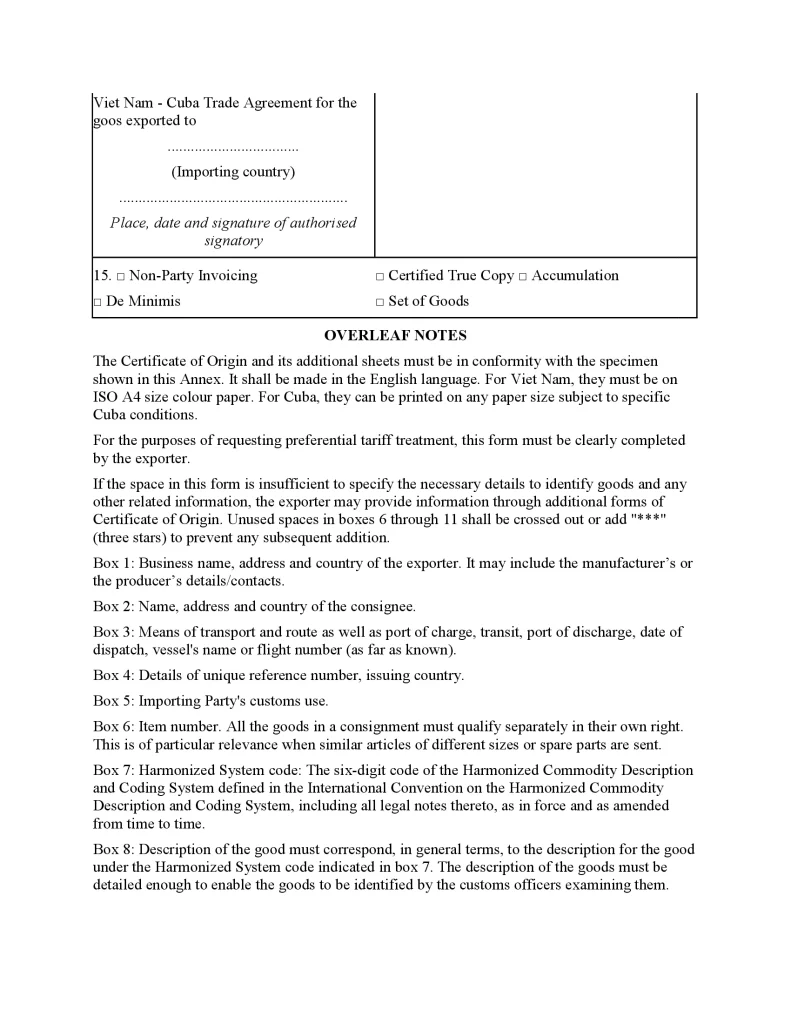
2. Legal Basis and Scope of Application
CO Form VN-CU is underpinned by the following regulatory framework:
- Vietnam–Cuba Bilateral Trade Agreement — the primary instrument establishing preferential tariff schedules and origin requirements between the two countries
- Decree 31/2018/NĐ-CP — provides detailed provisions on rules of origin for exported goods under Vietnam’s Law on Foreign Trade Management
- Relevant MOIT circulars — set out the C/O form template, application procedures, and issuing authority for each preferential market
- Bilateral origin rules — goods must either be wholly obtained in Vietnam or undergo sufficient transformation, as defined by the agreement
Scope: all goods exported from Vietnam to Cuba that fall under an eligible HS code in the preferential schedule and satisfy the applicable origin criteria. Goods that do not meet origin requirements must use a standard non-preferential C/O (Form B) and are subject to MFN tariff rates.
3. Origin Criteria for CO Form VN-CU
To qualify for CO Form VN-CU, goods must satisfy one of the following two origin criteria:
| Criterion | Definition | Typical application |
|---|---|---|
| Wholly Obtained (WO) | Goods entirely grown, harvested, extracted, or produced in Vietnam with no imported inputs | Agricultural products, minerals, seafood caught within Vietnam’s territorial waters |
| Sufficient Transformation | Goods use imported materials but meet the Change in Tariff Classification (CTC) or Regional Value Content (RVC) threshold specified in the agreement | Manufactured goods, processed foods, textiles, electronics, industrial products |
Regional Value Content (RVC) is typically calculated using the Build-Down or Build-Up method. Exporters must identify which calculation method applies to their specific HS code before preparing the declaration, as the wrong method can invalidate the claimed origin criterion.
Practical example: A Vietnamese exporter ships roasted coffee (HS 0901.22) to Cuba. The beans are grown and processed entirely in Vietnam — qualifying under the Wholly Obtained (WO) criterion. The exporter can proceed directly to CO application with standard production documentation.
4. Required Documents for CO Form VN-CU Application
Submit the following documents to the Regional Import–Export Management Department or electronically via ecosys.gov.vn:
- C/O Application Form — completed using the MOIT-prescribed template, with full shipment details
- CO Form VN-CU — one original plus two copies (or digital file for online submissions)
- Export Customs Declaration — stamped copy confirmed by the port customs authority
- Commercial Invoice — copy showing value, quantity, and description of goods
- Bill of Lading or Airway Bill — confirming the shipment is in transit or has been dispatched
- Bill of Materials (BOM) — required for manufactured goods using imported inputs; must show the proportion of domestic versus imported content
- Proof of Origin for Input Materials — purchase invoices and/or C/O documents for imported raw materials (where applicable)
- Product Catalogue or Technical Specifications — may be requested by the issuing authority to verify the nature of the goods
Note: Online submission via ecosys.gov.vn requires a registered company account with a valid digital signature. For in-person submissions at the regional office, original documents bearing the company seal are required.
Download the CO Form VN-CU template at ecosys.gov.vn
5. How to Fill in CO Form VN-CU – Field-by-Field Guide
CO Form VN-CU contains numbered fields from 1 to 14. An error in any field — even a minor discrepancy — can result in the C/O being rejected at the issuing authority or denied at Cuban customs, causing the shipment to lose its preferential tariff status.
| Field | Name | How to fill it in |
|---|---|---|
| Field 1 | Exporter | Full company name, registered address, and country (Vietnam). Must match exactly with the commercial invoice and export customs declaration |
| Field 2 | Consignee | Full name and address of the buyer or consignee in Cuba. If shipped to order, write “To Order of [bank name]” |
| Field 3 | Departure Date | Date the vessel or aircraft departs the loading port. Use DD/MM/YYYY format. Must match the Bill of Lading or Airway Bill |
| Field 4 | Vessel / Flight No. | Vessel name and voyage number (e.g. MV EVER GIVEN V.001) or flight number (e.g. VN 301). Do not leave blank |
| Field 5 | Port of Loading | Name of the Vietnamese port or airport of departure. Example: Cat Lai Port, Ho Chi Minh City or Noi Bai Airport, Hanoi |
| Field 6 | Port of Discharge | Name of the Cuban port or airport of arrival. Example: Port of Havana, Cuba |
| Field 7 | Country of Final Destination | Enter: Cuba. Do not enter a transit country (e.g. Panama) even if the shipment transits there |
| Field 8 | Item Number | Number each line item sequentially. Each distinct HS code must appear on a separate line |
| Field 9 | Marks and Numbers | Shipping marks printed on packaging or cartons. If none, write “N/M” (No Marks) |
| Field 10 | Number and Type of Packages | Example: “500 Cartons”, “20 Pallets”, “1 x 20′ FCL Container”. Must match the packing list exactly |
| Field 11 | Description of Goods | Commercial trade description plus HS code (6 digits minimum). Avoid vague terms like “general goods”. Must align with the commercial invoice description |
| Field 12 | Gross Weight or Other Quantity | State gross weight in kg or quantity in the applicable unit of measure. Must be consistent with the invoice and packing list |
| Field 13 | Number and Date of Invoice | Invoice number and date of issue. Example: “INV-2025-001 dated 10/01/2025”. Must match the original invoice exactly |
| Field 14 | Origin Criterion | Enter the applicable code: WO (Wholly Obtained), PE (Produced Entirely), or PSR with the relevant HS code and RVC percentage if claiming the Sufficient Transformation criterion |
Step 1: Gather and cross-check all supporting documents
Collect the commercial invoice, packing list, Bill of Lading, and export customs declaration before touching the form. Verify that quantities, weights, and product descriptions are 100% consistent across all documents — any discrepancy is grounds for rejection.
Step 2: Determine the origin criterion (Field 14)
This is the most critical step. Identify whether your goods qualify as Wholly Obtained (WO) or whether you need to calculate RVC. For manufactured goods with imported inputs, complete the RVC or CTC calculation before filling in Field 14 — using the wrong criterion or wrong formula is a common and serious error.
Step 3: Complete the form in English
Fill in all fields sequentially from Field 1 to Field 14. All content must be in English. Do not use correction fluid or make handwritten amendments — if an error is made, start with a new blank form. Erasures or overwriting will cause the form to be rejected.
Step 4: Sign and stamp the Exporter’s Declaration
An authorized signatory must sign in wet ink (no photocopied signatures) and affix the company seal in the Exporter’s Declaration box. This confirms the accuracy of the information declared. The form is then ready for submission to the issuing authority.
Step 5: Submit the application and collect the C/O
Submit online via ecosys.gov.vn (recommended) or in person at your regional Import–Export Management Department. Standard processing time is 1–3 working days. Urgent processing on the same day may be available for eligible shipments — confirm with your local office.
6. Common Errors When Declaring CO Form VN-CU
The following mistakes account for the majority of CO rejections and customs disputes at the Cuban border:
| Error | Consequence | How to prevent it |
|---|---|---|
| Information on the C/O does not match the invoice or Bill of Lading (quantity, weight, description) | C/O rejected at the issuing authority; Cuban customs denies preferential tariff | Cross-check all documents before completing the form. Correct the invoice or B/L first if discrepancies exist |
| Wrong origin criterion in Field 14 — e.g. declaring WO when imported materials were actually used | May be treated as origin fraud; C/O revoked and administrative or criminal penalties applied | Calculate RVC or verify CTC compliance before completing Field 14; consult a specialist if unsure |
| Mandatory fields left blank (especially Fields 4, 5, 6, 7) | C/O is invalid; entire application must be resubmitted | Complete all required fields; write “N/A” instead of leaving any field blank |
| Vague goods description in Field 11 with no HS code | Issuing authority requests supplementary information or refuses the application | State the full trade name plus 6-digit HS code (or 8-digit if required) for every line item |
| C/O issued after the vessel departure date without a retroactive issuance endorsement | C/O is considered invalid as it does not reflect the actual shipment timeline | Submit the application before or on the date of shipment. For late issuance, request the “Issued Retroactively” endorsement per MOIT regulations |
Important: A CO Form VN-CU rejected at Cuban customs means the entire shipment is subject to the standard MFN tariff rate instead of the preferential rate under the bilateral agreement. For many product categories, this tariff gap can amount to tens of thousands of USD per shipment — directly eroding the exporter’s price competitiveness in the Cuban market.
7. CO Form VN-CU vs. Other Vietnamese C/O Forms
| C/O Form | Destination Market | Agreement | Issuing Authority |
|---|---|---|---|
| CO Form VN-CU | Cuba | Vietnam–Cuba Bilateral Trade Agreement | Ministry of Industry and Trade (MOIT) |
| CO Form D | ASEAN (ATIGA) | ASEAN Trade in Goods Agreement | MOIT |
| CO Form E | China (ACFTA) | ASEAN–China Free Trade Agreement | MOIT |
| CO Form EUR.1 | European Union (EVFTA) | EU–Vietnam Free Trade Agreement | MOIT / VCCI |
| CO Form AI | India (AIFTA) | ASEAN–India Free Trade Agreement | MOIT |
| CO Form B (Standard C/O) | Non-FTA markets | Non-preferential (no tariff benefit) | VCCI |
The critical distinction: CO Form VN-CU is valid only for shipments to Cuba. No other C/O form — regardless of how the goods were produced — can substitute for it when claiming preferential tariffs under the Vietnam–Cuba agreement.
Read more: C/O Form AHK, C/O Form VK,…
8. Frequently Asked Questions (FAQ)
How long is CO Form VN-CU valid?
CO Form VN-CU is valid for 12 months from the date of issuance. The goods must be exported and arrive in Cuba within this period. A CO that has expired before the shipment reaches Cuban customs will not be accepted for preferential tariff treatment.
Can a first-time exporter apply for CO Form VN-CU?
Yes. First-time applicants must register as an exporter with their regional Import–Export Management Department and create an account on ecosys.gov.vn. Once registered, the company can submit C/O applications online for all subsequent shipments.
Can CO Form VN-CU be issued after the goods have already been shipped?
Yes, under a retroactive issuance procedure. The issuing authority will endorse the C/O with “Issued Retroactively.” However, not all Cuban customs offices accept retroactively issued C/Os — exporters should confirm this in advance with the Cuban importer before relying on this option.
If goods transit through a third country (e.g. Panama), does CO Form VN-CU remain valid?
The C/O remains valid provided the goods are not processed or transformed in the transit country, and continuous transit can be demonstrated with a Through Bill of Lading. The exporter may need to provide additional transit documentation to confirm that the goods’ origin was not altered en route.
What are the penalties for declaring the wrong origin criterion in Field 14?
Incorrectly declaring the origin criterion may constitute a violation of Vietnam’s rules-of-origin regulations. Penalties range from administrative fines and C/O revocation to reputational damage affecting future export approvals. Intentional origin fraud can result in criminal liability under Vietnamese law.
Does the Cuban importer need the original CO Form VN-CU or is a copy sufficient?
Cuban customs generally requires the original C/O to grant preferential tariff treatment. Copies may be used for internal filing or LC documentation purposes but do not substitute for the original in the import customs process in Cuba.
Summary – Key Steps to Obtain a Valid CO Form VN-CU
- Verify origin eligibility: confirm your goods qualify as Wholly Obtained (WO) or calculate the RVC/CTC compliance before starting the application.
- Prepare a complete document set — commercial invoice, B/L, export customs declaration, BOM — and cross-check that all figures are consistent across every document.
- Complete the CO Form VN-CU accurately, paying particular attention to Field 11 (goods description + HS code) and Field 14 (origin criterion).
- Submit your application via ecosys.gov.vn or at the regional MOIT office before the shipment departure date to ensure timely C/O issuance.
This article is compiled based on Decree 31/2018/NĐ-CP on rules of origin for exported goods, MOIT circulars on the issuance of preferential certificates of origin, and the provisions of the Vietnam–Cuba Bilateral Trade Agreement.
3W Logistics – Your C/O Advisory and Export Customs Partner for Cuba
Preparing CO Form VN-CU without in-depth knowledge of origin rules and submission procedures is a fast track to errors, delays, and lost tariff advantages — with a financial impact that can run to tens of thousands of USD per shipment. 3W Logistics is a leading Vietnamese logistics and customs service provider with a dedicated team of C/O specialists who handle hundreds of origin documentation cases each year for exporters across all industries.
- C/O and export customs expertise: 3W Logistics has specialists trained in Vietnam’s full range of preferential origin frameworks — from Form D and Form E to CO Form VN-CU. We help exporters determine the correct origin criterion, calculate RVC where required, and prepare error-free documentation from the first submission.
- Global freight network and NVOCC capability: As a licensed NVOCC (Non-Vessel Operating Common Carrier), 3W Logistics operates ocean freight services from Vietnam to Latin America, including transhipment routes serving Cuban ports. Exporters benefit from competitive freight rates and reliable sailing schedules to their destination.
- Fast processing — reduced ancillary costs: 3W Logistics coordinates tightly between its documentation and customs teams to ensure CO Form VN-CU is issued before vessel departure, eliminating delays that trigger DEM/DET charges. Average C/O processing time for eligible shipments is reduced to 1 working day.
If your business needs expert support with CO Form VN-CU declaration, export customs clearance for Cuba, or an end-to-end freight solution, contact 3W Logistics today for a complimentary consultation.
Contact 3W Logistics – Free Consultation
CONTACT INFORMATION:
Head Office – 3W Logistics Ho Chi Minh City Branch
Address: 34 Bach Dang Street, Tan Son Hoa Ward, Ho Chi Minh City
Hotline: +84 28 3535 0087
3W Logistics Hanoi Branch
Address: 81A Tran Quoc Toan Street, Cua Nam Ward, Hanoi
Hotline: +84 24 3202 0482
3W Logistics Hai Phong Branch
Address: 8A Lot 28 Le Hong Phong Street, Gia Vien Ward, Hai Phong
Hotline: +84 225 355 5939
3W LOGISTICS CO., LTD – We here serve you there!
Email: quote@3w-logistics.com
Website: www.3w-logistics.com

Hello, I’m Nguyen Phuong Nhan (Ms. Nina)
I currently serve as Trade Lanes Supervisor at 3W Logistics, with more than 10 years of experience in international logistics and freight forwarding.
My primary responsibility is developing and managing global logistics partnerships, building strategic trade lanes, and working closely with overseas agents to provide reliable and competitive transportation solutions for customers.
I regularly collaborate with agents and logistics partners worldwide to explore new business opportunities, negotiate freight rates, develop trade routes, and support import-export shipments. I also work closely with our sales team to design logistics solutions tailored to specific markets and customer requirements.
My expertise includes Ocean Freight, Air Freight, Trade Lane Development, Global Agent Network Management, International Logistics Solutions, and Import-Export Support.
Through the articles I share on the 3W Logistics website, I aim to provide practical insights into the international logistics industry, global transportation trends, overseas agent cooperation, and effective logistics strategies that help businesses optimize their supply chain operations.
I believe that strong global partnerships and well-developed trade lanes are essential to delivering sustainable logistics solutions and long-term value to customers worldwide.


