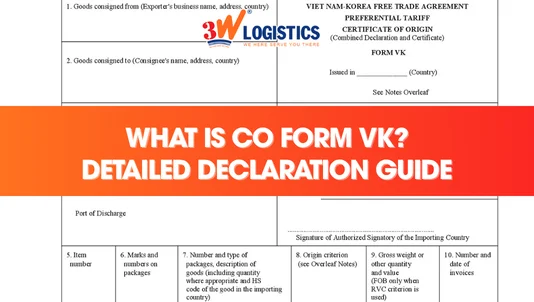
What is CO Form VK? Requirements, Process & Origin Rules
What is CO Form VK? This is a common question among Vietnamese import-export businesses looking to take advantage of the benefits offered under the Vietnam–Korea Free Trade Agreement (VKFTA). Since the VKFTA came into effect, thousands of tariff lines have been reduced or eliminated entirely — but only for goods accompanied by a valid certificate of origin.
This article provides a comprehensive guide to C/O Form VK, including its definition, scope of application, origin criteria, required documentation, application procedures, and common mistakes businesses should avoid when applying for it.
1. What is CO Form VK?
CO Form VK (Certificate of Origin Form VK) is a certificate of origin issued under the Vietnam–Korea Free Trade Agreement (VKFTA), which entered into force on December 20, 2015. The abbreviation “VK” stands for Vietnam – Korea.
C/O Form VK is issued by organizations authorized by the Vietnamese Ministry of Industry and Trade. It is a mandatory document for goods exported from Vietnam to South Korea to qualify for preferential tariff treatment under the VKFTA instead of the standard MFN (Most-Favored Nation) tariff rates.
Practical Example: A Vietnamese company exports frozen shrimp to South Korea. Without a valid C/O Form VK, the shipment may be subject to an MFN tariff of up to 20%. With a properly issued C/O Form VK, the tariff rate may be reduced to 0%, saving tens of thousands of dollars per container.
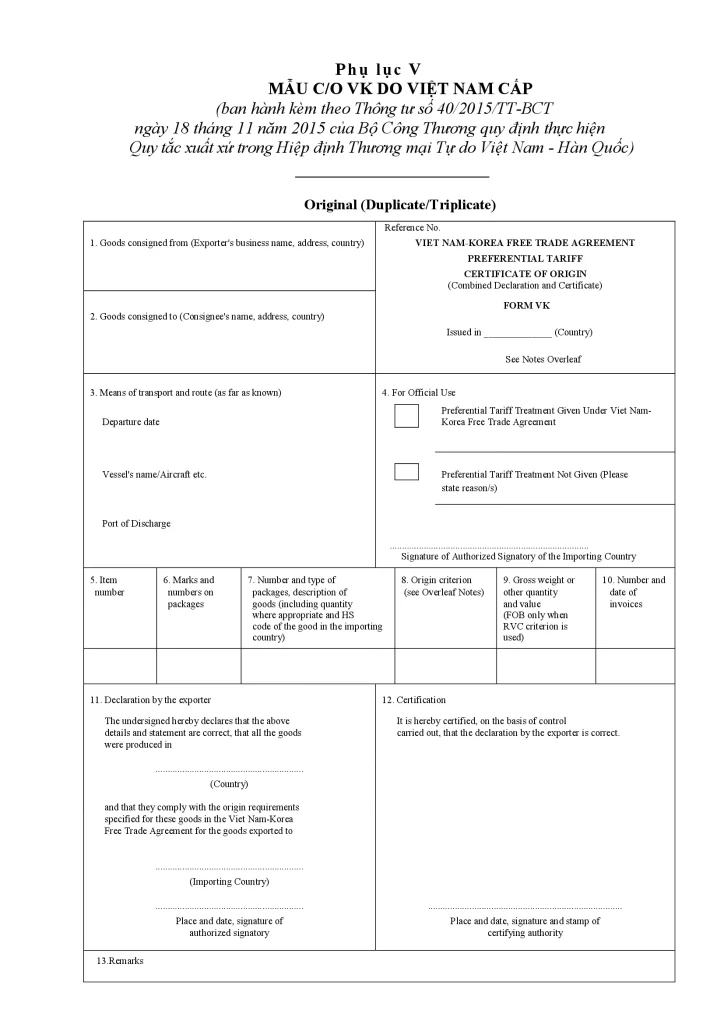
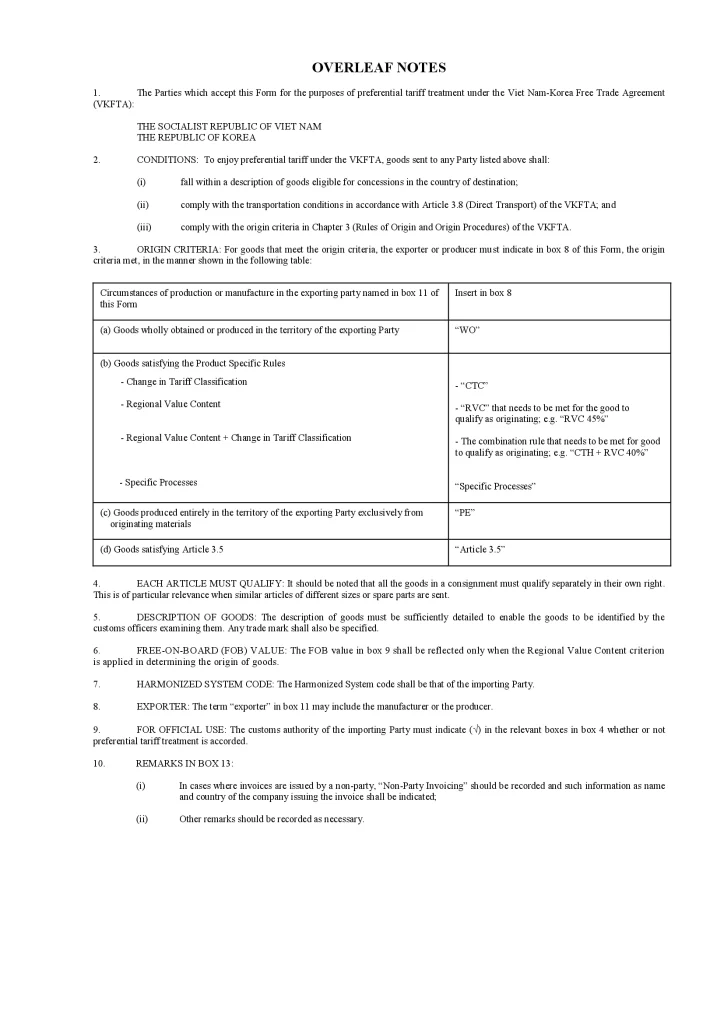
Download the VK Certificate of Origin Form Here
2. Scope of Application and Eligible Users of CO Form VK
C/O Form VK applies to goods exported from Vietnam to South Korea under the VKFTA framework. It is a separate bilateral agreement from the AKFTA (ASEAN–Korea Free Trade Agreement, which uses C/O Form AK), and the two certificates are not interchangeable.
| Comparison Criteria | C/O Form VK | C/O Form AK |
|---|---|---|
| Agreement | VKFTA (Vietnam – Korea) | AKFTA (ASEAN – Korea) |
| Effective Date in Vietnam | 20/12/2015 | 01/01/2010 |
| Tariff Reduction Level | More extensive, many tariff lines reduced to 0% | Moderate, some tariff lines remain subject to duties |
| Origin Criteria | WO, CTH, RVC ≥ 40% or CC | WO, CTH, RVC ≥ 40% |
| Issuing Authority | Ministry of Industry and Trade (VCCI, Import-Export Management Offices) | Ministry of Industry and Trade |
| Self-Certification of Origin | Not widely implemented | Not widely implemented |
Businesses should carefully review the VKFTA tariff schedule for each HS code to determine which type of C/O offers the most favorable tariff treatment before submitting their application.
Learn More: What is CO?, CO Form CPTPP, CO Form VN-CU, and more.
3. Origin Criteria for Obtaining CO Form VK
Goods must satisfy at least one of the origin criteria specified under Circular No. 40/2015/TT-BCT and the Product Specific Rules (PSR) annexed to the VKFTA. There are three primary origin criteria:
3.1 Wholly Obtained (WO)
The entire production, extraction, cultivation, or harvesting process takes place in Vietnam. This criterion mainly applies to agricultural products, seafood, minerals, live animals and plants, and products derived from them.
3.2 Regional Value Content (RVC)
The proportion of regional value originating from ASEAN member states and South Korea must account for at least 40% of the product’s value. This can be calculated using either the Build-Down or Build-Up method. This is the most commonly used criterion for industrial and processed consumer goods.
3.3 Change in Tariff Classification (CTC)
The finished product must be classified under a different HS code from the non-originating materials used in its production. The required level of tariff shift may be at the chapter level (CC – 2 digits), heading level (CTH – 4 digits), or subheading level (CTSH – 6 digits), depending on the applicable PSR for each product.
Important Note: Certain products may be subject to combined criteria (e.g., RVC + CTC) or special product-specific requirements. Businesses should always review the PSR applicable to the product’s six-digit HS code before declaring origin to avoid C/O rejection or potential tariff reassessments.
4. Required Documents for Applying for CO Form VK
The application dossier for C/O Form VK must be submitted to the regional Import-Export Management Office under the Ministry of Industry and Trade or through the electronic system at ecosys.gov.vn. The required documents include:
- Application Form for C/O Issuance (completed according to the prescribed format with full shipment details)
- Completed C/O Form VK (01 original and 02 copies)
- Export Customs Declaration (company-stamped copy or electronic declaration printed from the VNACCS system)
- Commercial Invoice (company-stamped copy)
- Bill of Materials / Production Norms (required if applying under RVC or CTC criteria)
- Import Customs Declarations for Raw Materials (if imported materials are used, company-stamped copies)
- Bill of Lading / Airway Bill (copy) to prove direct consignment
- RVC Calculation Sheet (if applying under the RVC criterion, prepared and signed by the exporter)
Note: The issuing authority may request additional supporting documents during the review process. Businesses should prepare sales contracts, packing lists, and supporting documents proving the origin of input materials for verification purposes.
5. Step-by-Step Process for Obtaining CO Form VK
The C/O Form VK application process is carried out through the eCOSys system (ecosys.gov.vn) or by direct submission to the Import-Export Management Office. Processing time is generally 4–8 working hours if the dossier is complete.
Step 1: Register an Account and Declare Manufacturer Information
Businesses must register an account on ecosys.gov.vn. First-time applicants are required to submit manufacturer information and production capability documents to the issuing authority.
Step 2: Create a C/O Application on the System
Log in to eCOSys, select C/O Form VK, and complete the shipment details, including HS code, quantity, value, destination port, and Korean buyer information. Upload all required supporting documents.
Step 3: Submit the Application and Await Approval
Submit the electronic dossier through the system. Reviewing officers may request additional information through eCOSys or by phone. Businesses can monitor application status directly through their eCOSys account.
Step 4: Receive the C/O and Verify Information Before Shipment
Once approved, businesses receive the original C/O (either in person or by mail, depending on registration preferences). Carefully verify all information, especially the HS code, product description, exporter, and importer details before including it in the shipping document package.
Step 5: Submit the C/O to the Korean Importer
The original C/O Form VK must be sent together with the shipping documents to the Korean importer. The importer submits the C/O during customs clearance in South Korea to obtain VKFTA preferential tariff treatment.
Practical Example: A garment manufacturer in Binh Duong exports 5,000 jackets to Seoul. The application dossier is submitted through eCOSys at 8:00 AM and approved by 4:00 PM the same day, allowing the company to include the C/O in the shipping documents before the carrier’s manifest cut-off time.
6. How to Complete CO Form VK – Key Fields
C/O Form VK contains several mandatory information fields. Incorrect or incomplete information may result in rejection of the certificate or denial of preferential tariff treatment in South Korea.
| Box No. | Required Information | Important Notes |
|---|---|---|
| Box 1 | Exporter Name and Address | Must match the Invoice and Customs Declaration |
| Box 2 | Consignee Name and Address | Provide the complete address in South Korea |
| Box 3 | Means of Transport and Route | Indicate vessel/flight number, port of loading, and port of discharge |
| Box 4 | For Official Use | Leave blank for the issuing authority |
| Box 5 | Item Number | Use consecutive numbering if multiple products are listed |
| Box 6 | Marks and Numbers of Packages | Must match the Packing List |
| Box 7 | Quantity, Type of Packages, and Product Description | Description should be detailed enough to identify the HS code |
| Box 8 | HS Tariff Number | Use the current 6-digit HS Code |
| Box 9 | Gross Weight or Other Quantity | Units must be consistent with the Invoice |
| Box 10 | Invoice Number and Date | Must exactly match the actual Invoice |
| Box 11 | Origin Criterion | Clearly state WO / RVC / CTH / CTSH or combined criteria |
| Box 12 | Exporter Declaration | Signed, stamped, and dated |
| Box 13 | C/O Issuing Authority Certification | Leave blank for the issuing authority |
Note: Box 11 (Origin Criterion) is the most common source of errors. Many exporters incorrectly declare “WO” even when imported materials are used. Such misdeclarations may constitute origin fraud and could result in legal penalties.
7. Validity Period and Direct Consignment Requirements
C/O Form VK is valid for 12 months from the date of issuance. After expiration, Korean importers can no longer use it to claim VKFTA tariff preferences.
The Direct Consignment Rule requires goods to be transported directly from Vietnam to South Korea without undergoing commercial processing in a third country. If goods transit through an intermediate port (such as Singapore or Hong Kong), the following documents may be required:
- A Through Bill of Lading from Vietnam to South Korea
- Certification from the customs authority of the transit country confirming that the goods were not altered or further processed
- Warehouse entry/exit customs declarations at the transit port (if the shipment was split)
Practical Example: A furniture shipment exported from Hai Phong transits through Singapore before arriving in Busan. The exporter provides a Through Bill of Lading and a confirmation from the Singapore port authority stating that the goods remained in temporary storage without alteration. The C/O remains valid under VKFTA rules.
8. Common Mistakes When Applying for CO Form VK
| Common Error | Consequence | Solution |
|---|---|---|
| Incorrect HS Code compared with Invoice and Customs Declaration | C/O rejected; preferential treatment denied | Verify the correct HS code and ensure consistency across documents |
| Incorrect Origin Criterion | Potential duty reassessment and penalties | Calculate RVC accurately or verify PSR requirements before declaring |
| Exporter Name/Address Inconsistent with Invoice | C/O rejected by Korean Customs | Use the full legal company name exactly as registered |
| C/O Submitted More Than 3 Days After Export | May be treated as a retroactive C/O requiring additional explanation | Prepare documents before vessel departure and submit promptly |
| Transit Through a Third Country Without Supporting Documents | Violation of direct consignment requirements; C/O invalidated | Obtain a Through Bill of Lading and transit confirmation documents |
| Authorized Signature Does Not Match Registered Specimen | Application returned for correction | Keep signature records updated with the issuing authority |
9. Retroactive Issuance and Reissuance of CO Form VK
If a business is unable to obtain a C/O before or at the time of export, it may apply for a Retroactive C/O within 12 months from the export date, provided there is a valid reason and sufficient supporting evidence. The certificate will be marked “ISSUED RETROACTIVELY” in Box 4.
If the original C/O is lost or damaged, a Certified True Copy may be requested from the original issuing authority. The certified copy carries the same legal validity as the original and will be marked “CERTIFIED TRUE COPY”.
10. Frequently Asked Questions About CO Form VK (FAQ)
What is the difference between CO Form VK and CO Form AK?
C/O Form VK is issued under the Vietnam–Korea Free Trade Agreement (VKFTA), a bilateral agreement between Vietnam and South Korea that entered into force in 2015. C/O Form AK, on the other hand, is issued under the ASEAN–Korea Free Trade Agreement (AKFTA), a multilateral agreement effective since 2010. These two certificates are not interchangeable. For a specific product, exporters should compare the preferential tariff rates available under both agreements and choose the more advantageous option.
Who can apply for CO Form VK?
Any Vietnamese enterprise whose products meet the VKFTA rules of origin may apply for C/O Form VK. Businesses must register an account on the eCOSys system and complete the initial manufacturer declaration process before submitting applications.
How long does it take to obtain CO Form VK?
Under normal circumstances, the processing time is approximately 4–8 working hours if all documents are complete and there are no issues related to origin verification. If an on-site inspection of the manufacturing facility is required, the process may take 1–3 working days.
Can CO Form VK be issued after the goods have already been exported?
Yes. Exporters may apply for a retroactive C/O within 12 months from the export date, provided they can demonstrate a valid reason, such as force majeure events or technical issues. In such cases, the certificate will be marked “ISSUED RETROACTIVELY” and may require additional explanation during customs clearance in South Korea.
Will transshipment through Singapore or Hong Kong affect the validity of CO Form VK?
No. The certificate remains valid as long as the shipment is covered by a Through Bill of Lading from Vietnam to South Korea and supporting documentation from the transit country’s customs authority or port operator confirms that the goods were not altered, processed, or commercially handled during transit. Failure to provide such documents may result in a violation of the direct consignment requirement and invalidate the C/O.
Can one CO Form VK be used for multiple shipments?
No. Each CO Form VK is issued for one specific shipment associated with a particular commercial invoice. Separate certificates must be obtained for each export shipment.
Which system should businesses use to register a trader profile and apply for CO Form VK for the first time?
At present, applications for C/O Form VK are still processed through the current eCOSys platform. However, first-time trader registration must be completed through the Ministry of Industry and Trade’s Public Service Portal at dichvucong.moit.gov.vn. Once the trader profile has been approved, businesses may proceed with submitting C/O Form VK applications through eCOSys.
If a product is exported under the RVC criterion, can locally sourced materials listed in Appendix X and meeting only the CTH criterion still be treated as originating materials?
Yes. The origin criterion applied to materials listed in Appendix X does not necessarily have to be the same as the origin criterion applied to the finished product under C/O Form VK. If locally sourced materials satisfy the CTH requirement under Appendix X, they are considered originating materials and may be used in the origin calculation of the exported product.
Conclusion – Key Points to Remember About CO Form VK
To fully benefit from VKFTA tariff preferences through C/O Form VK, businesses should follow these four essential steps:
- Determine the correct origin criterion for each product’s HS code (WO, RVC ≥40%, CTH, CTSH, etc.) based on the applicable Product Specific Rules (PSR) under the VKFTA before production begins.
- Prepare all supporting documents, including customs declarations, commercial invoices, bills of materials, and RVC calculations where applicable, ensuring that all information is consistent across documents.
- Submit applications through eCOSys as early as possible, preferably before the carrier’s manifest cut-off time, to avoid the need for retroactive issuance and additional administrative procedures.
- Carefully verify the issued C/O before sending it to the importer, paying particular attention to the HS code, origin criterion (Box 11), exporter/importer details, and invoice information.
This article is based on Circular No. 40/2015/TT-BCT of the Ministry of Industry and Trade, the Vietnam–Korea Free Trade Agreement (VKFTA), and current regulations governing rules of origin.
3W Logistics – CO Application and Export Customs Services for South Korea
Errors in C/O Form VK documentation can result not only in the loss of preferential tariff benefits but also in duty reassessments, administrative penalties, and reputational risks with Korean trading partners. 3W Logistics is a professional logistics provider with more than 10 years of experience handling Vietnam–Korea import-export documentation. We support businesses throughout the entire process, from determining the appropriate origin criterion to obtaining a valid C/O certificate.
- Experienced Origin Compliance Specialists: We provide consultation on origin determination for specific products, including WO, RVC, and CTH criteria. Our team also assists with RVC calculations, manufacturer capability dossiers, and internal training programs for C/O management.
- Extensive Vietnam–Korea Transportation Network: Leveraging our NVOCC capabilities and strong relationships with major shipping lines operating between Hai Phong/Ho Chi Minh City and Busan/Incheon, we help ensure compliant Through Bills of Lading and provide support for direct consignment documentation when shipments transit through third countries.
- Fast Processing and Reduced Customs Risks: With experience handling hundreds of C/O Form VK applications annually, we help shorten processing times, often obtaining certificates within the same day while minimizing the risk of DEM/DET charges caused by documentation delays.
If your business requires assistance with C/O Form VK applications or export procedures to South Korea, contact 3W Logistics today for comprehensive consultation and end-to-end logistics solutions.
CONTACT INFORMATION
3W Logistics – Ho Chi Minh City Headquarters
Address: 34 Bach Dang Street, Tan Son Hoa Ward, Ho Chi Minh City, Vietnam
Hotline: +84 28 3535 0087
3W Logistics – Hanoi Branch
Address: 81A Tran Quoc Toan Street, Cua Nam Ward, Hanoi, Vietnam
Hotline: +84 24 3202 0482
3W Logistics – Hai Phong Branch
Address: 8A Lot 28 Le Hong Phong Street, Gia Vien Ward, Hai Phong, Vietnam
Hotline: +84 225 355 5939
3W LOGISTICS CO., LTD – We Here Serve You There!
Email: quote@3w-logistics.com
Website: www.3w-logistics.com

Hello, I’m Nguyen Phuong Nhan (Ms. Nina)
I currently serve as Trade Lanes Supervisor at 3W Logistics, with more than 10 years of experience in international logistics and freight forwarding.
My primary responsibility is developing and managing global logistics partnerships, building strategic trade lanes, and working closely with overseas agents to provide reliable and competitive transportation solutions for customers.
I regularly collaborate with agents and logistics partners worldwide to explore new business opportunities, negotiate freight rates, develop trade routes, and support import-export shipments. I also work closely with our sales team to design logistics solutions tailored to specific markets and customer requirements.
My expertise includes Ocean Freight, Air Freight, Trade Lane Development, Global Agent Network Management, International Logistics Solutions, and Import-Export Support.
Through the articles I share on the 3W Logistics website, I aim to provide practical insights into the international logistics industry, global transportation trends, overseas agent cooperation, and effective logistics strategies that help businesses optimize their supply chain operations.
I believe that strong global partnerships and well-developed trade lanes are essential to delivering sustainable logistics solutions and long-term value to customers worldwide.


