

CO Form CPTPP in Vietnam: Procedures & Declaration Guide
Since the Comprehensive and Progressive Agreement for Trans-Pacific Partnership (CPTPP) entered into force for Vietnam on January 14, 2019, thousands of tariff lines have been eliminated or significantly reduced across the markets of its 11 partner member countries. However, to benefit from these preferential tariff rates, businesses must possess a valid certificate of origin. Therefore, understanding what is a CPTPP Certificate of Origin (CO Form CPTPP) is the first essential step for exporters.
This article provides a comprehensive overview of the CPTPP Certificate of Origin (CO Form CPTPP), including its definition, key differences from traditional certificates of origin, origin criteria, required documents, application procedures, and common mistakes—helping businesses prepare compliant export documentation from their very first shipment.
1. What Is CO Form CPTPP?
CO Form CPTPP is a certificate of origin used under the Comprehensive and Progressive Agreement for Trans-Pacific Partnership (CPTPP). It serves as legal proof that goods qualify for preferential tariff treatment when exported to CPTPP member countries.
One of the key features that distinguishes CO Form CPTPP from traditional certificates of origin is that the agreement allows two methods of origin certification:
- Certificate of Origin issued by a competent authority (traditional C/O).
- Self-certification of origin, issued directly by an eligible exporter or producer.
Practical Example: A Vietnamese garment manufacturer exports jackets to Canada, a CPTPP member country. If the products satisfy CPTPP origin requirements and the exporter is approved for self-certification, the company may issue an origin declaration directly on the commercial invoice instead of applying for a traditional C/O from a government authority, significantly reducing processing time.
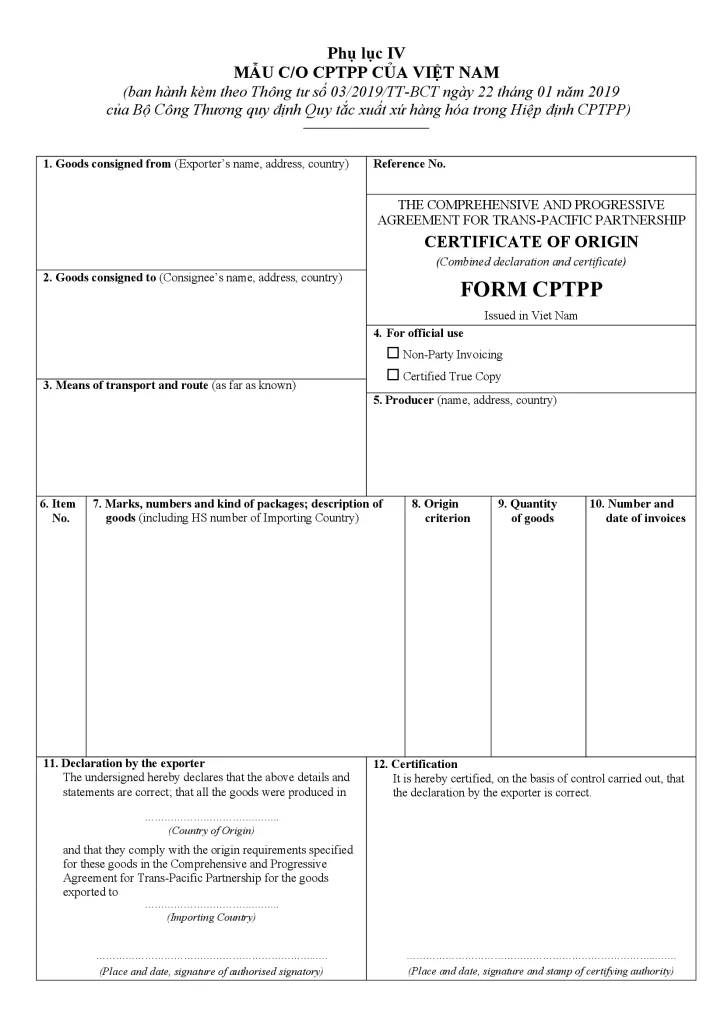
Download the CPTPP Certificate of Origin Template Here
2. Which Countries Are Members of CPTPP?
CPTPP currently has 12 member countries (including the United Kingdom, which officially joined in 2024). Vietnamese exporters can use CO Form CPTPP to claim preferential tariff treatment when exporting to the other 11 member countries.
| Region | CPTPP Member Countries | Effective Date for Vietnam |
|---|---|---|
| Oceania | Australia, New Zealand | January 14, 2019 |
| Americas | Canada, Mexico, Peru, Chile | January 14, 2019 |
| Asia | Japan, Singapore, Malaysia, Brunei | January 14, 2019 |
| Asia-Pacific | Vietnam | January 14, 2019 (7th member to ratify) |
| Europe | United Kingdom | December 15, 2024 (12th member) |
Note: Tariff reduction schedules and eligible product categories may vary among CPTPP member countries. Exporters should review the applicable CPTPP tariff schedule between Vietnam and the destination market to determine the actual benefits available.
3. Origin Certification Methods Under CPTPP
Unlike most earlier free trade agreements, CPTPP provides two parallel mechanisms for proving the origin of goods. Businesses may choose the method that best suits their export operations and compliance capabilities.
| Criteria | Authority-Issued Certificate of Origin | Self-Certification of Origin |
|---|---|---|
| Issuing Party | Ministry of Industry and Trade (via eCOSys) | Eligible exporter or producer |
| Eligibility Requirements | Available to all exporters | Approved exporters meeting regulatory requirements |
| Supporting Document | Original Certificate of Origin (C/O) | Origin declaration on invoice or commercial document |
| Processing Time | Approximately 4–8 working hours | Issued immediately by the exporter |
| Best Suited For | New or occasional exporters | Frequent exporters with large shipment volumes |
| Value Limitation | No limit | No limit (after approval) |
Related Reading:
What Is a Certificate of Origin (C/O)?,
What Is CO Form VK?, What is CO Form X?,and other certificate of origin forms.
4. Origin Criteria for Obtaining a CPTPP Certificate of Origin
Goods must satisfy the origin requirements stipulated in Circular 03/2019/TT-BCT and the CPTPP Rules of Origin Annex. There are four primary origin criteria:
4.1 Wholly Obtained (WO)
The goods are entirely obtained, harvested, extracted, or produced within a CPTPP member country. This criterion commonly applies to agricultural products, seafood, minerals, and products manufactured entirely from domestic materials.
4.2 Regional Value Content (RVC)
The proportion of value originating from CPTPP member countries must meet the minimum threshold specified for each product category—typically RVC ≥ 40% using the Build-Down method or RVC ≥ 30% using the Net Cost method. This is the most common criterion for industrial products, electronics, and consumer goods.
4.3 Change in Tariff Classification (CTC)
The finished product must be classified under a different HS code than the non-originating materials used in its production. The required change may be at the chapter (CC), heading (CTH), or subheading (CTSH) level, depending on the Product-Specific Rules (PSRs) applicable to the product.
4.4 Specific Process (SP)
Certain products, such as textiles, chemicals, and some processed food products, are subject to specific manufacturing requirements. Particular production processes must be performed within the territory of one or more CPTPP member countries.
Important Note for Textile Products: CPTPP applies the “Yarn-Forward” rule, meaning that the yarn, fabric, and final garment must all originate from CPTPP member countries. This requirement is stricter than those found in many other free trade agreements. Exporters should carefully review their upstream supply chain before applying for a CPTPP Certificate of Origin.
5. Documents Required for a CPTPP Certificate of Origin Application
Applications may be submitted through the eCOSys system or directly to the Regional Import-Export Management Offices under the Ministry of Industry and Trade. The application dossier generally includes:
- Application Form for Certificate of Origin, completed with shipment details and the applicable origin criterion.
- Completed CPTPP Certificate of Origin Form (one original and two copies, either typed or generated from the electronic system).
- Export Customs Declaration (certified copy or electronic declaration printed from VNACCS).
- Commercial Invoice (certified copy).
- Bill of Lading or Air Waybill (copy proving direct shipment to a CPTPP member country).
- Bill of Materials and Production Consumption Report (required when applying under RVC or CTC criteria).
- Import Customs Declarations for Raw Materials (if imported materials are used).
- Regional Value Content (RVC) Calculation Sheet signed and certified by the exporter (if applicable).
- Evidence of Manufacturing Processes (for SP criterion applications, such as process descriptions or production flowcharts).
Note: First-time applicants must also submit a Manufacturer Declaration package, including a business registration certificate, manufacturing process description, and sample product information. For subsequent applications, only shipment-specific documents are generally required unless there have been significant changes.
6. CPTPP Certificate of Origin Application Procedure
The entire process can be completed through the eCOSys system (ecosys.gov.vn) or by submitting physical documents to the Regional Import-Export Management Offices. Processing typically takes 4–8 working hours when all required documents are complete and accurate.
Step 1: Register an Account and Declare Manufacturer Information
The exporter creates an account on eCOSys and submits manufacturer information during the initial registration process. Authorities may review the manufacturer’s production capability and, in some cases, conduct an on-site inspection.
Step 2: Determine the Applicable Origin Criterion and Prepare Documents
Review the CPTPP Product-Specific Rules (PSRs) based on the product’s HS code to identify the applicable criterion (WO, RVC, CTC, or SP). Calculate RVC if required, prepare the bill of materials, and gather all supporting documents before the shipping manifest cutoff time.
Step 3: Create and Submit the Application Through eCOSys
Log in to eCOSys, select the CPTPP Certificate of Origin option, and complete all shipment information, including HS code, quantity, FOB value, destination port, and importer details. Upload scanned supporting documents in the required format.
Step 4: Monitor the Review Process and Provide Additional Documents if Requested
Reviewing officers may request supplementary documentation through the system. Exporters should regularly monitor their application status and respond promptly to avoid delays.
Step 5: Receive the Certificate of Origin and Verify All Information
Upon approval, obtain the original Certificate of Origin and carefully verify all information, particularly the HS code, origin criterion, exporter/importer details, and invoice number, before including it in the shipping document package.
Step 6: Importer Submits the Certificate to Destination Customs
The importer presents the CPTPP Certificate of Origin to customs authorities in the importing member country to claim preferential tariff treatment. Customs authorities may request origin verification from the Vietnamese issuing authority within three years of issuance.
Practical Example: A seafood processor in Can Tho exports pangasius fillets to Mexico. The shipment qualifies under the WO criterion and the application is submitted through eCOSys at 8:00 AM. The Certificate of Origin is approved by 2:00 PM the same day, allowing the exporter to send the original document to its freight agent in Ho Chi Minh City before the carrier’s manifest cutoff.
7. How to Complete a CPTPP Certificate of Origin
The CPTPP Certificate of Origin follows a structure similar to other FTA certificates of origin but includes additional fields related to origin criteria and reference declarations. Errors in the fields below are among the most common reasons for C/O rejection.
| Field | Required Information | Completion Notes |
|---|---|---|
| Exporter | Full name and address of the exporter | Must match exactly with the Commercial Invoice and Customs Declaration |
| Producer | Name and address of the manufacturer (if different from the exporter) | “Available Upon Request” may be used for legitimate commercial confidentiality reasons |
| Importer | Name and address of the importer in the CPTPP member country | Must be completed in full and match the Commercial Invoice |
| Description of Goods | Detailed description of the goods | Must be sufficient to identify the HS code; avoid generic trade names |
| HS Tariff Classification | 6-digit HS code of the exported goods | Must comply with the current HS system and match customs documents |
| Origin Criterion | Applicable origin criterion | Clearly indicate: A (WO) / B (RVC%) / C (CTC) / D (SP) |
| Invoice Number & Date | Commercial invoice number and issuance date | Must exactly match the invoice included in the shipping documents |
| Blanket Period | Validity period for a Blanket Certificate of Origin (if applicable) | Maximum of 12 months; suitable only when goods and origin conditions remain unchanged |
| Certification | Declaration and signature of the authorized signatory | Signature, title, and date must match the registered signature specimen |
Important Note Regarding the “Origin Criterion” Field: CPTPP uses the symbols A/B/C/D instead of WO/RVC/CTH commonly used in other FTAs. Specifically, A = Wholly Obtained; B = Regional Value Content (specify percentage); C = Change in Tariff Classification; D = Specific Process. Incorrect use of these codes is one of the most common reasons applications are returned for correction.
8. CPTPP Self-Certification of Origin
Self-Certification of Origin is one of the most significant innovations introduced by CPTPP. It allows approved exporters or producers to issue origin declarations directly without obtaining a traditional Certificate of Origin from a government authority.
8.1 Requirements for Self-Certification
- The company must be approved by the Ministry of Industry and Trade as an Approved Exporter.
- An internal origin control system must be in place to ensure full traceability.
- No record of origin-related violations within the previous three years.
- A commitment to assume full legal responsibility for the accuracy of origin declarations.
8.2 How to Issue a Self-Certification Declaration
The origin declaration may be printed directly on the Commercial Invoice, Packing List, or any accompanying commercial document. The declaration must include:
- Name and address of the exporter or producer
- Description of the goods and corresponding HS code
- Applicable origin criterion (A/B/C/D)
- Approved Exporter authorization number (if applicable)
- Date and signature of the authorized representative
Note: False origin declarations may result in retroactive duty collection, administrative penalties, and revocation of self-certification privileges. Exporters must retain all supporting origin documentation for at least five years for verification purposes.
9. Common Mistakes When Applying for a CPTPP Certificate of Origin
| Common Error | Consequence | Recommended Solution |
|---|---|---|
| Incorrect origin criterion code (A/B/C/D) | Application returned and reissuance required | Verify the applicable PSR for the 6-digit HS code before submission |
| HS code differs from customs declaration or invoice | Certificate rejected by destination customs authorities | Ensure all documents use the same 6-digit HS code |
| Failure to meet the Yarn-Forward rule (textiles) | Retroactive duties and origin fraud penalties | Verify yarn and fabric sourcing before production |
| Incorrect RVC calculation | Loss of preferential tariff treatment | Follow official RVC calculation guidelines and seek expert review |
| Insufficient proof of direct shipment during transit | Violation of direct shipment requirements | Obtain a Through Bill of Lading and transshipment confirmation |
| Retrospective application without valid justification | Potential rejection and customs scrutiny | Prepare documentation before shipment whenever possible |
| Self-certification without Approved Exporter status | Origin declaration invalid; MFN duty rates applied | Complete Approved Exporter registration before using self-certification |
10. Validity, Record Retention, and Verification of CPTPP Certificates of Origin
A CPTPP Certificate of Origin remains valid for 12 months from the date of issuance (or the date of self-certification). CPTPP also permits the use of a Blanket Certificate of Origin, which may cover multiple shipments of identical goods for up to 12 months.
Exporters must retain all origin-related documents for at least five years from the issuance date. Customs authorities in the importing country may request verification during this period.
The verification process generally involves:
- The importing country’s customs authority submits a verification request to Vietnam’s issuing authority.
- The Ministry of Industry and Trade has up to 90 days to respond.
- During verification, goods may be temporarily held or subject to provisional MFN duties.
- If verification fails, duties may be retroactively collected and the exporter may be flagged as a high-risk trader.
Practical Example: An electronics shipment exported to Japan was selected for origin verification six months after customs clearance. The exporter provided complete component import invoices, RVC calculations, and production flowcharts. The verification was successfully completed within 45 days, and no additional duties were imposed.
Frequently Asked Questions (FAQ) About CPTPP Certificates of Origin
What is a CPTPP Certificate of Origin and how does it differ from a traditional Certificate of Origin?
A CPTPP Certificate of Origin certifies that goods qualify for preferential tariff treatment under the CPTPP Agreement. Unlike many traditional FTAs, CPTPP permits both authority-issued certificates and self-certification by approved exporters.
Can small businesses use CPTPP self-certification?
Yes, provided they obtain Approved Exporter status from the Ministry of Industry and Trade. New exporters are generally advised to begin with authority-issued certificates before transitioning to self-certification.
Is it easy for Vietnamese textile exporters to satisfy CPTPP origin requirements?
Not always. The Yarn-Forward rule requires yarn, fabric, and finished garments to originate from CPTPP member countries. Textile products made from fabric imported from non-member countries generally do not qualify.
How long is a CPTPP Certificate of Origin valid?
The certificate is valid for 12 months from the issuance date. Blanket Certificates of Origin may also cover multiple shipments for up to 12 months.
Can customs authorities in the importing country verify a CPTPP Certificate of Origin?
Yes. Verification requests may be initiated within five years of issuance. Exporters must maintain complete supporting records throughout this period.
Can a CPTPP Certificate of Origin be used for all exported products?
No. Only products eligible for CPTPP tariff preferences and meeting the applicable origin requirements may receive a CPTPP Certificate of Origin.
11. Key Takeaways About CPTPP Certificates of Origin
Proper use of CPTPP Certificates of Origin can generate substantial tariff savings across CPTPP markets. To maximize benefits and avoid compliance risks, exporters should follow these four key steps:
- Determine the correct origin criterion (A/B/C/D) for each product based on CPTPP Product-Specific Rules.
- Prepare complete origin documentation, including customs declarations, invoices, bills of materials, and RVC calculations where applicable.
- Select the appropriate certification method—authority-issued certification or self-certification as an Approved Exporter.
- Retain all records for at least five years and be prepared for potential origin verification requests.
This article is based on the CPTPP Agreement and relevant Vietnamese regulations governing rules of origin under CPTPP.
3W Logistics – CPTPP Certificate of Origin Services and Export Customs Support
The CPTPP Certificate of Origin process is more complex than many traditional certificates of origin. Exporters must accurately determine the applicable origin criterion, calculate Regional Value Content (RVC) where required, and decide whether self-certification is appropriate. Mistakes can result in the loss of preferential tariff treatment, retroactive duty assessments, penalties, and reputational risks with overseas buyers.
3W Logistics is a professional logistics provider with more than 10 years of experience supporting Vietnamese exporters in maximizing the benefits of free trade agreements. We provide comprehensive assistance throughout the entire CPTPP Certificate of Origin process—from origin analysis to final document issuance.
- FTA Origin Consulting Specialists: Our team has extensive knowledge of CPTPP Product-Specific Rules (PSRs) across various industries. We assist businesses in identifying the correct origin criteria, preparing accurate RVC calculations, and compiling Approved Exporter applications for companies seeking to implement self-certification.
- Transportation Network Covering CPTPP Markets: Leveraging our NVOCC capabilities and strong carrier partnerships on routes between Vietnam and key CPTPP destinations such as Japan, Australia, Canada, and Mexico, 3W Logistics supports direct shipment compliance and provides proper Through Bills of Lading for transshipment cargo.
- Fast Document Processing and Reduced DEM/DET Risks: With experience handling hundreds of CPTPP Certificate of Origin applications each year, we help exporters minimize documentation delays, shorten processing times, and reduce demurrage and detention costs at destination ports.
For assistance with CPTPP Certificates of Origin, self-certification applications, or export customs procedures for CPTPP markets, contact 3W Logistics today for a comprehensive consultation and tailored logistics solution.
CONTACT INFORMATION
Head Office – 3W Logistics Ho Chi Minh City Branch
Address: 34 Bach Dang Street, Tan Son Hoa Ward, Ho Chi Minh City, Vietnam
Hotline: +84 28 3535 0087
3W Logistics Hanoi Branch
Address: 81A Tran Quoc Toan Street, Cua Nam Ward, Hanoi, Vietnam
Hotline: +84 24 3202 0482
3W Logistics Hai Phong Branch
Address: 8A, Lot 28 Le Hong Phong Street, Gia Vien Ward, Hai Phong, Vietnam
Hotline: +84 225 355 5939
3W LOGISTICS CO., LTD – We Here Serve You There!

Hello, I’m Nguyen Phuong Nhan (Ms. Nina)
I currently serve as Trade Lanes Supervisor at 3W Logistics, with more than 10 years of experience in international logistics and freight forwarding.
My primary responsibility is developing and managing global logistics partnerships, building strategic trade lanes, and working closely with overseas agents to provide reliable and competitive transportation solutions for customers.
I regularly collaborate with agents and logistics partners worldwide to explore new business opportunities, negotiate freight rates, develop trade routes, and support import-export shipments. I also work closely with our sales team to design logistics solutions tailored to specific markets and customer requirements.
My expertise includes Ocean Freight, Air Freight, Trade Lane Development, Global Agent Network Management, International Logistics Solutions, and Import-Export Support.
Through the articles I share on the 3W Logistics website, I aim to provide practical insights into the international logistics industry, global transportation trends, overseas agent cooperation, and effective logistics strategies that help businesses optimize their supply chain operations.
I believe that strong global partnerships and well-developed trade lanes are essential to delivering sustainable logistics solutions and long-term value to customers worldwide.


