

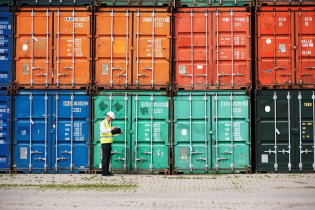
Most Common Shipping Container Dimensions and Sizes
Are you looking for container dimensions to support cargo packing and transportation planning? Please refer to the article below, where 3W Logistics has compiled the complete basic dimensions of the most common container types.
1. Basic Concepts of Container Dimensions
A container is a rectangular empty steel box built with a durable structure and available in different sizes. It was originally invented by Malcolm McLean in 1930 to support the transportation, storage, and safe preservation of cargo. Accordingly, container dimensions are associated with several key concepts, including:
- Internal container dimensions: This refers to the inside dimensions after deducting the wall thickness.
- External dimensions: This refers to the outside dimensions, including wall thickness.
- Cubic capacity: This is the cargo volume capacity, measured in cubic meters or cubic feet.
- Gross weight: This is the total weight of the cargo plus the container tare weight.
- Net payload: This is the total cargo weight, reflecting the carrying capacity of the container.
- Door opening: This refers to the dimensions of the container door.
- TEU (Twenty-Foot Equivalent Unit): This is the standard unit used to describe a container with dimensions of 20 feet long, 8 feet wide, 8.5 feet high, and a volume of approximately 39 cubic meters.
>> Learn more: Ocean Freight Rates
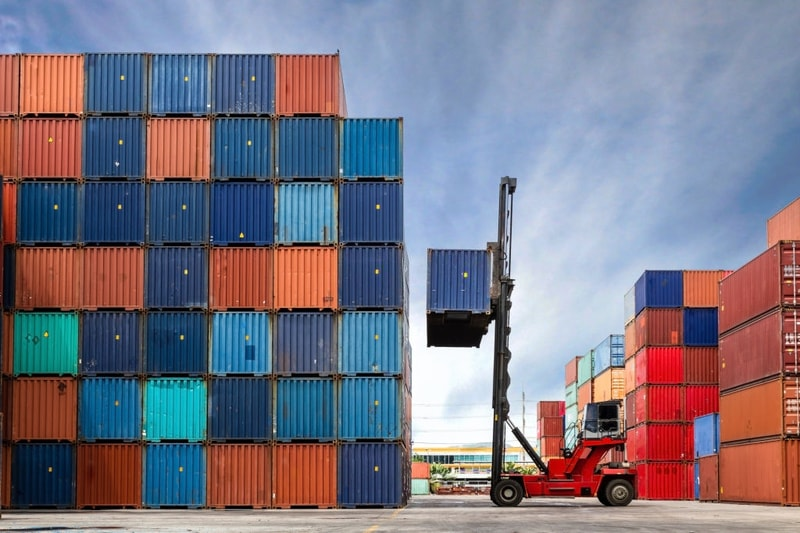
Containers are widely used for cargo storage, protection, and safe transportation
2. ISO Standard Container Dimensions
According to ISO container regulations (standard 668:1995), a standard container must meet the following five requirements:
- Durable and robust design, capable of being reused multiple times.
- Compatible with various transport modes, including ocean vessels, trucks, railways, or aircraft.
- Supports fast cargo stuffing and unloading operations.
- Easy to install cargo handling equipment when switching transport modes.
- The minimum internal volume must be at least 35.4 cubic feet.
In addition, the currently accepted container dimensions are also defined under two standards: ISO 668:2013 (Series 1 freight containers – classification, dimensions, and ratings) or ISO 1496-1:2013 (Series 1 freight containers – specifications and testing). Specifically:
- Width: Containers must have a width of approximately 2,438 mm (8 ft).
- Height: For standard containers, the average height is 8 feet 6 inches (8’6”), equivalent to approximately 2,590 mm. For high cube containers, the average height is 9 feet 6 inches (9’6”), equivalent to approximately 2,895 mm.
- Payload: According to the Vietnam Register, current container types (especially 20-foot containers) must meet a standard payload of 20.32 tons.
[irp posts=”3532″ name=”Bulk Container and 5 Must-Know Facts”]
3. Common Container Size Classifications
Below are the detailed dimensions of the most commonly used container types today:
3.1 10-Foot Container Dimensions
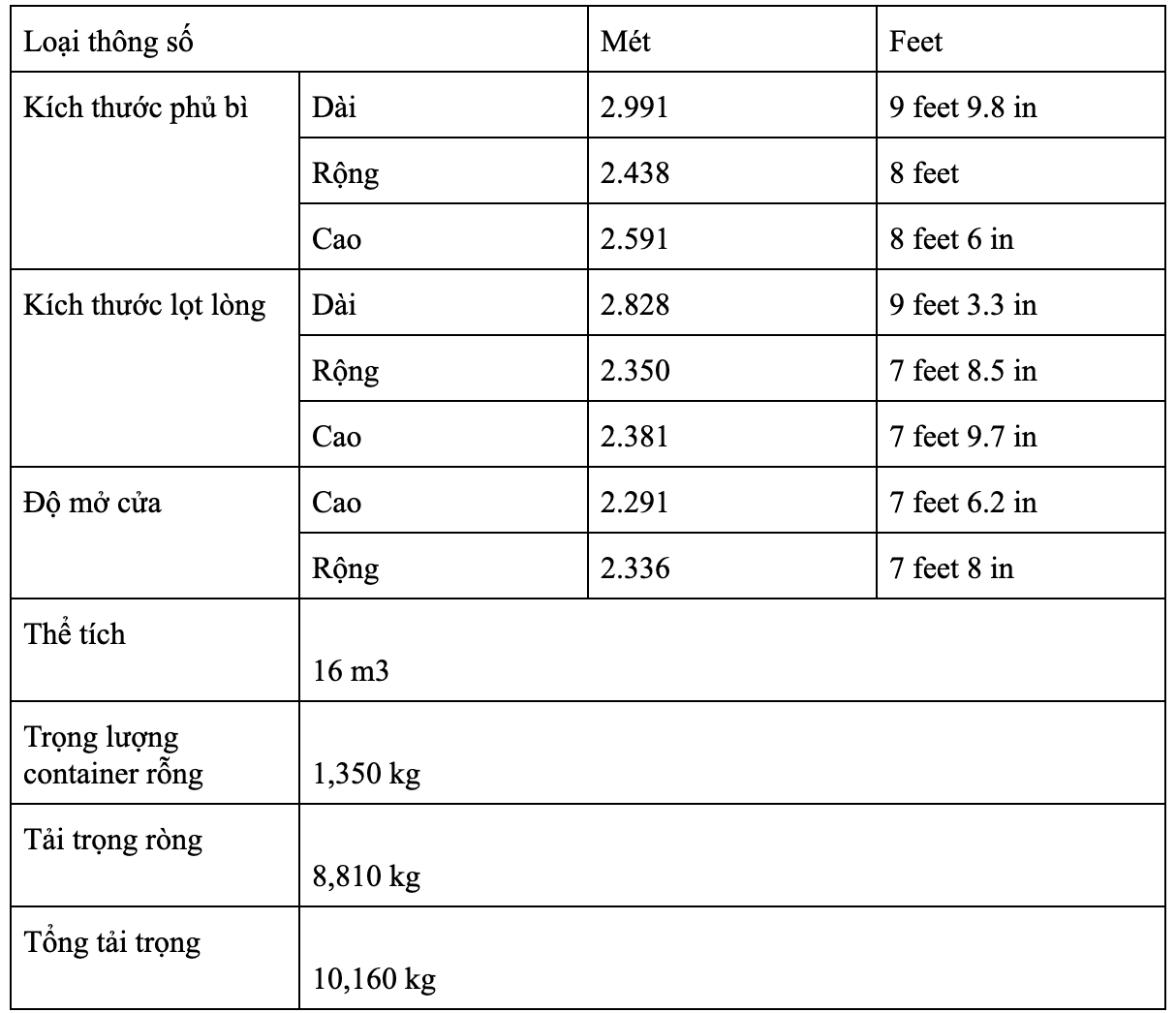
This is a compact container size mainly used in design and construction applications such as mini warehouses, public restrooms, site offices, or container houses. The technical specifications of a 10-foot container are as follows:
 3.2 20-Foot Container Dimensions
 3.2 20-Foot Container Dimensions
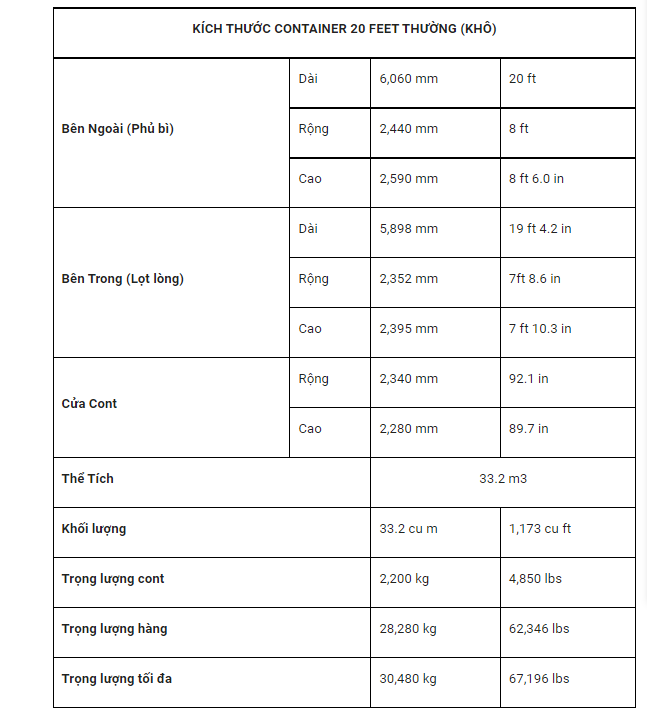
This container size accommodates different cargo requirements and categories, including standard dry containers, reefer containers (RF), high cube containers (HC), high cube reefer containers (HR), open top containers (OT), and flat rack containers.
– Standard 20-foot container (Dry Container)
The 20-foot dry container is used for heavy cargo with moderate dimensions and no temperature control requirements, such as rice, flour, steel, cement, or grains.
>> Learn more: U.S. Import Regulations
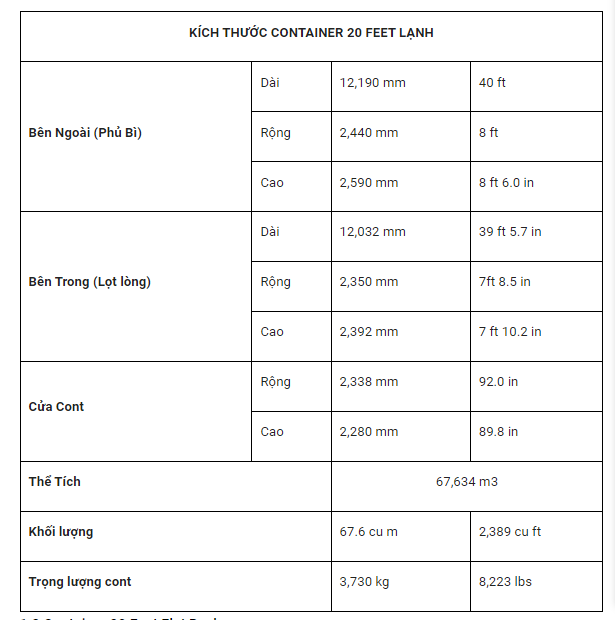
 – 20-foot Reefer Container (RF)
The 20-foot reefer container is used to preserve cargo at low temperatures, including fresh agricultural products, seafood, or frozen food.
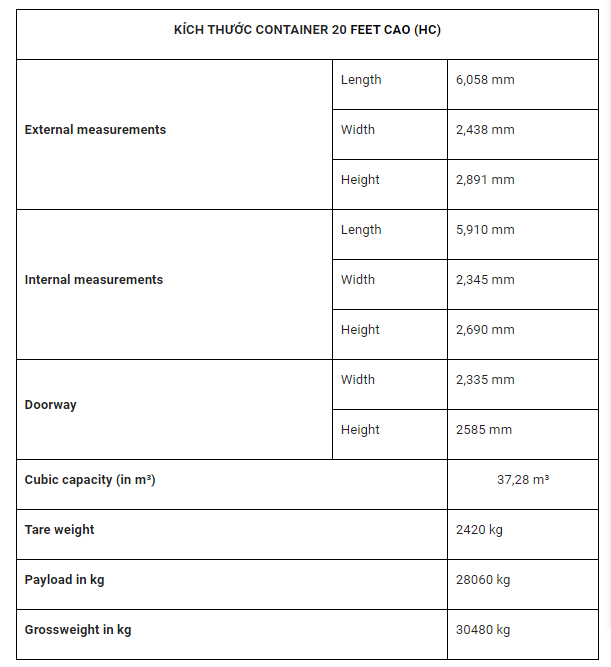
 – 20-foot High Cube Container (HC)
The 20-foot high cube container is more commonly used in Europe than in Vietnam. Its additional height compared to the standard type allows for greater cargo volume.
[irp posts=”3506″ name=”Top 8 Key Export Commodities of Vietnam”]
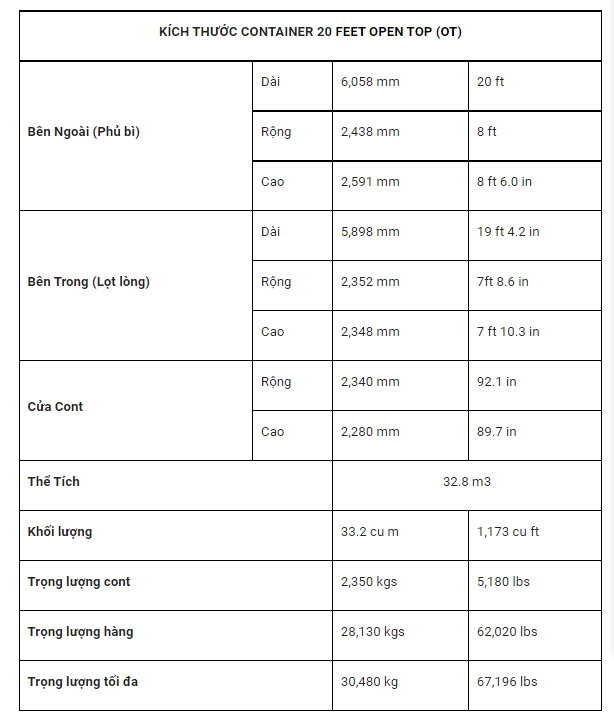
 – 20-foot Open Top Container (OT)
The 20-foot open top container is capable of storing oversized, heavy-lift, and out-of-gauge cargo.
 – 20-foot Flat Rack Container
Without a roof structure and with expanded loading space, the 20-foot flat rack container is suitable for oversized cargo, machinery, and equipment weighing under 30 tons.
 3.3 40-Foot Container Dimensions
 3.3 40-Foot Container Dimensions
Similar to 20-foot containers, 40-foot containers are also available in multiple types to meet diverse transportation needs.
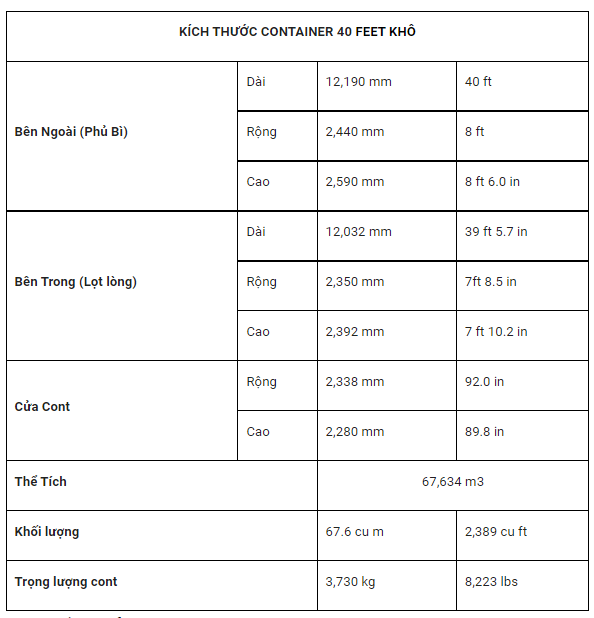
– Standard 40-foot container (Dry Container)
Cargo commonly shipped in 40-foot dry containers includes garments, dried cassava slices, furniture, or processed plastic products that do not require heavy weight capacity.
 – 40-foot High Cube Container (HC)
Unlike the 20-foot HC container, the 40-foot HC container is widely preferred in Vietnam due to its reasonable freight rates and ability to carry a wide variety of cargo.
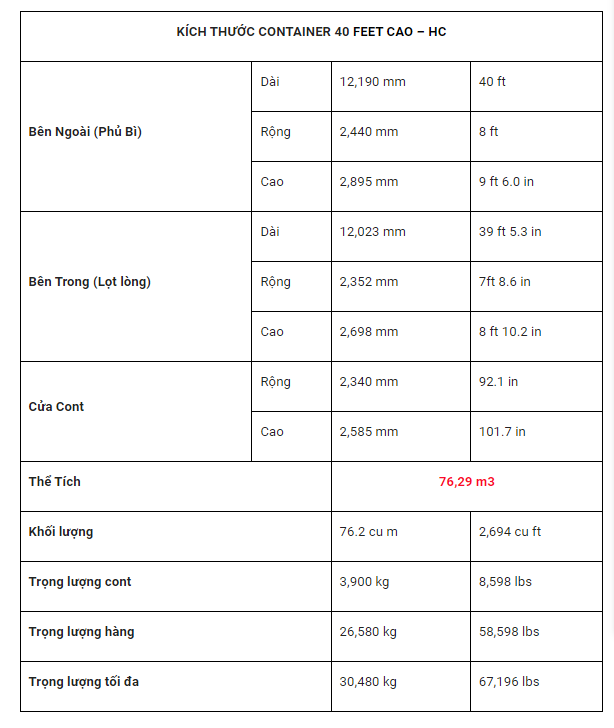 – 40-foot Reefer Container (RF)
The 40-foot reefer container is designed for transporting and preserving low-temperature cargo (up to -18°C), including frozen goods, agricultural products, seafood, or fresh food.
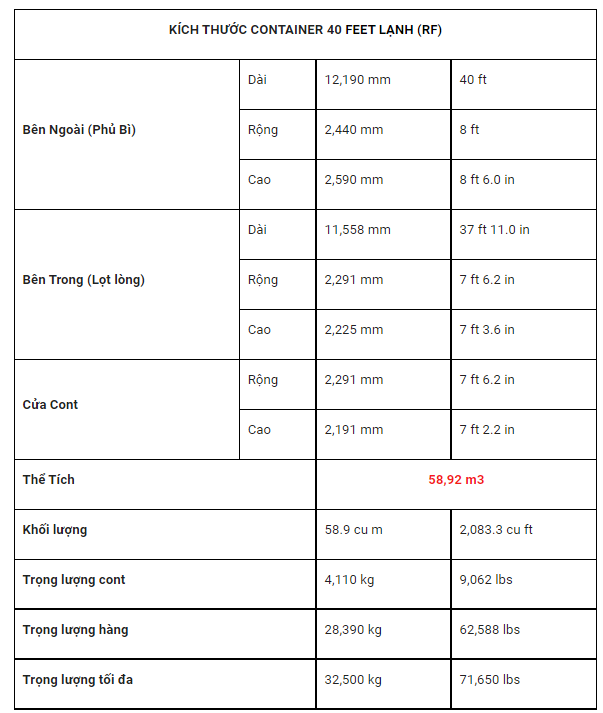 – 40-foot Flat Rack Container
The key feature of the 40-foot flat rack container is transporting high-weight cargo under 35 tons or cargo that requires crane handling for loading and unloading.
>> Learn more: Ocean Freight Transit Time
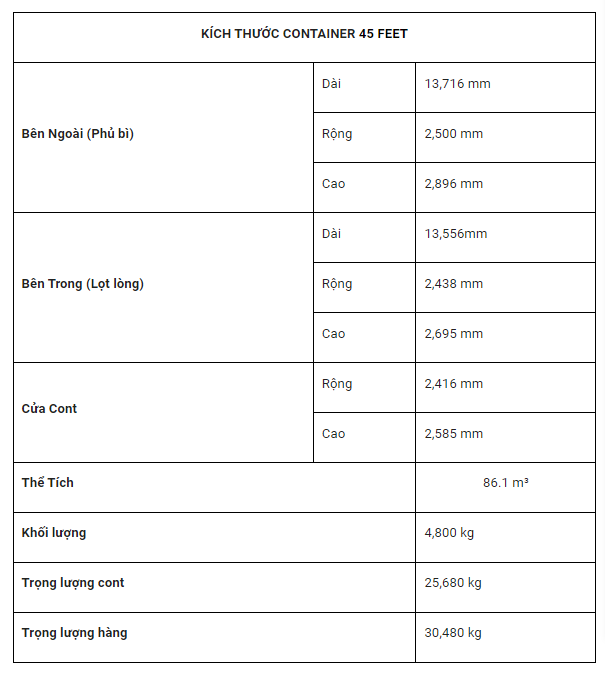
3.4 45-Foot Container Dimensions
The 45-foot container offers substantial length and volume, making it suitable for cargo transportation as well as utility construction applications such as offices, mobile warehouses, public restrooms, booths, or kiosks.
 3.5 50-Foot Container Dimensions
 3.5 50-Foot Container Dimensions
In Vietnam, 50-foot containers are rarely used in common logistics operations. However, if businesses are interested, they may refer to the dimensions of this type as follows:
- External dimensions (overall dimensions): Length x Width x Height: 15.240 x 2.438 x 2.896 meters.
- Internal dimensions of the 50-foot container: Length x Width x Height: 15.040 x 2.348 x 2.690 meters.
3.6 Tank Container Dimensions
Tank containers are used for transporting liquid cargo such as chemicals, beverages, or alcoholic drinks. Instead of using length x width x height dimensions, tank containers are measured by volume capacity, typically ranging from 21,000 to 26,000 liters.
Note: The above container specifications are for reference only. Depending on the manufacturer and rounding conventions, actual container dimensions may vary by a few millimeters or centimeters.
4. Important Considerations When Choosing a Container
When selecting container transportation services, businesses should consider the following:
– Depending on the cargo type and shipment volume, businesses should carefully choose the most suitable container size. This helps ensure efficient transportation while minimizing time and cost.
– Inspect the container condition to ensure there is no damage, deformation, corrosion, or structural defects.
– Prioritize genuine containers with clear origin documentation and compliance with ISO container standards.
– Choose a reputable container leasing company that provides high-quality containers at competitive pricing.
Currently, 3W Logistics is one of the leading, professional, and high-quality container leasing providers. The company maintains strong relationships with major container partners in the market, thereby ensuring reasonable freight and leasing rates aligned with customers’ budgets.
By choosing 3W Logistics, businesses also receive consultation on the most suitable container dimensions, along with 24/7 support from our dedicated and highly experienced container specialists. In addition, we assist customers with container trucking to the designated location, helping import-export operations proceed quickly, safely, and smoothly.
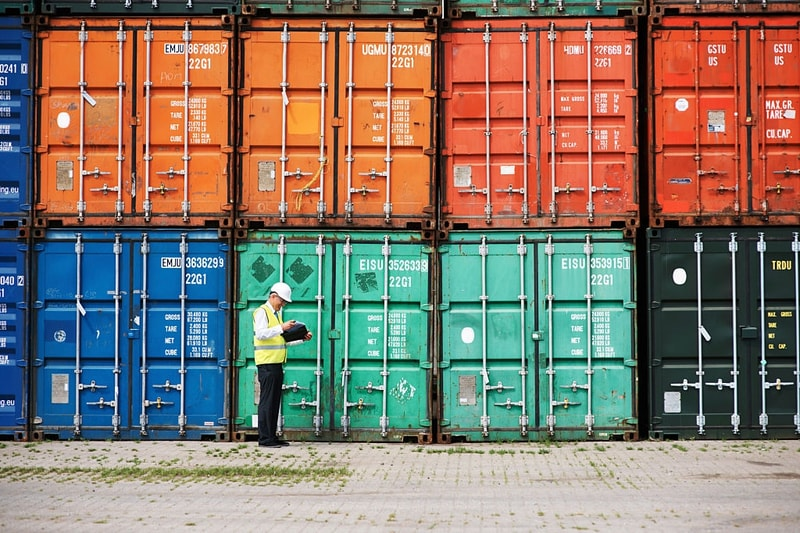
Choosing a reputable container leasing company helps businesses select the right container size, optimize costs, and ensure safe transportation
With all the information above, we hope your business now has a clear understanding of the most common container dimensions available today. Overall, these specifications are essential data points that help you select the right container to meet your cargo transportation needs. To lease containers at cost-effective rates while ensuring safety and quality, businesses should work with a trusted provider offering flexible and competitive services such as 3W Logistics.
“We here to serve you there” – At 3W Logistics, we are committed to delivering well-structured container solutions that maximize cost savings and customer satisfaction. Contact us today for service consultation and a detailed quotation.
| 1. CONTAINER TRANSIT TIME FROM VIETNAM TO THE USA 2. SHIPPING FROM VIETNAM TO CHINA |

Hello, I’m Nguyen Phuong Nhan (Ms. Nina)
I currently serve as Trade Lanes Supervisor at 3W Logistics, with more than 10 years of experience in international logistics and freight forwarding.
My primary responsibility is developing and managing global logistics partnerships, building strategic trade lanes, and working closely with overseas agents to provide reliable and competitive transportation solutions for customers.
I regularly collaborate with agents and logistics partners worldwide to explore new business opportunities, negotiate freight rates, develop trade routes, and support import-export shipments. I also work closely with our sales team to design logistics solutions tailored to specific markets and customer requirements.
My expertise includes Ocean Freight, Air Freight, Trade Lane Development, Global Agent Network Management, International Logistics Solutions, and Import-Export Support.
Through the articles I share on the 3W Logistics website, I aim to provide practical insights into the international logistics industry, global transportation trends, overseas agent cooperation, and effective logistics strategies that help businesses optimize their supply chain operations.
I believe that strong global partnerships and well-developed trade lanes are essential to delivering sustainable logistics solutions and long-term value to customers worldwide.


