
Packaging specifications for exported coffee are the set of requirements for packaging materials, weight, labeling, and stowage that businesses, processing plants, and traders must complete before container loading. Vietnam is the world’s second-largest coffee exporter and the largest producer of robusta, but green coffee absorbs moisture and odor very quickly, while the European market is entering a new phase of control with the EUDR Regulation (applicable from December 30, 2026) and the PPWR Packaging Regulation (already applicable from August 12, 2026).
In this article, 3W Logistics compiles the complete set of packaging specifications for exported coffee under current Vietnamese law as of September 2026 – from the Law on Product and Goods Quality (as amended by Law No. 78/2025/QH15), Decree 37/2026/ND-CP on goods labeling, to TCVN 4193:2014 and TCVN 1279:1993 on green coffee – together with the requirements of major importing markets, from the perspective of a forwarder with over 10 years of experience shipping exported agricultural products.
1. Why Are Packaging Specifications the Top Priority for Exported Coffee?
Green coffee is an agricultural product sensitive to moisture, foreign odors, and temperature fluctuations. Inside a sealed container, the temperature difference between day and night as the vessel passes through different climate zones causes condensation on the walls and ceiling (known as “container rain”), which then drips onto the bags positioned at the top and against the walls. Sea voyages range from about 10 days to Northeast Asia to over 40 days to Europe or the US East Coast, so correctly specified packaging is the decisive factor in whether the coffee arrives free of moisture damage, mold, odor change, or loss.
Beyond preservation, packaging specifications for exported coffee must simultaneously meet three groups of requirements:
- Domestic legal requirements: The Law on Product and Goods Quality as amended by Law No. 78/2025/QH15 (effective from January 1, 2026); Decree 37/2026/ND-CP dated January 23, 2026 on goods labeling; the 2013 Law on Plant Protection and Quarantine together with Circular 33/2014/TT-BNNPTNT (as amended and supplemented) on export plant quarantine; the 2010 Food Safety Law and Decree 15/2018/ND-CP for roasted, ground, and instant coffee.
- Technical standard requirements: TCVN 4193:2014 on green coffee, TCVN 1279:1993 on packaging, labeling, storage, and transport of green coffee, TCVN 6602:2013 (ISO 8455:2011) on storage and transport guidance, together with TCVN 5250:2015, TCVN 5251:2015, and TCVN 12459:2018 for roasted coffee, ground coffee, and instant coffee.
- Importing country requirements: Each market has its own regulations on labeling, documentation, and traceability data. Europe is the most notable, with the EUDR Regulation on deforestation-free products and the PPWR Packaging Regulation (EU) 2025/40.
Important note: From January 23, 2026, Decree 37/2026/ND-CP replaces Decree 43/2017/ND-CP and Decree 111/2021/ND-CP on goods labeling. Commercial packaging already printed in compliance with the old regulations before January 23, 2026 may continue to be used, but for no more than two years from that date. Businesses still holding stock of packaging printed with the old template need to review the label content before packing new shipments, because packaging specifications for exported coffee that meet technical standards can still be rejected by the buyer if the labeling does not match the contract and documentation.
2. Green Coffee Quality Standards Before Packaging
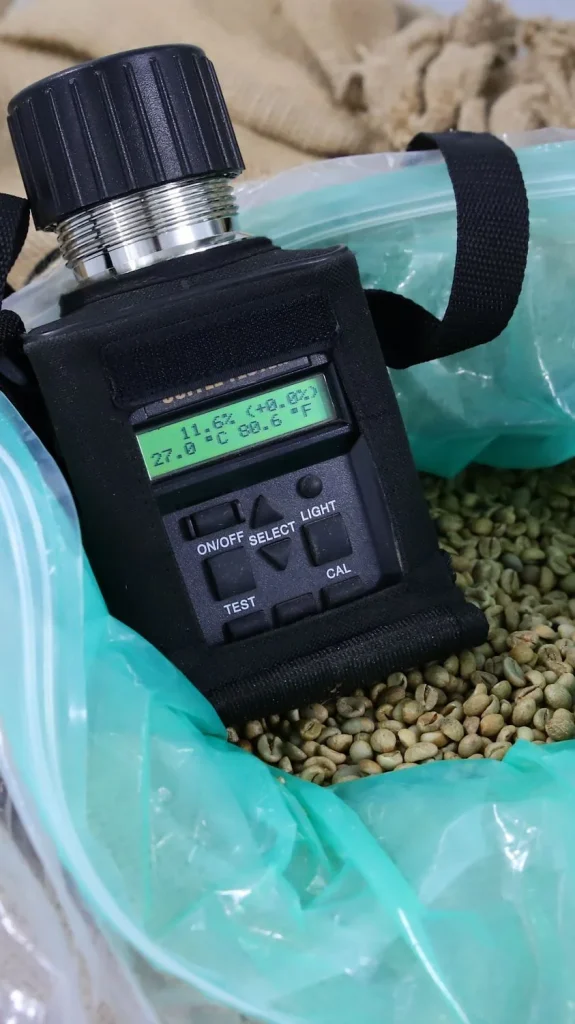
Packaging specifications for exported coffee only matter once the coffee going into the bag has already met the standard under TCVN 4193:2014, applicable to Arabica and Robusta coffee. Checking coffee quality standards before packaging directly affects the pre-export inspection process. Many facilities bag coffee before it has reached the correct moisture content or has been clearly graded, leading to price deductions or rejection by the buyer at the destination port.
| Criterion | Standard Requirement | Rejected / Downgraded When |
|---|---|---|
| Moisture | Not exceeding 12.5% per TCVN 4193:2014; re-measured immediately before bagging, freshly dried coffee needs to cool and stabilize before being bagged | Moisture exceeding 12.5% – risk of mold, discoloration, and rancid odor developing inside the sealed container over the long journey |
| Color and odor | Color characteristic of each green coffee type; characteristic odor, no foreign odor | Mold, smoky, earthy, or chemical odor present – the shipment is downgraded or rejected immediately upon sensory sample inspection |
| Cross-species mixing ratio | Per Table 2 of TCVN 4193:2014 for each grade; for example, Grade 1 Arabica must not be mixed with Robusta or Chari coffee; each type packed separately, no mixing between batches | Arabica, Robusta, or Chari coffee mixed beyond the permitted level – deviates from the quality grade stated in the contract |
| Defective beans and foreign matter | Not exceeding the maximum ratio for the declared grade; visual inspection per TCVN 4808:2007 on a 300 g sample | Black beans, broken beans, husk, stones, branches exceeding the threshold – the buyer deducts from the price or refuses the shipment |
| Bean size (screen) | Meets the minimum weight ratio retained on a round-hole screen for each grade; size analysis per TCVN 4807:2013 (ISO 4150:2011) | Bean size not uniform across bags within the same batch, or fails to meet the screen size stated in the contract |
| Pesticide residue and mold toxins | Meets the maximum residue limit (MRL) of the importing country; a test report from an accredited laboratory for large batches or when required by the buyer | Residue exceeding the target market’s MRL – the EU and Japan tightly control pesticide residue and ochratoxin A toxin in coffee |
| Plant quarantine | No live insects or insect eggs; a Phytosanitary Certificate issued by the quarantine authority under the Department of Crop Production and Plant Protection when required by the importing country; fumigation when required by the contract or the importing country | Harmful insects detected, or the required certification is missing – the shipment is held, must be reprocessed, or is rejected |
3. Packaging Material Standards for Green Coffee
This is the core part of packaging specifications for exported coffee, set out in TCVN 1279:1993 (which replaced TCVN 1279-84) and referenced by TCVN 4193:2014, combined with storage and transport guidance in TCVN 6602:2013 (ISO 8455:2011). The content below on container lining, desiccants, and stowage is common commercial practice, supplementing the standard.
| Packaging Parameter | Specific Requirement | Reason / Notes |
|---|---|---|
| Bag material | Bags woven from soaked jute fiber, or a dedicated container per TCVN 1279:1993; bags must be firmly woven and stitched, uniform in color, dry, clean, and free of foreign odor | Jute fiber is breathable, helping coffee maintain stable moisture; torn, unstitched, or odor-contaminated bags cause weight loss and odor contamination across the whole batch |
| Bag weight | 60 kg net per bag, with a tolerance of ±0.18 kg; the average weight of bags upon inspection must not be less than 60 kg | The most common specification for exported green coffee; 30 kg bags or jumbo bags are used only when specified in the contract |
| Bag mouth stitching | Sealed with twisted jute thread or non-metal material, ensuring durability, no tearing or unraveling during storage and transport | Metal is not used to avoid contaminating the coffee with foreign objects; loose stitching causes the bag to open when stacked and repeatedly handled |
| Moisture-barrier liner bag | An airtight liner bag (such as GrainPro, Ecotact) placed inside the jute bag for long sea shipments, specialty coffee, or markets requiring stricter preservation | Jute bags are breathable but do not fully block moisture; the liner limits external moisture and odor from penetrating |
| Staging warehouse before loading | Bags stacked on sturdy wooden flooring, at least 0.3 m above the floor and at least 0.5 m from the wall; separated by batch; not stored together with goods that have a foreign odor | Prevents moisture absorption from the warehouse floor and facilitates sampling and inspection; coffee readily absorbs odor from goods stored in the same warehouse |
| Container and lining | Sealed, dry, clean, odor-free container with good moisture insulation; multiple layers of kraft paper lining on the walls and ceiling, hanging strip-type desiccant bags before loading | Limits condensation (“container rain”) and odor from the container floor and walls; check the container shell for punctures and water leaks before loading |
| Stowage of bags in the container | Stacked tightly, staggered between layers, with dunnage to prevent shifting; typically floor-loaded directly to maximize the number of bags, with pallets used when the contract requires it | Loose stacking easily topples and tears bags as the vessel rolls; using pallets reduces the number of bags fitting in each container |
4. Mandatory Labeling Requirements on Exported Coffee Bags
Labels on coffee bags must simultaneously meet the labeling content under TCVN 1279:1993, Decree 37/2026/ND-CP, and the importing country’s specific requirements. Under Decree 37/2026/ND-CP, the labeling of exported goods follows the importing country’s law, the contract, and international treaties to which Vietnam is a party, and must not display images or content related to sovereignty disputes or other sensitive content.
| Label Information | Mandatory Content | Practical Notes |
|---|---|---|
| Product name and coffee type | Product name in English or the importing country’s language (e.g. Green Coffee – Robusta); species symbol per TCVN 1279:1993: A for Arabica, R for Robusta, C for Chari coffee | Do not use the generic term “Coffee” – the type, grade, and screen size must be clearly stated matching the contract (e.g. Grade 2, Screen 13, 5% black and broken) |
| Place of production and packing | Name and address of the production location per TCVN 1279:1993 | Information must match the facility’s registration file and export documentation so the buyer can trace it in case of complaints |
| Country of origin | “Product of Vietnam” or “Made in Vietnam”; the growing region is added if the contract or a traceability program requires it | The origin on the label must match the C/O (including the ICO form C/O when required by the importing country or contract) and customs documentation |
| Net and gross weight | Net weight and gross weight (kg) clearly stated per TCVN 1279:1993 | Must match the packing list, bill of lading, and customs declaration – large discrepancies when weighed at the destination port often lead to shortage complaints |
| Receiving location and lot marking | Name and address of the receiving location, shipment marking (shipping mark, lot number, contract number), and other instructions per the buyer’s requirements | Labels are printed directly on both sides of the bag using dark-colored ink on the jute bag; within one batch, labels must use the same ink color, font, and numbering |
| Shipment traceability code | A lot code linked to the growing area record, harvest date, and processing facility; referencing TCVN 13840:2023 on traceability of the green coffee supply chain | Importers in the EU need growing-area geolocation data to file a due diligence statement from December 30, 2026; a label missing a lot code breaks the traceability chain |
| Prohibited content | No images or content related to sovereignty disputes or other sensitive content, per Decree 37/2026/ND-CP | Review any graphics or maps printed on retail packaging before mass printing, as incorrectly printed packaging is very difficult to reprocess |
5. Packaging Specifications for Exported Coffee by Product Type and Market
Packaging specifications for exported coffee differ significantly between bulk-traded green coffee and retail finished coffee products. Businesses need to agree on the packaging format with the buyer right from the contract negotiation stage to avoid incurring repackaging costs.
Green Coffee in 60 kg Jute Bags
This is the most common format when exporting green coffee to Europe, the US, Japan, South Korea, and the Middle East. A 20-foot container typically fits about 275-320 bags of 60 kg, equivalent to 16.5-19.2 tons depending on the stowage method. Bags are packed by separate batch, with the lot number clearly marked so the buyer can sample and verify quality. 40-foot containers are less commonly used for green coffee since the cargo is heavy, reaching the weight limit before the volume is filled, which makes the cost less favorable.
Bulk Green Coffee in Liner (Bulk Liner and GrainPro)
For large shipments, some buyers accept coffee poured loose into a bulk liner placed inside a 20-foot container, with the load capacity reaching up to about 21 tons. This method reduces packaging and bagging labor costs but does not allow separation into small batches and requires specialized loading equipment. An alternative is to use an airtight GrainPro or Ecotact liner bag inside the jute bag to increase moisture resistance and preserve flavor for specialty coffee. Both formats should only be applied when specified in the contract.
Retail Roasted, Ground, and Instant Coffee
- Roasted coffee is packed in dry, clean, moisture-resistant packaging dedicated to food use per TCVN 5250:2015; the roasted product must have a moisture content not exceeding 5.0%, total ash content not exceeding 5.0%, and foreign matter not exceeding 0.3%.
- Ground coffee per TCVN 5251:2015 must be stored and transported using dry, clean means, free of foreign odor.
- Instant coffee applies TCVN 12459:2018.
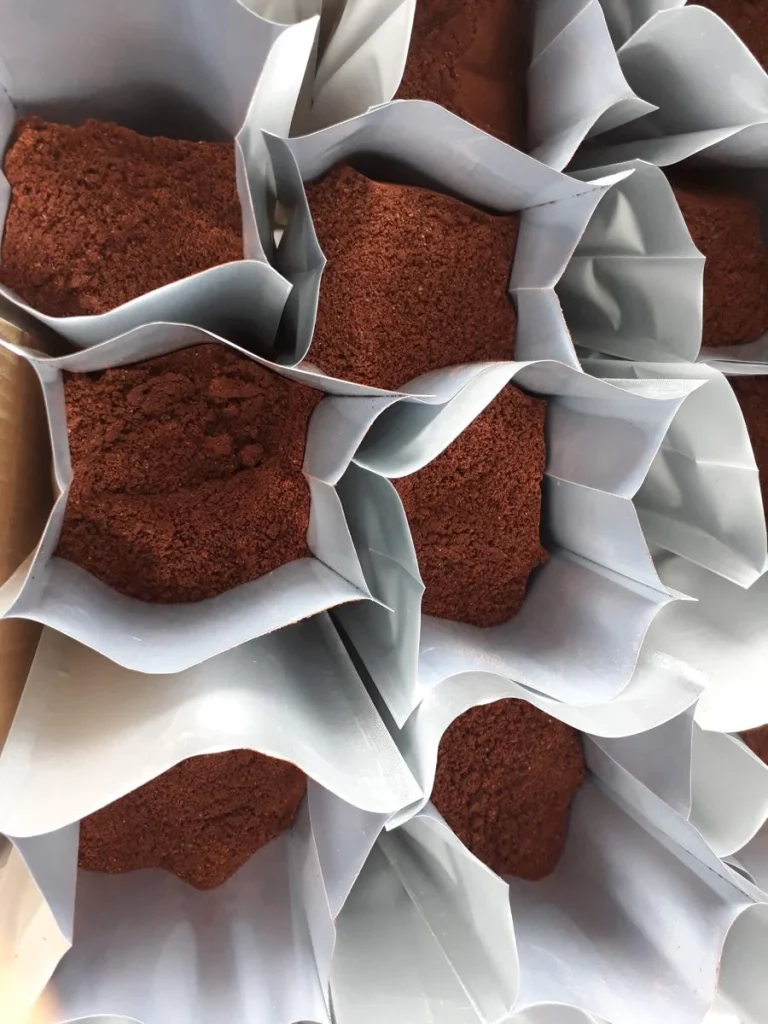
Labels for pre-packaged products follow TCVN 7087:2013 (CODEX STAN 1-1985) and the importing country’s regulations, typically including ingredients, production date, expiry date, storage instructions, and a retail barcode. Aluminum-laminated bags with a one-way valve are commonly used for ground and roasted coffee to preserve aroma and release CO2 gas.
On food safety, this product group falls under the scope of the 2010 Food Safety Law (consolidated in Consolidated Document 61/VBHN-VPQH of 2025), and Decree 15/2018/ND-CP remains the guiding document currently in effect. Decree 46/2026/ND-CP and Resolution 66.13/2026/NQ-CP are currently suspended pending the effectiveness of the amended Food Safety Law and its guiding decree. For export shipments, declaration and certification follow the importing country’s requirements and the contract terms.
Specific Requirements for Exporting to the EU (EUDR and PPWR)
Regulation (EU) 2023/1115 on deforestation-free products (EUDR), as amended by Regulation (EU) 2025/2650, applies to coffee from December 30, 2026 for medium and large businesses, and from June 30, 2027 for small and micro businesses. Coffee must be produced on land that was not deforested after December 31, 2020, and must be legal under the producing country’s law.
The entity placing the goods on the EU market (usually the importer) files a due diligence statement together with geolocation data for the plots of land, so Vietnamese exporters need to clearly separate batches, mark the lot code on the bag, and keep complete growing-area records. The European Commission updated its FAQs and guidance documents in May 2026, and businesses should cross-check with the importer before each shipment.
The PPWR Packaging Regulation – Regulation (EU) 2025/40 – applies from August 12, 2026 to all packaging placed on the EU market, including imported packaging. From this date, food-contact packaging is strictly limited on PFAS content, along with new obligations for technical documentation and a declaration of conformity. The EU-wide harmonized label applies later, from August 2028, and recyclability requirements from January 1, 2030. For retail coffee packaging, businesses should agree with the importer on who is responsible for the documentation and on sourcing laminate film and inks that meet the requirements.
From 3W Logistics’ practical experience: The most frequent risks with exported coffee shipments usually lie in the loading and documentation stage rather than in bean quality: a container without kraft lining or desiccants leads to condensation on the walls, the actual weight deviates from the declaration, and labels or shipping marks don’t match the bill of lading or C/O. From the end of this year, missing shipment traceability data will become a fourth risk for shipments to Europe. All of these errors are preventable with proper control at the warehouse before the goods leave the factory. – Ms. Apple, CCO, 3W Logistics
6. Common Errors in Exported Coffee Packaging Specifications
| Common Error | Practical Consequence | Prevention |
|---|---|---|
| No container lining, no desiccants | Water vapor condenses on the walls and ceiling and drips onto the cargo, causing moisture and mold on the bags near the walls and at the top; the buyer files a quality complaint | Line with multiple layers of kraft paper, hang strip-type desiccant bags, and check the container for punctures and odor before loading |
| Bagging before moisture content is reached or before the coffee has cooled after drying | Coffee exceeding the 12.5% threshold is prone to mold and odor change during the long journey, resulting in a downgrade or rejection | Measure moisture content for each batch immediately before bagging, let the coffee cool and stabilize, and keep the result slip for each batch |
| Using old bags, odor-contaminated bags, or insecure stitching | Bags tear or open at the mouth when stacked and handled; loss of goods, odor contamination, and complaints from the buyer | Use new, dry, clean, odor-free bags; stitch with twisted jute thread or non-metal material; randomly check stitching before stacking |
| Bag weight deviating from 60 kg ± 0.18 kg | Actual total weight deviates from the declaration and packing list, leading to shortage complaints when weighed at the destination port | Weigh each bag or weigh by batch using a calibrated scale, ensuring the average weight is not below 60 kg |
| Labeling not matching the documentation or still using the old regulatory template | A label that deviates from the bill of lading, C/O, or contract prolongs customs clearance; a label missing content required by the buyer gets rejected | Cross-check the label against the contract, C/O, bill of lading, and Decree 37/2026/ND-CP before mass printing; process remaining stock of old-template packaging |
| Missing lot code and traceability data for shipments to the EU | The importer is unable to file a due diligence statement under EUDR, and the shipment is held or denied entry | Separate batches by growing area, mark the lot code on the bag, and keep geolocation data along with purchasing and processing records for each batch |
FAQ – Frequently Asked Questions About Exported Coffee Packaging Specifications
Question 1: What packaging is required for exported green coffee and how many kg per bag?
Per TCVN 1279:1993, green coffee is packed in bags woven from soaked jute fiber or in a dedicated container, with a net weight of 60 kg ± 0.18 kg per bag and an average weight upon inspection not below 60 kg. In practice, many shipments also use airtight liner bags such as GrainPro or Ecotact, or are shipped loose in a bulk liner as agreed with the buyer. The foreign trade contract is the final basis for the packaging specification of each shipment.
Question 2: Which Decree currently governs labeling for exported coffee?
From January 23, 2026, Decree 37/2026/ND-CP, which guides the Law on Product and Goods Quality, replaces Decree 43/2017/ND-CP and Decree 111/2021/ND-CP on goods labeling. Labels for exported goods follow the importing country’s law, the contract, and international treaties to which Vietnam is a party, and must not contain images or content related to sovereignty disputes. Packaging printed under the old regulations before January 23, 2026 may continue to be used, but for no more than two years from that date.
Question 3: What should be noted about packaging and documentation when exporting coffee to the EU from late 2026?
There are two regulations to monitor. First, EUDR applies to coffee from December 30, 2026 (medium and large businesses) and June 30, 2027 (small and micro businesses), requiring shipments to have growing-area geolocation data so the importer can file a due diligence statement. Second, PPWR applies from August 12, 2026, limiting PFAS in food-contact packaging and establishing obligations for technical documentation and a declaration of conformity. Businesses should discuss with the importer to allocate responsibility right from the contract signing stage.
Question 4: What is the HS code for exported coffee and the current export tax rate?
Coffee falls under HS heading 0901: subheading 0901.11 is unroasted, non-decaffeinated coffee (with 0901.11.20 for Arabica and 0901.11.30 for Robusta), 0901.12 is unroasted decaffeinated coffee, 0901.21 and 0901.22 are roasted coffee, and 0901.90 covers coffee husks, coffee skins, and coffee substitutes containing coffee. Instant coffee falls under heading 2101. Coffee is not subject to export tax, so the export tax rate is 0%; businesses need to apply the correct HS code to accurately declare the C/O and customs documentation.
How Does 3W Logistics Support Coffee Exports?
As a freight forwarding company registered as an OTI-NVOCC with an FMC (Federal Maritime Commission) bond in the United States, with over 10 years of experience shipping exported agricultural products, 3W Logistics provides an end-to-end service for processing plants, businesses, and traders exporting coffee – from consulting on packaging specifications for exported coffee, through to customs clearance and delivery to the buyer’s warehouse in the importing country.
End-to-end coffee export solutions from 3W Logistics:
- Packaging specification consulting and documentation review before packing: Reviewing packaging, labeling, bag weight, and documentation before container loading, catching errors early rather than at the destination port.
- Container booking and lining and stowage planning: Calculating the number of bags based on the 20-foot container’s weight capacity, advising on kraft paper lining, desiccants, liner, or GrainPro suited to each route and each buyer.
- Sea freight shipping to Europe, the US, Japan, South Korea, the Middle East, and other markets: Optimizing routes, transit times, and costs for each market and each coffee product type.
- Customs declaration and documentation preparation: Supporting C/O (including ICO form C/O when required), Phytosanitary Certificate, fumigation certificate, and other contract-specified documents.
- Support with shipment traceability records and shortage complaint handling: Keeping packing photos, weighing slips, lot codes, and documentation for each batch to help meet EUDR requirements and resolve quickly when the buyer files a complaint about weight or quality.
Why choose 3W Logistics for exported coffee shipments? Correct packaging specifications are only a necessary condition. A batch of properly packaged coffee can still be held or generate a complaint if the labeling does not match the C/O, if traceability data for EUDR is missing, or if condensation inside the container causes moisture damage. We control the entire chain from the packing warehouse through to delivery, not just booking the vessel and filing the declaration. Contact 3W for specific guidance on the route and cost before the peak harvest of the new coffee season.
Address: 34 Bach Dang, Tan Son Hoa Ward, Ho Chi Minh City
Hotline: +84 28 3535 0087
____________________________
3W Logistics Hanoi Branch
Address: 81A Tran Quoc Toan, Cua Nam Ward, Hanoi
Hotline: +84 24 3202 0482
____________________________
3W Logistics Hai Phong Branch
Address: 8A Lot 28 Le Hong Phong, Gia Vien Ward, Hai Phong
Hotline: +84 225 355 5939
____________________________
3W LOGISTICS CO., LTD – We here serve you there!
Email: info@3w-logistics.com
Website: www.3w-logistics.com

Ms. Apple is the CCO (Chief Commercial Officer) at 3W Logistics, with over 10 years of experience in sales and business operations management.
At 3W Logistics, Ms. Apple is responsible for commercial strategy, corporate customer development, managing a team of more than 50 sales professionals, and improving business performance in the logistics sector.
With practical experience in sales management and market development, Ms. Apple shares professional insights on business logistics solutions, international transportation, freight forwarding, customer management, trade lane development, and growth strategies in the logistics industry.


