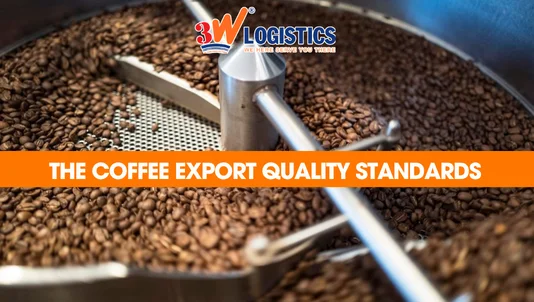
Meeting coffee export quality standards is a prerequisite for Vietnamese businesses to maintain their position as the world’s leading Robusta coffee exporter. Beyond the familiar technical criteria such as moisture, defective bean ratio, or foreign matter, exported coffee now also faces new barriers such as the EU’s Deforestation Regulation (EUDR) – a factor that is reshaping the entire global coffee supply chain.
This article by 3W Logistics summarizes the complete current system of coffee export quality standards – from the national TCVN standard, mandatory technical criteria, specific requirements by key target market, required international certifications, to the inspection and certification process – helping businesses proactively prepare documentation and avoid the risk of customs clearance rejection or returned shipments in the importing market.
1. General Standard for Vietnamese Export Coffee (TCVN 4193:2014)
Overview of the National Standard Applicable to Green Coffee Beans
The foundational technical standard for green coffee beans exported from Vietnam today is TCVN 4193:2014 (Green Coffee Beans – Technical Requirements), compiled by the Department of Agro-Forestry-Fisheries Product Processing and Market Development together with the Coffee and Import-Export Goods Inspection Joint Stock Company, proposed by the Ministry of Agriculture and Rural Development, and announced by the Ministry of Science and Technology. This is the latest version, replacing TCVN 4193:2005 (the previous version once recognized by the International Coffee Organization – ICO as the standard classification benchmark) and TCVN 4193:2001.
The most important difference between the 2014 version and previous versions lies in how defects are calculated: instead of counting defects in a 300-gram sample as under the old standard, TCVN 4193:2014 switches to calculating the percentage of defects by weight – an approach better aligned with international practice, making it easier for businesses to negotiate export contracts with foreign partners.
1.2. TCVN 4193:2014 Applies to Green Coffee Beans of the Two Main Species Vietnam Exports:
- Arabica: the high-value segment, typically exported to demanding markets such as the EU, US, and Japan, requiring uniform shape and limited breakage.
- Robusta: Vietnam’s primary output, accounting for the majority of export turnover, common in many markets worldwide.
Green coffee beans are graded from Special grade, Grade 1, down to lower grades based on defect ratio by weight; the Special grade and Grade 1 of Arabica must not be mixed with Robusta or Excelsa (cà phê mít) coffee.
2. Mandatory Coffee Export Quality Criteria
The table below summarizes the core technical criteria under TCVN 4193:2014 that businesses need to control before exporting.
| Criterion | Regulated Level | Basis |
|---|---|---|
| Moisture | Maximum 12.5% | TCVN 4193:2014 |
| Black & Broken bean ratio | Maximum 2% by weight (may be lower depending on grade) | TCVN 4193:2014 |
| Foreign Matter | Maximum 0.5% (Arabica), maximum 1% (Robusta) | TCVN 4193:2014 |
| Moldy beans | No moldy beans permitted in the shipment | TCVN 4193:2014 |
| Color, aroma | Characteristic color and aroma per type, no foreign odor | TCVN 4193:2014 |
| Cross-type mixing ratio | Arabica Special grade and Grade 1 must not be mixed with Robusta or Excelsa coffee | TCVN 4193:2014 |
Moisture Regulation
Moisture is the most strictly controlled physicochemical criterion in coffee export quality standards, with the maximum permitted level under TCVN 4193:2014 being 12.5%. This is the easiest threshold to control in the post-harvest process, but it directly affects the risk of mold development, particularly the toxin Ochratoxin A – a criterion closely monitored by many importing markets during transport and long-term storage.
Black and Broken Bean Ratio
The ratio of black and broken beans is calculated as a percentage by weight of the total sample, with a common maximum of 2%, though the control level may be stricter depending on the declared quality grade. This is a criterion that directly affects the selling price, as black and broken beans are typically linked to picking unripe cherries or improper storage.
Foreign Matter Ratio
Foreign matter includes husks, twigs, stones, and soil mixed in with the green coffee beans. TCVN 4193:2014 stipulates a maximum of 0.5% for Arabica and 1% for Robusta – this difference reflects the differing harvesting and processing characteristics of the two coffee types.
Other Sensory Criteria
Besides the quantitative criteria, exported green coffee beans must also meet requirements regarding characteristic color and aroma for each type, with no foreign odor, and absolutely no moldy beans in the shipment – this is a mandatory condition with no exceptions regardless of quality grade.
3. Coffee Export Quality Standards by Target Market
Beyond the national standard, each importing market sets its own additional requirements, particularly increasingly stringent technical and environmental barriers. The table below provides a visual comparison of the core requirements across Vietnam’s four key coffee export markets.
| Criterion | EU | US | Japan | China |
|---|---|---|---|---|
| Managing authority/regulation | European Commission – Regulation (EU) 2023/1115 (EUDR) | FDA (U.S. Food and Drug Administration) | MHLW – Positive List System | GACC (China Customs) – Order 248, 249 |
| Notable specific requirement | Anti-deforestation traceability (EUDR): proving the growing area is not linked to deforestation after Dec 31, 2020, with GPS/polygon coordinates for each land plot | FDA facility registration; control of Ochratoxin A, harmful microorganisms | Extremely strict pesticide residue limits under the Positive List mechanism, inspection of every shipment | Registration of growing area codes, processing and packaging facility codes under Order 248/249 |
| Penalty if violated | Fine up to 4% of revenue, possible exclusion from the EU market | Import refusal, destruction of non-compliant shipments | Shipment returned, subsequent shipments placed under enhanced inspection | Suspension of the violating facility’s export eligibility |
| Priority coffee segment | High-quality Arabica and Robusta with sustainability certification | Specialty Arabica, industrial Robusta | High sensory quality requirements, uniform shape | Diverse segments, rapidly growing demand for instant and roasted-ground coffee |
European Market (EU): The EUDR Anti-Deforestation Barrier
The biggest challenge for Vietnamese coffee exported to the EU today is the Deforestation Regulation (EUDR) under Regulation (EU) 2023/1115, which applies to 7 commodity groups including coffee, cocoa, soy, palm oil, rubber, wood, and cattle. Exporting businesses must prove that their products are not linked to deforestation or forest degradation after December 31, 2020, through GPS geolocation data (point coordinates for plots under 4 ha, or polygon maps for plots over 4 ha) for each growing plot.
The EUDR application timeline has been adjusted several times by the European Commission due to concerns that the data system is not yet ready to process the enormous volume of information; as of this article’s update, the full application deadline has been pushed back to the end of 2026, but businesses should not be complacent, as the legal framework is assessed as unlikely to be pushed back further. Given the fragmented, small-scale household nature of Vietnamese coffee production, collecting coordinate data from thousands of farming households is the biggest challenge that needs to be prepared for starting now. Vietnam is currently classified by the EU as a “low-risk” country for deforestation – an advantage businesses need to leverage and maintain.
US Market (FDA): Toxin and Microorganism Control
Similar to many other agricultural products, businesses exporting coffee to the US need to register their facility with the FDA before exporting. The FDA places particular emphasis on controlling the toxin Ochratoxin A (produced by mold during high-moisture storage) and harmful microorganism criteria, while also requiring clear traceability capability.
Japanese Market: Strict Pesticide Residue Limits
Japan applies the Positive List System managed by the Ministry of Health, Labour and Welfare (MHLW), which sets maximum residue levels for each pesticide active ingredient – considered one of the strictest control systems in the world. Businesses need to thoroughly test residue levels before exporting to avoid having shipments returned.
Chinese Market: Growing Area Code Registration under Order 248, 249
Since GACC Order 248 and Order 249 took effect, green coffee beans exported to China – as an agricultural food product – also fall within the scope of requirements to register growing area codes and processing/packaging facility codes with Chinese customs authorities before being permitted to export.
4. International Certifications Needed for Coffee Export
Sustainability Certifications: Rainforest Alliance, Fairtrade, 4C
Rainforest Alliance (now merged with UTZ) and Fairtrade are the two most common sustainability certifications, assessing environmentally friendly farming conditions and ensuring fair income for farmers. 4C (Common Code for the Coffee Community) is a common code of conduct, typically a minimum requirement for participating in the global coffee supply chain.
Food Safety Management Systems: HACCP and ISO 22000
For exported shipments of roasted-ground coffee and instant coffee (not just raw green coffee beans), HACCP and ISO 22000 are nearly mandatory foundations to ensure the roasting, grinding, and packaging processes are safely controlled.
Good Agricultural Practice Standard: VietGAP
VietGAP controls quality right from the cultivation stage – proper use of fertilizers and pesticides according to regulations – helping businesses control chemical residues and creating favorable groundwork for meeting stricter international certifications.
Other Specific Certifications: Organic, C.A.F.E. Practices
For the premium specialty coffee segment, businesses can add organic certification (USDA Organic, EU Organic) for growing areas farmed without synthetic chemicals, or C.A.F.E. Practices – a responsible sourcing standard applied by major coffee brands worldwide.
5. Inspection and Certification Process for Export Coffee Quality
Step 1: Prepare the Shipment and Take Test Samples
Take representative samples at the warehouse or port according to standard sampling methods (referencing TCVN 5702 – ISO 4072), ensuring the sample accurately reflects the actual quality of the entire shipment.
Step 2: Test the Criteria at an Accredited Testing Laboratory
The sample is analyzed for physicochemical criteria (moisture, defective bean ratio, foreign matter under TCVN 4193:2014) and food safety criteria (pesticide residue, Ochratoxin A toxin) at a testing laboratory accredited under the ISO/IEC 17025 standard.
Step 3: Prepare Traceability Data (Especially for the EU Market)
For shipments exported to the EU, businesses need to collect and declare growing-area geolocation data as required by EUDR, while also preparing the Due Diligence Statement before the goods clear customs in the importing country.
Step 4: Issue the Quality Certificate
Once test results meet requirements, businesses are issued a Certificate of Quality/Quantity by independent inspection organizations (such as SGS, Vinacontrol, Bureau Veritas) or the Coffee and Import-Export Goods Inspection Joint Stock Company, completing the documentation set for the coffee export procedure.
Frequently Asked Questions About Coffee Export Standards
Question 1: What is the maximum moisture level required for exported coffee?
Under TCVN 4193:2014, the maximum permitted moisture level for exported green coffee beans is 12.5%. This is the easiest criterion to control but directly affects the risk of mold and Ochratoxin A toxin developing during transport and long-term storage.
Question 2: How does the EUDR affect coffee exported to the EU?
EUDR requires businesses to prove that coffee exported to the EU is not linked to deforestation after December 31, 2020, through GPS coordinate data for each growing area. Non-compliant businesses can face fines of up to 4% of revenue and exclusion from the EU market. The full application timeline has been adjusted several times; businesses should proactively build a traceability data system starting now rather than waiting until the deadline approaches.
Question 3: What certifications should a new coffee-exporting business prioritize first?
New businesses should prioritize: passing the TCVN 4193:2014 quality tests, building a growing-area traceability system (especially if targeting the EU market), registering the facility with the FDA if exporting to the US, and registering growing-area codes under Order 248/249 if exporting to China. Sustainability certifications such as Rainforest Alliance and 4C should be considered as additions to expand access to major buyers.
3W Logistics Accompanies Coffee-Exporting Businesses
Fully meeting coffee export quality standards is only a necessary condition; ensuring the shipment reaches the importing partner on time and at the right quality also requires a professional logistics process, especially amid increasingly complex technical barriers such as EUDR. With experience handling diverse categories of agricultural and food exports, and registration as an OTI-NVOCC with an FMC bond (Federal Maritime Commission) in the US, 3W Logistics provides a comprehensive service for coffee-exporting businesses:
- Consulting on documentation by market: Assisting with preparing documentation sets that meet the specific requirements of the EU, US, Japan, or China.
- Updates on the EUDR compliance roadmap: Timely advice on changes to timelines and traceability data requirements when exporting to the EU.
- Connecting with reputable testing and inspection organizations: Helping businesses work with independent inspection organizations to obtain quality certificates on time.
- Expertise in long-haul agricultural product transport: Ensuring proper storage conditions and moisture protection to preserve coffee quality throughout the export journey.
- Electronic customs declaration and handling issues at the border gate: Quickly resolving any requests for supplementary documentation that may arise during the export process.
Contact 3W Logistics for specific consultation on the roadmap to meet standards and the coffee export procedure suited to your business’s target market.
Address: 34 Bach Dang, Tan Son Hoa Ward, Ho Chi Minh City
Hotline: +84 28 3535 0087
____________________________
3W Logistics Hanoi Branch
Address: 81A Tran Quoc Toan, Cua Nam Ward, Hanoi
Hotline: +84 24 3202 0482
____________________________
3W Logistics Hai Phong Branch
Address: 8A Lot 28 Le Hong Phong, Gia Vien Ward, Hai Phong
Hotline: +84 225 355 5939
____________________________
3W LOGISTICS CO., LTD – We here serve you there!
Email: info@3w-logistics.com
Website: www.3w-logistics.com

Ms. Apple is the CCO (Chief Commercial Officer) at 3W Logistics, with over 10 years of experience in sales and business operations management.
At 3W Logistics, Ms. Apple is responsible for commercial strategy, corporate customer development, managing a team of more than 50 sales professionals, and improving business performance in the logistics sector.
With practical experience in sales management and market development, Ms. Apple shares professional insights on business logistics solutions, international transportation, freight forwarding, customer management, trade lane development, and growth strategies in the logistics industry.


