

Packaging specifications for exported cashew nuts are the set of requirements for packaging materials, weight, labeling, and stowage that processing businesses and traders must complete before container loading. Vietnam has held the position of the world’s largest cashew kernel exporter for many years running, yet processed cashew kernels are very brittle, easily absorb moisture, and are prone to oil oxidation, while major importing markets such as the US, EU, and China are tightening their requirements on labeling, food safety, and traceability.
In this article, 3W Logistics compiles the complete set of packaging specifications for exported cashew nuts under current Vietnamese law as of September 2026 – from the Law on Product and Goods Quality (as amended by Law No. 78/2025/QH15), Decree 37/2026/ND-CP on goods labeling, to TCVN 4850:2010 on cashew kernels and QCVN 01-08:2009/BNNPTNT on food hygiene and safety – together with the AFI packaging standard widely used by international importers, from the perspective of a forwarder with over 10 years of experience shipping exported agricultural products.
1. Why Are Packaging Specifications the Top Priority for Exported Cashew Nuts?
Processed cashew kernels contain a high amount of natural oil, are brittle, and are highly sensitive to moisture, temperature, and mechanical impact. When the humidity inside the container rises, cashew kernels easily soften, lose their crispness, or develop a rancid odor; when compressed or impacted during loading, the broken-kernel ratio rises, sharply reducing the shipment’s value since the W grade (whole kernels) always commands a higher price than broken grades. The sea journey from Vietnam to the US or Europe typically takes over 25 days, so correctly specified packaging determines whether the cashew kernels arrive still crisp, the right color, and free from oxidation.
Beyond preservation, packaging specifications for exported cashew nuts must simultaneously meet three groups of requirements:
- Domestic legal requirements: The Law on Product and Goods Quality as amended by Law No. 78/2025/QH15 (effective from January 1, 2026); Decree 37/2026/ND-CP dated January 23, 2026 on goods labeling; the 2010 Food Safety Law together with Decree 15/2018/ND-CP (which continues to apply pending the amended Food Safety Law).
- Technical standard requirements: TCVN 4850:2010 on cashew kernels, QCVN 01-08:2009/BNNPTNT on food hygiene and safety criteria for semi-processed cashew kernels, and TCVN 13752:2023 applicable specifically to roasted cashew kernels.
- Importing country requirements: Each market has its own regulations on labeling, food safety certification, and traceability data. Most cashew foreign trade contracts today reference the AFI (African Fine Foods / American cashew standard) packaging standard, which is widely accepted by US and European importers.
Important note: From January 23, 2026, Decree 37/2026/ND-CP replaces Decree 43/2017/ND-CP and Decree 111/2021/ND-CP on goods labeling. Commercial packaging already printed in compliance with the old regulations before January 23, 2026 may continue to be used, but for no more than two years from that date. Businesses still holding stock of cartons or PE bags printed with the old template need to review the label content before packing new shipments, because packaging specifications for exported cashew nuts that meet technical standards can still be rejected by the buyer if the labeling does not match the contract and documentation.
2. Cashew Kernel Quality Standards Before Packaging
Packaging specifications for exported cashew nuts only matter once the kernels going into packaging have already met the quality standards under TCVN 4850:2010 and QCVN 01-08:2009/BNNPTNT. Many small facilities pack kernels before they have been clearly graded or before moisture has stabilized, leading to shipments being returned by partners or subjected to price cuts when inspected at the destination port.
| Criterion | Standard Requirement | Rejected / Downgraded When |
|---|---|---|
| Moisture | Typically 3-5% per common trade practice, properly dried before packaging under TCVN 4850:2010 | Moisture exceeds the agreed threshold – risk of soft kernels, mold, and oil deterioration during long transport |
| Shape and residual testa | Kernels properly dried, with characteristic shape, not contaminated with cashew nut shell oil; residual testa ratio not exceeding 1.5% by weight | Kernels contaminated with cashew nut shell oil (CNSL) or with excessive residual testa – affects taste and results in a downgrade upon sample inspection |
| Grading by shape | Classified as whole kernels (W), crosswise-broken kernels (Butts), lengthwise-broken kernels (Splits), large pieces (LP), small pieces (SSP), and fine fragments (B-B) under TCVN 4850:2010; each grade packed separately, not mixed | Grades mixed within the same batch – violates the contract and the declared quality standard |
| Kernel size (for whole kernels) | Classified by number of kernels per pound (e.g. W180, W240, W320, W450) matching the contract; uniform in size and color within the same batch | Kernel size not uniform or grade code incorrect versus the contract – buyer deducts from the price or demands regrading |
| Food hygiene and safety | Meets the maximum limits for Aflatoxin B1 and total Aflatoxin B1, B2, G1, G2 under QCVN 01-08:2009/BNNPTNT, determined by high-performance liquid chromatography (TCVN 7596:2007) | Exceeds the Aflatoxin limit – the EU and US in particular exercise very strict control over mold toxins in nuts |
| Insects and foreign odor | No live insects, no musty or green mold, no rancid odor, no foreign odor per TCVN 4850:2010 | Insects or foreign odor detected during sample inspection – the shipment is held for treatment or returned |
3. Packaging Material Standards for Exported Cashew Nuts
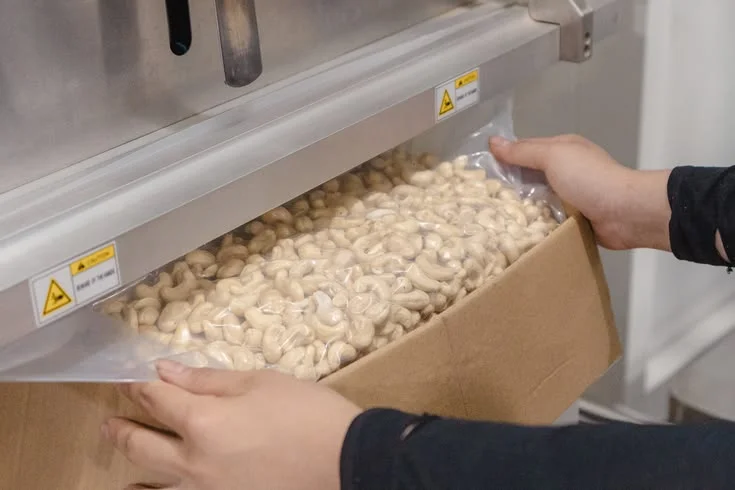
This is the core part of packaging specifications for exported cashew nuts. TCVN 4850:2010 sets out general requirements for cashew kernels but does not describe packaging construction in detail; in commercial practice, Vietnamese businesses commonly apply the AFI standard with two main packaging formats: vacuum-sealed or inert-gas-flushed PE/PA bags placed inside cartons, or sealed tin cans.
| Packaging Parameter | Specific Requirement | Reason / Notes |
|---|---|---|
| Innermost layer (bag or can) | Multi-layer laminated PA/PE bag or sealed tin can; vacuum-sealed or flushed with inert gas (nitrogen, CO2) to displace oxygen before sealing | Inert gas prevents oxidation of the oil in the kernel, preserving crispness and flavor throughout the long journey |
| Packing weight | Commonly 22.68 kg (50 lb) per PE/PA bag, or 11.34 kg (25 lb) per tin can, two cans per carton; some retail orders are packed at 5-10 kg on request | Pound-based specifications originate from the AFI standard, which the US market and many international importers use by default |
| Outer carton | 5-ply or 7-ply carton with high puncture and compression resistance; outer layer coated with a moisture-resistant film; sealed with adhesive or heavy-duty tape, no metal staples | Metal staples risk contaminating the food and are a food safety violation that many importers reject immediately upon inspection |
| Handling before container loading | Cartons stacked on quarantine-treated wooden pallets, secured with shrink wrap or strapping | Pallets provide moisture isolation from the container floor and facilitate forklift unloading at the destination port |
| Staging warehouse before loading | Enclosed, dry, clean warehouse, free of foreign odors, insects, and rodents; away from direct heat sources | Cashew kernels absorb odor and moisture from the surrounding storage environment very easily |
| Container and stowage | Sealed, dry, clean, odor-free container; cartons stowed firmly with dunnage to prevent shifting, leaving reasonable space for air circulation | Loose stowage causes cartons to topple, crush, and increases the broken-kernel ratio as the vessel rolls at sea |
4. Mandatory Labeling Requirements on Exported Cashew Nut Packaging
Labels on cashew nut packaging must simultaneously meet the requirements of Decree 37/2026/ND-CP, the content per the AFI standard commonly used in the international market, and the importing country’s specific requirements. Under Decree 37/2026/ND-CP, the labeling of exported goods follows the importing country’s law, the contract, and international treaties to which Vietnam is a party, and must not display images or content related to sovereignty disputes or other sensitive content.
| Label Information | Mandatory Content | Practical Notes |
|---|---|---|
| Product name and grade code | Product name in English (e.g. Cashew Kernel); clear grade code such as W180, W240, W320, LP, SP, SW per the AFI standard and matching the contract | Do not use the generic term “Cashew Nuts” – the grade code and kernel size must be clearly stated exactly as in the contract and the quality analysis report |
| Exporter’s and importer’s name and address | Full name and address of the Exporter and the Importer | Information must match the foreign trade contract and bill of lading to avoid confusion during customs clearance at the destination port |
| Country of origin | “Product of Vietnam” or “Made in Vietnam” | The origin stated on the label must match the C/O and customs documentation so the partner can enjoy tariff preferences under the FTAs |
| Net and gross weight | Net weight and gross weight stated in kg or lb, clearly printed | Must match the packing list, bill of lading, and customs declaration – large discrepancies when weighed at the destination port often lead to complaints |
| Production date and expiry date | Specific day, month, and year; recommended shelf life under dry storage conditions, away from direct sunlight | Mandatory under the food labeling regulations of most importing markets, and supports traceability in case of complaints |
| Lot number and traceability code | Lot/Batch Number linked to the raw material record and processing facility; standard international markings such as “This Side Up,” “Fragile,” “Keep Dry” clearly printed on the carton | The lot number allows quick traceability when the buyer files a quality complaint or when an inspection authority requests records |
| Prohibited content | No images or content related to sovereignty disputes or other sensitive content, per Decree 37/2026/ND-CP | Review any graphics or maps printed on retail packaging before mass printing, as incorrectly printed packaging is very difficult to reprocess |
5. Packaging Specifications for Exported Cashew Nuts by Format and Market
Packaging specifications for exported cashew nuts differ significantly between tin can packing, vacuum-sealed bags, and retail packaging. Businesses need to agree on the packaging format with the buyer right from the contract negotiation stage to avoid incurring repackaging costs.
Sealed Tin Can Packing
The traditional and most common format for bulk exports to the US and many European markets. Each can typically contains 11.34 kg (25 lb) of cashew kernels, flushed with inert gas and completely sealed before two cans are placed into one carton. Tin cans provide near-absolute airtightness, suitable for shipments traveling long distances and stored for extended periods, but packaging costs are higher and packing takes more time compared to bags.
Vacuum-Packed or Inert-Gas-Flushed Bags
Commonly applied for large-volume shipments to multiple markets, using multi-layer laminated PA/PE bags, typically at 22.68 kg (50 lb) per bag, placed inside 5-ply or 7-ply cartons. This packing method is lighter than tin cans, saves on shipping costs and container space, but requires tight control over bag sealing to ensure absolute airtightness throughout the journey.
Retail-Ready Packaging
For orders supplied directly to supermarket chains or distributors in the EU, US, or Australia, the packaging format shifts to small bags of 100 g to 1 kg or glass jars, with professional printed design, retail barcodes, and a complete nutrition facts panel per each market’s food labeling regulations. For roasted cashew kernels, businesses also apply TCVN 13752:2023, which specifically regulates roasted products.
From 3W Logistics’ practical experience: For shipments of cashew kernels to the US and Europe, the most frequent issues at the destination port usually stem from three packaging and documentation errors: a bag or can that is not sealed airtight, causing the kernels to oxidize and lose crispness mid-journey; the grade code printed on the packaging not matching the quality analysis report attached to the contract; and the lot number on the carton not matching the packing list. All three errors are preventable if the packing process and documentation review are carried out rigorously before the goods leave the warehouse. – Ms. Apple, CCO, 3W Logistics
6. Common Errors in Exported Cashew Nut Packaging Specifications
| Common Error | Practical Consequence | Prevention |
|---|---|---|
| Bag or can seal not airtight | Oxygen enters, causing oil oxidation in the kernels, loss of crispness, and odor change during the long journey; the buyer files a quality complaint | Check the vacuum machine, inert gas flushing, and randomly test the seal on each batch before cartoning |
| Using metal staples to seal cartons | Risk of metal contaminating the food, a serious food safety violation, and rejection during inspection at the destination port | Only use adhesive or heavy-duty tape to seal cartons; never use metal staples at any stage |
| Mixing kernel grades within the same batch | Deviates from the grade code and kernel size agreed in the contract; the buyer deducts from the price or demands regrading the entire batch | Classify and pack each grade separately right from the processing stage, and randomly inspect samples before cartoning |
| Stacking cartons without dunnage or pallets | Cartons topple and get crushed as the vessel rolls at sea; the broken-kernel ratio rises sharply, reducing the shipment’s value against the contract | Stack cartons on quarantine-treated wooden pallets, secured with shrink wrap or strapping before loading into the container |
| Labeling not matching the documentation or still using the old regulatory template | A label that deviates from the bill of lading, C/O, or contract prolongs customs clearance; a label missing content required by the buyer gets rejected | Cross-check the label against the contract, C/O, bill of lading, and Decree 37/2026/ND-CP before mass printing; process remaining stock of old-template packaging |
FAQ – Frequently Asked Questions About Exported Cashew Nut Packaging Specifications
Question 1: Should exported cashew kernels be packed in tin cans or vacuum-sealed bags?
Both formats are common, and there is no legal requirement mandating either one. Sealed tin cans maintain near-absolute airtightness, suitable for shipments stored for extended periods, but at a higher cost. Vacuum-sealed or inert-gas-flushed PA/PE bags are lighter, save on shipping cost and container space, and are preferred by many bulk importers. The final choice depends on what is agreed in the foreign trade contract.
Question 2: Which Decree currently governs labeling for exported cashew nuts?
From January 23, 2026, Decree 37/2026/ND-CP, which guides the Law on Product and Goods Quality, replaces Decree 43/2017/ND-CP and Decree 111/2021/ND-CP on goods labeling. Labels for exported goods follow the importing country’s law, the contract, and international treaties to which Vietnam is a party, and must not contain images or content related to sovereignty disputes. Packaging printed under the old regulations before January 23, 2026 may continue to be used, but for no more than two years from that date.
Question 3: What does the grade W180, W240, W320 on cashew nut packaging mean?
This is the grade code based on the number of whole kernels (W) per pound under the AFI standard commonly used in the international market: W180 means approximately 180 kernels per pound (the largest kernels, the highest price), while W240 and W320 respectively have more kernels per pound, meaning smaller kernels. Besides the W codes, there are also broken-kernel grades such as LP (large pieces), SP or SSP (small pieces), and B-B (fine fragments). The grade code on the label must match the quality analysis report attached to the contract.
Question 4: What is the HS code for exported cashew nuts and the current export tax rate?
Cashew nuts fall under HS heading 0801: 0801.31 is cashew nuts in shell (not shelled), and 0801.32 is shelled cashew nuts, further distinguished by whole or broken kernels depending on the detailed tariff schedule. Roasted or otherwise processed cashew kernels fall under HS heading 2008.19. Under the current export tariff schedule, exported cashew kernels are subject to a 0% export tax rate, allowing businesses to focus resources on packaging and quality control rather than on optimizing tax costs.
How Does 3W Logistics Support Cashew Nut Exports?
As a freight forwarding company registered as an OTI-NVOCC with an FMC (Federal Maritime Commission) bond in the United States, with over 10 years of experience shipping exported agricultural products, 3W Logistics provides an end-to-end service for cashew processing plants, businesses, and traders exporting cashew nuts – from consulting on packaging specifications for exported cashew nuts, through to customs clearance and delivery to the buyer’s warehouse in the importing country.
End-to-end export solutions from 3W Logistics:
- Packaging specification consulting and documentation review before packing: Reviewing packaging, bag or can seals, labeling, and documentation before container loading, catching errors early rather than at the destination port.
- Container booking and pallet stowage planning: Calculating the number of cartons based on container weight capacity and volume, advising on pallet stacking and dunnage suited to each route to limit broken kernels.
- Sea freight shipping to the US, EU, China, the Middle East, and other markets: Optimizing routes, transit times, and costs for each market and each packaging format.
- Customs declaration and documentation preparation: Supporting C/O, food safety test reports, phytosanitary certification when required by the importing country, and other contract-specified documents.
- Support with shipment traceability records and complaint handling: Keeping packing photos, weighing slips, lot numbers, and documentation for each batch to resolve quickly when the buyer files a complaint about weight, crispness, or grade.
Why choose 3W Logistics for exported cashew nut shipments? Correct packaging specifications are only a necessary condition. A batch of properly packaged cashew kernels can still generate complaints if the seal is not airtight, the grade code on the label does not match the quality analysis report, or the lot number does not match the documentation. We control the entire chain from the packing warehouse through to delivery, not just booking the vessel and filing the declaration. Contact 3W for specific guidance on the route and cost for your next cashew nut export shipment.
Address: 34 Bach Dang, Tan Son Hoa Ward, Ho Chi Minh City
Hotline: +84 28 3535 0087
____________________________
3W Logistics Hanoi Branch
Address: 81A Tran Quoc Toan, Cua Nam Ward, Hanoi
Hotline: +84 24 3202 0482
____________________________
3W Logistics Hai Phong Branch
Address: 8A Lot 28 Le Hong Phong, Gia Vien Ward, Hai Phong
Hotline: +84 225 355 5939
____________________________
3W LOGISTICS CO., LTD – We here serve you there!
Email: info@3w-logistics.com
Website: www.3w-logistics.com

Ms. Apple is the CCO (Chief Commercial Officer) at 3W Logistics, with over 10 years of experience in sales and business operations management.
At 3W Logistics, Ms. Apple is responsible for commercial strategy, corporate customer development, managing a team of more than 50 sales professionals, and improving business performance in the logistics sector.
With practical experience in sales management and market development, Ms. Apple shares professional insights on business logistics solutions, international transportation, freight forwarding, customer management, trade lane development, and growth strategies in the logistics industry.


