
Meeting the correct quality standards for exported cashew nuts is the condition for a shipment to be accepted by the buyer and paid for under the contract, since every batch of cashew kernels must simultaneously meet requirements for kernel size, color, broken-kernel ratio, moisture content, and the food safety thresholds of the importing country.
Vietnam is the world’s largest cashew exporter. In just the first 8 months of 2026, the cashew industry earned around USD 3.37 billion, with China and the United States as the two largest markets. At that scale, a shipment exceeding the aflatoxin threshold, with the wrong kernel size, or with incomplete documentation can all lead to delayed clearance, forced price cuts, or returned goods.
In this article, 3W Logistics compiles the current system of quality standards for exported cashew nuts – from the national TCVN standards, mandatory technical criteria, market-specific requirements, and international certifications, to the inspection and quality certificate issuance process – helping businesses proactively prepare documentation and reduce the risk of shipment rejection.
1. General Standards for Vietnamese Exported Cashew Nuts
Overview of the National Standards Applicable to Cashew Kernels
Vietnam’s exported cashew products are mainly cashew kernels – the part obtained after heating, shelling, drying, peeling the testa, and grading. The foundational technical standard for this product group is TCVN 4850:2010 (Cashew Kernels), compiled by the Coffee and Export-Import Goods Inspection Joint Stock Company (CAFECONTROL) and published by the Ministry of Science and Technology.
TCVN 4850:2010 sets out the general requirements, quality grading, and test methods for cashew kernels. Businesses need to distinguish this standard from other documents in the same processing chain:
- TCVN 4850:2010: technical requirements, grading, and test methods for finished cashew kernels.
- TCVN 12380:2018: technical requirements for raw cashew nuts used as processing raw material, including how to determine the number of nuts per 1 kg and the kernel recovery ratio.
- TCVN 12461:2018: code of hygienic practice for cashew nut processing.
- TCVN 13752:2023: roasted cashew kernels, where the testa-peeled kernel raw material must comply with TCVN 4850.
- QCVN 01-27:2010/BNNPTNT: national technical regulation on food hygiene and safety criteria for cashew kernels, issued under Circular 37/2010/TT-BNNPTNT.
Vietnam imports most of its raw cashew nuts from Africa and Cambodia for processing, so the quality of the input raw material under TCVN 12380:2018 directly affects the kernel recovery ratio and the broken-kernel ratio of the exported finished product.
Classification of Exported Cashew Kernels by Grade
Cashew kernels are classified by shape, color, and size. In export contracts, the grade is usually noted with a letter symbol along with the maximum number of kernels per pound:
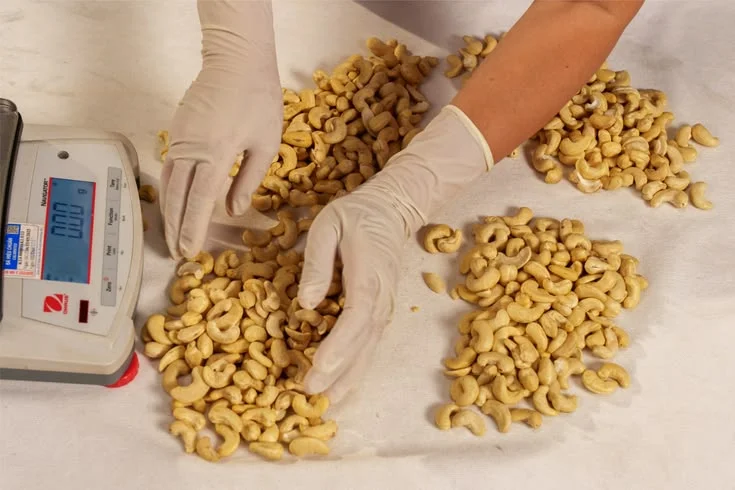
- White Wholes (W): whole or broken kernels not exceeding 1/8 of their size, white, ivory white, pale ivory, pale yellow, or pale ash-grey in color. Common sizes are W180, W210, W240, W320, and W450; the smaller the number, the larger the kernel.
- Scorched Wholes (SW): kernels that are yellow, light brown, ivory, or ash-grey due to overheating during oil-roasting or drying, for example SW240, SW320.
- Second Scorched Wholes (SSW): kernels with a deep yellow color due to overheating, which may be immature, deep ivory, pale green, or brown to dark brown in color.
- Butts and Splits: Butts are broken crosswise, with the remaining piece being smaller than 7/8 and larger than 3/8 of a whole kernel; Splits are broken lengthwise, with the two cotyledons separated and each cotyledon not broken by more than 1/8.
- Pieces: Large Pieces pass through an 8 mm screen and are retained on a 4.75 mm screen; Small Pieces pass through a 4.75 mm screen and are retained on a 2.8 mm screen; Baby Bits are fragments retained on a 1.7 mm screen.
International Trade Standards: UNECE and AFI
Besides TCVN, buyers often reference international trade standards directly in the contract. In Europe, the UNECE DDP-17 standard for cashew kernels (updated in 2023) is the most widely applied. This standard limits maximum moisture content to 5%, divides cashew kernels into three grades (Extra for white kernels, Grade I for scorched wholes, Grade II for second-scorched or dessert-grade kernels), and divides whole kernels into 7 size groups from 150 to 500 based on the maximum number of kernels per pound.
For the US market, contracts often reference the cashew kernel specifications of the American Food Industry (AFI) Association. Many Vietnamese processors also use AFI to grade cashew kernels when producing for other markets, so businesses need to cross-check this specification against TCVN 4850:2010 before finalizing the contract.
2. Mandatory Quality Criteria for Exported Cashew Kernels
Under TCVN 4850:2010, exported cashew kernels must meet general requirements for sensory characteristics, moisture content, and grade-mixing levels. Food safety criteria are controlled according to the importing country’s regulations, with the EU having the most specific thresholds. The table below summarizes the most important criteria businesses need to control before exporting.
| Criterion | Prescribed Level | Basis |
|---|---|---|
| Moisture content | Maximum 5% by weight | TCVN 4850:2010; UNECE DDP-17 |
| Residual testa | Maximum 1.5% by weight; the combined diameter of testa fragments adhering to the kernel not exceeding 2 mm | TCVN 4850:2010 |
| Cashew nut shell oil | Kernels must not be contaminated with cashew nut shell oil | TCVN 4850:2010 |
| Pests, insects, mold | No living pests, insect remains, or mold; no visible contamination when observed with the naked eye or a magnifying glass at approximately 10x | TCVN 4850:2010 |
| Odor | Natural odor, no rancidity, no foreign odor | TCVN 4850:2010 |
| Grade-mixing and broken-kernel level | Each grade must not be mixed with more than 5% of the next-lower adjacent grade, and no more than 5% broken kernels at the time of packing | TCVN 4850:2010 |
| Aflatoxin (EU market) | Aflatoxin B1 maximum 5 µg/kg; total B1, B2, G1, G2 maximum 10 µg/kg | Regulation (EU) 2023/915 |
| Cadmium (EU market) | Maximum 0.20 mg/kg wet weight | Regulation (EU) 2023/915 |
| Chlorate (EU market) | Maximum 0.1 mg/kg for tree nuts, including cashew nuts | Regulation (EU) 2020/749 |
Moisture Content Regulations
The maximum moisture content of cashew kernels is 5% by weight, a level specified in both TCVN 4850:2010 and the UNECE standard. Cashew kernels have high oil content and are moisture-sensitive, so exceeding the moisture threshold or storing in a humid environment easily causes mold, rancidity, and enzymatic changes during sea transport. The recommended practice is to keep relative humidity below 65% during storage and transport.
Kernel Size and Number of Kernels per Unit of Weight
Kernel size is a commercial criterion that determines the selling price. The symbol W320, for example, refers to white whole kernels with a maximum of 320 kernels per pound (about 454 g). The table below shows the common grades under TCVN 4850:2010.
| Group | Symbol | Kernels/kg | Kernels/pound (lb) |
|---|---|---|---|
| White Wholes | W180 | 355 – 395 | 161 – 180 |
| White Wholes | W210 | 440 – 465 | 200 – 210 |
| White Wholes | W240 | 485 – 530 | 220 – 240 |
| White Wholes | W320 | 660 – 705 | 300 – 320 |
| White Wholes | W450 | 880 – 990 | 400 – 450 |
| Scorched Wholes | SW240 | 485 – 530 | 220 – 240 |
| Scorched Wholes | SW320 | 660 – 705 | 300 – 320 |
Color, Testa, Shell Oil, and Foreign Matter
Color must be uniform within each grade. Cashew kernels that turn yellow due to overheating during oil-roasting or drying are downgraded to the SW or SSW group, while immature kernels are small in size with a wrinkled surface. Cashew kernels are also prone to insect damage, shown by black or brown spots on the surface.
Residual testa must not exceed 1.5% by weight, and kernels must not be contaminated with cashew nut shell oil (CNSL), a viscous, toxic liquid contained in the hard shell. QCVN 01-27:2010/BNNPTNT also requires that cashew kernels contain no hard, sharp, or pointed foreign matter such as metal, glass fragments, soil, or stones, and no hair or disinfectant residue.
Food Safety Criteria
QCVN 01-27:2010/BNNPTNT sets toxin limits and food hygiene and safety criteria for semi-processed cashew kernels imported, produced, and consumed in Vietnam; aflatoxin is determined under TCVN 7596:2007 using high-performance liquid chromatography. For export shipments, the importing country’s limits and contract terms are usually the decisive basis, so businesses need to test for aflatoxin, heavy metals, pesticide residue, and microorganisms according to the destination market’s requirements.
Aflatoxin deserves the most attention because it is heat-stable and is not completely eliminated by roasting or cooking. Toxin-producing fungi can develop on cashew nuts both before and after harvest under hot, humid conditions.
Packaging, Labeling, and Storage
Exported cashew kernels are typically packed in 10 – 25 kg PE bags or flexi bags placed inside cartons, or in sealed 10 kg tin cans. To extend shelf life, bags are usually vacuum-sealed and then filled with CO2 and nitrogen. Per AFI, packaging must be new, clean, dry, non-leaking, airtight, and unlined with paper on the inside.
Cartons must state the product name, the manufacturer’s or packer’s name and address, grade, gross and net weight, origin, allergen warning, and lot number. The packing list should show the lot number, production date code, and corresponding quantity for traceability when needed.
3. Quality Standards for Exported Cashew Nuts by Target Market
In addition to the national standard, each importing market has its own requirements for contaminant thresholds, facility registration, and labeling. The table below compares the core requirements across the four main market groups for Vietnamese cashew kernels. Understanding these differences determines whether a shipment clears customs smoothly.
| Criterion | EU | United States | China | Middle East (UAE, Saudi Arabia) |
|---|---|---|---|---|
| Managing authority/regulation | European Commission (Regulation (EU) 2023/915 on contaminants; pesticide MRL regulations) | FDA (US Food and Drug Administration) under FSMA; CBP | GACC (General Administration of Customs China) – Order 280 | SFDA (Saudi Arabia), each country’s own standards body, and the GSO standard of the GCC bloc |
| Pre-export conditions | Facility registration not mandatory, but importers usually require GFSI-recognized certification | Mandatory FDA facility registration and designation of a US Agent; Prior Notice must be filed for each shipment | Cross-check the registration list under Order 280; if applicable, the facility needs a GACC registration number | The importer registers the product with the managing authority; the exporter provides documentation and test results |
| Key control focus | Aflatoxin (B1 maximum 5 µg/kg), pesticide residue, chlorate, cadmium, microorganisms, allergen labeling | AFI specification, microorganisms, residues, insects, allergen labeling, lot traceability | Accurate registration information and customs declaration, intended use as food (Edible), food safety criteria | Arabic labeling, minimum remaining shelf life on arrival, Halal documentation when required by the buyer |
| Commonly referenced trade standard | UNECE DDP-17; BRCGS, IFS, FSSC 22000, or SQF certification | AFI; HACCP and FSMA compliance | Per contract (TCVN 4850:2010, AFI, or the buyer’s own standard) | Per contract and the importer’s requirements |
| Import scale from Vietnam | About 26% of Vietnam’s exported cashew kernel volume (2024) | About USD 704.5 million in the first 8 months of 2026 | About USD 839.5 million in the first 8 months of 2026 | A key market group, with the proportion varying by period |
The European Market (EU): Aflatoxin Thresholds, Residues, and Buyer Requirements
The EU market controls contaminants in food under Regulation (EU) 2023/915. For cashew nuts, the aflatoxin B1 limit is 5 µg/kg, total aflatoxin (B1, B2, G1, G2) is 10 µg/kg, and cadmium is 0.20 mg/kg. Regulation (EU) 2020/749 sets a maximum of 0.1 mg/kg for chlorate in tree nuts, including cashew nuts; this substance can be introduced from water or chlorine-based cleaning agents in the factory. Pesticide residue is controlled under EU MRLs, and many importers still require a multi-residue test report even though the hard shell has already been removed.
EU law does not mandate food safety certification for cashew kernels, but most importers require it and often audit the factory before signing a contract. Cashew nuts are an allergen, so retail labels must clearly declare them. In 2022, the RASFF rapid alert system recorded a shipment of Vietnamese cashews blocked in Italy due to aflatoxin contamination, so aflatoxin testing before packing is a step businesses should not skip.
The US Market (FDA): Facility Registration, Prior Notice, and AFI Specifications
Businesses exporting cashew kernels to the US must register their production facility with the FDA and designate a US Agent before the first shipment. Each shipment must have a Prior Notice filed with the FDA before it arrives at port, while the importer is responsible for implementing the Foreign Supplier Verification Program (FSVP) under FSMA. Missing any of these steps could result in the shipment being held or denied entry.
Contracts with US buyers typically reference AFI specifications with sizes W180, W240, W320, W450, splits, and pieces. Per AFI, cashew kernels must be packed in new, clean, dry, non-leaking, airtight cartons without paper lining; the carton label must state the product name, packer, grade, weight, origin, allergen warning, and lot number. If live insects are found in two or more cartons, the entire lot should be cold-treated at -18°C for at least 21 days.
The China Market: Order 280 and Registration Number Declaration
China is the largest market for Vietnamese cashews by value. From June 1, 2026, GACC Order 280 on the registration of overseas food production facilities replaced Order 248. Under GACC Notice No. 27 dated March 18, 2026, the list of foods requiring introduction for registration by the exporting country’s competent authority is updated regularly and includes a nut category.
Industry opinion on the extent of the impact on cashew kernels is not fully unified. The Vietnam Cashew Association (VINACAS) believes that processed cashew kernels are less affected, while some localities have guided businesses to submit applications through the Department of Crop Production and Plant Protection and register on the CIFER system. Businesses should check the latest list before signing a contract. If a facility is subject to registration, the GACC registration number must be correctly declared on the customs declaration, together with the intended use stated as food (Edible).
The Middle East Market (UAE, Saudi Arabia): Arabic Labeling and Remaining Shelf Life
The UAE and Saudi Arabia are among the key markets for Vietnamese cashews. Goods entering Saudi Arabia must be product-registered by the importer with the Saudi Food and Drug Authority (SFDA), along with documentation such as ingredients, origin, shelf life, labeling, and test results.
Label information must be in Arabic under GSO 9 of the GCC bloc; English may only be used alongside it, not as a substitute. Gulf countries also regulate the minimum remaining shelf life upon arrival at port, so the production date and expiry date need to be factored into the delivery schedule. Depending on the importer, the contract may also require additional Halal certification.
4. International Certifications Required for Exported Cashew Kernels
Food Safety Management Systems: HACCP and ISO 22000
HACCP and ISO 22000 are the foundation that a cashew processing plant needs to control hazards from raw material intake, oil-roasting, drying, and testa peeling through to grading and packing. Plants can use TCVN 12461:2018 on the code of hygienic practice for cashew nut processing to build their sanitation and hazard control program. For the US market, HACCP goes hand in hand with FSMA compliance and FDA facility registration.
GFSI-Recognized Certifications: BRCGS, IFS, FSSC 22000, and SQF
European buyers commonly require food safety certification recognized by the Global Food Safety Initiative (GFSI). The four most common programs for cashew nuts are BRCGS, IFS, FSSC 22000, and SQF. UK buyers typically require BRCGS, while IFS is more common among German retailers. Large importers also often audit the factory in person before beginning cooperation.
Other Specific Certifications: Halal, Kosher, Organic, and Sustainability
Depending on the target market, businesses may need to add: Halal for Islamic and Middle Eastern markets; Kosher for the Jewish community; organic certification (USDA Organic, EU Organic) for the premium segment. Every batch of organic cashews imported into the EU must be accompanied by an electronic certificate of inspection (e-COI), issued by a control body designated by the competent authority.
Some buyers also require sustainability certifications such as Fairtrade, Rainforest Alliance, or social responsibility assessments under SMETA, amfori BSCI, and each retailer’s own code of conduct.
5. Inspection and Quality Certificate Issuance Process for Exported Cashew Kernels
Step 1: Prepare the shipment and take samples
Inspect the shipment before container loading and take a representative sample per the method in the applicable standard or as agreed in the contract. AFI recommends test-roasting a sample (frying in vegetable oil at approximately 149°C for 2 – 3 minutes) to check the kernel color after roasting and confirm the shipment is correctly graded.
Step 2: Test the criteria at an accredited laboratory
The sample is analyzed for sensory and physicochemical criteria (moisture, kernel size, broken-kernel ratio, residual testa) as well as food safety criteria (aflatoxin, heavy metals, pesticide residue, microorganisms) at a laboratory accredited under ISO/IEC 17025, typically units meeting VILAS accreditation.
Step 3: Disinfection treatment and plant quarantine registration
Under TCVN 4850:2010, only permitted disinfectants may be used on cashew kernels, and residue levels must meet both Vietnam’s requirements and those of the importing country. When the importing country requires it, businesses register for plant quarantine with the Department of Crop Production and Plant Protection (Ministry of Agriculture and Environment) to obtain a Phytosanitary Certificate.
Step 4: Independent inspection and quality certificate issuance
Once the test results meet requirements, the shipment is issued a Certificate of Quality/Quantity (C/Q) by an independent inspection body (such as SGS, Vinacontrol, Bureau Veritas, or CAFECONTROL). This document completes the documentation set needed for export procedures and delivery to the partner.
Frequently Asked Questions About Exported Cashew Nut Standards
Question 1: What is the maximum moisture content required for exported cashew kernels?
Under TCVN 4850:2010 and the UNECE DDP-17 standard, the maximum permitted moisture content for cashew kernels is 5% by weight. This threshold helps limit mold, rancidity, and spoilage during sea transport that can last several weeks.
Question 2: What should a business new to exporting cashew nuts prepare first?
A new business should start by building a HACCP or ISO 22000 system (or a GFSI-recognized certification if targeting European buyers), completing product declaration procedures under current food safety regulations, and testing the shipment at an accredited laboratory. After that, depending on the target market, the business should add FDA facility registration (US market), a GACC registration number (China market, if applicable), and plant quarantine when required by the importing country.
Question 3: What is the aflatoxin limit for cashew kernels exported to the EU?
Under Regulation (EU) 2023/915, aflatoxin B1 in cashew nuts must not exceed 5 µg/kg and total aflatoxin (B1, B2, G1, G2) must not exceed 10 µg/kg. Since aflatoxin is not completely eliminated by roasting, businesses should test at an accredited laboratory before packing to avoid being blocked or returned at the destination port.
3W Logistics Accompanies Cashew Nut Exporting Businesses
Fully meeting quality standards for exported cashew nuts is only a necessary condition; for a shipment to reach the partner on time and at the right quality also requires a logistics process that understands each market’s requirements. With experience handling a wide range of agricultural and exported food products, and registration as an OTI-NVOCC with an FMC (Federal Maritime Commission) bond in the United States, 3W Logistics provides an end-to-end cashew nut export service for businesses:
- Documentation consulting by market: Support in preparing documentation matching the specific requirements of the EU, US, China, and Middle Eastern markets.
- Connecting with reputable testing and inspection units: Helping businesses work with independent inspection bodies to obtain quality certificates on time.
- Support with plant quarantine procedures: Assisting from registration through to obtaining the Phytosanitary Certificate, when required by the importing country.
- Expertise in long-haul cashew nut transport: Ensuring appropriate packing conditions and moisture protection to preserve the quality of cashew kernels throughout the journey.
- Electronic customs declaration and handling issues at the border checkpoint: Quickly handling any requests for additional documentation that arise during the export process.
- Sea freight shipping to the US, Europe, China, the Middle East, and other markets: Optimizing routes, transit times, and costs for each market, with support for AMS/ISF declaration for shipments to the US.
Contact 3W Logistics for specific guidance on a path to meeting standards and export procedures for cashew nuts suited to your business’s target market.
Address: 34 Bach Dang, Tan Son Hoa Ward, Ho Chi Minh City
Hotline: +84 28 3535 0087
____________________________
3W Logistics Hanoi Branch
Address: 81A Tran Quoc Toan, Cua Nam Ward, Hanoi
Hotline: +84 24 3202 0482
____________________________
3W Logistics Hai Phong Branch
Address: 8A Lot 28 Le Hong Phong, Gia Vien Ward, Hai Phong
Hotline: +84 225 355 5939
____________________________
3W LOGISTICS CO., LTD – We here serve you there!
Email: info@3w-logistics.com
Website: www.3w-logistics.com

Ms. Apple is the CCO (Chief Commercial Officer) at 3W Logistics, with over 10 years of experience in sales and business operations management.
At 3W Logistics, Ms. Apple is responsible for commercial strategy, corporate customer development, managing a team of more than 50 sales professionals, and improving business performance in the logistics sector.
With practical experience in sales management and market development, Ms. Apple shares professional insights on business logistics solutions, international transportation, freight forwarding, customer management, trade lane development, and growth strategies in the logistics industry.


