
What are refrigerated containers? Structure, role, and practical applications.

Every year, millions of tons of fresh food, pharmaceuticals, cosmetics, and temperature-sensitive chemicals travel tens of thousands of kilometers by sea and air – and still reach consumers in perfect, safe condition. This is made possible by one specialized unit: the reefer container, also known as a refrigerated container.
Unlike a standard dry container that only protects cargo from external rain and wind, a temperature controlled container precisely regulates the internal temperature throughout the entire journey – from -30°C for deep-frozen goods to 20°C for fresh flowers or pharmaceuticals. This is why the reefer container is the backbone of the entire global cold chain logistics network.
This article provides everything you need to know about refrigerated containers: from the concept, structure, dimensions, operating temperature ranges, advantages and disadvantages, to real-world applications and key considerations when using reefer container shipping in import and export operations.
1. What Is a Reefer Container?
A reefer container – also known as a refrigerated shipping container (abbreviated as RF) is a specialized transport unit equipped with an integrated refrigeration system capable of maintaining a stable internal temperature on demand, ranging from deep-frozen -30°C to positive controlled temperatures of +30°C, throughout the entire shipping journey – whether the outside environment is a hot, humid tropical port or a freezing ocean.
In appearance, a refrigerated cargo container looks quite similar to a standard container the same ISO steel frame, the same 20ft or 40ft external dimensions but with an integrated refrigeration unit mounted at the front end of the container. This is the “heart” of the reefer container, operating continuously to maintain the internal temperature at the pre-set parameters throughout the voyage.
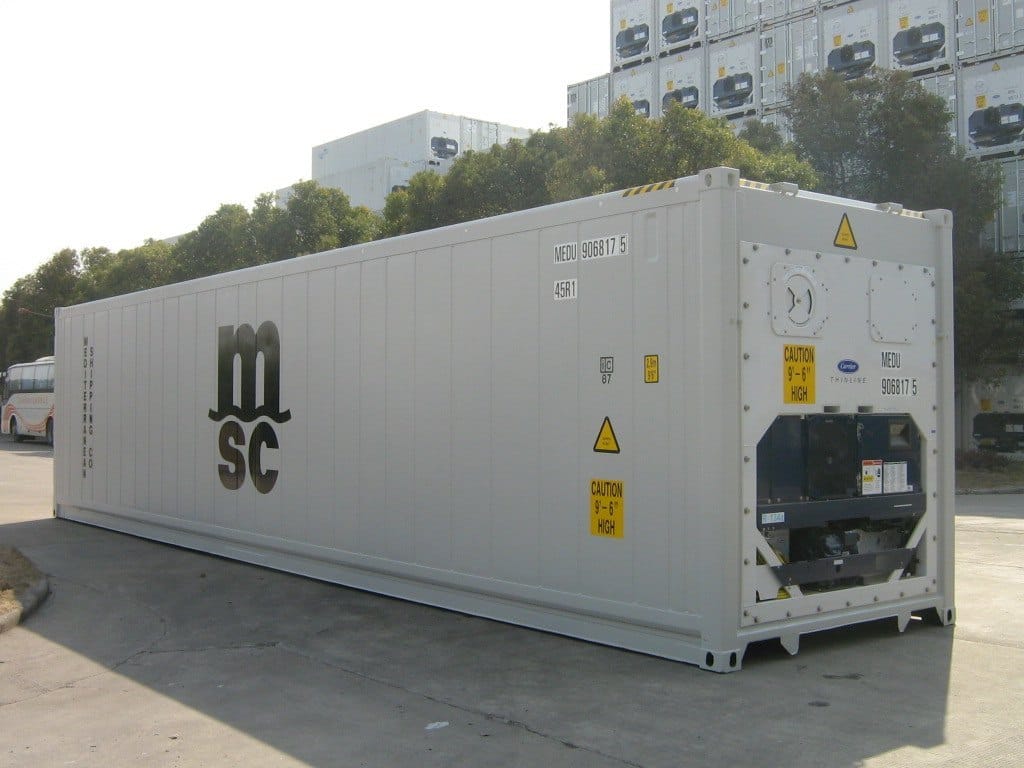
An important distinction: a refrigerated container is not a dry container retrofitted with an air conditioning unit – it is a purpose-built container designed from the ground up with specialized insulation materials, a controllable ventilation system, a T-bar floor for uniform cold air circulation beneath the cargo, and a dedicated electrical system connected to the vessel’s or terminal’s power supply.
ISO reefer containers are manufactured and operated in accordance with ISO 1496-2 and IICL (Institute of International Container Lessors) regulations, ensuring full compatibility with port infrastructure, vessels, and cargo handling equipment worldwide. Each container type serves specific cargo needs just as open-top containers and tank containers each fill a distinct role in reefer container logistics and the broader supply chain.
2. Structure and Dimensions of Refrigerated Containers
2.1 Detailed Structure of a Reefer Container
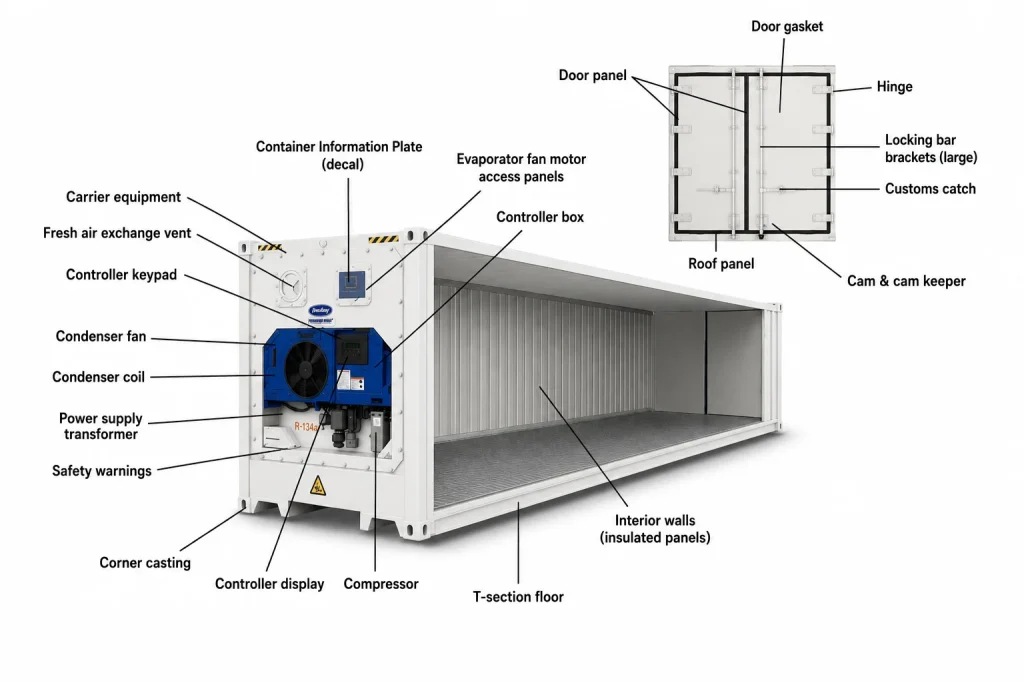
A refrigerated cargo container includes all the components of a standard dry container, plus the following specialized elements:
- Integrated Refrigeration Unit: Mounted permanently at the front wall of the reefer container. It comprises a compressor, condenser, evaporator, and cold air circulation fans. The unit runs on electricity connected to the vessel’s reefer socket while at sea, and to shore power or a generator while at the terminal.
- Polyurethane (PU Foam) Insulation: All side walls, roof, floor, and front wall are lined with 80–100mm thick PU foam insulation – significantly thicker than a dry container which has none. This is the most critical heat-retention layer, determining energy efficiency and the container’s ability to maintain temperature when the refrigeration unit temporarily stops.
- T-bar Floor: Instead of the flat wooden floor found in dry containers, refrigerated shipping containers use parallel T-shaped aluminum floor profiles that create airflow channels running the full length of the floor. Cold air flows from the refrigeration unit along these channels beneath the cargo and circulates back upward for recirculation – the key factor in maintaining uniform temperature throughout the entire container volume.
- Temperature Sensors and Data Logger: Modern reefer containers feature 2–4 temperature sensors positioned at different locations (supply air, return air, mid-container). The data logger records temperature at regular intervals (typically every 15–30 minutes) throughout the journey – providing critical legal evidence in the event of a cargo quality dispute at the destination port.
- Fresh Air Ventilation System: Adjustable ventilation valves allow precise control of fresh air intake – essential for respiring agricultural products (fruits, vegetables) that require specific levels of oxygen and CO₂ to extend shelf life during refrigerated container transport.
- Stainless Steel or Aluminum Interior Lining: All interior surfaces are covered with corrosion-resistant, easy-to-clean material that does not absorb odors – a mandatory requirement for food and pharmaceutical cargo in any cold storage container.
- Insulated Doors: The rear doors are thicker than those of dry containers, with multiple layers of airtight rubber gaskets and robust locking mechanisms. Door opening time must be minimized to prevent cold loss.
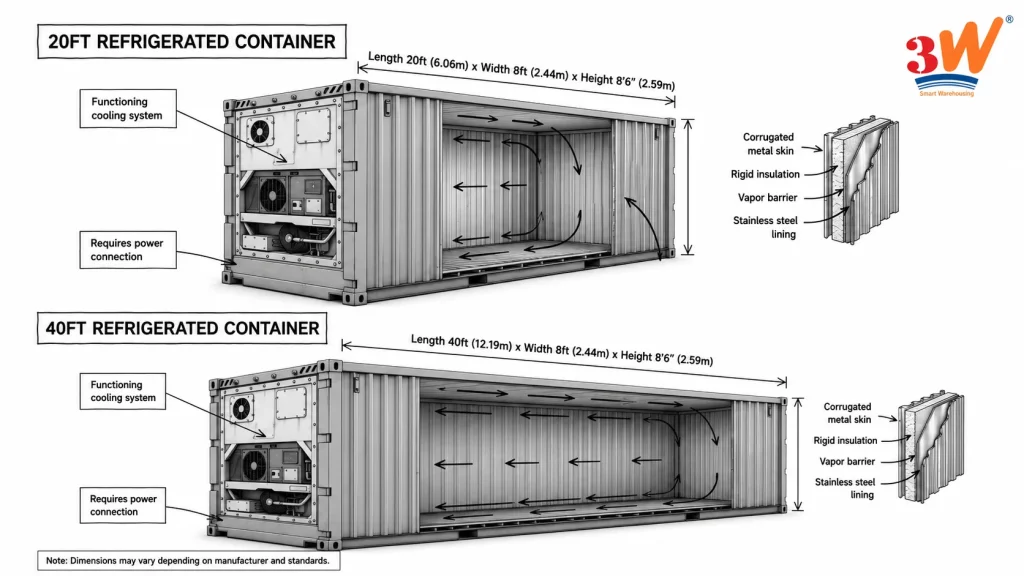
2.2 Dimensions and Technical Specifications of Standard Reefer Containers
Standard Reefer Container Technical Specifications
| Specification | 20ft Reefer Container | 40ft Reefer Container (HC) | Practical Notes |
|---|---|---|---|
| External Length | 6,058 mm (20′) | 12,192 mm (40′) | 40ft reefer containers are typically High Cube (9’6″) to compensate for space taken by the refrigeration unit |
| External Width | 2,438 mm (8′) | 2,438 mm (8′) | Same as standard dry container |
| External Height | 2,591 mm (8’6″) | 2,896 mm (9’6″) | 40ft reefer is typically taller than standard (High Cube) |
| Internal Length (usable) | ~5,380 mm | ~11,200 mm | Shorter than dry container as the refrigeration unit occupies ~50cm at the front |
| Internal Width (usable) | ~2,286 mm | ~2,286 mm | Narrower than dry container due to thicker insulation lining |
| Internal Height (usable) | ~2,250 mm | ~2,530 mm | Lower than dry container due to roof insulation and T-bar floor |
| Cargo Volume | ~28 CBM | ~67 CBM | Smaller than a dry container of the same external size due to insulation and refrigeration unit |
| Maximum Payload | ~21,000 kg | ~29,000 kg | Lower than dry container due to the tare weight of the refrigeration unit (~300–400kg) |
| Operating Temperature Range | -30°C to +30°C | -30°C to +30°C | Varies by refrigeration unit type and container manufacturer |
| Power Requirements | 380V / 32A / 3-phase | 380V / 32A / 3-phase | Requires reefer socket on vessel and at terminal |
Practical Note: The majority of 40ft reefer containers on the market are High Cube (9’6″) — not the standard 8’6″ height of dry containers. This compensates for the volume lost to thick insulation lining. When booking a reefer shipping container, always confirm the container height with the carrier to avoid discrepancies in customs declarations and port handling.
3. Operating Temperature Ranges and Cargo Classification
One of the greatest strengths of a temperature controlled container is its ability to operate across multiple temperature ranges – allowing a single container type to serve a wide variety of cold chain cargo categories:
Deep Frozen: -18°C to -30°C
Suitable for: frozen meat (beef, pork, poultry, fish), frozen seafood (shrimp, squid, crab), ice cream, and frozen dairy products. This is the most technically demanding range for any refrigerated freight container – the refrigeration unit must operate continuously without performance degradation even when the external environment reaches 40°C in tropical conditions.
Chilled: 0°C to 5°C
Suitable for: fresh (unfrozen) meat, fresh milk, cheese, eggs, and temperature-sensitive produce (lettuce, leafy vegetables, strawberries). This is the most commonly used range in premium fresh food import and export via reefer shipping containers.
Cool / Controlled Temperature: 5°C to 15°C
Suitable for: tropical fruits (ripening bananas, mangoes, avocados), sensitive vegetables, and cut flowers. For this cargo group, lower is not always better – excessive cold causes chilling injury, which can destroy the entire shipment. Proper cold chain container management is critical here.
Ambient / Warm Controlled: 15°C to 25°C
Suitable for: pharmaceuticals, vaccines, certain cosmetics, and heat-sensitive chemicals that must avoid high temperatures but do not require actual refrigeration. In these cases, the refrigerated container functions as a precision temperature control chamber rather than a true cold storage unit.
4. The Role of Reefer Containers Across Transport Modes
Ocean Freight
Sea freight is the most widely used mode for reefer container shipping, handling large-volume, long-distance shipments. Modern container vessels are equipped with thousands of reefer sockets on deck and in their holds, providing continuous power to the refrigeration unit of each ISO reefer container throughout the voyage. This is why frozen shrimp from Ca Mau, dragon fruit from Binh Thuan, and fresh coffee from Dak Lak can reach supermarket shelves in Japan or Europe in perfect condition.
Road Freight
Refrigerated trucks handle the cargo collection phase – from factory or farm to cold storage warehouse or export port – and the last-mile delivery from the destination port to the consignee’s distribution center. Any break in the cold chain at any stage can ruin the entire shipment. This is precisely why reefer logistics demands seamless coordination across all transport modes.
Rail and Air Freight
Refrigerated containers can also be transported by rail on routes equipped with reefer power infrastructure. For extremely high-value cargo requiring rapid transit (specialist pharmaceuticals, vaccines, medical specimens), air freight using dedicated thermal shippers or dry ice containers is an alternative – though at significantly higher cost than reefer transportation by sea.
5. Advantages and Disadvantages of Reefer Containers
Advantages
- Precise temperature maintenance over long voyages: This is the unmatched advantage of refrigerated shipping containers. A reefer unit can hold internal temperature stable within ±0.5°C of the set point throughout a 20–30 day ocean voyage – a level of precision no other transport method can replicate.
- Preserves fresh cargo and extends shelf life: For frozen seafood, meat, and fresh fruit, reefer container shipping enables transoceanic transport without significant quality degradation, opening global export markets to Vietnam’s agricultural and food products.
- Continuous temperature monitoring with full documentation: The data logger records the complete temperature history of every cold chain container voyage – providing transparent legal evidence in the event of a cargo quality dispute at the destination port. International buyers increasingly require temperature reports as part of the shipping document set.
- Controlled ventilation for respiring cargo: Ventilation valves allow fine adjustment of O₂ and CO₂ levels, extending the shelf life of respiring fruits and vegetables without the need for more costly Controlled Atmosphere (CA) storage.
- ISO compatibility — operable on any trade lane: ISO reefer containers are compatible with ports, vessels, and logistics infrastructure worldwide, allowing cargo to move across multiple transport modes and countries without transloading.
Disadvantages
- Hire cost 2–3 times higher than dry containers: Reefer containers are significantly more expensive due to the cost of the refrigeration unit, regular maintenance, and the reefer surcharge carriers levy to offset the cost of on-vessel power supply. This is why many businesses seek to optimize usage or explore insulated dry container alternatives when feasible.
- Dependence on continuous power supply: If power is lost during terminal storage or while awaiting vessel loading, internal temperatures rise quickly and cargo can be damaged within hours. This risk requires a clear contingency plan – backup generators and priority loading schedules are essential in reefer freight operations.
- Smaller usable volume than a dry container of the same external size: Due to thick insulation and the space occupied by the refrigeration unit, a 20ft refrigerated cargo container holds only ~28 CBM versus ~33 CBM for a standard dry container – a ~15% volume reduction that directly affects cargo efficiency and per-unit logistics cost.
- Strict sanitation requirements between shipments: Cold storage containers used for food must be thoroughly cleaned and sanitized before each cargo load – especially when switching between meat and produce or vice versa. Cleaning time and cost are a significant recurring expense in reefer container logistics.
- Lower availability than dry containers during peak season: The global fleet of reefer shipping containers is considerably smaller than that of dry containers. During Vietnam’s peak agricultural export seasons (lychee, mango, dragon fruit), reefer units can be in short supply and must be booked 2–3 weeks in advance.
6. Real-World Applications of Reefer Containers in Import and Export
Frozen Seafood — Vietnam’s Billion-Dollar Export Industry
Shrimp, pangasius, tuna, squid, and processed frozen seafood products are the cargo categories that rely most heavily on reefer containers in Vietnam. Transport temperatures are typically -18°C to -22°C. A single 40ft refrigerated freight container can hold approximately 18–22 tonnes of frozen shrimp — equivalent to 1–2 weeks of output from a mid-sized processing facility.
Fresh Fruit and Agricultural Produce for Export
Dragon fruit (Binh Thuan, Long An), mango (Dong Thap, Tien Giang), lychee (Bac Giang, Hai Duong), longan, and pomelo exported to China, the EU, and the US all require reefer shipping containers with temperature settings optimized per variety: green mango for Japan at 10–13°C, dragon fruit for the EU at 5–8°C, and lychee for the UK at 1–3°C.
Meat and Livestock Products
Frozen beef imported from Australia and the US, pork from Europe, and chicken from Brazil – all meat imports into Vietnam move via refrigerated containers at -18°C to -22°C. Veterinary quarantine procedures at the import port are stringent and require a continuous temperature log from the entire reefer transportation journey.
Pharmaceuticals, Vaccines, and Biomedical Products
This is the most demanding cargo category – not only in terms of temperature, but also stability (even brief temperature excursions cannot be tolerated). Vaccines typically require 2–8°C and must never freeze. Specialized biologics may require -70°C (cryogenic conditions). 3W Logistics partners with specialist pharmaceutical logistics providers to meet GDP (Good Distribution Practice) standards for this cargo group under the most rigorous cold chain container protocols.
Cosmetics and Temperature-Sensitive Chemicals
Certain premium cosmetics, essential oils, and industrial chemicals that are susceptible to degradation, alteration, or loss of efficacy when exposed to temperatures above 25–30°C require temperature controlled containers operating in cool mode rather than deep-frozen mode.
Cut Flowers and Plant Material
Roses, chrysanthemums, and lilies exported to Japan, South Korea, and the EU require temperatures of 1–5°C and high relative humidity (90–95%) throughout transit. This is an exceptionally sensitive cargo category for reefer freight a 1–2°C deviation from the set point can cause premature blooming or chilling injury, destroying the entire commercial value of the shipment.
7. Documentation for Reefer Container Shipments
Reefer container shipments require a more comprehensive document set than dry container shipments – in addition to standard commercial documents, they also require specific quarantine certificates and temperature confirmation records. Below is a breakdown by the three main parties involved:
Documents Prepared by the Shipper
- Commercial Invoice: Reflects the value of the goods, buyer and seller details, and international payment terms.
- Packing List: Details the number of packages, weight, dimensions, and loading method. For refrigerated container shipments, the required storage temperature must be clearly stated.
- Sales Contract: The trade agreement between both parties, including temperature transport conditions where applicable for cold chain cargo.
- Shipping Instruction (SI): Must clearly state the required temperature set point, ventilation settings, and any special handling requirements for the reefer shipping container — submitted to the forwarder and carrier.
- Certificate of Origin (C/O): Proof of goods’ country of origin to claim FTA preferential tariff rates.
- Phytosanitary / Health Certificate: Mandatory for food products, agricultural produce, meat, and seafood. Issued by veterinary or plant quarantine authorities following inspection of the cargo before stuffing into the cold storage container.
- VGM (Verified Gross Mass): Confirmation of the total weight of the packed reefer container before vessel loading.
- Reefer Set Point Confirmation: Written confirmation of the refrigeration unit’s temperature set point — typically provided by the shipper or forwarder to the carrier before vessel departure.
Documents Prepared by the Freight Forwarder
- Booking Confirmation (Reefer): Confirms the reefer container booking, vessel schedule, and the number of reefer sockets allocated by the carrier.
- Customs Declaration: Import/export customs filing – for refrigerated cargo container shipments, the correct HS code and storage conditions must be declared.
- Debit Note / Logistics Invoice: Includes the reefer surcharge (power supply fee) and other charges specific to reefer logistics operations.
- Pre-trip Inspection (PTI) Report: Confirms that the ISO reefer container has been inspected and the refrigeration unit is functioning correctly at the required set point before handover to the shipper for stuffing.
- Support for C/O, Phytosanitary, and Health Certificate Applications: The forwarder assists the shipper in preparing and submitting quarantine and inspection permit applications on time.
Documents Issued by the Carrier
- Bill of Lading (B/L): Must clearly state the transport temperature, reefer container number, and any special conditions for the cold chain shipment.
- Temperature Record / Download Report: The temperature report extracted from the container’s data logger – provided by the carrier upon request, and especially critical for pharmaceutical and premium food shipments via refrigerated container transport.
- Manifest: The cargo declaration submitted to customs at both the port of loading and port of discharge.
- Delivery Order (D/O): The release order authorizing the consignee to collect the reefer container at the port or cold storage facility.
- EIR (Equipment Interchange Receipt): A container handover receipt confirming the condition of the unit and the refrigeration system at both pickup and return.
- Arrival Notice: Notification to the consignee that the shipment has arrived at the destination port, with the information needed to complete cargo collection procedures.
Having a complete and accurate documentation set for reefer container shipments — particularly quarantine certificates and temperature confirmation records – helps businesses avoid cargo holds at port, import refusals, or cargo quality disputes with overseas partners in reefer freight operations.
8. How 3W Logistics Supports Your Reefer Container Shipments
Refrigerated container transport is far more complex than standard dry cargo – a wrong temperature setting, a missed vessel, or a missing quarantine certificate can destroy an entire shipment worth hundreds of millions of Vietnamese dong. 3W Logistics provides end-to-end support across every stage of reefer container logistics:
- Temperature and container type consultation: Based on cargo type, transit time, and buyer requirements, the 3W team advises on the optimal temperature set point, whether a 20ft or 40ft reefer container is appropriate, and any additional conditions (ventilation, humidity) needed for the shipment.
- Reefer container booking with priority reefer socket allocation: 3W works directly with major carriers (Maersk, MSC, CMA CGM, Hapag-Lloyd, and others) to secure reefer shipping container bookings on time and confirm reefer socket slots — especially critical during peak season when refrigerated containers are in short supply.
- Pre-trip Inspection (PTI) before cargo stuffing: 3W coordinates with the container depot to conduct a full Pre-trip Inspection, confirming that the refrigeration unit is operating at the correct set point, has no leaks, and the door gaskets are fully sealed before the cold storage container is handed over to the shipper for loading.
- Quarantine permit and specialist documentation support: From Phytosanitary Certificates (agricultural produce, cut flowers), Health Certificates (meat, seafood), to country-specific import permits, 3W assists in preparing and submitting all documentation on time for every cold chain container shipment.
- Full customs clearance and trade document handling: Electronic customs filing, Certificate of Origin application, and preparation of the complete international payment document set (B/L, Invoice, Packing List, Certificates) — 3W manages everything end-to-end so clients can focus on production and business.
- Temperature monitoring and real-time shipment updates: After cargo is loaded, 3W monitors reefer data (actual temperature readings, refrigeration unit status where available from the carrier) and provides regular updates to clients — enabling early detection of any anomaly during reefer transportation.
A note from 3W Logistics’ field experience: One of the most common mistakes in reefer freight is stuffing cargo into a refrigerated container before the cargo itself has reached the required temperature. The cargo must be pre-cooled to the target temperature before loading — a reefer container is designed to maintain temperature, not to pull down the temperature of warm cargo (attempting to do so takes a very long time and rarely achieves uniform temperature distribution). Always pre-cool cargo in a cold storage facility first, then transfer it directly into the reefer shipping container. Contact 3W Logistics for the correct process guidance from the very first step.
Head Office – 3W Logistics Ho Chi Minh City Branch
Address: 34 Bach Dang Street, Tan Son Hoa Ward, Ho Chi Minh City
Hotline: +84 28 3535 0087
____________________________
3W Logistics Hanoi Branch
Address: 81A Tran Quoc Toan Street, Cua Nam Ward, Hanoi
Hotline: +84 24 3202 0482
____________________________
3W Logistics Hai Phong Branch
Address: 8A Lot 28 Le Hong Phong Street, Gia Vien Ward, Hai Phong
Hotline: +84 225 355 5939
____________________________
3W LOGISTICS CO., LTD – We here serve you there!
Email: quote@3w-logistics.com
Website: www.3w-logistics.com


