

Wooden furniture export procedures in Vietnam operate on the foundation of the Vietnam Timber Legality Assurance System (VNTLAS) under Decree 102/2020/ND-CP, combined with increasingly stringent requirements from international markets — particularly the EU Deforestation Regulation (EUDR), whose application deadline has just been pushed back to December 30, 2026.
This is one of Vietnam’s flagship export industries, with thousands of wood processing businesses nationwide, but it is also a product category subject to strict control over material origin to prevent illegal timber from entering the export supply chain.
Unlike many ordinary agricultural products, wooden furniture export procedures require businesses to prove the legality of their wood materials throughout the entire supply chain, from procurement to the moment the finished product leaves Vietnam. The article below compiles the full legal basis, conditions, HS codes, procedures, costs, and common risks involved in wooden furniture export procedures, updated according to the latest applicable regulations.
1. Potential and characteristics of Vietnam’s wooden furniture export industry
Vietnam is one of the world’s leading exporters of wooden furniture, with major processing hubs in Binh Duong, Dong Nai, Ho Chi Minh City, and the Central region. Wooden tables and chairs — including household furniture as well as office and outdoor furniture — form the flagship product group within wooden furniture export procedures specifically, and the wood industry more broadly.
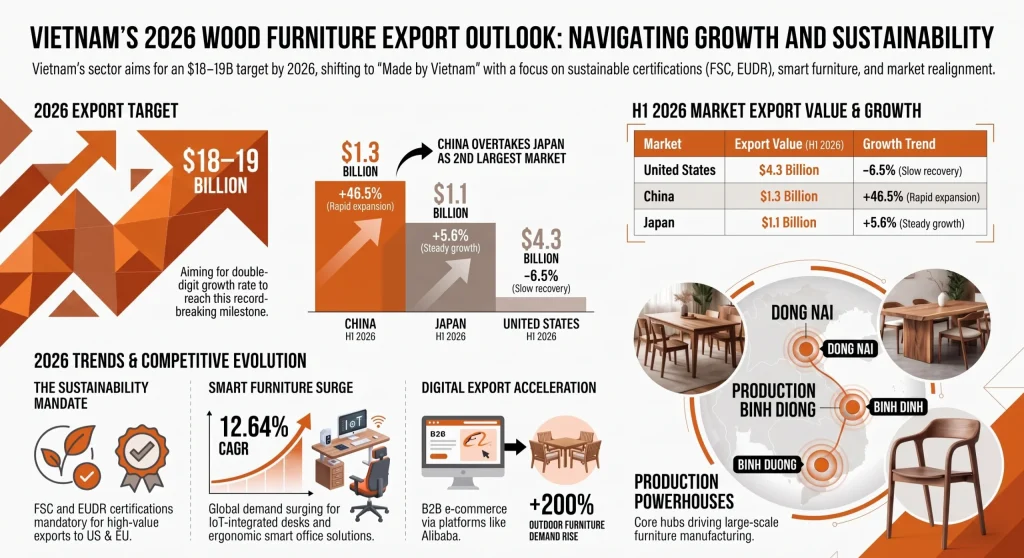
The U.S., the EU, Japan, South Korea, and China continue to be the main export markets, each with its own specific requirements: the U.S. applies the Lacey Act to control legal timber sourcing; the EU is about to apply the EUDR, requiring proof that wood is not linked to deforestation after 2020; while Asian markets tend to focus more on phytosanitary standards and product quality.
2. Legal basis governing wooden furniture export procedures
| Legal document | Content regulated |
|---|---|
| Decree 102/2020/ND-CP | Establishes the Vietnam Timber Legality Assurance System (VNTLAS), classifies businesses into Group I/Group II, governs wood origin verification, and FLEGT licensing |
| Circular 26/2022/TT-BNNPTNT | Regulates forestry product traceability, replacing most of the content of Circular 27/2018/TT-BNNPTNT |
| Decree 06/2019/ND-CP, Decree 84/2021/ND-CP | Governs management of endangered, precious, and rare forest flora and fauna, and enforcement of the CITES Convention |
| EUDR (EU) 2023/1115 | Requires proof that timber and timber products exported to the EU are not linked to deforestation after December 31, 2020; large/medium enterprises must comply from December 30, 2026 |
| Circular 38/2015/TT-BTC, amended by Circular 39/2018/TT-BTC | Customs procedures and supervision for exported goods |
Important update: After two postponements, the EUDR is now officially set to become mandatory for large and medium-sized enterprises starting December 30, 2026; micro and small enterprises in the wood sector must still comply by the same deadline, as they are not granted additional extension time like other industries. Businesses exporting wooden furniture to the EU need to urgently review their supply chains and prepare a Due Diligence Statement (DDS) now, so as not to be caught off guard once the regulation takes effect.
3. Conditions for businesses and wood materials
| Condition | Issuing/managing authority | Note |
|---|---|---|
| Wood processing enterprise classification (Group I/Group II) | Forest Protection authority | Group I enterprises benefit from a reduced rate of documentation checks during customs declaration |
| Legal forestry product origin documentation | Self-prepared and retained by the enterprise under Circular 26/2022/TT-BNNPTNT | Must be chronologically consistent between the material purchase invoice and the finished product export date |
| CITES export permit (for rare timber listed under the Appendices) | Vietnam CITES Management Authority | Applies to rosewood, Hopea (huong) wood, and other rare species under the controlled list |
| FLEGT license (not mandatory, but encouraged) | Forest Protection authority | Shipments with FLEGT receive priority customs processing; a major advantage when exporting to the EU |
4. HS codes and export duties for wooden furniture
Wooden tables and chairs fall under Chapter 94 — “Furniture; bedding, mattresses, mattress supports, cushions and similar stuffed furnishings” — with heading 94.03 covering other furniture (tables, cabinets) and heading 94.01 covering seats. Correctly determining the HS code according to product type is an important step in wooden furniture export procedures.
| Product type | HS code (Vietnam) | Vietnam export duty | Note |
|---|---|---|---|
| Wooden seats (upholstered or not) | 9401.61/9401.69 | 0% | Distinguished by whether or not it has a padded frame |
| Wooden tables for kitchen, dining room, living room use | 9403.60 | 0% | The most common code group for household wooden tables |
| Wooden outdoor furniture | 9403.40/9401.61 | 0% | Usually requires more thorough anti-termite and waterproofing treatment |
| Wooden office furniture | 9403.30 | 0% | Applies to wooden desks and office filing cabinets |
Practical note: Export duty on wooden furniture in Vietnam is currently 0% for most HS codes under Chapter 94. Businesses should note that sawn timber and raw wood material not yet processed into a finished product fall under a different code group (Chapter 44) and may be subject to a different management policy than finished furniture products.
5. Documentation package for wooden furniture export procedures
| Document | When to prepare | Important note |
|---|---|---|
| Sales Contract | Before manufacturing and packing | Must clearly state Incoterms, specifications, and the type of wood used |
| Export timber declaration form (Form No. 05/06, Appendix I of Decree 102/2020/ND-CP) | Before export, prepared by the shipment owner | Group II enterprises or wood owners outside Group I need additional confirmation from the local Forest Protection authority |
| CITES export permit (for rare timber listed under the Appendices) | Before goods reach the port | Mandatory to submit to the customs authority during procedures; cannot be replaced by another document |
| Fumigation Certificate | After container loading, before yard drop-off | Required by most markets to prevent insects and wood-boring pests in wood products |
| Commercial Invoice and Packing List | After packing, before customs declaration | Value must match the contract and the bill of lading |
| Certificate of Origin (C/O) | After the export declaration is issued | Required to enjoy preferential tariffs under the relevant FTA for the destination market |
| Export customs declaration (VNACCS) | Before customs clearance | Declare the correct HS code for tables or chairs, attaching the timber declaration form |
6. Wooden furniture export procedure steps
Step 1: Confirm enterprise classification and wood material origin
The enterprise checks its Group I/Group II classification with the Forest Protection authority, while fully preparing legal forestry product origin documentation for all wood materials used — this is the foundational first step in wooden furniture export procedures.
Step 2: Verify wood origin before export (if applicable)
For wood owners not classified under Group I, or shipments exported to the EU, submit documentation to the local Forest Protection authority to obtain wood origin verification; shipments sourced from domestically planted forests and exported to markets outside the EU are exempt from this verification.
Step 3: Sign the contract and manufacture according to the order
Agree with the importer on specifications, dimensions, and wood type, then proceed with manufacturing, surface finishing, and packing the wooden furniture according to the agreed standards.
Step 4: Apply for a Fumigation Certificate
After loading the goods into the container, the enterprise declares the shipment and bill of lading information to a fumigation company to obtain the certificate before drop-off at the export yard.
Step 5: Complete the documentation package and declare customs export
The enterprise or its forwarder prepares the invoice and packing list, and declares the electronic customs declaration on the VNACCS system, attaching the export timber declaration form, the fumigation certificate, the CITES permit (if applicable), and a C/O matching the FTA of the destination market.
Step 6: International transport and import clearance in the destination country
Once the declaration is cleared, the goods are handed over to a sea carrier by container. The importer coordinates with the local customs authority to complete import procedures; for the EU market specifically, a Due Diligence Statement (DDS) under the EUDR must be submitted once the regulation takes effect.
7. Timeline, costs, and common risks
| Stage | Estimated time | Note |
|---|---|---|
| Wood origin verification (if applicable) | 1 – 3 working days | At the local Forest Protection authority, district level or above |
| Applying for the fumigation certificate | 0.5 – 1 day | After container loading, before yard drop-off |
| Export customs declaration (VNACCS) | 0.5 – 1 day | Faster if the enterprise is classified under Group I and the declaration is routed to the green channel |
| Sea transport | 15 – 35 days | Depending on the market: U.S., EU, or Asia |
| Risk | Manifestation | Prevention |
|---|---|---|
| Chronologically inconsistent wood origin documentation | Suspected origin fraud, delayed customs clearance, or additional investigation | Carefully cross-check the material purchase invoice against the finished product export date |
| EUDR documentation not yet prepared for the EU market | Customs clearance denied in the EU once the regulation officially takes effect from December 30, 2026 | Proactively review the supply chain and prepare the Due Diligence Statement early |
| Missing CITES permit for rare timber | Goods held or confiscated at customs | Carefully check whether the wood species used falls under a CITES Appendix before manufacturing |
| Termites or insects present in the wood product | Goods rejected for import at the destination port due to quarantine violations | Carry out complete, properly executed fumigation before export |
8. FAQ – Frequently asked questions about wooden furniture export procedures
Question 1: Do all wooden furniture export shipments require wood origin verification?
No. Shipments sourced from domestically planted forest wood and exported to markets outside the EU are exempt from wood origin verification; this requirement mainly applies to enterprises not classified under Group I, or shipments exported to the EU.
Question 2: How does the EUDR affect wooden furniture export procedures to the EU?
From December 30, 2026, large and medium-sized enterprises exporting wooden furniture to the EU must include a Due Diligence Statement (DDS), proving that the raw wood is not linked to forest land deforested after December 31, 2020.
Question 3: What is the current export duty on wooden furniture in Vietnam?
Wooden furniture under Chapter 94 enjoys a 0% export duty rate in Vietnam for most common HS codes.
Question 4: What is the difference between Group I and Group II enterprises in wooden furniture export procedures?
Group I enterprises are those with a strong compliance record and a well-organized system for managing wood origin documentation, benefiting from a reduced rate of paper documentation checks during customs declaration, while Group II enterprises or other wood owners require an additional verification step from the local Forest Protection authority.
How does 3W Logistics support wooden furniture export procedures?
As a freight forwarding company registered as an OTI-NVOCC with an FMC bond in the United States, holding an SCAC Code to self-file AMS/ISF declarations directly, 3W Logistics supports businesses through the entire wooden furniture export procedure — from wood origin documentation advisory and coordinating fumigation through to customs clearance in the importing country.
Full-package logistics service at 3W Logistics:
- Wood origin documentation advisory and EUDR updates: Guiding businesses in preparing the export timber declaration form and reviewing supply chains to meet EUDR requirements for the EU market.
- Support connecting to obtain the fumigation certificate and CITES permit (if applicable): Coordinating with fumigation providers and CITES authorities so shipments have complete documentation on time.
- Booking vessels and container transport: Arranging sea transport to the U.S., EU, and Asian markets, optimizing costs for bulky cargo such as wooden furniture.
- Electronic customs declaration (VNACCS): A professional team handles declarations and cross-checks HS codes; as an OTI-NVOCC with FMC and an SCAC Code, 3W Logistics directly issues its own HBL and self-files AMS/ISF for shipments bound for the U.S.
Why choose 3W Logistics: With offices in Ho Chi Minh City, Hanoi, and Hai Phong, and a team knowledgeable in wood industry regulations that stays closely updated on everything from VNTLAS to the EUDR, 3W Logistics ensures wooden furniture shipments clear customs on time and to standard, right from the very first export. – Ms. Apple, CCO of 3W Logistics
Head Office – 3W Logistics Ho Chi Minh City Branch
Address: 34 Bach Dang, Tan Son Hoa Ward, Ho Chi Minh City
Hotline: +84 28 3535 0087
____________________________
3W Logistics Hanoi Branch
Address: 81A Tran Quoc Toan, Cua Nam Ward, Hanoi
Hotline: +84 24 3202 0482
____________________________
3W Logistics Hai Phong Branch
Address: 8A Lot 28 Le Hong Phong, Gia Vien Ward, Hai Phong
Hotline: +84 225 355 5939
____________________________
3W LOGISTICS CO., LTD – We here serve you there!
Email: quote@3w-logistics.com
Website: www.3w-logistics.com

Ms. Apple is the CCO (Chief Commercial Officer) at 3W Logistics, with over 10 years of experience in sales and business operations management.
At 3W Logistics, Ms. Apple is responsible for commercial strategy, corporate customer development, managing a team of more than 50 sales professionals, and improving business performance in the logistics sector.
With practical experience in sales management and market development, Ms. Apple shares professional insights on business logistics solutions, international transportation, freight forwarding, customer management, trade lane development, and growth strategies in the logistics industry.


