

Wood chips export procedures have one important difference compared to most other wood and wood-product categories in Vietnam: this is one of the few forestry export products still subject to a 2% export duty, rather than the 0% rate enjoyed by wooden furniture or wood pellets.
Wood chips are a product ground from raw wood material (mainly acacia and eucalyptus from planted forests), used primarily to supply the pulp and paper industries in China, Japan, and South Korea, with export volumes growing steadily year after year.
Having a clear understanding of wood chips export procedures – from the legal basis and HS codes to tax policy and the process itself – is a prerequisite for businesses to operate efficiently. The article below compiles everything necessary, updated according to the latest applicable regulations.
1. Potential and current status of Vietnam’s wood chips exports
Vietnam is currently one of the world’s largest exporters of wood chips, with raw materials mainly sourced from planted acacia and eucalyptus forests in the Central, Northeast, and Central Highlands regions. Wood chip mills are concentrated in areas with convenient seaport access, such as Quang Ninh, Thanh Hoa, Nghe An, Quang Ngai, and Binh Dinh, creating favorable conditions for wood chips export procedures by sea.
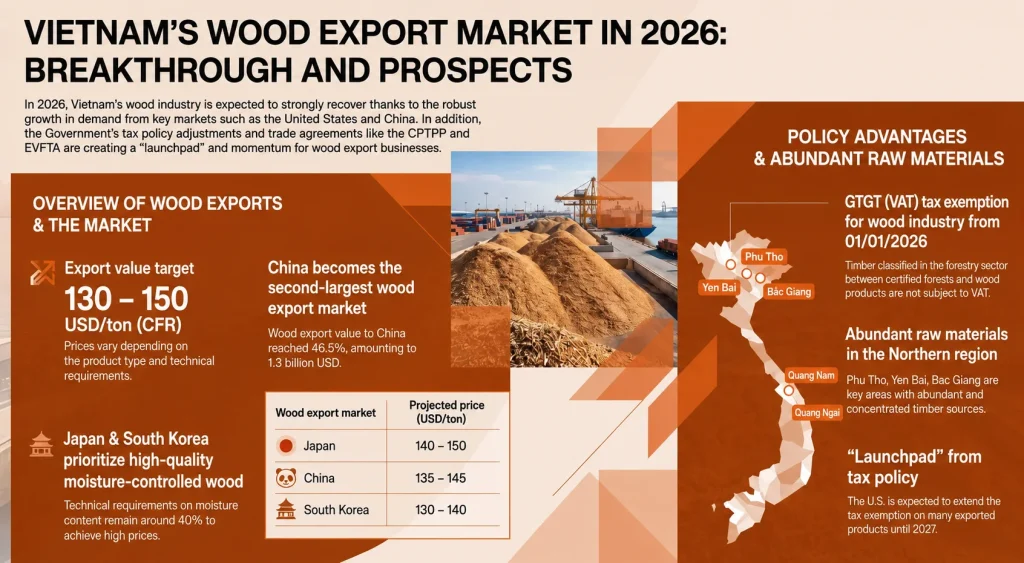
China, Japan, and South Korea are Vietnam’s three largest wood chip consumer markets, mainly supplying pulp and paper mills. Wood chip export turnover in recent years has continuously recorded significant growth, confirming this industry’s position within Vietnam’s overall wood and forestry product exports.
2. Legal basis governing wood chips export procedures
| Legal document | Content regulated |
|---|---|
| Decree 102/2020/ND-CP | Establishes the Vietnam Timber Legality Assurance System (VNTLAS), enterprise classification, and wood origin verification |
| Circular 26/2022/TT-BNNPTNT | Regulates forestry product traceability, requiring a forestry product declaration form based on raw material purchase invoices |
| Decree 26/2023/ND-CP | Preferential export and import tariff schedule; sets a separate 2% export duty rate for wood chips (HS codes 4401.21.00.90 and 4401.22.00.90) |
| Decree 69/2018/ND-CP | Wood chips fall under the category of freely exportable goods, not requiring a specialized export license from the Ministry of Industry and Trade |
| Circular 38/2015/TT-BTC, amended by Circular 39/2018/TT-BTC | Customs procedures and supervision for exported goods |
This is the fundamental legal framework that businesses need to understand clearly in order to correctly carry out wood chips export procedures, especially the specific tax policy applicable to this product.
3. Conditions for businesses and wood chip materials
| Condition | Issuing/managing authority | Note |
|---|---|---|
| Forestry product declaration form proving origin | Self-prepared by the enterprise under Circular 26/2022/TT-BNNPTNT | Based on raw wood material purchase invoices, proving no use of illegally harvested wood from natural forests |
| Wood processing enterprise classification (Group I/Group II) | Forest Protection authority | Group I enterprises benefit from a reduced rate of documentation checks during customs declaration |
| No specialized export license required | Not applicable | Wood chips are freely exportable goods under Decree 69/2018/ND-CP |
| Phytosanitary certificate (if required by the market) | Plant quarantine authority | Ensures no bacteria, fungal pathogens, or harmful insects are carried into the importing country |
4. HS codes and export duties for wood chips
Wood chips fall under Chapter 44 — “Wood and articles of wood; wood charcoal” — heading 44.01, “Fuel wood, in logs, in billets, in twigs, in faggots or in similar forms; wood in chips or particles; sawdust and wood waste and scrap.” Correctly determining the HS code based on the type of raw wood material (coniferous or non-coniferous) is an important step in wood chips export procedures.
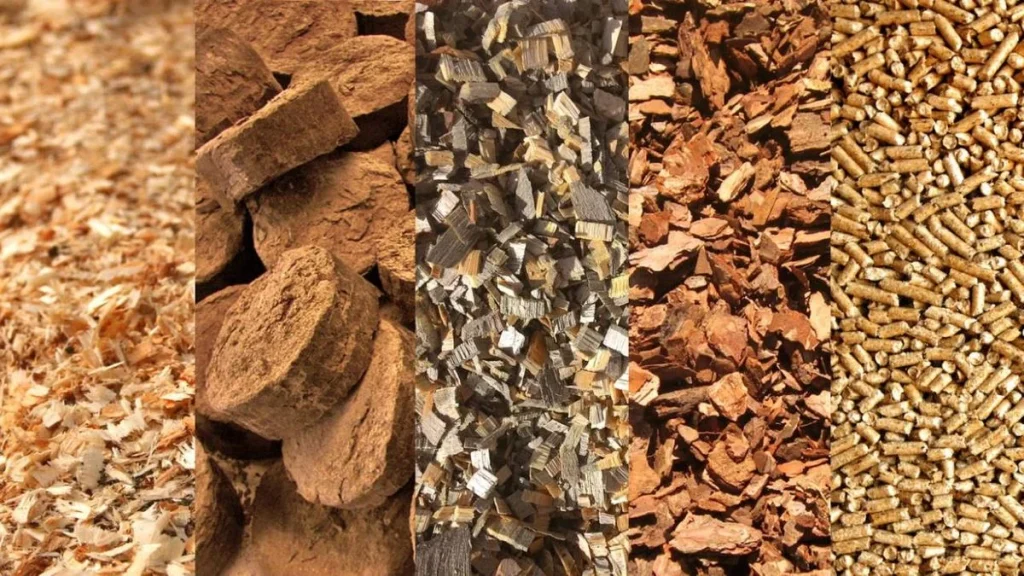
| Product type | HS code (Vietnam) | Vietnam export duty | Note |
|---|---|---|---|
| Wood chips from coniferous trees (pine and similar species) | 4401.21.00.90 | 2% | Less common in Vietnam compared to non-coniferous wood chips |
| Wood chips from non-coniferous trees (acacia, eucalyptus, rubber) | 4401.22.00.90 | 2% | The most common code group, accounting for the majority of Vietnam’s wood chip export turnover |
| Wood pellets | 4401.31 | 0% | Significantly different from wood chips, as it has already been processed and compressed into pellets |
Practical note: Unlike most other wood and wood-product categories, which currently enjoy a 0% export duty, wood chips under HS codes 4401.21.00.90 and 4401.22.00.90 still carry a 2% export duty under the current export tariff schedule. This policy has remained stable for many years, even though wood industry associations have repeatedly petitioned for it to be adjusted to 0% to reduce cost pressure on businesses, especially during periods of market volatility.
5. Documentation package for wood chips export procedures
| Document | When to prepare | Important note |
|---|---|---|
| Sales Contract | Before manufacturing and delivery | Must clearly state Incoterms, moisture content, allowable impurity level, and type of raw wood |
| Forestry product declaration form proving wood origin | Based on raw material purchase invoices | Mandatory under Circular 26/2022/TT-BNNPTNT; without this document, goods cannot clear customs |
| Commercial Invoice and Packing List | Before customs declaration | Value must match the contract and the bill of lading |
| Phytosanitary certificate (if required by the market) | Before goods reach the port | Carried out in parallel with the loading process to save time |
| Certificate of Origin (C/O) | After the export declaration is issued | Required to enjoy preferential import tariffs under the relevant FTA for the destination market |
| Export customs declaration (VNACCS) | Before customs clearance | Declare the correct HS code for coniferous/non-coniferous wood, and declare the 2% export duty |
6. Wood chips export procedure steps
Step 1: Prepare wood material origin documentation
The enterprise prepares a forestry product declaration form based on invoices for purchasing raw wood from forest-growing households or supply units, ensuring chronological and quantitative consistency — this is the foundational first step in wood chips export procedures.
Step 2: Manufacturing, chipping, and quality control
Raw wood is chipped according to the size specifications and moisture content agreed with the importer, and is typically quality-checked at the export port before being loaded onto the vessel.
Step 3: Sign the contract and determine delivery terms
Agree with the importer on quantity, moisture content, allowable impurities, and the delivery method (typically under FOB or CIF terms at major seaports).
Step 4: Register for phytosanitary inspection (if required by the market)
For markets that require phytosanitary inspection, the enterprise registers so the specialized authority can take samples, inspect, and issue a certificate before loading.
Step 5: Complete the documentation package and declare customs export
The enterprise or its forwarder prepares the invoice and packing list, and declares the electronic customs declaration on the VNACCS system, attaching the forestry product declaration form, declaring and paying the 2% export duty, and preparing a C/O matching the FTA of the destination market.
Step 6: International transport and import clearance in the destination country
Once the declaration is cleared, wood chips are loaded directly onto a dedicated bulk carrier or into containers depending on shipment volume, then transported to import ports in China, Japan, or South Korea.
7. Timeline, costs, and common risks
| Stage | Estimated time | Note |
|---|---|---|
| Preparing the forestry product declaration and origin documentation | 1 – 2 days | Self-prepared by the enterprise based on material purchase invoices |
| Phytosanitary inspection (if applicable) | 0.5 – 1 day | Carried out in parallel with the loading process |
| Export customs declaration (VNACCS) | 0.5 – 1 day | Includes declaring and paying the 2% export duty |
| Sea transport | 3 – 15 days | Depending on the destination port in China, Japan, or South Korea |
| Risk | Manifestation | Prevention |
|---|---|---|
| Forestry product declaration inconsistent with actual origin | Suspected origin fraud, delayed customs clearance, or additional investigation | Carefully cross-check material purchase invoices against exported wood chip volume |
| Confusion over the tax rate between wood chips and wood pellets | Under-declaring the 2% export duty, resulting in retroactive tax collection and penalties | Carefully cross-check the HS code and corresponding tax rate before customs declaration |
| Moisture content or impurities in wood chips exceeding the agreed threshold | Rejected by the importer or a price reduction demanded | Control quality at the mill before loading onto the vessel |
| Missing quarantine certificate required by the market | Goods held for additional inspection at the destination port | Confirm each market’s specific quarantine requirements before signing the contract |
8. FAQ – Frequently asked questions about wood chips export procedures
Question 1: Why do wood chips still carry an export duty while most other wood and wood products are at 0%?
This policy is designed to limit the export of raw materials and encourage businesses to process further and add more value. Wood chips under HS codes 4401.21.00.90 and 4401.22.00.90 have maintained a 2% export duty across multiple tariff schedule revisions.
Question 2: Does exporting wood chips require a license from the Ministry of Industry and Trade?
No. Wood chips are freely exportable goods under Decree 69/2018/ND-CP; businesses do not need to apply for a specialized export license before carrying out wood chips export procedures.
Question 3: What is the most important document when exporting wood chips?
The forestry product declaration form proving legal wood origin is the most important and mandatory document, prepared based on raw material purchase invoices in accordance with Circular 26/2022/TT-BNNPTNT.
Question 4: What HS code applies to wood chips from acacia and eucalyptus?
Wood chips from non-coniferous trees such as acacia, eucalyptus, and rubber fall under HS code 4401.22.00.90, carry a 2% export duty, and represent the most common code group in wood chips export procedures in Vietnam.
How does 3W Logistics support wood chips export procedures?
As a freight forwarding company registered as an OTI-NVOCC with an FMC bond in the United States, holding an SCAC Code to self-file AMS/ISF declarations directly, 3W Logistics supports businesses through the entire wood chips export procedure — from HS code advisory and tax declaration through to customs clearance at the destination port.
Full-package logistics service at 3W Logistics:
- Accurate HS code and export duty advisory: Clearly distinguishing between coniferous wood chips, non-coniferous wood chips, and wood pellets to declare the correct code and duty rate from the start.
- Support completing the forestry product declaration form: Guiding businesses in cross-checking material purchase invoices against export volume in accordance with VNTLAS regulations.
- Booking vessels and bulk/container transport: Arranging sea transport by dedicated bulk carrier or container to ports in China, Japan, and South Korea.
- Electronic customs declaration (VNACCS): A professional team handles declarations and accurate export duty reporting; as an OTI-NVOCC with FMC and an SCAC Code, 3W Logistics directly issues its own HBL and self-files AMS/ISF for shipments bound for the U.S.
Why choose 3W Logistics: With offices in Ho Chi Minh City, Hanoi, and Hai Phong, and a team knowledgeable in the wood chip industry’s specific tax policies, 3W Logistics ensures shipments clear customs on time and to standard, avoiding the risk of retroactive tax collection right from the very first export. – Ms. Apple, CCO of 3W Logistics
Head Office – 3W Logistics Ho Chi Minh City Branch
Address: 34 Bach Dang, Tan Son Hoa Ward, Ho Chi Minh City
Hotline: +84 28 3535 0087
____________________________
3W Logistics Hanoi Branch
Address: 81A Tran Quoc Toan, Cua Nam Ward, Hanoi
Hotline: +84 24 3202 0482
____________________________
3W Logistics Hai Phong Branch
Address: 8A Lot 28 Le Hong Phong, Gia Vien Ward, Hai Phong
Hotline: +84 225 355 5939
____________________________
3W LOGISTICS CO., LTD – We here serve you there!
Email: info@3w-logistics.com
Website: www.3w-logistics.com

Ms. Apple is the CCO (Chief Commercial Officer) at 3W Logistics, with over 10 years of experience in sales and business operations management.
At 3W Logistics, Ms. Apple is responsible for commercial strategy, corporate customer development, managing a team of more than 50 sales professionals, and improving business performance in the logistics sector.
With practical experience in sales management and market development, Ms. Apple shares professional insights on business logistics solutions, international transportation, freight forwarding, customer management, trade lane development, and growth strategies in the logistics industry.


