What Is Incoterms? Definition, Purpose & Real-World Examples
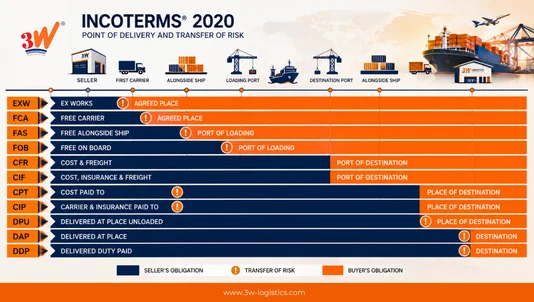
Incoterms (International Commercial Terms) are a set of international trade terms published by the International Chamber of Commerce (ICC) that clearly define the responsibilities, costs, and point of risk transfer between the seller and the buyer in an international sale-of-goods contract. The current edition in force is Incoterms 2020, made up of 11 trade terms divided into 2 groups based on the mode of transport.
Many newcomers to import-export often confuse the different Incoterms rules, are unsure whether Incoterms carry mandatory legal force, and frequently search — mistakenly — for an “Incoterms 2026” edition that has never existed. The article below sets out the full definition, purpose, history, the list of 11 rules, and what’s new in Incoterms 2020, so you can apply them correctly in practice.
1. What Is Incoterms?
Incoterms stands for “International Commercial Terms” — a set of rules drafted and published by the International Chamber of Commerce (ICC) to create a shared understanding of responsibility, cost, and risk between the seller and the buyer in an international sale of goods.
Incoterms are not law; they are an internationally recognized trade custom, widely adopted by the global business community, and only become binding once the parties expressly reference them in the sales contract.
Real-world example: When a contract states “FOB Cat Lai Port, Vietnam, Incoterms 2020,” both parties implicitly understand that the seller is responsible and bears the cost until the goods are loaded onto the vessel at Cat Lai Port, and from that point on, all further shipping risk and cost belong to the buyer.
2. The Purpose and Role of Incoterms in International Trade
Incoterms let a seller and buyer in two different countries instantly agree on responsibility without renegotiating every small detail, thanks to 3 core elements that every Incoterms rule defines.
- Point of risk transfer: pinpoints exactly when and where the risk of loss or damage to the goods passes from seller to buyer.
- Cost allocation: specifies who is responsible for paying main freight, insurance, loading/unloading fees, and other logistics costs.
- Documentary responsibility: specifies which party must obtain export/import licenses and complete the corresponding customs procedures.
- Reduces trade disputes: helps both parties avoid disagreements and misunderstandings arising from differing trade customs between countries.
Note: Incoterms only govern shipping, cost, and risk allocation for the goods; they do not govern the transfer of ownership, the price, or the payment method — these must be set out separately in the sales contract. That’s an important part of knowing your Incoterms before signing any international contract.
3. The History of Incoterms
Incoterms were first published by the ICC in 1936, and since 1980 have been updated on a roughly ten-year cycle to keep pace with the evolution of international trade and transport.
- Incoterms 1936: the first edition, laying the foundation for unified international trade terms.
- Incoterms 2000: adjusted to reflect the growth of container shipping and e-commerce.
- Incoterms 2010: reduced the number of rules from 13 to 11, regrouped into 2 transport-mode categories.
- Incoterms 2020: the current edition, effective from January 1, 2020, with several important changes compared to Incoterms 2010.
4. The List of 11 Incoterms 2020 Rules
Incoterms 2020 consists of 11 trade terms, split into 2 groups: 7 rules that apply to any mode of transport, and 4 rules that apply only to sea and inland waterway transport.
| Code | Full Name | Transport Group |
|---|---|---|
| EXW | Ex Works | Any mode of transport |
| FCA | Free Carrier | Any mode of transport |
| CPT | Carriage Paid To | Any mode of transport |
| CIP | Carriage and Insurance Paid To | Any mode of transport |
| DAP | Delivered At Place | Any mode of transport |
| DPU | Delivered at Place Unloaded | Any mode of transport |
| DDP | Delivered Duty Paid | Any mode of transport |
| FAS | Free Alongside Ship | Sea and inland waterway |
| FOB | Free On Board | Sea and inland waterway |
| CFR | Cost and Freight | Sea and inland waterway |
| CIF | Cost, Insurance and Freight | Sea and inland waterway |
5. What’s New in Incoterms 2020 Compared to Incoterms 2010?
Incoterms 2020 introduced 4 notable changes compared to Incoterms 2010: replacing DAT with DPU, adjusting the insurance requirement under CIP, allowing FCA to use an “on-board” bill of lading, and adding provisions on security-related costs.
| Change | Incoterms 2010 | Incoterms 2020 |
|---|---|---|
| Rule name | DAT (Delivered At Terminal) | Renamed to DPU (Delivered at Place Unloaded), applicable to any destination, not just a terminal |
| Insurance level under CIP | Required a minimum insurance level (Institute Cargo Clauses C) | Raised to the highest insurance level (Institute Cargo Clauses A), unless otherwise agreed |
| Bill of lading under FCA | No specific provision for an “on-board” bill of lading | Allows the parties to agree that the carrier issue an “on-board” bill of lading to the seller, supporting L/C payment |
| Security-related costs | Not clearly regulated | Clarifies responsibility and cost related to security requirements in transport |
6. Is There an Incoterms 2026?
No. No “Incoterms 2026” edition has been published by the ICC. The current edition in force is Incoterms 2020, effective since January 1, 2020.
Because the ICC typically updates Incoterms on a roughly ten-year cycle (2000, 2010, 2020), many people mistakenly assume a new edition will appear in 2026 and search for “Incoterms 2026.” In reality, the next edition, if one is published, is expected only around 2030, and as of now the ICC has made no official announcement about a release date.
Important note: When drafting a foreign trade contract in 2026, businesses should still clearly state “Incoterms 2020” (for example: “FOB Hai Phong Port, Vietnam, Incoterms 2020”) to avoid disputes over which edition applies, since courts, customs authorities, and banks worldwide currently only recognize Incoterms 2020 as the edition in force.
7. A Real-World Example of Incoterms in Use
A Vietnamese business exports wooden furniture to the US under the term FOB Cat Lai Port, Vietnam, Incoterms 2020. Under this term, the Vietnamese business is responsible for domestic transport costs, export customs clearance, and loading the goods onto the vessel at Cat Lai Port. From the moment the goods pass the ship’s rail, all further risk and cost — international freight, insurance, and US import procedures — belong to the buyer.
Conversely, if the contract instead states DDP (Delivered Duty Paid), the Vietnamese business would bear all cost and risk until the goods are delivered to the buyer’s door in the US, including import duty.
8. Common Mistakes When Applying Incoterms
The most common mistakes when applying Incoterms are failing to state the edition year, choosing a rule that doesn’t match the mode of transport, or confusing Incoterms with matters outside their scope.
| Common Mistake | Consequence | How to Fix It |
|---|---|---|
| Not stating the Incoterms edition | Disputes over which edition applies when rules differ across years | Always state the edition year, e.g. “CIF Ho Chi Minh City Port, Vietnam, Incoterms 2020” |
| Using a sea-only term (FOB, CIF) for air/road cargo | The term doesn’t match the actual mode of transport, causing disputes over the risk-transfer point | Use a term from the “any mode of transport” group (FCA, CPT, CIP, etc.) for air, road, or multimodal cargo |
| Assuming Incoterms also govern ownership transfer | Disputes over ownership of the goods when an issue arises | Set out ownership transfer separately in other clauses of the sales contract |
| Not naming a specific location alongside the term | The exact point of risk and cost transfer cannot be determined | Always name a specific location, e.g. “FOB Cat Lai Port” instead of just “FOB” |
Real-world example: A business signed a contract stating only “CIF” without naming the specific destination port, leading to a dispute with the partner over which port the insurance and freight costs were calculated to, delaying payment.
9. Do Incoterms Carry Mandatory Legal Force?
Incoterms are not a piece of legislation and carry no mandatory legal force under any country’s law; they are an international trade custom published by the ICC. Incoterms only become legally binding between the parties once expressly referenced in the international sale-of-goods contract.
In Vietnam, there is currently no separate law mandating the use of Incoterms, but parties are fully free to agree to apply Incoterms under the principle of freedom of contract set out in the Civil Code and the Commercial Law.
10. Frequently Asked Questions About Incoterms (FAQ)
What is the current Incoterms edition?
The Incoterms edition currently in force is Incoterms 2020, effective from January 1, 2020.
Is there an Incoterms 2026?
No. No “Incoterms 2026” edition has been published by the ICC; the latest edition remains Incoterms 2020, and the next edition, if one is published, is expected only around 2030.
Is it mandatory to use Incoterms in a foreign trade contract?
No. Using Incoterms is entirely based on the voluntary agreement between the parties in the sales contract.
Do Incoterms govern the transfer of ownership of goods?
No. Incoterms only govern shipping, cost, and risk; ownership transfer must be set out separately in other clauses of the contract.
Which Incoterms rule is most commonly used in Vietnamese import-export?
FOB and CIF are the two most commonly used rules for sea-freight shipments in Vietnam, due to their simplicity and familiarity among import-export businesses.
Can a business use Incoterms 2010 instead of Incoterms 2020?
Yes, if both parties agree and clearly state in the contract that Incoterms 2010 applies, since there is no requirement to use the latest edition.
What’s the biggest difference between the 7 “any mode of transport” rules and the 4 “sea freight” rules?
The 7 rules for any mode of transport (EXW, FCA, CPT, CIP, DAP, DPU, DDP) can be used for sea, air, road, or multimodal transport; the remaining 4 rules (FAS, FOB, CFR, CIF) apply only to sea and inland waterway transport.
What should businesses keep in mind when choosing an Incoterms rule?
Businesses should choose a rule that matches the actual mode of transport, clearly state the edition year and a specific location, and fully understand their own scope of responsibility before signing the contract.
3W Logistics – Consulting on Choosing the Right Incoterms Rule
Choosing the right Incoterms rule helps businesses control cost and risk and avoid international trade disputes. 3W Logistics works alongside import-export businesses to advise on and correctly apply Incoterms for each type of transaction.
- Consulting on choosing the right Incoterms rule: helps businesses weigh the options based on the mode of transport and their capacity to manage risk.
- Support drafting precise contract clauses: ensures the Incoterms rule is stated with the correct edition and a specific location, limiting disputes.
- Keeping up with the latest Incoterms updates: continuously tracks changes and official announcements from the ICC to advise clients promptly.
Businesses needing consulting on Incoterms and choosing the right delivery term, please contact 3W Logistics directly for support.
CONTACT INFORMATION:
Head Office – 3W Logistics Ho Chi Minh Branch
Address: 34 Bach Dang, Tan Son Hoa Ward, Ho Chi Minh City
Hotline: +84 28 3535 0087
3W Logistics Hanoi Branch
Address: 81A Tran Quoc Toan, Cua Nam Ward, Hanoi
Hotline: +84 24 3202 0482
3W Logistics Hai Phong Branch
Address: 8A Lot 28 Le Hong Phong, Gia Vien Ward, Hai Phong
Hotline: +84 225 355 5939
3W LOGISTICS CO., LTD – We here serve you there!
Email: info@3w-logistics.com
Website: www.3w-logistics.com

Hello, I’m Nguyen Phuong Nhan (Ms. Nina)
I currently serve as Trade Lanes Supervisor at 3W Logistics, with more than 10 years of experience in international logistics and freight forwarding.
My primary responsibility is developing and managing global logistics partnerships, building strategic trade lanes, and working closely with overseas agents to provide reliable and competitive transportation solutions for customers.
I regularly collaborate with agents and logistics partners worldwide to explore new business opportunities, negotiate freight rates, develop trade routes, and support import-export shipments. I also work closely with our sales team to design logistics solutions tailored to specific markets and customer requirements.
My expertise includes Ocean Freight, Air Freight, Trade Lane Development, Global Agent Network Management, International Logistics Solutions, and Import-Export Support.
Through the articles I share on the 3W Logistics website, I aim to provide practical insights into the international logistics industry, global transportation trends, overseas agent cooperation, and effective logistics strategies that help businesses optimize their supply chain operations.
I believe that strong global partnerships and well-developed trade lanes are essential to delivering sustainable logistics solutions and long-term value to customers worldwide.


