

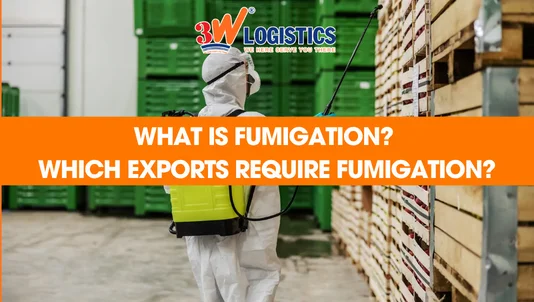
Fumigation is a mandatory quarantine procedure that many Vietnamese exporters of agricultural products, handicrafts, and goods packed on wooden pallets still confuse or overlook — leading to shipments being held or rejected right at the destination port.
In this article, 3W Logistics explains in detail what fumigation is, the current legal basis, the list of goods required to undergo fumigation, common treatment methods, and the standard process — from the perspective of a forwarder with more than 10 years of experience shipping agricultural products and other export goods.
1. What is fumigation?
Fumigation is a phytosanitary treatment method that uses gaseous chemicals or high temperature to destroy insects, insect eggs, mold, and other harmful organisms present in goods, wooden packaging, or containers before export. It is one of the forms of “treatment of objects subject to phytosanitary quarantine” defined under the Law on Plant Protection and Quarantine No. 41/2013/QH13.
In essence, fumigation does not alter the quality or composition of the goods themselves — it only acts on harmful organisms attached to the goods, packaging, or pallets. After fumigation, the service provider issues a Fumigation Certificate, which serves as the legal basis for the importing country’s customs authority to confirm that the shipment has undergone proper quarantine treatment.
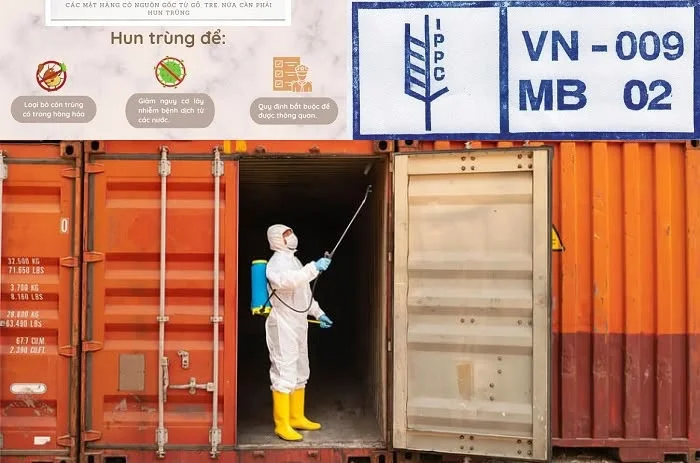
Fumigation is particularly inseparable from rice export, as well as coffee, cassava, and various types of corn.
- Quarantine purpose: Prevents the spread of harmful organisms between countries through international trade, protecting the importing country’s agricultural ecosystem.
- Preservation purpose: Limits insects, pests, and mold from developing during long-distance transport, especially for goods sealed in containers for many days.
- Clearance purpose: Meets the mandatory customs requirements of many markets such as the US, EU, Australia, and New Zealand — without a valid fumigation certificate, a shipment may be held, forced into re-treatment, or re-exported.
Important note: Only units licensed by the Plant Protection Department (Ministry of Agriculture and Environment) with a Certificate of Practice for Treatment of Objects Subject to Phytosanitary Quarantine under the Law on Plant Protection and Quarantine No. 41/2013/QH13 are permitted to carry out fumigation and issue legally valid certificates for customs clearance. Businesses should carefully verify the legal standing of their fumigation service provider before signing a contract, to avoid a certificate that is not recognized by the importing country’s customs authority.
2. Legal basis for fumigation of export goods
Fumigation activities in Vietnam are governed by a combination of domestic legal documents and international standards, which exporters need to understand clearly in order to prepare the correct documentation and avoid violations.
| Legal Document | Main Content | Note |
|---|---|---|
| Law on Plant Protection and Quarantine No. 41/2013/QH13 | Sets out the legal framework for pest prevention, phytosanitary quarantine, and treatment of objects subject to phytosanitary quarantine, including the conditions for issuing and revoking the Certificate of Practice for treatment | Effective from January 1, 2015; the foundational document governing all fumigation and phytosanitary quarantine activities in Vietnam |
| Circular 33/2014/TT-BNNPTNT | Sets out the order and procedures for phytosanitary quarantine of imports, exports, transit goods, and post-import inspection | The basis for businesses to apply for a Phytosanitary Certificate together with fumigation documentation |
| Circular 30/2014/TT-BNNPTNT | Issues the List of Objects Subject to Phytosanitary Quarantine and the List of Objects Requiring Pest Risk Analysis Prior to Import | The basis for determining which goods are subject to mandatory quarantine, and thus whether fumigation is required |
| Circular 04/2023/TT-BNNPTNT | Updates Vietnam’s List of 117 Regulated Phytosanitary Pests | Businesses need to cross-check this list when goods carry a risk of harboring regulated harmful organisms |
| ISPM 15 Standard (IPPC/FAO) | International Standard for Phytosanitary Measures No. 15, mandatory for wood packaging materials (pallets, wooden crates, dunnage) in international trade | Vietnam officially adopted ISPM 15 in 2005; most major markets such as the US, EU, China, Japan, and Australia require compliance |
3. Goods that require fumigation when exporting
Not every export shipment requires fumigation — it only applies to goods carrying a risk of insects, pests, or mold, or as required by the specific importing country and the type of packaging used.
| Goods Category | Specific Examples | Reason Fumigation Is Required |
|---|---|---|
| Grain and dried agricultural products | Rice, coffee, black pepper, cashew nuts, various beans, dried cassava slices, corn, dried tea | High risk of pests and insects hiding within the grains throughout long sea voyages |
| Wood products and wooden packaging | Wooden pallets, wooden crates, dunnage, wooden furniture, plywood not treated with high heat | Mandatory under the international ISPM 15 standard to prevent pests and harmful organisms from spreading via wood transport |
| Handicraft goods | Woven rattan and bamboo products, wooden handicrafts, products made from bamboo, reed, rush, or water hyacinth | Natural materials easily harbor insects hidden within the material fibers; many markets require quarantine before clearance |
| Fresh agricultural products and fruit | Certain fresh fruits, fresh flowers, and vegetables per the specific requirements of the importing market (usually combined with cold treatment or hot vapor treatment rather than chemicals) | Prevents fruit flies and harmful organisms per the specific phytosanitary requirements of markets such as the US, Japan, and South Korea |
| Natural textile raw materials and products | Raw cotton fiber, coconut fiber, and various natural fibers not yet industrially processed | Raw materials of plant origin can easily harbor insect eggs if not treated before export |
4. Common fumigation methods today
| Method | How It Is Performed | Notes When Applying |
|---|---|---|
| Methyl Bromide (CH3Br) — MB | Gas is injected into the container or a sealed chamber and held for 16-24 hours depending on the goods; good diffusion and penetration make it suitable for large shipments and warehouses of tens of thousands of cubic meters | An ozone-depleting substance, so it is restricted or banned in many countries — check the importing country’s regulations before selecting this method |
| Phosphine (PH3) — from AlP/MgP tablets | Aluminum phosphide or magnesium phosphide tablets release phosphine gas; the exposure period is longer than Methyl Bromide but it is more environmentally friendly | Considered an effective alternative to Methyl Bromide, suitable for grain-type agricultural products stored over longer periods |
| Heat Treatment — HT | Wood is heated to a minimum core temperature of 56°C, maintained continuously for at least 30 minutes to destroy harmful organisms | Applied mainly to wooden pallets and wood packaging materials under ISPM 15; uses no chemicals, so it is favored by many markets |
5. Fumigation process for export goods
Step 1: Schedule and prepare documentation
The business contacts a fumigation provider licensed by the Plant Protection Department, providing documentation including the Packing List, Commercial Invoice, and information on the container or shipment to be treated.
Step 2: Chemical application or heating
The licensed provider injects specialized chemicals (Methyl Bromide or Phosphine) into the container, or applies heat treatment for wood materials, following the correct dosage and prescribed procedure.
Step 3: Exposure period and ventilation
The container is sealed and held for the prescribed exposure period, typically 12-24 hours depending on the goods and chemical used. Once the exposure period ends, staff break the seal and ventilate the container to remove any remaining toxic gas, ensuring safety before transport.
Step 4: Issuance of the Fumigation Certificate
After treatment is complete, the fumigation provider issues the Fumigation Certificate within 1-2 days, showing full details including business information, chemical type, dosage, exposure time, and a valid confirmation stamp for use in customs procedures.
From 3W Logistics’ practical experience: Among the agricultural and wooden-pallet-packed shipments we have handled, the most frequent issues arising at the destination port do not stem from a lack of fumigation but from three documentation errors: a faded or incorrectly positioned ISPM 15 stamp on wooden pallets, a fumigation certificate listing a chemical type that does not match what was actually used, and a certificate issue date that does not align with the container stuffing date on the bill of lading. All three of these are entirely preventable if the business works with a licensed fumigation provider and carefully cross-checks documentation before the goods leave the warehouse. — Ms. Apple, CCO, 3W Logistics
6. Common notes and errors in fumigating export goods
| Common Error | Actual Consequence | Prevention |
|---|---|---|
| Using an unlicensed fumigation provider | The certificate is not recognized by the importing country’s customs authority — the shipment is held and re-fumigation is required at the destination port, incurring cost and delay | Verify the provider’s Certificate of Practice for Treatment of Objects Subject to Phytosanitary Quarantine before signing a contract |
| Faded or missing ISPM 15 stamp on wooden pallets | Customs in markets such as the EU, US, and Japan refuse the import or require destruction of non-compliant pallets right at the destination port | Check that the stamp is clear and present on at least two opposite faces of the pallet before shipping; avoid using reused pallets of unclear origin |
| Insufficient exposure time as prescribed | Insects not fully destroyed, detected during quarantine inspection at the destination port, leading to re-treatment or return of the shipment | Follow the recommended exposure time strictly based on the chemical and goods type; never shorten the process to save time |
| Fumigation certificate information not matching the bill of lading | Customs suspects the authenticity of the documentation, requests further explanation, or holds the shipment for physical inspection, prolonging clearance time | Carefully cross-check container number, quantity, and stuffing date between the fumigation certificate, Bill of Lading, and Packing List before submitting documentation |
FAQ – Frequently asked questions about fumigation of export goods
Question 1: Are fumigation and phytosanitary quarantine the same thing?
Not exactly. Phytosanitary quarantine is the overall inspection process used to detect harmful organisms in goods, while fumigation is a specific treatment method (using chemicals or heat) to destroy those harmful organisms. Fumigation is typically one step within the phytosanitary quarantine process, or an additional requirement under specific regulations for wood packaging and certain goods categories.
Question 2: Which goods do not require fumigation?
Goods not of plant origin, or that do not use raw wood packaging or pallets, generally do not require fumigation. Per guidance from the Plant Protection Department, non-wood goods packaged with wood packaging or pallets that have already undergone industrial processing (high-heat pressing, engineered board) may also be exempted from phytosanitary quarantine depending on the specific case.
Question 3: How long does it take to issue a Fumigation Certificate?
Typically within 1-2 days from completion of treatment and submission of the full documentation set (Packing List, Commercial Invoice, Bill of Lading). Businesses should schedule fumigation early, at least 2-3 days before container stuffing, to avoid impacting the vessel schedule.
Question 4: How is the fumigation cost calculated?
The cost depends on the type of goods, volume, treatment method (Methyl Bromide, Phosphine, or Heat Treatment), and the service provider. For wooden pallets under the ISPM 15 standard, cost is typically calculated per pallet or by container volume; for grain-type agricultural products, cost is typically calculated per tonne or per container.
How does 3W Logistics support fumigation of export goods?
As a freight forwarding company registered as an OTI-NVOCC with an FMC Bond (Federal Maritime Commission) in the United States, with more than 10 years of experience shipping agricultural products and handicrafts, 3W Logistics supports businesses with end-to-end fumigation and phytosanitary quarantine handling before goods leave the warehouse.
Full-package rice export solutions and other agricultural products from 3W Logistics:
- Advising which goods require fumigation: Reviewing the goods category, packaging type, and specific requirements of each importing market to accurately determine whether fumigation is needed, avoiding unnecessary costs.
- Connecting with licensed fumigation providers: Working with providers licensed by the Plant Protection Department, ensuring the certificate is legally valid for customs clearance in the importing country.
- Scheduling in sync with vessel booking: Calculating fumigation, exposure, and ventilation time so as not to impact the container stuffing schedule and vessel departure date.
- Customs declaration and documentation cross-checking: Verifying consistency between the fumigation certificate, Bill of Lading, Packing List, and other quarantine documents before submitting customs paperwork.
- Support in resolving issues at the destination port: Coordinating with partners and quarantine authorities to quickly resolve cases where a shipment is held due to fumigation documentation issues.
Why choose 3W Logistics for your export fumigation service? Correctly performed fumigation is only a necessary condition — the sufficient condition is that all accompanying documentation is accurate, consistent, and issued by a legally qualified provider. A fumigation certificate with even one small discrepancy can result in an entire container being held at the destination port. We control the entire documentation chain, not just book the vessel and print the declaration. Contact 3W for specific advice on the fumigation process and cost for your shipment.
Address: 34 Bach Dang, Tan Son Hoa Ward, Ho Chi Minh City
Hotline: +84 28 3535 0087
____________________________
3W Logistics Hanoi Branch
Address: 81A Tran Quoc Toan, Cua Nam Ward, Hanoi
Hotline: +84 24 3202 0482
____________________________
3W Logistics Hai Phong Branch
Address: 8A Lo 28 Le Hong Phong, Gia Vien Ward, Hai Phong
Hotline: +84 225 355 5939
____________________________
3W LOGISTICS CO., LTD – We here serve you there!
Email: info@3w-logistics.com
Website: www.3w-logistics.com

Ms. Apple is the CCO (Chief Commercial Officer) at 3W Logistics, with over 10 years of experience in sales and business operations management.
At 3W Logistics, Ms. Apple is responsible for commercial strategy, corporate customer development, managing a team of more than 50 sales professionals, and improving business performance in the logistics sector.
With practical experience in sales management and market development, Ms. Apple shares professional insights on business logistics solutions, international transportation, freight forwarding, customer management, trade lane development, and growth strategies in the logistics industry.


