
Legal Framework for Rice Export Procedures in Vietnam
Before starting the rice export process, businesses need a thorough understanding of the current legal documents governing this activity. The legal framework for rice exports in Vietnam is built on the core foundation of Decree 107/2018/NĐ-CP dated August 15, 2018, which comprehensively regulates business conditions, rights, and obligations of rice exporters.
On January 1, 2025, the Government issued Decree 01/2025/NĐ-CP amending and supplementing Decree 107/2018/NĐ-CP, adding provisions on rice export trading rights, effective from March 1, 2025. At the circular level, Circular 35/2025/TT-BCT dated June 2, 2025 further amends and supplements Circular 30/2018/TT-BCT, which provides detailed guidance on implementing Decree 107, effective from July 18, 2025.
Notably, under the new regulations, traders holding a Certificate of Eligibility for Rice Export may only entrust exports to, or accept export entrustment from, traders who also hold an equivalent Certificate. Furthermore, rice is not merely a standard agricultural commodity — it is a strategic product directly tied to national food security. Staying current with all applicable legal requirements is therefore a prerequisite for businesses to avoid legal risk and sustain long-term export operations.
Step-by-Step Rice Export Process
To complete rice export procedures in Vietnam, businesses must follow a rigorous 5-step process: obtaining a business license, registering the export contract with VFA, quality inspection, customs declaration, and cargo clearance and transportation to port. A solid understanding of each step not only helps businesses avoid legal risks but also shortens clearance times, optimizes logistics costs, and protects their reputation with overseas partners.
Step 1: Obtain a Certificate of Eligibility for Rice Export
The Certificate of Eligibility for Rice Export, issued by the Ministry of Industry and Trade, is a mandatory prerequisite that every business must hold before executing any international shipment.
Under current regulations, businesses must meet two minimum infrastructure criteria: ownership of at least one dedicated warehouse with a capacity of 5,000 tonnes of paddy or more, and a rice milling facility with a minimum capacity of 10 tonnes of paddy per hour. Specialty product lines such as organic rice, parboiled rice, and micronutrient-fortified rice may be exempt from these requirements if they fully comply with their respective specialized standards.
Step 2: Sign and Register the Export Contract with VFA
After signing a commercial contract with a foreign buyer, the business is required to register that contract with the Vietnam Food Association (VFA) within 3 working days from the signing date – a mandatory requirement designed to monitor national export volumes. The registration dossier includes a written request, a copy of the contract, and a report on current paddy and rice stock held in warehouses. Late registration not only affects clearance timelines but may also result in administrative penalties and delays to the entire shipment.
Step 3: Quality Inspection and Technical Documentation
This is the most document-intensive step in the entire rice export process, requiring businesses to prepare multiple technical documents simultaneously. Goods must be packaged and labeled (Shipping Mark) in accordance with the importing country’s requirements, and must be accompanied by three core certifications:
- Phytosanitary Certificate – confirming the goods are free from pests and diseases.
- Fumigation Certificate – carried out immediately after container stuffing to prevent infestation.
- Certificate of Origin (C/O) – issued in the correct form for the target market (Form B, Form E, Form AK, EUR.1, etc.), enabling the buyer to benefit from preferential tariff rates under applicable free trade agreements.
Step 4: Rice Export Customs Declaration via VNACCS
The export customs declaration is submitted electronically through ECUS software or the VNACCS system. Businesses are required to declare accurately and completely, submitting: the customs declaration form, Commercial Invoice, Packing List, Sales Contract, Certificate of Eligibility for Rice Export, and the VFA Contract Registration Confirmation. Any error in the declaration may result in the shipment being routed to an inspection channel, extending clearance time and generating container detention costs at the port.
Step 5: Customs Clearance, Channel Assignment, and Cargo Transportation
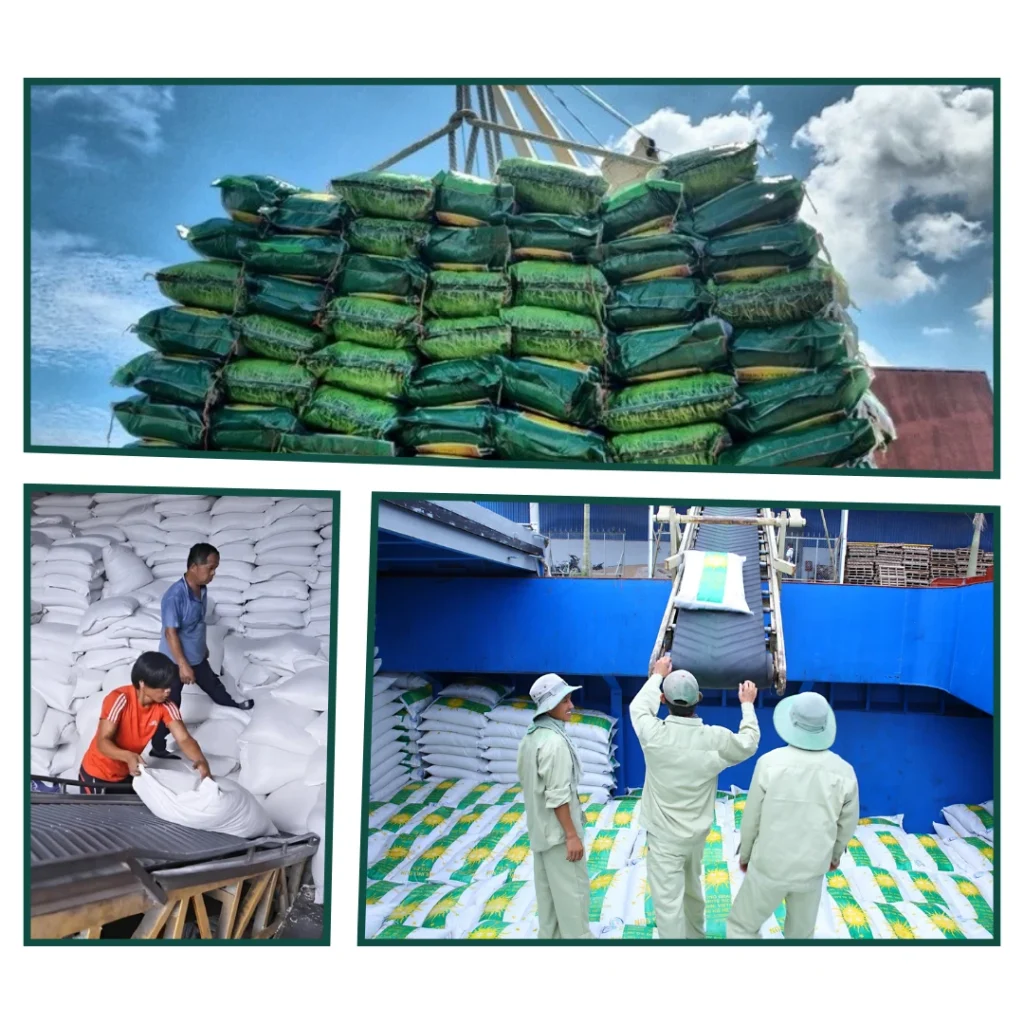
After the declaration is submitted, the customs system automatically assigns an inspection channel: Green Channel allows immediate clearance; Yellow Channel requires a full review of all paper documents; and Red Channel involves physical inspection of the goods at the port. The assigned channel depends heavily on the business’s compliance history and the accuracy of the submitted documentation. Once the cargo is loaded on board and the Bill of Lading is issued, the business proceeds to finalize the customs declaration at the port to officially complete the export procedures as required.
HS Codes for Rice Exports and Applicable Tax Policy
Identifying the correct HS Code for rice exports is a foundational step in the entire customs clearance process – an incorrect code means a wrong tax rate declaration, risking penalties or cargo holds at the port. Rice export HS Codes fall under Chapter 10 (Cereals), heading 1006, but the specific 8-digit code will differ depending on the type of rice, degree of milling, and broken grain percentage. Understanding each HS sub-heading along with the current VAT and export tax rates allows businesses to optimize costs and ensure accurate customs declarations from the outset.
Rice Export HS Code Classification Table
In the import-export tariff schedule, rice HS Codes fall under Section II – Vegetable Products, Chapter 10 – Cereals, heading 1006 (Rice). For a valid customs declaration, businesses must identify the correct code down to the 8-digit level according to Vietnam’s current Import-Export Tariff Schedule (Circular 31/2022/TT-BTC).
The table below shows the most commonly used HS Codes for rice exports:
| HS Code | Description |
|---|---|
| 10061000 | Paddy rice (unmilled) |
| 10062000 | Brown rice (husked, bran layer retained) |
| 10063010 | Wholly or partly milled rice — short grain |
| 10063091 | Milled brown rice — other types (long grain, medium grain) |
| 10063099 | Milled and polished white rice — other types |
| 10064000 | Broken rice |
Practical note: The 6-digit HS Code is the internationally standardized format set by the World Customs Organization (WCO) – for example, 1006.30 is the globally recognized code for milled rice. In Vietnam, the HS system is expanded to 8 digits under Circular 31/2022/TT-BTC to enable more detailed classification for tax calculation and cargo inspection purposes.
Current Rice Export Tax Rates: VAT and Export Duty
This is the topic most businesses ask about first, as it directly affects the cost structure and profitability of each shipment.
When exporting rice, businesses are subject to two types of tax: VAT and export duty. Under current regulations, VAT on exported goods – including rice – is 0%. The export duty on rice is also currently 0%.
The 2025 export tariff schedule under Decree 144/2024/NĐ-CP applies preferential tax rates to most rice varieties, in support of the Ministry of Agriculture and Rural Development’s export target of 7–8 million tonnes per year.
| Tax Type | Rate | Legal Basis |
|---|---|---|
| Export Duty | 0% | Decree 144/2024/NĐ-CP |
| VAT | 0% | VAT regulations for exported goods |
In-depth note: A 0% tax rate does not mean all financial obligations are waived. Businesses are still required to follow the correct process for VAT input credit refunds, and should note that applicable tax rates may change depending on the importing country and the international trade agreements Vietnam is party to – particularly when exporting to markets outside ASEAN or CPTPP.
How to Determine the Correct HS Code for Rice
Using an incorrect HS Code when exporting rice is one of the most common mistakes, resulting in administrative penalties, supplementary declaration requirements, or even cargo holds. To classify correctly, businesses need to assess three key technical factors:
1. Degree of milling
Whether the rice is unmilled (paddy), brown rice, partly milled, or wholly milled determines which HS sub-heading under heading 1006 applies. This is the single most important classification factor.
2. Broken grain percentage
Rice with 5%, 15%, or 25% broken grains may result in different 8-digit codes – particularly within sub-headings 10063091 and 10063099.
3. Variety characteristics
Jasmine rice, Japonica rice, ST25, or standard white rice must each be carefully cross-referenced against product catalogues and technical documentation. Under current regulations, HS Code classification must be based on the product catalogue, technical specifications (if available), or an official classification ruling from the Customs Valuation and Classification Department.
Official reference tools:
- Vietnam General Department of Customs – HS Code lookup system
- Vietnam Import-Export Tariff Schedule under Circular 31/2022/TT-BTC
- Advance ruling request to the Customs Valuation and Classification Department if classification remains uncertain
For Smooth Rice Exports, Partner with 3W Logistics
Rice export procedures demand precision at every step – from phytosanitary inspection and fumigation to customs declaration and international freight. A single mistake can result in cargo being held at port, contract loss, or unnecessary cost overruns.
3W Logistics has a team of experienced specialists with deep expertise in rice export processes to demanding markets including the Philippines, Indonesia, Africa, and the EU. We provide end-to-end support – from documentation consulting and customs clearance to on-time delivery at the destination port.
Head Office – 3W Logistics Ho Chi Minh City Branch
Address: 34 Bach Dang Street, Tan Son Hoa Ward, Ho Chi Minh City
Hotline: +84 28 3535 0087
____________________________
3W Logistics Hanoi Branch
Address: 81A Tran Quoc Toan Street, Cua Nam Ward, Hanoi
Hotline: +84 24 3202 0482
____________________________
3W Logistics Hai Phong Branch
Address: 8A Lot 28 Le Hong Phong Street, Gia Vien Ward, Hai Phong
Hotline: +84 225 355 5939
____________________________
3W LOGISTICS CO., LTD – We here serve you there!
Email: quote@3w-logistics.com
Website: www.3w-logistics.com

Mr. William, Vietnamese name Vu Van Nho, is the CEO of 3W Logistics. In his leadership role, he is responsible for strategic development, business operations, and improving the company’s logistics service quality.
He has experience in logistics, import-export operations, and international transportation, especially in sea freight, air freight, inland transportation, customs procedures, and supply chain solutions for businesses.
With a practical business mindset and a customer-focused approach, Mr. William aims to develop 3W Logistics into a reliable, professional, and efficient logistics service provider for import-export companies in Vietnam.


