

CFS Warehouse: Definition, Requirements, Roles & LCL Operations
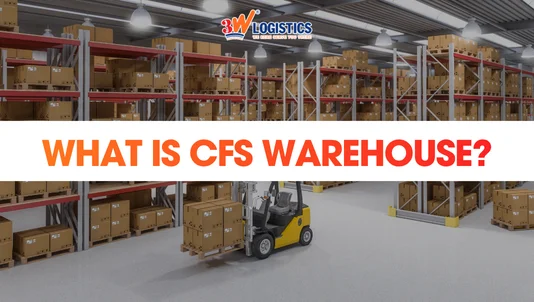
What is CFS warehouse (Container Freight Station), known in Vietnamese as a “địa điểm thu gom hàng lẻ” (LCL consolidation point), is a warehouse or yard area used to consolidate and deconsolidate cargo belonging to multiple cargo owners sharing the same container, under customs supervision. A CFS warehouse plays a central role in handling less-than-container-load (LCL) cargo, helping businesses with small-volume shipments reduce shipping costs.
Many newcomers to logistics often confuse a CFS warehouse with a bonded warehouse, and are unclear on the establishment conditions or the specific role this type of warehouse plays in the supply chain. The article below sets out the full concept, characteristics, establishment conditions, role, and current legal basis for a CFS warehouse in Vietnam.
1. What Is a CFS Warehouse?
A CFS warehouse is a warehouse or yard area used to consolidate and deconsolidate cargo of multiple cargo owners sharing the same container, as defined under Clause 24, Article 4 of Customs Law No. 54/2014/QH13. It is a key link supporting less-than-container-load (LCL) shipping, where goods from different cargo owners are consolidated into a single container to optimize shipping costs, or unloaded from a shared container and separated for individual cargo owners.
Real-world example: A cosmetics importer has only 5 cubic meters of cargo, not enough to fill an entire container, so the goods are consolidated with cargo from 3 other businesses on the same route at a CFS warehouse in the exporting country, then shipped together in one container to Vietnam and deconsolidated at the destination CFS warehouse.
2. Characteristics of a CFS Warehouse
A CFS warehouse’s defining characteristic is that it handles goods over a short-term period for consolidation/deconsolidation purposes, unlike long-term storage facilities such as a bonded warehouse.
- Under customs supervision: every activity moving goods into or out of a CFS warehouse is supervised by the managing Customs Sub-Department.
- Serves LCL cargo: specializes in handling shipments too small to fill an entire container, which need to be consolidated with cargo from other owners.
- Short-term storage: goods are usually kept at a CFS warehouse only for the duration of the consolidation/deconsolidation process, unlike the long-term storage purpose of a bonded warehouse.
- Location is specifically regulated: may only be established in seaports, international civil airports, domestically established import-export cargo ports, road checkpoints, international rail stations, industrial parks, hi-tech parks, non-tariff zones, and other areas as regulated.
3. Conditions for Establishing a CFS Warehouse
Under Article 19 of Decree 68/2016/ND-CP (as amended by Decree 67/2020/ND-CP), an LCL consolidation point (CFS warehouse) must meet conditions on location, area, a perimeter fence, and a camera surveillance system connected online to the customs authority.
- Location: within an area specified under Clause 1, Article 62 of the 2014 Customs Law (seaports, international civil airports, domestic import-export cargo ports, road checkpoints, international rail stations, industrial parks, hi-tech parks, non-tariff zones, etc.).
- Minimum warehouse area: 1,000 m², not including the yard and auxiliary structures.
- Perimeter fence: must have a solid fence separating it from the surrounding area, meeting the customs authority’s inspection and supervision requirements.
- Camera surveillance system: must connect online to the managing customs authority, cover every location in the warehouse at all times (24/7), and retain footage for at least 6 months.
- Port operators are exempt from the full recognition procedure: if the LCL consolidation point is located within a seaport or a domestically recognized import-export cargo port and operated by the port operator itself, the business only needs to apply for a location code instead of going through the full recognition procedure.
4. The Role of a CFS Warehouse in Logistics
A CFS warehouse plays a central consolidation/deconsolidation role in the international logistics chain, helping businesses with small shipments save significantly on shipping costs compared to renting an entire container.
- Optimizes shipping costs for LCL cargo: multiple cargo owners can share the cost of one container instead of each business renting a full container for a small shipment.
- Connects multiple cargo owners on the same route: helps forwarders consolidate cargo from multiple customers on the same route to optimize container frequency and load.
- Supports value-added services: some CFS warehouses allow repackaging, labeling, and counting of goods during the consolidation/deconsolidation process.
- Ensures customs supervision of LCL cargo: the entire consolidation/deconsolidation process for multiple cargo owners is carried out under close customs supervision, ensuring shipment transparency.
- Shortens LCL processing time at port: handling consolidation/deconsolidation at a dedicated CFS warehouse reduces the load on the main port area, speeding up delivery.
5. Activities Carried Out at a CFS Warehouse
A CFS warehouse mainly handles the consolidation of export cargo from multiple owners into a shared container, and the deconsolidation of import cargo from a shared container for individual owners.
- Export cargo consolidation: combining LCL cargo from multiple owners on the same route into one shared container for export.
- Import cargo deconsolidation: separating cargo from a shared container into individual shipments for each cargo owner.
- Counting and sorting goods: checking the quantity and condition of goods before consolidation or after deconsolidation.
- Packaging and labeling: carrying out simple value-added services while the goods are stored at the warehouse.
6. Procedure for Moving Goods Into and Out of a CFS Warehouse
The procedure for handling goods at a CFS warehouse consists of receiving LCL cargo from multiple owners, consolidating/deconsolidating it under customs supervision, and delivering it to the correct owner.
Step 1: Receiving LCL cargo at the CFS warehouse
Goods from multiple cargo owners are transported to the CFS warehouse, information is declared, and the goods undergo an initial check by warehouse staff.
Step 2: Consolidating or deconsolidating the cargo
For export cargo, warehouse staff consolidate LCL shipments on the same route into a shared container; for import cargo, the shared container is opened and the goods are separated by cargo owner.
Step 3: Customs supervision and confirmation
The entire consolidation/deconsolidation process is carried out under the supervision of the Customs Sub-Department managing the CFS warehouse, ensuring the quantity and category of goods match the declaration.
Step 4: Delivering goods to each cargo owner
Once customs procedures are complete, the goods are handed over to each cargo owner or the next transport party in the supply chain.
7. How Is a CFS Warehouse Different from a Bonded Warehouse?
A CFS warehouse specializes in short-term consolidation/deconsolidation of LCL cargo, while a bonded warehouse is used to store goods awaiting export, import, or re-export over a longer period, along with deferring import duty.
| Criteria | CFS Warehouse | Bonded Warehouse |
|---|---|---|
| Purpose | Consolidating/deconsolidating LCL cargo for container stuffing/stripping | Storing goods awaiting export/import, re-export, deferring import duty |
| Storage period | Short-term, for the consolidation/deconsolidation process | Maximum 12 months, extendable by up to 12 more months |
| Tax obligation | Not a duty-deferral warehouse; serves cargo consolidation | Import duty deferred until goods enter the domestic market |
| Minimum area | 1,000 m² (excluding the yard and auxiliary structures) | Based on expected cargo volume, with no fixed minimum like a CFS warehouse |
| Typical users | Forwarders, LCL consolidators | Import-export cargo owners, distributors |
| Legal basis | Article 61, Customs Law 2014; Articles 19-20, Decree 68/2016/ND-CP | Articles 61-63, Customs Law 2014; Articles 82-91, Decree 08/2015/ND-CP |
8. Advantages and Disadvantages of a CFS Warehouse
A CFS warehouse helps businesses with small shipments save significantly on shipping costs, but the trade-off is that processing time can take longer while waiting to consolidate enough cargo on the same route.
Advantages:
- Saves shipping costs for shipments too small to fill an entire container.
- Flexible in volume, well suited to small and medium-sized businesses or trial market shipments.
- Value-added services such as packaging and labeling can be carried out right at the warehouse.
Disadvantages:
- Transit time can be longer while waiting to consolidate enough cargo on the same route from multiple owners.
- Higher risk of damage or loss due to more frequent handling and separation compared to full-container cargo.
- Cost per cubic meter (CBM) can be higher than renting a full container for a sufficiently large shipment.
9. Common Mistakes Businesses Make When Using a CFS Warehouse
The most common mistake when using a CFS warehouse is failing to carefully check packaging information before shipping, leading to discrepancies when deconsolidating cargo for different owners.
| Common Mistake | Consequence | How to Fix It |
|---|---|---|
| Incorrect packaging | Goods are prone to damage or loss due to repeated handling at the CFS warehouse | Pack securely and clearly label cargo-owner information before shipping |
| Misdeclaring actual quantity/weight | Discrepancies during deconsolidation, extending processing time | Count accurately before handing goods over to the CFS warehouse for consolidation |
| Not tracking the consolidation schedule | Goods may be delayed while waiting to consolidate enough cargo on the same route | Proactively confirm the cut-off schedule and consolidation status with the forwarder |
| Confusing a CFS warehouse with a bonded warehouse | Choosing the wrong warehouse type, mismatched with the actual purpose of storage or consolidation | Determine the actual need (LCL consolidation vs. long-term storage) before choosing the warehouse type |
Real-world example: A business sent LCL cargo to a CFS warehouse with improper packaging, causing some packages to be damaged during deconsolidation alongside other owners’ cargo, resulting in a complaint and a delayed delivery to the customer.
10. Current Legal Regulations on CFS Warehouses
CFS warehouses in Vietnam are currently governed directly by Customs Law No. 54/2014/QH13 and Decree 68/2016/ND-CP, as amended by Decree 67/2020/ND-CP.
- Customs Law No. 54/2014/QH13 — Clause 24, Article 4 defines an LCL consolidation point; Clause 1, Article 62 specifies where it may be established.
- Decree 68/2016/ND-CP — Article 19 regulates the conditions for recognizing an LCL consolidation point; Article 20 regulates the recognition dossier.
- Decree 67/2020/ND-CP — amends and supplements certain articles of Decree 68/2016/ND-CP, including provisions on the dossier and procedure for recognizing an LCL consolidation point.
- Circular 38/2015/TT-BTC (amended by Circular 39/2018/TT-BTC) — guides customs procedures for goods entering and leaving an LCL consolidation point.
11. Frequently Asked Questions About CFS Warehouses (FAQ)
Does a CFS warehouse need to be licensed before it can operate?
Yes, except where a port operator’s LCL consolidation point is located within a seaport or a domestically recognized import-export cargo port — in that case, only a location code application is required instead of the full recognition procedure.
What is the minimum area to establish a CFS warehouse?
Under Article 19 of Decree 68/2016/ND-CP, a CFS warehouse must have a minimum warehouse area of 1,000 m², not including the yard and auxiliary structures.
Is a CFS warehouse a duty-deferral warehouse like a bonded warehouse?
No. A CFS warehouse only serves short-term cargo consolidation/deconsolidation and has no import-duty deferral function like a bonded warehouse.
What kind of goods are typically handled at a CFS warehouse?
Mainly LCL (less-than-container-load) cargo — small-volume shipments not large enough to fill an entire container, which need to be consolidated with cargo from other owners.
Does a CFS warehouse need a surveillance camera system?
Yes. A CFS warehouse must have a camera surveillance system connected online to the customs authority, covering every location in the warehouse 24/7, with footage retained for at least 6 months.
Who is allowed to use CFS warehouse services?
Import-export businesses with small shipments, or forwarders/consolidators needing to combine cargo from multiple customers on the same route, can all use CFS warehouse services.
How is the cost of using a CFS warehouse calculated?
Cost is usually calculated per cubic meter (CBM) or cargo weight, unlike the full-container-based pricing of a bonded warehouse or FCL shipping.
What should businesses keep in mind when shipping cargo through a CFS warehouse?
Businesses should pack securely, clearly label cargo-owner information, count quantities accurately, and closely track the consolidation schedule to avoid delays.
3W Logistics – LCL Consolidation Solutions via CFS Warehouses
Handling LCL cargo through a CFS warehouse requires close coordination among multiple cargo owners and strict compliance with the customs supervision process. 3W Logistics works alongside import-export businesses with small shipments to optimize shipping costs through professional LCL consolidation services.
- Extensive CFS warehouse network: connects with CFS warehouse systems at major seaports and airports, supporting fast cargo consolidation/deconsolidation.
- Proactive consolidation schedule tracking: continuously updates consolidation status to ensure shipments aren’t delayed beyond plan.
- Consulting on the optimal shipping method: helps businesses weigh LCL via a CFS warehouse against FCL to save on costs.
Businesses looking to learn more about a CFS warehouse and LCL consolidation services, please contact 3W Logistics directly for tailored consulting solutions.
CONTACT INFORMATION:
Head Office – 3W Logistics Ho Chi Minh Branch
Address: 34 Bach Dang, Tan Son Hoa Ward, Ho Chi Minh City
Hotline: +84 28 3535 0087
3W Logistics Hanoi Branch
Address: 81A Tran Quoc Toan, Cua Nam Ward, Hanoi
Hotline: +84 24 3202 0482
3W Logistics Hai Phong Branch
Address: 8A Lot 28 Le Hong Phong, Gia Vien Ward, Hai Phong
Hotline: +84 225 355 5939
3W LOGISTICS CO., LTD – We here serve you there!
Email: info@3w-logistics.com
Website: www.3w-logistics.com

Hello, I’m Nguyen Phuong Nhan (Ms. Nina)
I currently serve as Trade Lanes Supervisor at 3W Logistics, with more than 10 years of experience in international logistics and freight forwarding.
My primary responsibility is developing and managing global logistics partnerships, building strategic trade lanes, and working closely with overseas agents to provide reliable and competitive transportation solutions for customers.
I regularly collaborate with agents and logistics partners worldwide to explore new business opportunities, negotiate freight rates, develop trade routes, and support import-export shipments. I also work closely with our sales team to design logistics solutions tailored to specific markets and customer requirements.
My expertise includes Ocean Freight, Air Freight, Trade Lane Development, Global Agent Network Management, International Logistics Solutions, and Import-Export Support.
Through the articles I share on the 3W Logistics website, I aim to provide practical insights into the international logistics industry, global transportation trends, overseas agent cooperation, and effective logistics strategies that help businesses optimize their supply chain operations.
I believe that strong global partnerships and well-developed trade lanes are essential to delivering sustainable logistics solutions and long-term value to customers worldwide.


