Among all types of Bill of Lading, the Order Bill of Lading is the most widely used in international trade – especially in transactions involving banks such as L/C, D/P, and D/A. The core difference from a Straight B/L is that an Order B/L is transferable through endorsement, meaning ownership of the goods can be transferred while the cargo is still at sea.
What is an Order Bill of Lading?
Order Bill of Lading (abbreviated: Order B/L) is a type of B/L where the Consignee field reads “To Order” or “To the Order of Shipper” instead of a specific company name. This wording carries important legal significance: the goods will be released according to the order of the shipper, and the shipper can transfer that order to another party by endorsing (signing) the back of the original B/L.
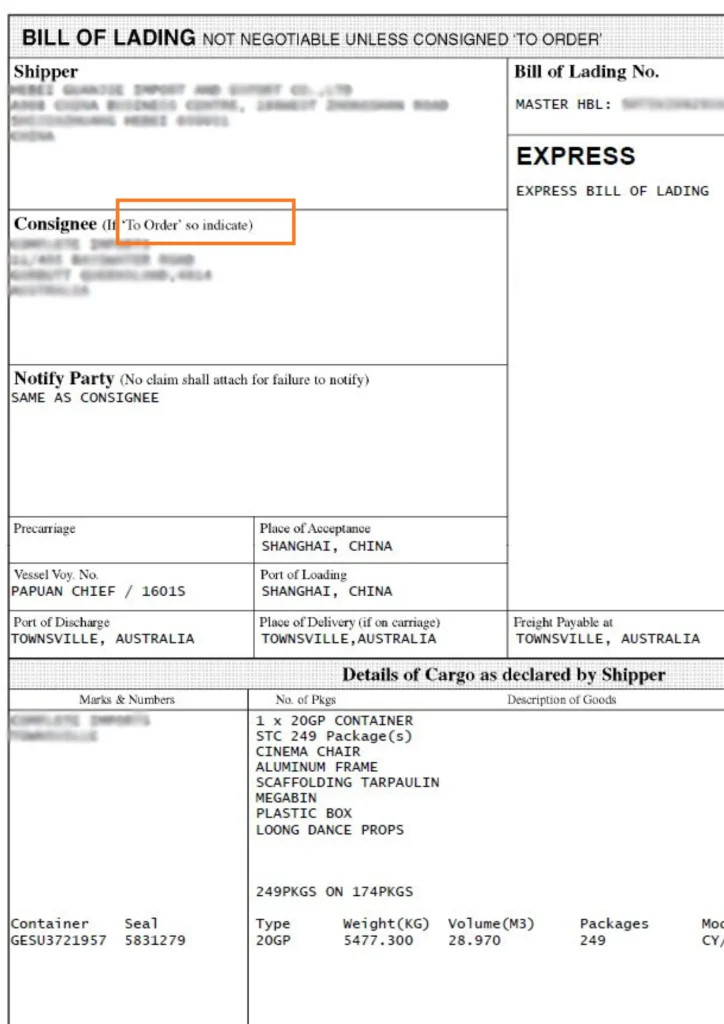
An Order B/L is a Negotiable B/L – a transferable bill of lading and a full Document of Title: whoever holds the original with a valid endorsement has full authority to claim the goods at the port of destination. This function turns the B/L into a financial instrument: goods in transit can be bought and sold multiple times through B/L transfers, without the cargo needing to arrive first.
Practical example: Company A (Vietnam) exports rice to Company B (Singapore). The B/L reads “To Order of Shipper.” While the vessel is underway, Company B sells the rice shipment to Company C (Netherlands). Company A endorses the B/L and transfers it to B; B endorses it further and passes it to C. When the vessel arrives in Rotterdam, Company C presents the twice-endorsed B/L and collects the goods – the entire transaction took place on paper while the cargo was still at sea.
What is an Order of Bank B/L?
Order of Bank B/L (bill of lading to the order of a bank) is the most common variant of Order B/L in bank-facilitated transactions. The only – but decisive difference: the Consignee field does not read “To Order of Shipper” but instead reads “To the Order of [Name of the Issuing Bank]”.
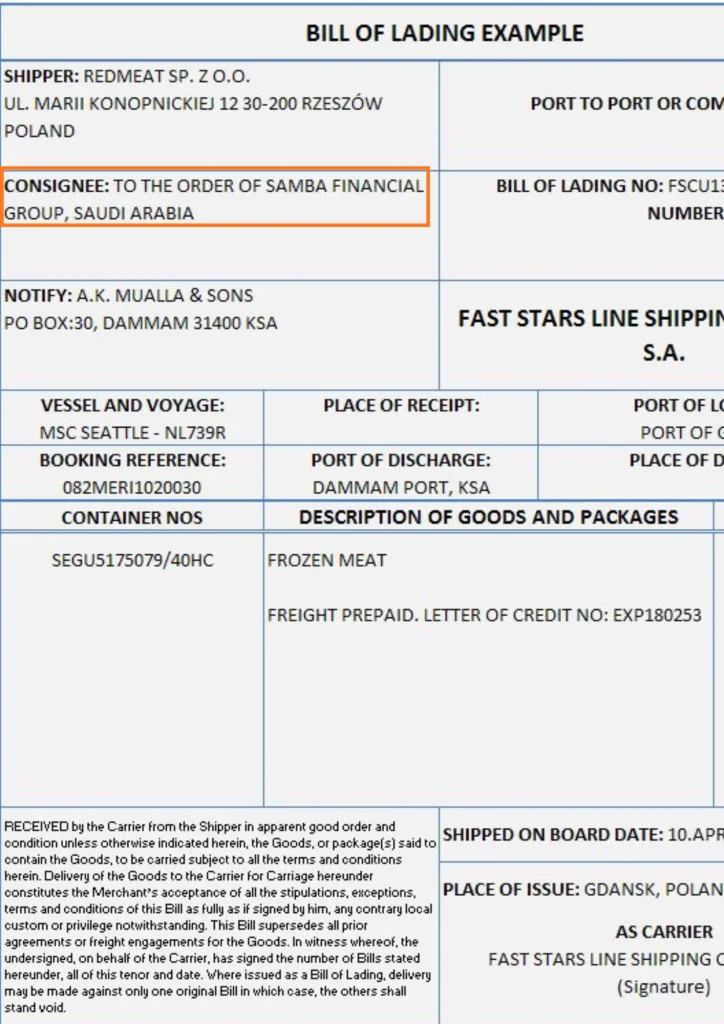
Practical example as it appears on a B/L:
Consignee: TO THE ORDER OF VIETCOMBANK
           (Joint Stock Commercial Bank for Foreign Trade of Vietnam)
           198 Tran Quang Khai, Hoan Kiem, Hanoi, Vietnam
When the Consignee field carries a bank’s name as shown above, the bank becomes the legal controller of the cargo. The shipping line will only release the goods to the party designated by the bank’s endorsement – i.e., the buyer after full payment or acceptance of the bill of exchange. This mechanism protects all three parties:
- Shipper: guaranteed that the bank holds the B/L until payment is received.
- Bank: controls the cargo as collateral for the credit it has extended.
- Consignee (buyer): receives the goods only after fulfilling their payment obligation.
How B/L Endorsement (Transfer) Works
Bill of Lading Endorsement is the act of the B/L holder signing the back of the original to transfer ownership of the goods to another party. This is the core legal mechanism that creates the “negotiable” nature of an Order B/L.
There are two common forms of endorsement:
1. Blank Endorsement
The B/L holder simply signs the back without naming the next recipient. Once blank-endorsed, the B/L operates similarly to a Bearer B/L – whoever holds the original can claim the goods. This form is commonly used when a bank endorses the B/L to the buyer after payment, as it is simple and fast.
2. Special Endorsement
The B/L holder writes the name of the next recipient before signing – for example: “Deliver to the order of XYZ Import Co., Ltd.” This form is safer because it specifies who receives the rights, reducing risk if the original is lost after endorsement.
In an L/C transaction, after the buyer makes payment, the Issuing Bank endorses the B/L – typically a Blank Endorsement and hands the original B/L to the buyer. The buyer then presents the endorsed B/L at the port to collect the goods. This entire chain of control only works because the B/L is an Order of Bank B/L, not a Straight B/L.
Comparison: Order B/L vs. Order of Bank B/L
| Criteria | Order B/L | Order of Bank B/L |
|---|---|---|
| Consignee field reads | “To Order” or “To the Order of Shipper” | “To the Order of [Issuing Bank Name]” |
| Who controls the cargo | Shipper — until endorsement and transfer | Bank — until the buyer makes payment |
| Transferable? | Yes — via endorsement | Yes — bank endorses and transfers to buyer |
| Document of Title? | Yes — full | Yes — full |
| Used in L/C? | Rarely — banks prefer Order of Bank B/L | Standard — most common in L/C transactions |
| Suitable payment methods | D/P, D/A, T/T (when cargo control is needed) | L/C (most common), D/P |
| Notify Party field | Actual buyer’s name | Actual buyer’s name (buyer does not appear in Consignee field) |
How to Fill the Consignee Field on an Order B/L in an L/C Transaction
This is the point that causes the most confusion and discrepancies in practice. When receiving an L/C, the shipper must carefully read the B/L clause – usually found under “Documents Required” or “Transport Document” – to know exactly what to enter in the Consignee field.
Three most common cases:
Case 1 – L/C states: “Full set of clean on board Bills of Lading made out to order of [Issuing Bank Name]”
→ Enter in Consignee field: “To the Order of [Issuing Bank Name]”
→ Notify Party: Full name and address of the buyer (Applicant)
Case 2 – L/C states: “Bills of Lading made out to order, blank endorsed”
→ Enter in Consignee field: “To Order”
→ Shipper applies a blank endorsement to the back of all originals before submitting to the bank
Case 3 – L/C states: “Bills of Lading consigned to [Applicant/Buyer Name]”
→ Enter the buyer’s specific name in the Consignee field → This is a Straight B/L, not an Order B/L
→ Rare in L/C transactions as the bank loses control over the cargo
Warning from 3W Logistics: An incorrect Consignee field is the most serious and most common discrepancy in an L/C document set. Copy and paste the bank’s name directly from the L/C into your Shipping Instruction – do not retype it, do not abbreviate, do not omit any detail. A single amendment costs USD 35–60 and an additional 1–2 days. – Ms. Apple, CCO, 3W Logistics
Document Flow from Shipper to Consignee in Practice
To understand how an Order of Bank B/L works in practice, follow the document flow of a typical L/C transaction:
[1] Shipping line issues original B/L
    Consignee: "To the Order of Vietcombank"
    Notify Party: ABC Import GmbH, Hamburg, Germany
         |
         ↓
[2] Shipper submits original B/L to Vietcombank (Negotiating Bank)
    along with the full L/C document set
         |
         ↓
[3] Vietcombank checks documents → forwards to Deutsche Bank (Issuing Bank)
         |
         ↓
[4] Deutsche Bank notifies ABC Import GmbH to make payment
         |
         ↓
[5] ABC Import GmbH pays → Deutsche Bank endorses the B/L
    (Blank Endorsement or "Deliver to ABC Import GmbH")
         |
         ↓
[6] ABC Import GmbH receives the endorsed original B/L
    → Presents B/L at Hamburg port → Collects goods
This entire chain of control only works because the B/L is an Order of Bank B/L. If it were a Straight B/L naming ABC Import GmbH, the buyer could collect the goods immediately without making payment — the bank would have no control mechanism whatsoever.
FAQ – Frequently Asked Questions
Question 1: What is an Order Bill of Lading?
An Order Bill of Lading is a type of B/L where the Consignee field reads “To Order” or “To the Order of Shipper.” It is a negotiable B/L transferable by endorsement, a full Document of Title, and the most widely used B/L type in international trade – especially in L/C, D/P, and D/A transactions.
Question 2: What is an Order of Bank B/L?
An Order of Bank B/L is a variant of Order B/L where the Consignee field reads “To the Order of [Issuing Bank Name].” The bank holds control over the cargo until the buyer completes payment. This is the standard B/L type used in L/C payment transactions.
Question 3: What is B/L endorsement?
B/L endorsement is the act of the B/L holder signing the back of the original to transfer ownership of the goods to another party. There are two forms: Blank Endorsement (anyone holding the original can collect the goods) and Special Endorsement (specifies the next named recipient).
Question 4: What is the difference between Order B/L and Order of Bank B/L?
Order B/L reads “To Order of Shipper” – the shipper controls it and can endorse it to anyone. Order of Bank B/L reads “To the Order of [Bank Name]” – the bank controls the cargo until the buyer pays, after which the bank endorses it to the buyer. In L/C transactions, Order of Bank B/L is more commonly used.
Question 5: Is an Order B/L mandatory in an L/C transaction?
Not absolutely mandatory, but it is the practical standard. UCP 600 Article 20 does not specifically require an Order B/L, but banks almost always require a B/L in the form of “To the Order of [Issuing Bank]” to maintain cargo control. Shippers must read the L/C terms carefully to fill in the Consignee field correctly.
How Does 3W Logistics Support B/L Documentation?
3W Logistics is an OTI-NVOCC with an FMC bond and can issue its own HBL and file AMS/ISF (for US cargo) and E-Manifest (for Canada cargo) using 3W’s own SCAC code. This makes shipping to the US and Canada through 3W Logistics significantly smoother.
With over 10 years of experience in logistics and freight forwarding, the 3W Logistics team provides comprehensive B/L documentation support services for import-export businesses:
- SI and Draft B/L Review: Thorough review of Shipping Instructions before submission and cross-checking the Draft B/L against commercial documents — especially in L/C transactions — to catch errors before amendment fees arise.
- Amendment Handling: Fast B/L amendment requests with shipping lines to minimize additional time and costs.
- L/C Documentation Support: Advisory and preparation of bank presentation document sets compliant with UCP 600, reducing discrepancy rates.

Ms. Apple is the CCO (Chief Commercial Officer) at 3W Logistics, with over 10 years of experience in sales and business operations management.
At 3W Logistics, Ms. Apple is responsible for commercial strategy, corporate customer development, managing a team of more than 50 sales professionals, and improving business performance in the logistics sector.
With practical experience in sales management and market development, Ms. Apple shares professional insights on business logistics solutions, international transportation, freight forwarding, customer management, trade lane development, and growth strategies in the logistics industry.


