What is Straight Bill of Lading? Understanding Straight B/L
Among the most common types of Bill of Lading in international maritime transport, the Straight Bill of Lading and the Bearer Bill of Lading are the two least discussed – yet they represent completely opposite ends of the spectrum when it comes to identifying who has the right to claim cargo. Understanding both helps shippers avoid using the wrong document, especially in intercompany shipments or when payment has been settled before the vessel departs.
What Is a Straight Bill of Lading?
A Straight Bill of Lading (abbreviated: Straight B/L), known in Vietnamese as vận đơn đích danh, is a type of B/L that names a specific consignee in the Consignee field. Only the exact person or company named on the document has the right to present the B/L and collect the cargo at the port of destination – no one else can substitute, even if they hold an original copy.
The defining feature of a Straight B/L lies in how the Consignee field is filled out: instead of writing “To Order” or “To the Order of [Bank]” as with negotiable B/Ls, a Straight B/L states the company or individual’s name directly – for example: “ABC Trading Co., Ltd, 123 Main Street, Rotterdam, Netherlands”.
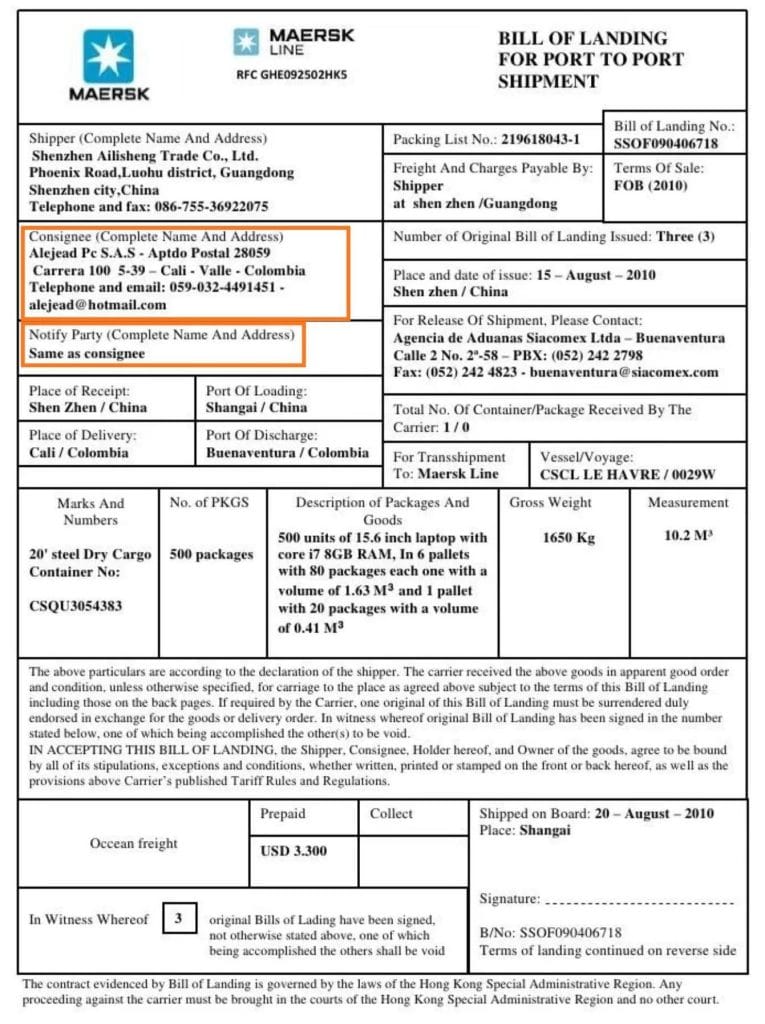
For this reason, a Straight B/L is also referred to as a Non-Negotiable B/L. Unlike an Order B/L, a Straight B/L cannot be endorsed to transfer ownership of the goods to another party while the cargo is in transit.
Technical note: A Straight B/L is not a full Document of Title in the same sense as an Order B/L. Under certain legal systems (such as U.S. law under the Pomerene Act), the carrier may deliver goods to the named consignee without requiring presentation of the original – identity verification alone may suffice. This reduces the B/L’s role as a cargo control instrument compared to negotiable types.
What Is a Bearer Bill of Lading?
A Bearer Bill of Lading is the complete opposite of a Straight B/L: the Consignee field is either left blank or marked “Bearer,” meaning anyone physically holding the original has the right to collect the cargo at the destination port – no identity verification or relationship with the shipper is required.
In theory, a Bearer B/L offers the highest flexibility of any B/L type: goods can change hands multiple times simply by passing the original document, with no endorsement required. However, this very flexibility creates serious risk.
In practice, Bearer B/Ls are almost entirely obsolete in modern international trade for a straightforward reason: if the original is lost, stolen, or falls into the wrong hands, the holder can claim the cargo immediately with no legal barriers. The fraud risk is simply too high for carriers, banks, and customs authorities to accept in standard commercial transactions.
From 3W Logistics: In over 10 years of operations, we have never handled a commercial shipment using a Bearer B/L. This document type now appears almost exclusively in specialized financial transactions or in logistics training materials as an illustration of risk. – Ms. Apple, CCO, 3W Logistics
Comparison of Straight B/L and Bearer B/L
Although neither is commonly used in standard international trade, Straight B/L and Bearer B/L differ fundamentally in their legal nature and risk profile:
| Criteria | Straight B/L | Bearer B/L |
|---|---|---|
| Vietnamese name | Vận đơn đích danh (Named consignee B/L) | Vận đơn vô danh (Anonymous B/L) |
| Consignee field | Specific company or individual name | Left blank or marked “Bearer” |
| Who can collect cargo | Only the named person or company | Anyone holding the original |
| Transferable? | No – Non-Negotiable | Yes – by passing the original |
| Document of Title? | Incomplete – some legal systems allow delivery without presenting the original | Yes – but the holder cannot be controlled |
| Main risk | Low – consignee is clearly identified | Very high – losing the original means losing the cargo |
| Usable in L/C? | Limited – banks typically require Order B/L | Not accepted |
| Suitable payment terms | T/T prepaid, intercompany, non-commercial | Virtually unused in practice |
| Usage in 2025 | Still used in certain specific scenarios | Nearly non-existent in real practice |
When to Use a Straight B/L and When to Avoid It
Despite being rarely used in standard international trade, Straight B/L does have appropriate use cases in practice:
Use Straight B/L when:
- Intercompany shipments: A parent company in Vietnam ships goods to its subsidiary in Germany – no transfer mechanism is needed, and the consignee is 100% confirmed.
- Gift or non-commercial cargo: Samples, corporate gifts, exhibition goods – no financial transaction is involved, so a negotiable Document of Title is unnecessary.
- Full T/T prepayment before vessel departure: When the seller has received full payment and no longer needs the B/L as a payment control tool, Straight B/L simplifies the release process at the destination port.
- Personal effects or relocation cargo: International movers shipping household belongings – sender and recipient are the same person or family.
Avoid Straight B/L when:
- L/C or D/P payment terms: Banks need to control cargo through the B/L – Straight B/L does not provide this mechanism adequately.
- Cargo may need to be sold in transit: Only an Order B/L allows ownership to be transferred via endorsement while goods are at sea.
- Payment has not been received or is deferred: If there is any risk of non-payment, using a Straight B/L means giving up your only cargo control tool.
Common confusions between Straight B/L and Order B/L
The most frequent mistake in practice is shippers not knowing when to use a Straight B/L versus an Order B/L. The table below highlights the key differences:
| Criteria | Straight B/L | Order B/L |
|---|---|---|
| Consignee field | Specific company or individual name | “To Order” or “To the Order of Shipper/Bank” |
| Transferable | No | Yes – via endorsement |
| Cargo control | Weak — consignee may collect with identity proof only | Strong – requires a properly endorsed original |
| Suitable payment terms | T/T prepaid, intercompany | L/C, D/P, D/A, T/T (all scenarios) |
| Used in L/C | Limited | Standard |
Can a Straight B/L Be Used in an L/C Transaction?
This is a practical question many shippers ask. The short answer: technically possible, but almost never done in practice.
Under UCP 600 Article 20, banks accept a B/L if it meets certain conditions – Straight B/Ls are not explicitly prohibited. However, in an L/C transaction, the issuing bank needs to control the cargo until the buyer makes payment. This control is typically exercised by having the bank named in the Consignee field as “To the Order of [Bank Name]” – i.e., an Order of Bank B/L.
If a Straight B/L names the bank directly in the Consignee field, the bank can technically still control the cargo. But the problem arises at the next step: when the buyer pays, the bank needs to “transfer” the right to collect the goods and a Straight B/L has no endorsement mechanism to accomplish this. That is why banks always require an Order B/L rather than a Straight B/L in L/C transactions.
Practical rule from 3W Logistics: If a bank is involved in the transaction (L/C, D/P, D/A), always use an Order B/L. A Straight B/L is only appropriate when no bank intermediary is involved and both parties fully trust each other or payment has already been completed. – Ms. Apple, CCO, 3W Logistics
FAQ – Frequently Asked Questions
Q1: What is a Straight Bill of Lading?
A Straight Bill of Lading is a type of B/L that names a specific consignee in the Consignee field. Only that named person or company has the right to collect the cargo at the port of destination. A Straight B/L cannot be transferred via endorsement and is not a full Document of Title in the same sense as an Order B/L.
Q2: What is a Bearer Bill of Lading?
A Bearer Bill of Lading is a type of B/L that does not name a consignee – anyone holding the original can claim the cargo. Due to the extremely high fraud risk if the original is lost, Bearer B/Ls are almost entirely unused in modern international trade.
Q3: Can a Straight B/L be used in an L/C transaction?
Technically yes, but almost never in practice. Banks in L/C transactions always require an Order B/L (To the Order of [Bank]) because they need an endorsement mechanism to transfer the right to collect cargo once the buyer pays – something a Straight B/L cannot provide.
Q4: When should I use a Straight Bill of Lading?
A Straight B/L is appropriate for: intercompany shipments between parent and subsidiary, gifts or non-commercial cargo, samples, full T/T prepayment before vessel departure, or when both parties have absolute trust and no cargo control mechanism via documents is needed.
8. How 3W Logistics Supports B/L Documentation
3W Logistics is a licensed OTI-NVOCC with FMC registration and bond, capable of issuing its own HBL and self-filing AMS/ISF (for U.S.-bound cargo) and E-Manifest (for Canada-bound cargo) under 3W’s own SCAC code. This makes shipments to the U.S. and Canada significantly more streamlined when handled through 3W Logistics.
With over 10 years of experience in logistics and freight forwarding, the 3W Logistics team provides comprehensive B/L documentation support for import/export businesses:
- SI and Draft B/L Review: Thorough review of Shipping Instructions before submission and Draft B/L cross-checking against commercial documents – particularly critical for L/C transactions — to catch errors before amendment fees arise.
- Amendment handling: Fast amendment requests to carriers, minimizing turnaround time and associated costs.
- L/C documentation support: Advisory and preparation of a full document set for bank presentation compliant with UCP 600, reducing discrepancy rates.
Head Office – 3W Logistics Ho Chi Minh City Branch
Address: 34 Bach Dang Street, Tan Son Hoa Ward, Ho Chi Minh City
Hotline: +84 28 3535 0087
____________________________
3W Logistics Hanoi Branch
Address: 81A Tran Quoc Toan Street, Cua Nam Ward, Hanoi
Hotline: +84 24 3202 0482
____________________________
3W Logistics Hai Phong Branch
Address: 8A Lot 28 Le Hong Phong Street, Gia Vien Ward, Hai Phong
Hotline: +84 225 355 5939
____________________________
3W LOGISTICS CO., LTD – We here serve you there!
Email: quote@3w-logistics.com
Website: www.3w-logistics.com

Ms. Apple is the CCO (Chief Commercial Officer) at 3W Logistics, with over 10 years of experience in sales and business operations management.
At 3W Logistics, Ms. Apple is responsible for commercial strategy, corporate customer development, managing a team of more than 50 sales professionals, and improving business performance in the logistics sector.
With practical experience in sales management and market development, Ms. Apple shares professional insights on business logistics solutions, international transportation, freight forwarding, customer management, trade lane development, and growth strategies in the logistics industry.


