

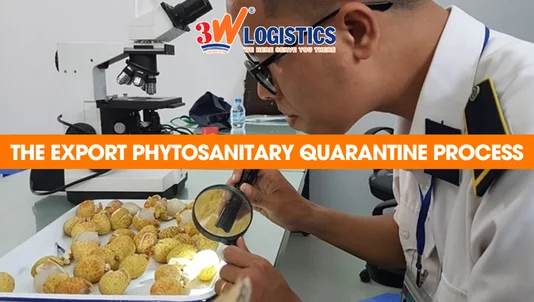
The export phytosanitary quarantine process | Detailed instructions
The export phytosanitary quarantine process is a mandatory procedure for most agricultural and forestry products of plant origin when exported abroad, aimed at proving the shipment does not carry harmful organisms and meets the quarantine requirements of the importing country. This is an indispensable step in the export documentation set for rice, coffee, black pepper, cashew nuts, fresh vegetables and fruit, round logs, sawn timber, rattan and bamboo weaving, as well as seeds and seedlings.
Although the original legal document was issued back in 2014, today’s export phytosanitary quarantine process has been adjusted and digitized through many rounds of amendment to shorten processing time and increase transparency. The article below summarizes all the legal basis, documentation, implementation steps, costs, and important notes in the export phytosanitary quarantine process, updated according to regulations current as of September 2026.
1. What Is Export Phytosanitary Quarantine and When Is It Required
Export phytosanitary quarantine is an inspection and monitoring activity aimed at detecting and preventing the spread of harmful organisms (insects, fungal diseases, weeds) from Vietnam to the importing country through goods of plant origin. Not every item requires the export phytosanitary quarantine process – it only applies to “objects subject to phytosanitary quarantine” under the list issued by the specialized authority.
Common commodity groups requiring this process include: agricultural products (rice, tea, coffee, black pepper, cashew nuts, fresh or dried vegetables and fruit), forestry products (round logs, sawn timber, rattan and bamboo weaving, wood chips), and plant varieties (seeds, seedlings, seed tubers). In addition, even when the importing country does not mandate it, many businesses still proactively apply for a Phytosanitary Certificate to increase credibility with their partners.
2. Legal Basis Governing the Export Phytosanitary Quarantine Process
| Legal Document | Regulatory Content |
|---|---|
| Law on Plant Protection and Quarantine 2013 (No. 41/2013/QH13) | Regulates the principles, conditions, and responsibility for issuing quarantine certification for exported, imported, and transiting products |
| Circular 33/2014/TT-BNNPTNT (October 30, 2014) | The original document specifying the sequence and procedure for import, export, transit, and post-import phytosanitary quarantine |
| Circular 30/2017/TT-BNNPTNT, Circular 15/2018/TT-BNNPTNT, Circular 15/2021/TT-BNNPTNT | Amend and supplement Circular 33/2014, repealing certain administrative procedures, adjusting the documentation requirements under Article 7 |
| Consolidated Document 06/VBHN-BNNPTNT (March 10, 2023) | Consolidates the entire content of Circular 33/2014 and its amending circulars into a single unified document, currently applied in practice |
| Circular 33/2021/TT-BTC (May 17, 2021) | Regulates the fee levels and fee collection/payment regime for phytosanitary and plant protection activities |
This is the foundational legal framework businesses need to understand to correctly carry out the export phytosanitary quarantine process, avoiding documentation and form errors when working with the specialized authority.
3. Implementing Authority and Quarantine Location
| Item | Detail |
|---|---|
| Specialized managing authority | Department of Crop Production and Plant Protection (Ministry of Agriculture and Environment) |
| Unit receiving documentation and taking samples | Regional Sub-Department of Plant Quarantine (Region I in Hai Phong, Region II in Ho Chi Minh City, and other regions nationwide) |
| Quarantine location | At the port, airport, border gate of export, or at the production facility/storage warehouse inland (if requested by the business) |
| Method of documentation submission | Online via the National Single Window Portal or submitted directly at the nearest quarantine authority |
4. Export Phytosanitary Quarantine Registration Documentation
| Document | Detailed Requirements |
|---|---|
| Export/Re-export Phytosanitary Quarantine Registration Form | Per the form specified in Appendix IV issued with Circular 33/2014/TT-BNNPTNT |
| Sales Contract, Invoice, Packing List | Provides information on the shipment’s volume, type, and packaging specification |
| Phytosanitary Certificate from the exporting country (if re-exporting) | Electronic or original copy, applies when the shipment originates from a third country |
| Power of Attorney (if a forwarder handles the procedure on behalf of the business) | Confirms the unit authorized to submit documentation and receive the results |
5. Steps to Carry Out the Export Phytosanitary Quarantine Process
Step 1: Register the Quarantine Documentation Online
The business accesses the National Single Window Portal or the quarantine authority’s system to submit the Export/Re-export Phytosanitary Quarantine Registration Form along with related documentation – this is the mandatory starting step in the export phytosanitary quarantine process. Download the Export/Re-export Phytosanitary Quarantine Registration Form Template
Step 2: The Quarantine Authority Receives and Checks the Validity of the Documentation
The plant quarantine authority immediately checks the validity of the documentation; if incomplete, the business will be asked to supplement and complete it before the documentation is approved and assigned a number.
Step 3: Contact the Regional Sub-Department of Plant Quarantine to Schedule Sampling
Once the online documentation is approved, the business contacts the Regional Sub-Department of Plant Quarantine responsible for the export area (e.g., Region I in Hai Phong, Region II in Ho Chi Minh City) to schedule sampling at the port, airport, or at a private warehouse if requesting to have the goods brought there for storage.
Step 4: Physical Inspection and Sampling of the Shipment
Quarantine officers conduct a preliminary inspection of the appearance and packaging, then take representative samples of the shipment to inspect for harmful organisms such as weevils, fungi, and insects, in accordance with Article 7.
Step 5: Issuance of the Phytosanitary Certificate
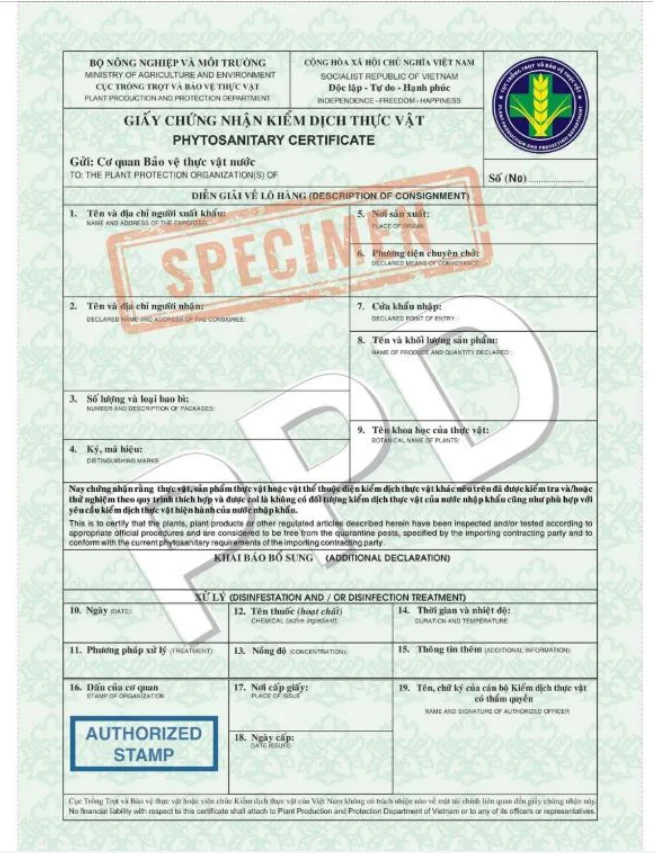
If the shipment meets the importing country’s quarantine requirements, the quarantine authority issues the Phytosanitary Certificate (per the Appendix V form) or the Re-export Phytosanitary Certificate (per the Appendix VI form) within 24 hours from the start of quarantine; in cases where this takes longer due to technical requirements, the authority will notify the business specifically.
6. Time and Cost of Carrying Out Phytosanitary Quarantine
| Stage | Estimated Time | Notes |
|---|---|---|
| Online registration, approval, and assignment of a number | A few hours to within the same day | Faster if the documentation is complete and accurate from the start |
| Sampling and physical inspection | Same day or the following morning | For ordinary goods such as vegetables, fruit, and rice, results are typically quick |
| Issuance of the Phytosanitary Certificate | Within 24 hours (as regulated) | May take longer if additional technical analysis is needed |
| Phytosanitary quarantine fees and charges | Per the fee schedule in Circular 33/2021/TT-BTC | The specific fee level depends on the type of object, volume, and quarantine location |
| Fee Item | Calculation Basis | Notes |
|---|---|---|
| Export phytosanitary quarantine fee (issuing the Phytosanitary Certificate) | Per Section III of the fee schedule issued with Circular 33/2021/TT-BTC, calculated by object type and shipment volume/quantity | Specific fee levels vary by commodity group (agricultural products, forestry products, plant varieties); businesses should look up the fee schedule directly or ask the regional Sub-Department of Plant Quarantine for the exact amount for their shipment |
| Quarantine fee for seed shipments (seedlings, grafts, buds, cuttings) | Calculated per individual unit for large shipments | Applies a different calculation method than ordinary agricultural goods, which are calculated by weight |
| Disinfection monitoring fee for objects subject to quarantine | Equal to 50% of the corresponding quarantine fee under Section III of the fee schedule | Applies when the shipment requires additional fumigation or disinfection treatment before certification is issued |
| Cases exempt from phytosanitary quarantine fees | Per Article 5 of Circular 33/2021/TT-BTC | Includes 6 cases: small-volume scientific research seed shipments (≤1kg of seed or ≤10 individuals/type); hand-carried plant products for use during travel; quarantine under diplomatic protocol; serving a national event; gifts from a Head of State; and phytosanitary quarantine for export to a newly opened market |
| Accompanying customs/logistics service costs (if outsourced) | Per agreement with the forwarding company | Not a state fee, but a separate service cost if the business authorizes a third party to handle the procedure |
Note on fee levels: Circular 33/2021/TT-BTC specifies the exact fee amounts in the attached fee schedule (Section III – Phytosanitary Quarantine Fees), categorized by object group and shipment volume/quantity, so there is no single fixed fee that applies uniformly to every item. Businesses should cross-check the fee schedule issued with the Circular directly, or contact the regional Sub-Department of Plant Quarantine responsible for their area for an accurate quote for their specific shipment. In particular, one point worth noting is that shipments exported to a newly opened market are fully exempt from phytosanitary quarantine fees – this is a policy to encourage businesses to expand into new export markets that many businesses are not fully aware of.
Practical note: Businesses should register for quarantine early, as soon as the goods are ready for packaging, rather than waiting until close to the export date, to have enough time to handle any issues if the inspection sample reveals a problem requiring remediation (heat treatment, additional fumigation). Coordinating closely with the logistics provider and the regional Sub-Department of Plant Quarantine significantly shortens the waiting time in the export phytosanitary quarantine process.
7. Common Risks in the Phytosanitary Quarantine Process
| Risk | Manifestation | Prevention Method |
|---|---|---|
| Harmful organism detected in the inspection sample | The shipment is required to undergo additional treatment (fumigation, heat treatment) or is refused certification | Control raw material quality and clean the warehouse before export packaging |
| Registration documentation is incomplete or has incorrect information | Required to supplement, extending the documentation processing time | Carefully cross-check the contract and invoice information before declaring online |
| Registering for quarantine too close to the vessel’s departure date | Not enough time for sampling and certification before the cut-off time, forcing the shipping schedule to be postponed | Register early as soon as the goods are ready, proactively contact the Sub-Department to schedule an appropriate time |
| The declared content on the Certificate does not match the importing country’s requirements | The goods are refused customs clearance at the destination port despite already having a certificate | Confirm each market’s specific additional declaration requirements with the importing partner in advance |
8. FAQ – Frequently Asked Questions About the Export Phytosanitary Quarantine Process
Question 1: Which items are required to undergo the export phytosanitary quarantine process?
Items on the list of objects subject to quarantine, such as agricultural products (rice, tea, coffee, black pepper, cashew nuts, vegetables and fruit), forestry products (round logs, sawn timber, rattan and bamboo weaving), and plant varieties (seeds, seedlings), are all required to undergo the export phytosanitary quarantine process before export.
Question 2: Which authority has the power to issue the export Phytosanitary Certificate?
The Regional Sub-Department of Plant Quarantine, under the Department of Crop Production and Plant Protection (Ministry of Agriculture and Environment), is the unit that receives documentation, takes samples, and issues the Phytosanitary Certificate for each specific shipment.
Question 3: How long does it take to issue the Phytosanitary Certificate?
As regulated, the Phytosanitary Certificate is issued within 24 hours from the start of quarantine if the shipment meets the requirements; in practice, for ordinary goods such as vegetables, fruit, and rice, the result is typically available the same day or the following morning.
Question 4: Can a business request to have the goods brought to a private warehouse for quarantine?
Yes. Businesses can ask the quarantine authority to carry out the inspection and sampling at the production facility or a storage warehouse further inland, rather than at the port or export border gate, allowing for more flexible timing in the export phytosanitary quarantine process.
How Does 3W Logistics Support the Export Phytosanitary Quarantine Process?
As a freight forwarding company registered as an OTI-NVOCC with an FMC bond in the US, holding a SCAC Code to self-file AMS/ISF directly, along with experience handling agricultural and forestry exports to diverse markets, 3W Logistics fully supports businesses through the export phytosanitary quarantine process – from documentation registration and sampling coordination to obtaining the Phytosanitary Certificate on time.
- Consulting on determining whether an item is subject to quarantine: Helping businesses cross-check the list of objects subject to quarantine, preparing documentation to the correct required form from the outset.
- Booking and transport synchronized with quarantine progress: Coordinating the timing of Phytosanitary Certificate issuance with vessel and flight schedules so the goods don’t miss the cut-off time.
- Electronic customs declaration (VNACCS): A professional team handles declarations, fully attaching quarantine documentation; as an OTI-NVOCC with FMC and SCAC Code status, independently issues HBLs and self-files AMS/ISF for shipments to the US.
Why choose 3W Logistics: With offices in Ho Chi Minh City, Hanoi, and Hai Phong, along with a team well-versed in the practical working process with the regional Sub-Departments of Plant Quarantine, 3W Logistics ensures agricultural and forestry shipments complete quarantine on time and clear customs to standard from the very first export. – Ms. Apple, CCO 3W Logistics
Head Office – 3W Logistics Ho Chi Minh City Branch
Address: 34 Bach Dang, Tan Son Hoa Ward, Ho Chi Minh City
Hotline: +84 28 3535 0087
____________________________
3W Logistics Hanoi Branch
Address: 81A Tran Quoc Toan, Cua Nam Ward, Hanoi
Hotline: +84 24 3202 0482
____________________________
3W Logistics Hai Phong Branch
Address: 8A Lot 28 Le Hong Phong, Gia Vien Ward, Hai Phong
Hotline: +84 225 355 5939
____________________________
3W LOGISTICS CO., LTD – We here serve you there!
Email: info@3w-logistics.com
Website: www.3w-logistics.com

Ms. Apple is the CCO (Chief Commercial Officer) at 3W Logistics, with over 10 years of experience in sales and business operations management.
At 3W Logistics, Ms. Apple is responsible for commercial strategy, corporate customer development, managing a team of more than 50 sales professionals, and improving business performance in the logistics sector.
With practical experience in sales management and market development, Ms. Apple shares professional insights on business logistics solutions, international transportation, freight forwarding, customer management, trade lane development, and growth strategies in the logistics industry.


