
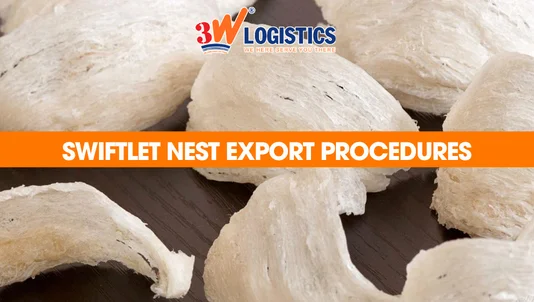
Swiftlet nest export procedures have taken a major step forward since Vietnam and China signed two bilateral protocols on swiftlet nest exports – the 2022 Protocol allowing exports of processed swiftlet nests, and the 2025 Protocol adding raw swiftlet nest products, significantly expanding the scope of goods eligible for official (formal) export channels.
This is great news for Vietnam’s swiftlet nest industry, which currently has more than 22,000 registered swiftlet houses nationwide, producing roughly 120 tons per year, equivalent to a market value of around USD 450 million.
Unlike many ordinary agricultural products, swiftlet nest export procedures are highly specialized because this is an animal-origin product that must go through strict quarantine processes related to disease control – particularly avian influenza – while also being subject to parallel oversight from both Vietnam’s veterinary authorities and China’s General Administration of Customs (GACC).
The article below compiles the full legal basis, conditions, HS codes, procedures, costs, and common risks involved in swiftlet nest export procedures, updated according to the latest applicable regulations.
1. Development potential of Vietnam’s swiftlet nest industry
Swiftlet farming in Vietnam has grown strongly thanks to favorable natural conditions, concentrated in provinces with abundant insect sources such as Khanh Hoa, Kien Giang, Binh Dinh, and several provinces in the South and Tay Ninh.
China is currently a market with very high demand for imported swiftlet nests, while Vietnam’s supply potential is abundant and the quality of domestically produced swiftlet nests has already been confirmed – this forms an important foundation for the industry to push forward with swiftlet nest export procedures through official trade channels.
With the 2025 Protocol adding raw swiftlet nest products alongside processed swiftlet nests already permitted since 2022, swiftlet-farming households now have an additional direct sales outlet, which is expected to help raise raw swiftlet nest material prices and open up opportunities for larger-scale exports to this billion-population market.
2. Legal basis governing swiftlet nest export procedures
| Legal document | Content regulated |
|---|---|
| Protocol on quarantine and health inspection requirements for swiftlet nest products exported from Vietnam to China (signed 2022) | The first bilateral document, allowing official exports of processed (refined) swiftlet nests |
| Supplementary Protocol 2025 | Adds raw (unprocessed) swiftlet nest products to the list of goods eligible for official export |
| Veterinary Law 2015 (79/2015/QH13), Decree 35/2016/ND-CP | General regulations on quarantine of animals and animal products for export |
| GACC Decree 280 (effective from June 1, 2026), replacing Orders 248 and 249 | Regulates registration and management of swiftlet nest processing enterprises for export under a new risk-assessment mechanism |
| Circular 38/2015/TT-BTC, amended by Circular 39/2018/TT-BTC | Customs procedures and supervision for exported goods |
This is the fundamental legal framework that businesses need to understand clearly in order to correctly carry out swiftlet nest export procedures, especially the specific provisions within the two bilateral protocols.
3. Conditions for swiftlet houses and processing facilities
| Condition | Issuing/managing authority | Note |
|---|---|---|
| Swiftlet house registration code | Local livestock and veterinary authority | Each swiftlet house is issued a unique registration code, the first mandatory condition for joining the export supply chain |
| Disease surveillance of swiftlet flocks | Sub-Department of Livestock Production and Animal Health | Periodic sampling to monitor avian influenza and other infectious diseases as required under the Protocol |
| Food safety eligibility certificate | Department of Livestock Production and Animal Health / food safety management authority | Mandatory for processing facilities, must remain valid at the time of export registration |
| Registration of processing/export enterprise code | Department of Livestock Production and Animal Health in coordination with GACC | Registered through China Customs’ enterprise registration management system, currently transitioning to the Decree 280 mechanism |
4. HS codes and export duties for swiftlet nests
Swiftlet nests fall under Chapter 04 — “Dairy produce; birds’ eggs; natural honey; edible products of animal origin, not elsewhere specified or included” — heading 04.10. Determining the correct HS code is a critical step in swiftlet nest export procedures, as it directly affects customs declaration and compliance with Protocol requirements.
| Product type | HS code (Vietnam) | Vietnam export duty | Note |
|---|---|---|---|
| Raw swiftlet nest (unprocessed, in original harvested state) | 0410.00.10 | 0% | Only permitted for official export to China following the 2025 Protocol |
| Processed swiftlet nest (cleaned of feathers and impurities) | 0410.00.20 | 0% | Permitted for official export since the 2022 Protocol |
| Processed swiftlet nest products (bottled bird’s nest drink, canned bird’s nest soup) | 2106.90/1901.90 | 0% | Classified under processed food, requires separate verification based on specific ingredients |
Practical note: Export duty on swiftlet nests in Vietnam is currently 0% for most HS codes under heading 0410. However, businesses must pay particular attention to clearly distinguishing raw versus processed swiftlet nests when declaring, as these are two product groups with different quarantine requirements and different permitted export timelines under the two separate Protocols.
5. Quarantine and food safety requirements for exported swiftlet nests
| Requirement | Content | Note |
|---|---|---|
| Avian influenza and infectious disease control | Swiftlet houses must implement preventive measures so that products are not exposed to virus sources, particularly avian influenza | A core requirement running through both the 2022 and 2025 Protocols |
| Product labeling | Must display the swiftlet house registration number, processing enterprise registration number, and source of raw materials | Must comply with China’s current labeling laws and standards |
| Quality inspection results | Export quality inspection results for swiftlet nests must remain valid within the most recent 6 months | Must be conducted periodically to ensure documentation remains valid before each shipment |
| Export quarantine certificate | Following the template agreed upon between Vietnam’s veterinary authority and GACC | Issued by the veterinary authority for each shipment prior to export |
6. Documentation package for swiftlet nest export procedures
| Document | When to prepare | Important note |
|---|---|---|
| Swiftlet house registration code, processing facility code | Before the first export shipment | Verify code validity before each shipment against the list published by GACC |
| Food safety eligibility certificate | Before registering for export | Must remain valid at the time of registration and customs clearance |
| Export swiftlet nest inspection results | Periodically, within the most recent 6 months | Testing of food safety indicators and residue levels as regulated |
| Quarantine certificate (Health Certificate) | Before goods reach the port/border gate | Issued by the veterinary authority using the template agreed with China Customs |
| Commercial contract, invoice, packing list | Before customs declaration | Value must match the bill of lading; must clearly state raw or processed swiftlet nest |
| Certificate of Origin (C/O Form E) | After the export declaration is issued | Required to enjoy preferential tariffs under ACFTA when clearing customs in China |
| Export customs declaration (VNACCS) | Before customs clearance | Declare the correct HS code for raw or processed swiftlet nest form |
7. Swiftlet nest export procedure steps
Step 1: Register the swiftlet house code
The swiftlet house owner registers a code with the local livestock and veterinary authority where the swiftlet house is located — this is the foundational and mandatory first step in swiftlet nest export procedures; each swiftlet house is issued only one unique code.
Step 2: Periodic disease surveillance of the swiftlet flock
The local veterinary authority coordinates sample collection for disease surveillance, particularly avian influenza, at swiftlet houses to satisfy technical barriers regarding veterinary and food safety standards required under the Protocol.
Step 3: Enterprise submits a request for export guidance
The enterprise submits a written request to the Department of Livestock Production and Animal Health requesting guidance and support for export procedures, together with the necessary documents such as the food safety eligibility certificate.
Step 4: Register the processing enterprise code on the GACC system
The enterprise declares and uploads the required documents onto China Customs’ enterprise registration management system; the Department of Livestock Production and Animal Health supplements this with a confirmation letter stating the enterprise fully meets Protocol requirements, sent to the Chinese side for review.
Step 5: Shipment quality inspection and issuance of the quarantine certificate
After obtaining satisfactory disease surveillance and food safety inspection results, the enterprise registers for quarantine inspection so the veterinary authority can issue a certificate, using the template agreed with China Customs, for each shipment.
Step 6: Complete the documentation package and declare customs export
The enterprise or its forwarder prepares the invoice and packing list, and declares the electronic customs declaration on the VNACCS system, attaching the quarantine certificate, the swiftlet house/processing facility code, and the C/O Form E.
Step 7: Transportation and import clearance in China
Once the declaration is cleared, the goods are handed over to the air or road carrier depending on volume; products that fail to meet Protocol requirements will be held, handled, returned, or destroyed by China Customs.
8. Transportation methods for swiftlet nests to China
Air freight: The top priority for swiftlet nests due to their high value and small volume, requiring safety assurance and fast delivery to minimize the risk of damage.
Road transport (border trade): Used for large-volume shipments through northern border gates, with short transit times, suited to businesses needing regular periodic deliveries.
9. Timeline and costs in swiftlet nest export procedures
| Stage | Estimated time | Note |
|---|---|---|
| Registering the swiftlet house code | A few weeks | Done once at the local livestock and veterinary authority |
| Registering the processing enterprise code with GACC | A few weeks to a few months | Includes waiting time for confirmation by the Department of Livestock Production and Animal Health and approval by GACC |
| Quality inspection and issuance of quarantine certificate | 1 – 3 days | For each specific export shipment |
| Export customs declaration (VNACCS) | 0.5 – 1 day | Faster if the declaration is routed to the green channel |
| Air transport | 1 – 3 days | The most common method for high-value goods such as swiftlet nests |
Practical note: Registering the swiftlet house code and the processing enterprise code only needs to be done once, but requires careful preparation, particularly the periodic disease surveillance records. Once completed, subsequent shipments in the swiftlet nest export procedure will be processed significantly faster. Businesses should proactively register early, especially for raw swiftlet nest products newly added under the 2025 Protocol.
10. Common risks in swiftlet nest export procedures
| Risk | Manifestation | Prevention |
|---|---|---|
| Swiftlet house without a registration code | Raw material cannot enter the official export supply chain and must be sold through domestic channels at a lower price | Proactively register the swiftlet house code early with the local livestock and veterinary authority |
| Signs of avian influenza or infectious disease detected | Shipment held, processed, returned, or destroyed in China | Fully implement preventive measures and periodic disease surveillance as guided by the veterinary authority |
| Confusion between raw and processed swiftlet nest when declaring | Incorrect HS code, delayed clearance, or rejection due to mismatch with the applicable Protocol’s scope | Clearly determine the product form and verify against the corresponding Protocol before exporting |
| Product labeling not compliant with regulations | Missing mandatory information (swiftlet house registration number, processing facility, raw material source) | Carefully review label content against China’s labeling requirements before packaging |
| Expired inspection results | Documentation rejected because inspection results are more than 6 months old | Schedule periodic inspections and proactively renew before expiry |
FAQ – Frequently asked questions about swiftlet nest export procedures
Question 1: Can raw swiftlet nests now be officially exported to China?
Yes. The 2025 Protocol just signed between Vietnam and China has officially added raw swiftlet nest products to the list of goods eligible for official export, alongside processed swiftlet nests that have been permitted since the 2022 Protocol.
Question 2: How many codes does each swiftlet house need to export?
Each swiftlet house is issued only one unique code — this is a mandatory condition for products from that swiftlet house to be included in the official export supply chain under swiftlet nest export procedures.
Question 3: What is the current export duty on swiftlet nests to China?
Swiftlet nests (HS codes under heading 0410) enjoy a 0% export duty rate in Vietnam. When clearing customs in China, businesses should have a C/O Form E to enjoy preferential import tariffs under the ACFTA agreement.
Question 4: What is the most important quarantine requirement for exported swiftlet nests?
The core requirement is that products must be guaranteed free from exposure to virus sources, particularly avian influenza, through full implementation of preventive measures at swiftlet houses and processing facilities as guided by the veterinary authority.
Question 5: Which agency supports businesses with swiftlet nest export procedures to China?
The Department of Livestock Production and Animal Health (Ministry of Agriculture and Environment) is the focal point for guiding and supporting businesses in completing their documentation, and is also the authority that confirms an enterprise fully meets Protocol requirements before submitting to China Customs for review.
How does 3W Logistics support swiftlet nest export procedures?
As a freight forwarding company registered as an OTI-NVOCC with an FMC bond (Federal Maritime Commission) in the United States, holding an SCAC Code to self-file AMS/ISF declarations directly, and with experience handling animal-origin cargo exported to diverse markets, 3W Logistics provides a full-package service for businesses on swiftlet nest export procedures — from advising on swiftlet house code registration through to customs clearance at the Chinese border.
- Advisory on export conditions under the 2022 and 2025 Protocols: Guiding businesses and swiftlet house owners in preparing registration documentation correctly, clearly distinguishing the conditions applicable to raw versus processed swiftlet nests.
- Support connecting to obtain the quarantine certificate (Health Certificate): Coordinating with veterinary authorities so shipments are inspected and certified on time, ensuring information matches the invoice and packing list.
- Continuous updates on GACC changes: Closely tracking new regulations during the transition to Decree 280, helping businesses proactively plan their export strategy.
- Booking flights and multimodal transport: Arranging air or road transport depending on volume, ensuring safety for high-value products such as swiftlet nests.
- Electronic customs declaration (VNACCS) and customs clearance procedures at the Chinese border: A professional customs declaration team handles export declarations, cross-checks HS codes and swiftlet house codes; as an OTI-NVOCC with FMC and an SCAC Code, 3W Logistics directly issues its own House Bill of Lading (HBL) and self-files AMS/ISF for shipments bound for the U.S.
- Handling situations that arise when goods reach the Chinese border: With a network of agents in China, 3W Logistics helps businesses prepare complete documentation and quickly resolve additional requirements arising from local customs authorities.
Why choose 3W Logistics for swiftlet nest exports: Unlike many intermediary forwarders, 3W Logistics is an OTI-NVOCC with a bond and direct FMC certification in the U.S., holding an SCAC Code that allows it to self-file AMS/ISF — helping to shorten documentation processing time and reduce the risk of delays, which is especially important for animal-origin goods requiring strict quarantine such as swiftlet nests. With offices in Ho Chi Minh City, Hanoi, and Hai Phong, and a team that stays closely updated on policy changes from GACC, 3W Logistics is a suitable choice for businesses wanting to ensure their swiftlet nest shipments clear customs on time and to standard, right from the very first export. – Ms. Apple, CCO of 3W Logistics
Head Office – 3W Logistics Ho Chi Minh City Branch
Address: 34 Bach Dang, Tan Son Hoa Ward, Ho Chi Minh City
Hotline: +84 28 3535 0087
____________________________
3W Logistics Hanoi Branch
Address: 81A Tran Quoc Toan, Cua Nam Ward, Hanoi
Hotline: +84 24 3202 0482
____________________________
3W Logistics Hai Phong Branch
Address: 8A Lot 28 Le Hong Phong, Gia Vien Ward, Hai Phong
Hotline: +84 225 355 5939
____________________________
3W LOGISTICS CO., LTD – We here serve you there!
Email: quote@3w-logistics.com
Website: www.3w-logistics.com

Ms. Apple is the CCO (Chief Commercial Officer) at 3W Logistics, with over 10 years of experience in sales and business operations management.
At 3W Logistics, Ms. Apple is responsible for commercial strategy, corporate customer development, managing a team of more than 50 sales professionals, and improving business performance in the logistics sector.
With practical experience in sales management and market development, Ms. Apple shares professional insights on business logistics solutions, international transportation, freight forwarding, customer management, trade lane development, and growth strategies in the logistics industry.


