Importing spirits into Vietnam is one of the conditional business categories subject to the strictest regulatory control in the import-export sector, as this product category directly affects public health and falls under the conditional business list set by the Ministry of Industry and Trade..
This article by 3W Logistics presents the complete spirits import procedure of all types under current regulations – covering legal conditions, HS codes, how to calculate the three tax layers, required documentation, step-by-step process, and real-world risks, from the perspective of a forwarder experienced in handling imported alcoholic beverage products.
1. Legal Conditions for Importing Spirits into Vietnam
This is the first barrier in spirits import procedures. Spirits with an alcohol content of 5.5 degrees or higher are conditional business goods under Decree 105/2017/ND-CP (amended by Decree 17/2020/ND-CP). Businesses must hold an Alcohol Distribution License issued by the Ministry of Industry and Trade before they can directly import for commercial purposes.

| Condition | Detailed Content |
|---|---|
| Business qualification | Must be a legally established business under Vietnamese law – individuals and household businesses are not eligible for an Alcohol Distribution License |
| Warehouse | Must have legal right to use a warehouse or warehouse system with a total usable floor area of 150 m² or more, meeting fire safety and environmental protection conditions |
| Distribution system | Must have a spirits distribution system covering 2 or more centrally-run provinces/cities; each province/city must have at least 1 wholesale spirits trader participating in the system |
| Documentation from the foreign supplier | Must have an introduction letter or principle agreement with a spirits supplier abroad, clearly stating the types of spirits intended for trading, consistent with the supplier’s business activities |
| Food safety | Spirits intended for trading must meet food safety conditions; must complete product self-declaration under Decree 15/2018/ND-CP before circulation |
Practical note: Many businesses mistakenly believe that simply registering a “spirits import and distribution” business line is sufficient for customs clearance. In reality, if a business does not yet have an Alcohol Distribution License or an Industrial Spirits Production License, it can still import spirits but only for product self-declaration purposes, with a maximum volume of 3 liters per label, and is not permitted to trade commercially. This is a key distinction new businesses need to understand clearly before placing large orders.
2. HS Codes and Import Tax on Spirits of All Types
Determining the correct HS code is the most important step affecting tax costs in spirits import procedures. Spirits fall under Chapter 22 (Beverages, spirits and vinegar) of the Import-Export Tariff Schedule, classified into 5 main groups from 2204 to 2208 based on raw material and alcohol content.
| Spirit Type | 8-Digit HS Code | Detailed Description | Import Tax (MFN) |
|---|---|---|---|
| Sparkling wine (Champagne, Prosecco) | 2204.10.00 | Sparkling wine made from fresh grapes, with an excess pressure of ≥3 bar when kept at 20°C | 50% |
| Regular wine, alcohol content ≤ 15% | 2204.21.11 | Red/white wine made from fresh grapes, packaged in containers under 2 liters, alcohol ≤15% by volume | 50% |
| Regular wine, alcohol content > 15% | 2204.21.13 | Red/white wine made from fresh grapes, packaged in containers under 2 liters, alcohol >15% by volume | 50% |
| Vermouth | 2205.10.10 | Fresh grape wine flavored with herbs/aromatics, alcohol content ≤15% | 50% |
| Cider / Perry | 2206.00.10 | Fermented beverages made from apples or pears, not fresh grapes | 55% |
| Brandy / Cognac | 2208.20.50 | Spirits distilled from grape wine or grape marc, alcohol <80% | 45% |
| Whisky | 2208.30.00 | Spirits distilled from fermented grain mash (barley, corn, rye…) | 45% |
| Rum | 2208.40.00 | Spirits distilled from fermented sugarcane products | 45% |
| Gin | 2208.50.00 | Gin and Geneva, distilled with juniper flavoring | 45% |
| Vodka | 2208.60.00 | Pure distilled ethyl alcohol, typically from grain or potatoes | 45% |
Important note: Spirits from countries with an FTA with Vietnam may qualify for special preferential import tax rates significantly lower than the MFN rates listed above – for example, EU wine with a geographical indication under EVFTA (C/O Form EUR.1) follows a roadmap gradually reducing to 0%; spirits from Japan under CPTPP/VJEPA (Form CPTPP/JV) and from Korea under VKFTA (Form KV) are also reduced on a roadmap. Without a valid C/O, the shipment is subject to the highest MFN tax rate in the table above.
Special Consumption Tax on Spirits Under the New Roadmap from 2026
Under Special Consumption Tax Law No. 66/2025/QH15, effective from January 1, 2026, the special consumption tax on spirits will increase gradually each year on a roadmap through 2031 – this is the biggest change businesses need to factor into long-term business planning.
| Spirit Group | 2026 | 2027 | 2028 | 2029 | 2030 | 2031 |
|---|---|---|---|---|---|---|
| Spirits ≥ 20 degrees alcohol | 65% | 70% | 75% | 80% | 85% | 90% |
| Spirits < 20 degrees alcohol | 35% | 40% | 45% | 50% | 55% | 60% |
3. Documentation for Spirits Import Procedures
The documentation set for spirits import procedures includes an additional layer of product self-declaration and mandatory stamp affixation compared to ordinary goods. Information on labels, invoices, and licenses must be completely consistent to avoid customs holding the shipment.
| Document | When to Prepare | Important Notes |
|---|---|---|
| Alcohol Distribution License | Before signing the contract | Issued by the Ministry of Industry and Trade, review time approximately 15 business days from valid application; this also serves as the basis for being granted direct import rights |
| Sales Contract | Before deposit payment | Clearly state spirit name, brand, alcohol content, volume, origin, Incoterms, and terms for providing C/O |
| Commercial Invoice & Packing List | Before goods are shipped | Fully list spirit name, alcohol content, bottle volume, number of cartons/packages – the basis for cross-checking against the actual label |
| Bill of Lading | After loading onto vessel | Spirits are usually shipped in dry containers, with temperature control for wine; the consignee must match the Alcohol Distribution License |
| C/O (Certificate of Origin) | Before goods are shipped | Determines the applicable import tax rate; Form EUR.1 (EU), Form CPTPP/JV (Japan), Form KV (Korea), Form E (ASEAN-China)… |
| Product self-declaration form | Before goods arrive at port | Filed at the Department of Industry and Trade under Decree 15/2018/ND-CP, accompanied by test results and CFS; processing time 15-20 days |
| Imported spirits stamp & Vietnamese sub-label | Before circulation | Register to purchase stamps from the customs authority, affix before goods leave the customs supervision area; sub-labels must be complete under Decree 43/2017/ND-CP and 111/2021/ND-CP |
| Electronic Customs Declaration (VNACCS) | Once documentation is complete | Declare the correct HS code under group 2204-2208, enter the Alcohol Distribution License number and C/O number on the declaration |
4. Step-by-Step Spirits Import Procedure
Step 1: Obtain the Alcohol Distribution License and prepare legal conditions
The business submits an application to the Ministry of Industry and Trade, prepares a warehouse meeting the minimum 150 m² area, and completes a distribution system in at least 2 provinces/cities. Processing time is approximately 15 business days from a valid application, so this should be started in parallel with supplier negotiations.
Step 2: Negotiate the contract, determine the HS code, and request C/O
Sign the spirits purchase contract, clearly specifying technical parameters (alcohol content, volume, origin) and requesting C/O under the corresponding FTA directly in the contract terms. For EU wine or Japanese/Korean spirits, C/O cannot be obtained retroactively after the goods have been loaded onto the vessel.
Step 3: Register product self-declaration
Before goods arrive at port, file the product self-declaration at the Department of Industry and Trade under Decree 15/2018/ND-CP, accompanied by test results and a Certificate of Free Sale (CFS) from the exporting country (with notarized translation).
Step 4: Ship goods to a Vietnamese port
Spirits are usually shipped in standard 20’/40′ containers; for wine, temperature-controlled containers are needed to prevent quality degradation on long journeys. The forwarder must seal carefully and clearly record quantity and type on the bill of lading.
Step 5: Customs declaration, tax payment, and physical inspection at port
Open the VNACCS declaration with the complete HS code, Alcohol Distribution License number, and C/O number. Customs cross-checks information on the declaration, invoice, and product self-declaration documents against the actual shipment. After confirmation, the business pays import tax, special consumption tax, and VAT.
Step 6: Affix stamps, clear customs, and transport goods to the warehouse
Register to purchase imported spirits stamps from the customs authority, affix compliance stamps and Vietnamese sub-labels before goods leave the supervision area. Once complete, the business receives the D/O and transports the goods to the warehouse for distribution.
5. How to Calculate Spirits Import Tax
Spirits are subject to three cumulative tax layers, similar to automobiles. For example, with a whisky shipment (HS code 2208.30) imported from Japan, CIF value of 500 million VND, comparing scenarios with and without CPTPP C/O:
| Tax / Cost Item | No C/O (MFN 50%) | With CPTPP C/O (25%) |
|---|---|---|
| CIF value | 500,000,000 VND | 500,000,000 VND |
| Import tax | 50% × 500M = 250,000,000 VND | 25% × 500M = 125,000,000 VND |
| Special consumption tax (65%, year 2026) | 65% × (500+250)M = 487,500,000 VND | 65% × (500+125)M = 406,250,000 VND |
| VAT (10%) | 10% × (500+250+487.5)M = 123,750,000 VND | 10% × (500+125+406.25)M = 103,125,000 VND |
| Total tax payable | 861,250,000 VND (~861 million) | 634,375,000 VND (~634 million) |
| Savings with C/O | ~226,875,000 VND – a substantial difference from just one valid C/O. This is why C/O is the top-priority document in spirits import procedures. | |
From 3W Logistics’ practical experience: Spirits is the product category where the most common mistake isn’t found in commercial documents but in the product self-declaration and stamp affixation stage – many businesses only prepare the import license and forget that they must complete product self-declaration and register to purchase stamps before goods can leave the customs supervision area, causing shipments to get “stuck” at port even after tax clearance is complete. Additionally, with the special consumption tax roadmap increasing 5%/year from 2027 to 2031, businesses need to recalculate profit margins for each year when planning long-term imports. – Ms. Apple, CCO, 3W Logistics
6. Common Risks in Spirits Import Procedures
| Risk | Manifestation | Prevention |
|---|---|---|
| No Alcohol Distribution License | Importing spirits for commercial purposes without a license – goods are held, may incur an administrative fine of 20-30 million VND under Decree 98/2020/ND-CP, and a 1-3 month suspension of business rights | Complete all conditions and obtain the license before signing a large-volume purchase contract |
| Product self-declaration not completed | Goods have cleared tax obligations but cannot leave the supervision area due to a missing self-declaration at the Department of Industry and Trade – resulting in container/storage fees | File the self-declaration in parallel with the shipping time, completing it before the vessel arrives at port |
| No C/O or invalid C/O | Must pay the MFN tax rate instead of the FTA preferential rate – the difference can amount to hundreds of millions of VND per shipment | Request C/O directly in the contract terms; verify the C/O matches the Invoice and B/L before goods are loaded onto the vessel |
| Label lacking mandatory information | Vietnamese sub-label missing importer name, origin, alcohol content, or storage instructions – customs holds the goods and requires re-labeling at port | Prepare correct sub-label samples under Decree 43/2017/ND-CP and 111/2021/ND-CP before goods arrive at port |
| Incorrect HS code between groups 2204-2208 | Confusing liqueur with pure spirits, or sparkling wine with regular wine – customs reclassifies, retroactively collecting the special consumption tax difference | Confirm the HS code based on the correct composition, alcohol content, and production method before opening the declaration; consult a forwarder experienced in the alcoholic beverage category |
Note: There have been cases where some businesses made mistakes or omissions in the customs declaration process, resulting in shipments being denied import.
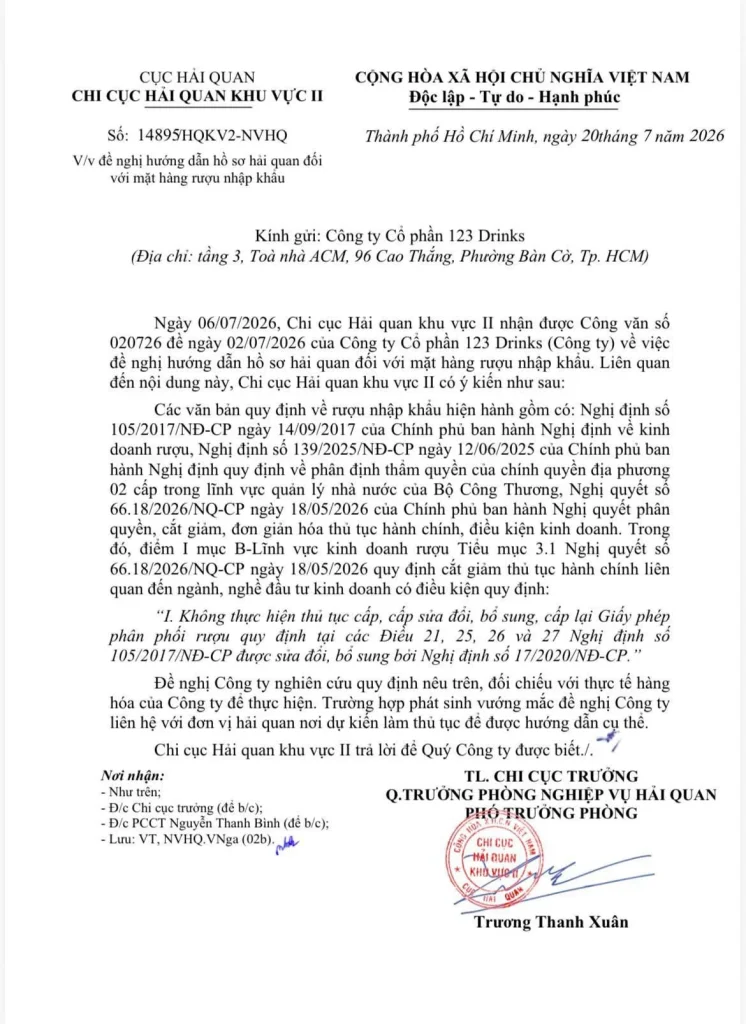
Businesses need to pay attention to and carefully consider the following documents, circulars, and decrees regarding the import of alcoholic beverages:
- Decree No. 105/2017/ND-CP
- Decree No. 139/2025/ND-CP
- Decree No. 66.18/2026/NQ-CP
FAQ – Frequently Asked Questions about Spirits Import Procedures
Question 1: What documents are needed for spirits import procedures?
A complete documentation set for spirits import procedures includes: Alcohol Distribution License (issued by the Ministry of Industry and Trade); Sales Contract; Commercial Invoice and Packing List; Bill of Lading; C/O under the corresponding FTA; Product self-declaration form at the Department of Industry and Trade; imported spirits stamp and Vietnamese sub-label; electronic customs declaration (VNACCS).
Question 2: Does importing spirits under 3 liters require a distribution license?
Not required if the purpose is product self-declaration only (not for commercial trading) – a business without an Alcohol Distribution License or an Industrial Spirits Production License can still import with a maximum volume of 3 liters per label, but this shipment is not permitted to be sold on the market.
Question 3: How many types of tax must be paid when importing spirits?
Spirits are subject to three cumulative tax layers: (1) Import tax, calculated on CIF value, ranging from 0% (with FTA) to 50% (MFN) depending on the HS code and origin; (2) Special consumption tax, calculated on CIF plus import tax, 65% in 2026 (spirits ≥20 degrees) or 35% (spirits <20 degrees), increasing 5%/year through 2031; (3) 10% VAT, calculated on total CIF plus import tax plus special consumption tax.
Question 4: How long does spirits import take?
The total time from applying for the Alcohol Distribution License to goods arriving at the warehouse typically ranges from 45-75 days. This includes: distribution license application, 15 business days; product self-declaration, 15-20 days; transport from Asia, 10-20 days, from Europe, 25-35 days; customs clearance and stamp affixation, 5-10 days. Shipments with complete documentation and a valid C/O clear significantly faster.
How 3W Logistics Supports Spirits Import Procedures
With over 10 years of experience handling imported food and beverage products and registration as an OTI-NVOCC with FMC bond (Federal Maritime Commission) in the United States, 3W Logistics offers a full-service package for businesses covering spirits import procedures for all types – from legal condition consulting to delivery at the distribution warehouse.
- Consulting on legal conditions and support preparing the Alcohol Distribution License: Review warehouse and distribution system conditions under Decree 105/2017 and Decree 17/2020; guide the application process submitted to the Ministry of Industry and Trade.
- HS code determination and actual tax calculation before ordering: Accurately determine the HS code under group 2204-2208 and alcohol content; calculate the three tax layers according to the latest special consumption tax increase roadmap – giving businesses an accurate cost figure before negotiation.
- Support obtaining the correct FTA C/O form from suppliers: Guide EU suppliers in obtaining Form EUR.1, Japanese suppliers Form CPTPP/JV, and Korean suppliers Form KV; verify the C/O before goods are loaded onto the vessel.
- Coordinate product self-declaration: Prepare self-declaration documentation at the Department of Industry and Trade in parallel with shipping time to avoid storage fees at port.
- Electronic customs declaration (VNACCS) and resolving issues at the border checkpoint: Declare the correct HS code, coordinate proper imported spirits stamp and sub-label application before clearance.
Why choose 3W Logistics for your spirits shipment? Spirits import procedures require simultaneous handling of multiple layers of regulation – business conditions under Decree 105/2017, product self-declaration documentation, calculating the three tax layers under the correct HS code, and optimizing FTA C/O amid a rising special consumption tax roadmap each year. We accompany you from the legal condition preparation stage through to warehouse delivery – helping businesses avoid the most costly mistakes. Contact 3W for specific consultation before signing your import contract.
Address: 34 Bach Dang, Tan Son Hoa Ward, Ho Chi Minh City
Hotline: +84 28 3535 0087
____________________________
3W Logistics Hanoi Branch
Address: 81A Tran Quoc Toan, Cua Nam Ward, Hanoi
Hotline: +84 24 3202 0482
____________________________
3W Logistics Hai Phong Branch
Address: 8A Lot 28 Le Hong Phong, Gia Vien Ward, Hai Phong
Hotline: +84 225 355 5939
____________________________
3W LOGISTICS CO., LTD – We here serve you there!
Email: quote@3w-logistics.com
Website: www.3w-logistics.com

Ms. Apple is the CCO (Chief Commercial Officer) at 3W Logistics, with over 10 years of experience in sales and business operations management.
At 3W Logistics, Ms. Apple is responsible for commercial strategy, corporate customer development, managing a team of more than 50 sales professionals, and improving business performance in the logistics sector.
With practical experience in sales management and market development, Ms. Apple shares professional insights on business logistics solutions, international transportation, freight forwarding, customer management, trade lane development, and growth strategies in the logistics industry.


