
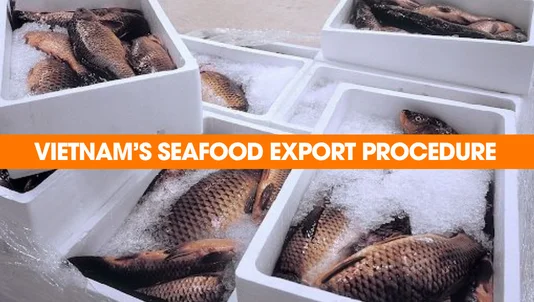
Vietnam’s seafood export procedure is entering its most decisive phase yet in the effort to lift the EU’s IUU “yellow card,” as the Government has just issued an Action Plan under Decision 1516/QD-TTg (August 10, 2026) to thoroughly address the European Commission’s recommendations following its 5th inspection mission, with a firm goal of lifting the warning within 2026. This is a moment seafood businesses need to pay particular attention to, as the entire process for issuing raw material confirmation certificates and catch origin certification for caught seafood has now fully moved to the electronic eCDT system.
As a key export industry with a wide range of products from shrimp, pangasius, tuna, squid, and octopus to various mollusks, the seafood export procedure requires businesses to clearly distinguish between farmed aquaculture products and wild-caught marine products, as these two groups have completely different documentation requirements. The article below summarizes all the legal basis, HS codes, procedures, costs, and common risks in the seafood export procedure, updated according to regulations current as of September 2026.
1. Potential and Main Seafood Export Markets
Vietnam is one of the world’s leading seafood exporting countries, with aquaculture areas concentrated in the Mekong Delta (shrimp, pangasius) and fishing fleets operating along the central and southern coasts (tuna, squid, octopus). The US, EU, Japan, South Korea, and China continue to be the key markets in the seafood export procedure over many years.
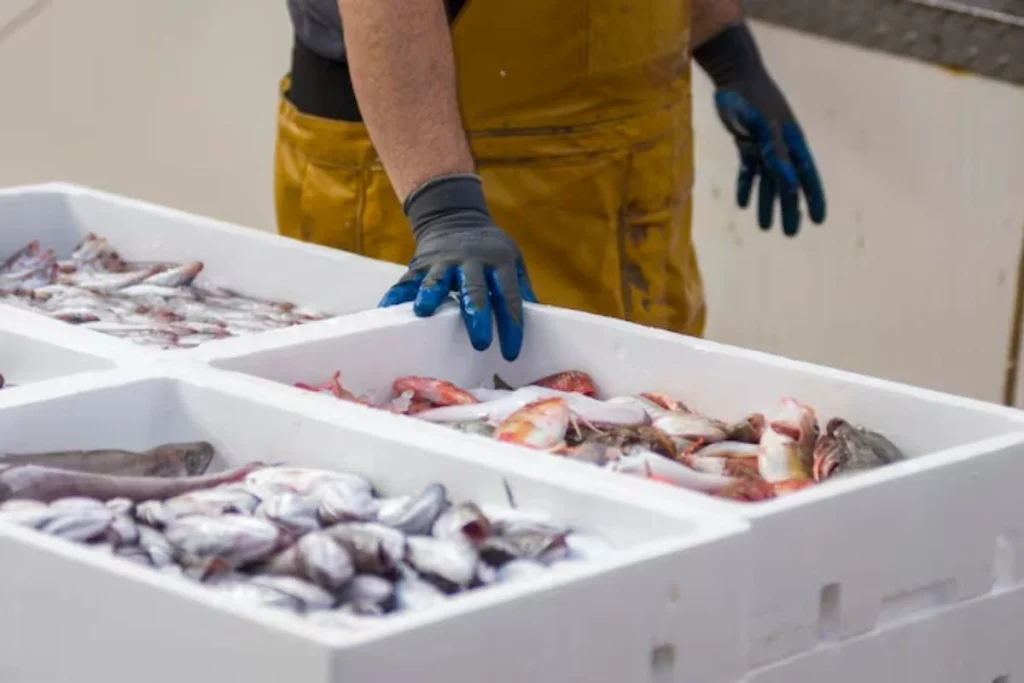
Each market applies a different level of control: the EU has maintained an IUU “yellow card” warning against Vietnam since 2017 and requires very strict traceability for wild-caught goods; the US applies equivalent regulations under the Marine Mammal Protection Act (MMPA), currently accepting only 11 fishing gear codes accompanied by COA certification; China, Japan, and South Korea focus more on food safety and processing facility registration.
2. Legal Basis Governing the Seafood Export Procedure
| Legal Document | Regulatory Content |
|---|---|
| Fisheries Law 2017 (18/2017/QH14) | General regulations on aquaculture, fishing, processing, and export of seafood |
| Consolidated Document 02/VBHN-BNNPTNT (consolidating Circular 48/2013 and 32/2022) | Inspection and certification of food safety for exported seafood; authority for NAFIQAD/NAFIQUAST to issue the Health Certificate |
| Circular 81/2025/TT-BNNMT | Regulates the full end-to-end issuance of raw material confirmation certificates and catch origin certificates for caught seafood through the electronic eCDT system |
| Decree 301/2025/ND-CP | Increases administrative penalty levels and adds remedial measures for violations related to Vessel Monitoring System (VMS) tracking and fishing logbooks |
| Decree 292/2026/ND-CP (effective from September 5, 2026, replacing Decree 69/2018/ND-CP) | General procedures for managing the import-export of goods; seafood is not on the list of banned exports |
Important new point to note: From 2026, 100% of documentation for issuing raw material confirmation certificates and catch origin certificates for seafood exported to markets that require them must be processed on the eCDT system; fishing vessels without valid journey data on this system will not be issued a raw material confirmation certificate. Businesses purchasing wild-caught raw materials need to pay particular attention to this condition when working with fishing fleets supplying raw materials.
3. Conditions for Businesses and Processing Facilities
| Condition | Issuing/Managing Authority | Notes |
|---|---|---|
| Export-standard processing plant code (DL code) | NAFIQAD/NAFIQUAST | The plant must be on the list recognized by each market (EU, China under GACC, South Korea…) |
| HACCP/ISO 22000 Certificate | Independent certification body | A near-mandatory condition for most major importers in the EU, US, and Japan |
| Raw material confirmation certificate/catch certificate (for wild-caught seafood) | Sub-Department of Fisheries, processed via the eCDT system | Only applies to wild-caught raw materials; farmed seafood does not need this document |
| COA Certificate (Certificate of Acceptability) when exporting to the US | Fisheries management authority in coordination with NOAA Fisheries (US) | Mandatory for seafood caught using one of the 11 fishing gear codes accepted by the US under the MMPA |
4. HS Code and Seafood Export Tax
Seafood primarily falls under Chapter 03 – “Fish and crustaceans, molluscs and other aquatic invertebrates” for fresh/frozen products, and Chapter 16 – “Preparations of meat, fish…” for deeply processed products. Correctly determining the HS code by species and processing level is an important step in the seafood export procedure.
| Product Type | HS Code (Vietnam) | Vietnam Export Tax | Notes |
|---|---|---|---|
| Frozen pangasius/basa fillets | 0304.62/0304.72 | 0% | Aquaculture product, does not require a wild-catch confirmation certificate |
| Frozen black tiger shrimp, whiteleg shrimp | 0306.17 | 0% | Requires detailed lookup at the 8-digit subheading level according to processing specification |
| Frozen, fresh tuna | 0303.4x | 0% | A wild-caught product, mandatorily accompanied by a raw material confirmation certificate via eCDT |
| Frozen squid, octopus | 0307.43/0307.51 | 0% | Primarily wild-caught goods, requires full origin certification |
| Canned/ready-processed fish and seafood | 1604.14/1605.21 | 0% | Applies to deeply processed products (canned, steamed, seasoned) |
Practical note: Vietnam’s seafood export tax is currently 0% for most HS codes. Businesses should note that certain items caught using gillnets, trawl nets, and purse seine nets (various tuna species, swordfish, grouper, mackerel, crab, squid, mullet) are currently not eligible for export to the US, as the fishing method has not yet been recognized as equivalent under the MMPA – only 11 fishing gear codes are accepted, and these must be accompanied by COA certification.
5. Specific Requirements by Export Market
| Market | Main Requirement | Notes |
|---|---|---|
| EU | SPS certification, IUU catch certification (for wild-caught goods), antibiotic residue control | Vietnam is still under the IUU “yellow card,” progress on remediation should be monitored |
| US | FDA facility registration, Prior Notice per shipment; wild-caught seafood requires COA certification under the MMPA | 12 species groups caught with gear not yet recognized as equivalent are currently not eligible for export to the US |
| China | Registration of business code under GACC Decree 280 | Applies to both official channel trade and part of border trade |
| Japan, South Korea | Chemical residue testing, packaging standards under JAS | Strict requirements on microbiological criteria and banned antibiotics |
6. Documentation Set for the Seafood Export Procedure
| Document | When to Prepare | Important Notes |
|---|---|---|
| Sales Contract, Invoice, Packing List | Before customs declaration | Clearly state Incoterms and processing specification (HOSO/HLSO/PD/PTO), matching figures with the bill of lading |
| Health Certificate (food safety) | Before the goods leave the port | Issued by NAFIQAD/NAFIQUAST after the sample passes microbiological and antibiotic criteria |
| Raw material confirmation certificate/catch certificate (via eCDT) | Before exporting to the EU or a market that requires it | Only applies to wild-caught raw materials; a vessel without valid VMS data will not be issued this certificate |
| COA Certificate (for wild-caught goods going to the US) | Before exporting to the US | Only applies to the 11 fishing gear codes already recognized as equivalent |
| Certificate of Origin (C/O) | After the export declaration is issued | Necessary to enjoy tariff preferences under FTAs (EVFTA, CPTPP, RCEP, ACFTA…) |
| Export Customs Declaration (VNACCS) | Before customs clearance | Declare the correct HS code according to species and processing level |
7. Seafood Export Procedure Step by Step
Step 1: Determine the Raw Material’s Origin (Farmed or Wild-Caught)
The business clearly classifies whether the input raw material is farmed aquaculture or wild-caught marine seafood – this is the foundational first step in the seafood export procedure, determining the entire legal documentation set to be prepared afterward.
Step 2: Register the Raw Material Confirmation Certificate via eCDT (For Wild-Caught Goods)
For wild-caught raw materials, the business registers for the raw material confirmation certificate and origin certificate on the eCDT system under Circular 81/2025/TT-BNNMT, ensuring the vessel supplying the raw materials has complete and valid journey data.
Step 3: Production, Freezing, and Quality Control
The raw material is pre-processed, sorted by size, frozen according to HACCP standards, and packaged according to the specifications agreed with the importer.
Step 4: Take Test Samples and Apply for the Health Certificate
The business registers for inspection at NAFIQAD/NAFIQUAST to check microbiological criteria and banned antibiotics; once the sample passes requirements, the competent authority issues the Health Certificate for the shipment.
Step 5: Register Supplementary Certification for the Destination Market (COA, GACC Code…)
For the US market, the business applies for COA certification if the raw material falls under an already-recognized-equivalent fishing gear code; for the Chinese market, cross-check the business code already registered under GACC Decree 280.
Step 6: Finalize the Documentation Set and File the Export Customs Declaration
The business or forwarding company prepares the Invoice and Packing List, files the electronic customs declaration on the VNACCS/VCIS system, and attaches the Health Certificate, raw material confirmation certificate (if applicable), and the appropriate C/O for the destination market’s FTA.
Step 7: International Transport and Import Clearance at the Destination Country
Once the declaration clears customs, the goods are handed over to the carrier by reefer container or air freight. The importer coordinates with the customs authority, FDA, or GACC at the destination country to complete import procedures.
8. Common Risks in the Seafood Export Procedure
| Risk | Manifestation | Prevention Method |
|---|---|---|
| Raw material caught by a vessel without valid VMS data | The raw material confirmation certificate is not issued, and export to the EU is not possible | Only purchase from fishing vessels with fully functioning journey monitoring equipment and updated data on eCDT |
| Exporting a species/fishing gear not yet recognized as equivalent by the US | The shipment is refused import into the US for violating the MMPA | Cross-check the list of 11 accepted fishing gear codes before signing a contract with a US partner |
| Banned antibiotic residue exceeding the threshold | The Health Certificate is refused, or a warning is issued in the importing country | Strictly control the farming area/raw material source, test samples periodically |
| Cold chain interruption during transport | Product quality declines, affecting sensory quality upon arrival | Use standard-compliant reefer containers, monitor temperature throughout the journey |
FAQ – Frequently Asked Questions About the Seafood Export Procedure
Question 1: Does farmed seafood require a wild-catch confirmation certificate?
No. The raw material confirmation certificate and origin certificate under the eCDT system only apply to wild-caught marine seafood; farmed seafood such as shrimp and pangasius requires traceability under a farming area code instead of catch certification.
Question 2: Why is Vietnam still under the IUU “yellow card”?
Vietnam was given an IUU “yellow card” warning by the EU in 2017 due to shortcomings in fishing vessel management and catch traceability; the Government has just issued an Action Plan under Decision 1516/QD-TTg with a firm goal of lifting this warning within 2026.
Question 3: What is the current seafood export tax in Vietnam?
All types of seafood (under Chapters 03 and 16) enjoy a 0% export tax rate in Vietnam for most common HS codes.
Question 4: What is the COA certificate for exporting seafood to the US?
COA (Certificate of Acceptability) is a certificate mandatory under the US Marine Mammal Protection Act (MMPA), confirming that wild-caught seafood was caught using one of the 11 fishing gear codes recognized as equivalent, reducing impact on marine mammals during the catch process.
How Does 3W Logistics Support the Seafood Export Procedure?
As a freight forwarding company registered as an OTI-NVOCC with an FMC bond (Federal Maritime Commission) in the US, holding a SCAC Code to self-file AMS/ISF directly, along with experience handling frozen seafood exports to diverse markets, 3W Logistics provides a comprehensive service for businesses regarding the seafood export procedure – from origin documentation consulting, coordinating testing, to the goods clearing customs at the importing country.
- Consulting on raw material classification and corresponding documentation: Guiding businesses to distinguish between farmed and wild-caught seafood, updating eCDT and COA requirements by market.
- Support connecting for the Health Certificate and origin certification: Coordinating with NAFIQAD/NAFIQUAST and the Sub-Department of Fisheries so shipments are tested and certified on schedule.
- Updates on IUU, MMPA, and GACC policy changes: Closely tracking the EU’s “yellow card” removal progress, US MMPA regulations, and China’s Decree 280 to help businesses proactively plan their export approach.
- Booking and reefer container transport: Arranging sea transport by reefer container or air freight depending on the market, maintaining stable temperature for the seafood throughout the journey.
- Electronic customs declaration (VNACCS) and import procedures at the destination country: A professional team handles export declarations; as an OTI-NVOCC with FMC and SCAC Code status, 3W Logistics independently issues House Bills of Lading (HBL) and self-files AMS/ISF directly for shipments to the US.
Why choose 3W Logistics for your seafood export route: Unlike many intermediary forwarders who must go through a third-party agent, 3W Logistics is an OTI-NVOCC with a bond and direct FMC certification in the US, holding a SCAC Code that enables self-filing of AMS/ISF – helping shorten documentation processing time and reduce delay risk, which is especially important for seafood with strict time requirements. With offices in Ho Chi Minh City, Hanoi, and Hai Phong, along with a team that stays closely updated on IUU, MMPA, and GACC policy changes, 3W Logistics is a suitable choice for businesses that want to ensure their shipments clear customs on time and to standard from their very first export. – Ms. Apple, CCO 3W Logistics
Head Office – 3W Logistics Ho Chi Minh City Branch
Address: 34 Bach Dang, Tan Son Hoa Ward, Ho Chi Minh City
Hotline: +84 28 3535 0087
____________________________
3W Logistics Hanoi Branch
Address: 81A Tran Quoc Toan, Cua Nam Ward, Hanoi
Hotline: +84 24 3202 0482
____________________________
3W Logistics Hai Phong Branch
Address: 8A Lot 28 Le Hong Phong, Gia Vien Ward, Hai Phong
Hotline: +84 225 355 5939
____________________________
3W LOGISTICS CO., LTD – We here serve you there!
Email: quote@3w-logistics.com
Website: www.3w-logistics.com

Ms. Apple is the CCO (Chief Commercial Officer) at 3W Logistics, with over 10 years of experience in sales and business operations management.
At 3W Logistics, Ms. Apple is responsible for commercial strategy, corporate customer development, managing a team of more than 50 sales professionals, and improving business performance in the logistics sector.
With practical experience in sales management and market development, Ms. Apple shares professional insights on business logistics solutions, international transportation, freight forwarding, customer management, trade lane development, and growth strategies in the logistics industry.


