
Correctly meeting rice export quality standards is a make-or-break condition for Vietnamese businesses bringing rice to the international market, since each import market sets its own set of requirements on moisture, broken rice ratio, pesticide residue, and accompanying certification.
Vietnam is currently one of the world’s three largest rice exporters, but to hold this position, businesses must have a firm grasp of everything from the national TCVN standard to the specific regulations of each target market such as the EU, the US, Japan, and China.
In this article, 3W Logistics compiles the complete system of current rice export quality standards – from the national standard, mandatory technical criteria, and market-specific requirements to the required international certifications and the inspection and certificate-issuance process – helping businesses proactively prepare documentation and avoid the risk of returned shipments or denied clearance in the importing country.
1. General standards for Vietnamese export rice
Overview of the national standard applicable to white rice
The foundational technical standard for white rice, both for export and domestic consumption in Vietnam, was previously TCVN 5644:2008 (White rice – Technical requirements), issued by the Ministry of Science and Technology. However, businesses should note that this standard has been replaced by TCVN 11888:2017 (White rice – Milled rice), drafted by the Agro Processing and Market Development Authority (Ministry of Agriculture and Rural Development) and issued by the Ministry of Science and Technology.
This standard is a mandatory requirement in the rice export procedure from Vietnam to other countries. TCVN 11888:2017 is currently the official technical basis applicable to white rice of the species Oryza sativa L., specifying the complete set of sensory requirements, physicochemical criteria, and food safety criteria.
The standard’s scope covers white rice used for both export and domestic consumption, and does not apply to glutinous rice or deeply processed rice products.
Classification of export rice by grade
Vietnamese export rice is mainly classified by broken rice ratio – the most common commercial criterion used when negotiating export contracts:
- 5% broken rice: a high grade with a low proportion of broken grains, typically exported to markets requiring high quality such as the EU, the US, and Japan.
- 10% and 15% broken rice: a fairly good mid-range grade, common in Asian and African markets.
- 25% broken rice: a standard grade at a competitive price, suited to markets with lower purchasing power or for processing use.
- Fragrant and specialty export rice: such as ST24, ST25, Jasmine, and DT8 – a high-value segment, typically enjoying separate tariff preferences under free trade agreements.
2. Mandatory quality criteria for export rice
Under TCVN 11888:2017, export white rice must simultaneously meet three groups of criteria: sensory, physicochemical, and food safety. The table below summarizes the most important criteria businesses need to control before exporting.
| Criterion | Specified Level | Basis |
|---|---|---|
| Moisture content | Maximum 14.5% | TCVN 11888:2017 |
| Broken rice ratio | Per the declared grade (5%, 10%, 15%, 25%), calculated as the weight of broken kernels shorter than 3/4 of a whole kernel | TCVN 11888:2017 |
| Yellow kernels, damaged kernels | Limited by grade, typically ranging 0.5% – 2.0% depending on the grade | TCVN 11888:2017 |
| Foreign matter | Maximum 0.1% – 0.2% (soil, stones, straw, husk) | TCVN 11888:2017 |
| Cadmium (heavy metal) | Maximum 0.4 mg/kg | TCVN 11888:2017 |
| Arsenic (heavy metal) | Maximum 1.0 mg/kg | TCVN 11888:2017 |
| Lead (heavy metal) | Maximum 0.2 mg/kg | TCVN 11888:2017 |
Moisture regulation
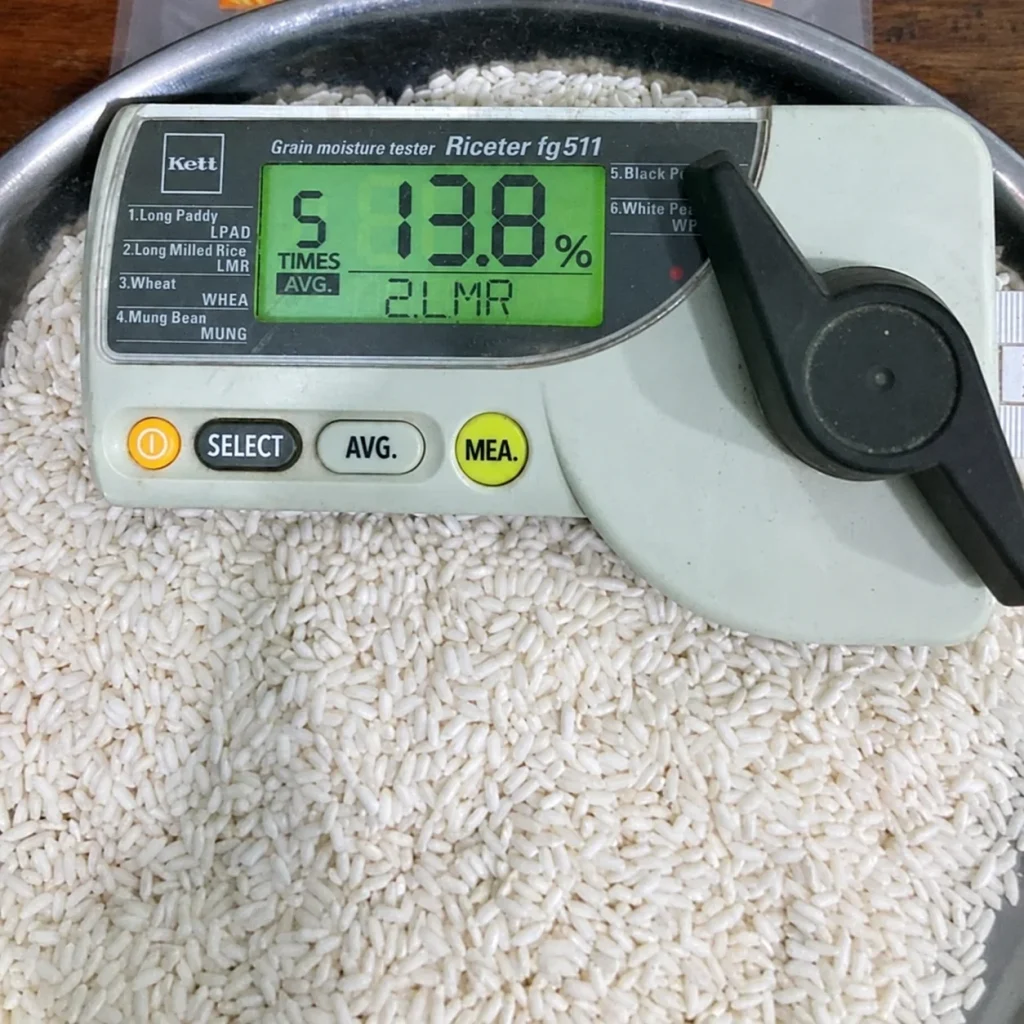
Moisture is the foremost physicochemical criterion in rice export quality standards; the maximum permitted level under TCVN 11888:2017 is 14.5%. Strict moisture control helps limit the risk of mold and pest infestation developing during long-distance transport, especially for shipments traveling by sea for weeks through hot, humid climate zones.
Broken rice ratio
The broken rice ratio is determined as the percentage weight of broken kernels shorter than 3/4 of a whole kernel’s length, relative to the total sample weight. This is the commercial criterion that directly determines the selling price and market segment of the rice batch, and is clearly stated in the export contract (5% broken, 10% broken, 15% broken, 25% broken).
Ratio of damaged kernels, yellow kernels, and chalky kernels
Beyond the broken rice ratio, TCVN 11888:2017 also specifies limits for other defective kernel types:
- Yellow kernels: kernels discolored due to improper storage, with a permitted limit typically ranging from 0.5% to 2.0% depending on the grade.
- Damaged kernels, chalky kernels, immature green kernels: each has its own specified limit, directly affecting the sensory assessment of the shipment.
Impurities and foreign grains
The ratio of mechanical impurities (soil, stones, straw, husk) must be kept below the 0.1% – 0.2% threshold depending on the declared grade. In addition, the standard also limits the ratio of unmilled paddy grains remaining in milled rice – a criterion that quality inspection teams at the destination port frequently sample and cross-check.
3. Rice export quality standards by target market
Beyond the national standard, rice exporters need to meet additional specific requirements from each import market – a decisive factor in whether the shipment clears customs smoothly. The table below visually compares the core requirements across the four leading market groups for Vietnamese rice exports.
| Criterion | EU | US | China | ASEAN (Philippines, Indonesia) |
|---|---|---|---|---|
| Managing authority/regulation | European Commission (EU Pesticides Database, MRL regulations) | FDA (U.S. Food and Drug Administration) | GACC (General Administration of Customs of China) — Decree 248, 249 | State tendering/import authority per each contract |
| Mandatory pre-export registration | No mandatory facility registration, but a complete MRL file is required | Mandatory facility registration with the FDA before the first shipment | Mandatory registration of the growing area code (PUC) and packing facility code | Per the specific requirements of each contract/tender |
| Control focus | Pesticide residue (especially Tricyclazole, Isoprothiolane), Non-GMO, heavy metals | Microorganisms (Salmonella, E. coli), aflatoxin, chemical residue, traceability | Growing area code, packing facility, fumigation to prevent pests | Grade (broken rice ratio), volume, packaging specifications, and shelf life |
| Priority grade | Premium fragrant rice (ST24, ST25, Jasmine) | High-quality rice, low broken ratio (near 5%) | Diverse grades, both standard and fragrant rice | Standard rice, 5%, 15%, 25% broken |
| Tariff preference | Preferential tariff quota under EVFTA for fragrant rice | Applies the standard U.S. import tariff rate | Per China’s rice import tariff quota | Typically per government-to-government agreement or ATIGA (intra-ASEAN) |
The European market (EU): Strict food safety requirements
The EU market applies extremely strict maximum residue limits (MRLs) for pesticides, especially for the active ingredients Tricyclazole and Isoprothiolane – two substances frequently detected exceeding the threshold in Vietnamese rice shipments to the EU in recent years. In addition, the EU also strictly controls non-genetically-modified (Non-GMO) rice and limits heavy metals such as Cadmium and Arsenic. In return, Vietnamese fragrant rice (ST24, ST25, Jasmine…) that meets the requirements qualifies for a preferential tariff quota under the EVFTA.
The US market (FDA): Toxicity standards and traceability
Businesses exporting rice to the US must register their facility with the U.S. Food and Drug Administration (FDA) before exporting their first shipment. The FDA strictly controls harmful microbiological criteria (Salmonella, E. coli), the mycotoxin aflatoxin, and pesticide residue, while also requiring clear traceability from the growing area to the packing plant.
The Chinese market: Growing area code and packing facility inspection
Since China’s General Administration of Customs (GACC) Decree 248 and Decree 249 took effect, businesses exporting rice to China must register a growing area code (PUC) and a packing facility code with the competent authority. Beyond the usual quality criteria, China also requires fumigation to eliminate pests before export.
The Southeast Asian market (Philippines, Indonesia): Focused on grade and volume
This is a traditional market group for Vietnamese rice, typically prioritizing the 5%, 15%, and 25% broken grades at competitive prices, with large trading volumes under government-to-government contracts or tenders. Packaging, film, and shelf-life requirements are also specifically stated in each contract.
4. Required international certifications for export rice
Food safety management systems: ISO 22000 and HACCP
ISO 22000 and HACCP (Hazard Analysis and Critical Control Points) form the near-mandatory foundation for export rice processing plants, ensuring the milling, packing, and storage process is safety-controlled from start to end of the production chain.
International retail standard certifications: BRC and IFS
For shipments destined for major supermarket chains in the EU, US, and UK, businesses typically also need BRC (British Retail Consortium) or IFS (International Featured Standards) certification — two international retail standards that major buyers require as a mandatory condition for entering their distribution chain.
Good agricultural practice standards: GlobalGAP and VietGAP
GlobalGAP and VietGAP control quality right from the cultivation stage – including fertilizer and pesticide use in the growing area – helping ensure chemical residue in the finished rice stays within the permitted threshold of demanding markets.
Other specialized certifications: Halal, Kosher, Organic
Depending on the target market, businesses may need additional certifications: Halal for Muslim markets such as Malaysia and the Middle East; Kosher for the Jewish community in the US and certain other countries; and organic rice certification (USDA Organic, EU Organic) for the premium rice segment, grown without synthetic chemicals.
5. Inspection and certification process for export rice quality
Step 1: Prepare the shipment and take test samples
Take a representative sample at the warehouse or port using a standard sampling method (referencing ISO 24333 or TCVN 5451:2008), ensuring the sample accurately reflects the actual quality of the entire shipment.
Step 2: Test the criteria at an accredited testing laboratory
The sample is analyzed for physicochemical criteria (broken rice ratio, moisture, impurities) and food safety criteria (pesticide residue, heavy metals, microorganisms) at a laboratory accredited to ISO/IEC 17025, typically a VILAS-accredited body.
Step 3: Register for phytosanitary quarantine
The business registers for phytosanitary quarantine with the Plant Protection Department (Ministry of Agriculture and Rural Development) to obtain a Phytosanitary Certificate – a mandatory document in the rice export documentation set for most markets.
Step 4: Obtain the quality certificate
Once test results meet the requirements, the business obtains a Certificate of Quality/Quantity (C/Q) from an independent inspection body (such as SGS, Vinacontrol, Bureau Veritas), completing the documentation set for export procedures and delivery to the importing partner.
Frequently asked questions about rice export standards
Question 1: What is the maximum moisture level required for export rice?
Under TCVN 11888:2017 (replacing TCVN 5644:2008), the maximum permitted moisture level for export white rice is 14.5%. This is an important threshold that helps limit mold and pest infestation during long-distance transport, especially for shipments exported by sea.
Question 2: What licenses and certifications should a new rice exporter prioritize first?
New businesses should prioritize completing, in this order: product quality self-declaration under Decree 15/2018/ND-CP, building a food safety management system under HACCP or ISO 22000, registering for phytosanitary quarantine with the Plant Protection Department, and, depending on the target market, adding specialized certifications such as FDA facility registration (US market) or a GACC growing area code (Chinese market).
Question 3: How can a business look up the permitted pesticide residue limits for exporting rice to the EU?
Businesses can look up the EU’s maximum residue limits (MRLs) for each active ingredient through the European Commission’s official MRL database (EU Pesticides Database), and should also work with an independent inspection body to test before export, avoiding the risk of the shipment being returned for exceeding the residue threshold – especially for the two active ingredients Tricyclazole and Isoprothiolane, which the EU closely monitors.
3W Logistics stands alongside rice exporters
Fully meeting rice export quality standards is only a necessary condition; getting the shipment to the importing partner on time and at the right quality also requires a professional logistics process that understands the specific requirements of each market. With experience handling a wide range of exported agricultural products and foodstuffs, and registration as an OTI-NVOCC with an FMC Bond (Federal Maritime Commission) in the United States, 3W Logistics provides a full-package rice export service for businesses:
- Documentation consulting by market: Supporting preparation of the documentation set matching the specific requirements of the EU, US, China, or ASEAN markets.
- Connecting with reputable testing and inspection bodies: Helping businesses work with independent inspection bodies to obtain the quality certificate on time.
- Support with phytosanitary quarantine procedures: Standing alongside you from registration through to obtaining the Phytosanitary Certificate.
- Expertise in long-distance agricultural product transport: Ensuring appropriate storage and moisture-protection conditions to preserve rice quality throughout the export journey.
- Electronic customs declaration and resolving issues at the border gate: Quickly handling any requests for additional documentation that arise during export.
- Ocean freight to the Philippines, Africa, the Middle East, and other markets: Optimizing route, transit time, and cost for each market and each rice product segment.
Contact 3W Logistics for specific advice on the path to meeting standards and the rice export procedure suited to your business’s target market.
Address: 34 Bach Dang, Tan Son Hoa Ward, Ho Chi Minh City
Hotline: +84 28 3535 0087
____________________________
3W Logistics Hanoi Branch
Address: 81A Tran Quoc Toan, Cua Nam Ward, Hanoi
Hotline: +84 24 3202 0482
____________________________
3W Logistics Hai Phong Branch
Address: 8A Lo 28 Le Hong Phong, Gia Vien Ward, Hai Phong
Hotline: +84 225 355 5939
____________________________
3W LOGISTICS CO., LTD – We here serve you there!
Email: info@3w-logistics.com
Website: www.3w-logistics.com

Ms. Apple is the CCO (Chief Commercial Officer) at 3W Logistics, with over 10 years of experience in sales and business operations management.
At 3W Logistics, Ms. Apple is responsible for commercial strategy, corporate customer development, managing a team of more than 50 sales professionals, and improving business performance in the logistics sector.
With practical experience in sales management and market development, Ms. Apple shares professional insights on business logistics solutions, international transportation, freight forwarding, customer management, trade lane development, and growth strategies in the logistics industry.


